Japan LED Traffic Signs and Signals Market Size, Share & Growth Rate
The Japan LED Traffic Signs and Signals Market was estimated at USD 229 Million in 2025 and is projected to reach USD 245 Million by 2032, growing at a CAGR of 1.0% from 2026 to 2032. This growth trajectory is fueled by increasing urbanization, coupled with ongoing infrastructure development initiatives aimed at enhancing road safety across the nation. As cities evolve, the demand for advanced, energy-efficient traffic management systems becomes even more critical, supporting the adoption of LED technology.
Japan LED Traffic Signs and Signals Market Year-wise Growth Rate and Key Drivers
This graph highlights how the Japan LED Traffic Signs and Signals Market has steadily grown over the years, supported by major growth factors.
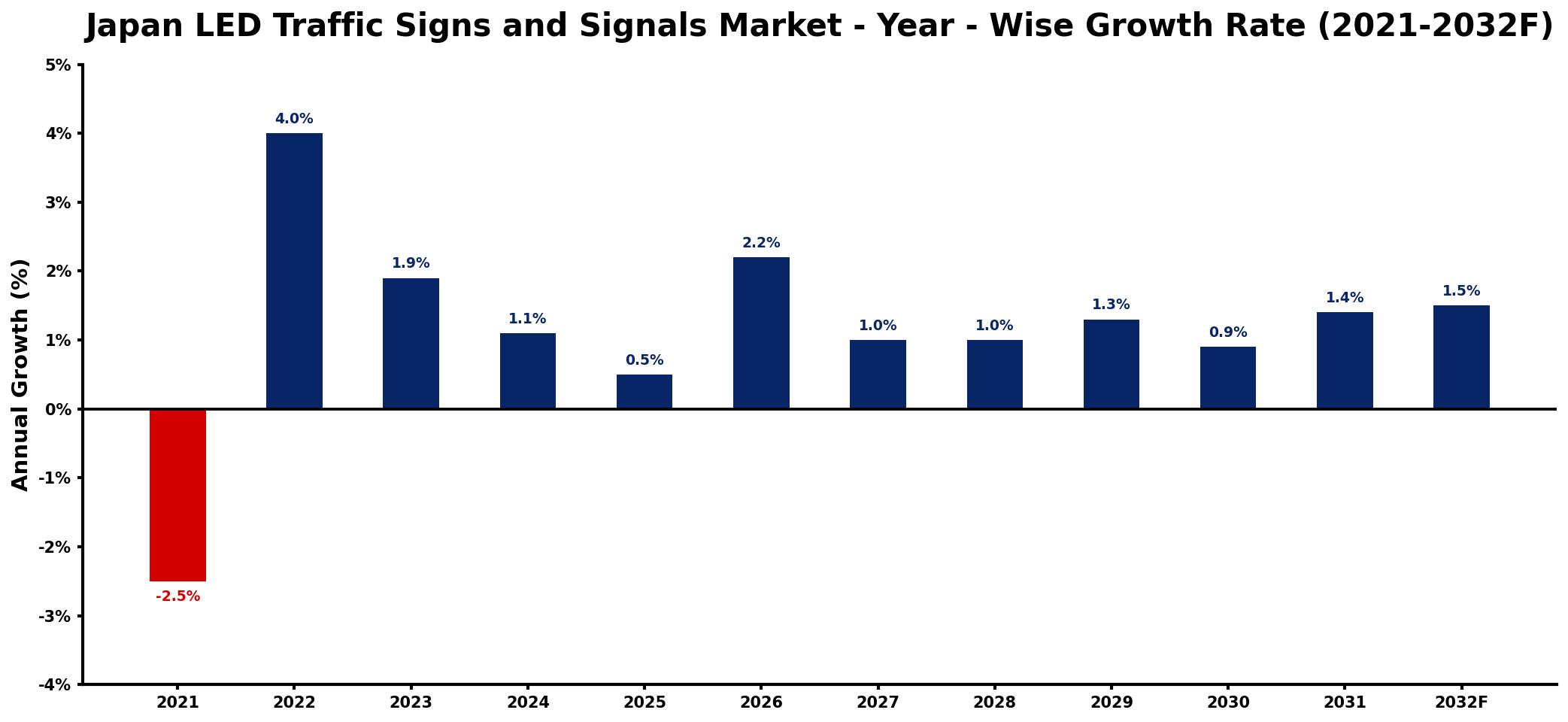
The table below presents the year‑wise growth rates along with the key drivers influencing the market
| Year | Growth Rate | Major Drivers |
| 2021 | -2.5% | decreasing infrastructure investment levels |
| 2022 | 4.0% | rising urbanization and modernization |
| 2023 | 1.9% | increased government safety initiatives |
| 2024 | 1.1% | growing smart city projects |
| 2025 | 0.5% | enhanced public transportation systems |
| 2026 | 2.2% | expanding renewable energy adoption |
| 2027 | 1.0% | increased focus on sustainability |
| 2028 | 1.0% | growing demand for automation |
| 2029 | 1.3% | rising construction activity levels |
| 2030 | 0.9% | advancements in technology integration |
| 2031 | 1.4% | increased public awareness campaigns |
| 2032 | 1.5% | growing investment in infrastructure |
Note: Market size estimations and growth projections presented in this report are based on 6Wresearch's proprietary forecasting methodology, utilizing the latest available industry data, government publications, and primary research inputs.
Japan LED Traffic Signs and Signals Market Synopsis
The strongest force currently shaping the Japan LED Traffic Signs and Signals market is the push towards smarter traffic management solutions. As urban areas expand and traffic volumes rise, cities are increasingly investing in innovative systems that leverage real-time data monitoring and adaptive controls to optimize traffic flow and improve safety.
Additionally, the rising emphasis on sustainability and energy efficiency has led to an accelerated shift from traditional signage to LED solutions. These advancements not only enhance visibility and reduce energy consumption but also align with Japan's broader commitment to sustainable urban development and the promotion of smart city initiatives.
Japan LED Traffic Signs and Signals Market Key Takeaways
- The market is primarily driven by urbanization, infrastructure development, and government safety initiatives.
- LED technology provides energy-efficient, durable, and highly visible solutions, making it increasingly favored over traditional signage.
- Smart traffic management systems are becoming integral, utilizing real-time data for improved traffic control.
- Investment opportunities exist in developing innovative LED technologies tailored to local needs.
- Government regulations and policies are supporting the transition towards energy-efficient traffic solutions.
Evaluation of Restraints in Japan LED Traffic Signs and Signals Market
Despite the promising growth prospects, several restraints continue to hinder the Japan LED Traffic Signs and Signals market. High initial installation costs pose a significant barrier, especially for municipalities hesitant to move away from traditional signage systems. This reluctance is often compounded by existing authority preferences and workflows. Additionally, the environmental durability and reliability of LED traffic signs under varying weather conditions remain critical challenges, as failure in functionality can compromise road safety. Regular maintenance requirements and technological updates can also introduce financial and logistical complexities that stakeholders must navigate.
Japan LED Traffic Signs and Signals Market Trends
Current trends in the Japan LED Traffic Signs and Signals market highlight a strong move towards integrating LED technology with Internet of Things (IoT) capabilities. This evolution allows for more sophisticated traffic management solutions that can monitor and adjust signals in real-time based on traffic conditions. Additionally, the incorporation of customizable messaging features enhances the communication of critical information to drivers, thereby improving overall safety. The market is also witnessing a surge in interest for smart city projects, further fueling demand for advanced traffic signage solutions.
Japan LED Traffic Signs and Signals Market Opportunities
Significant growth opportunities lie in providing LED products to government agencies and municipalities looking to modernize their traffic systems. As Japan continues to prioritize road safety and innovative infrastructure projects, the demand for cutting-edge traffic management solutions, including LED signs, is expected to rise. Moreover, there is potential for investing in research and development to create tailored LED technologies that address specific urban challenges, enhancing the appeal to various stakeholders in the market.
Government Initiatives in the Japan LED Traffic Signs and Signals Market
The Japanese government plays a pivotal role in shaping the LED traffic signs and signals market through its regulations and initiatives. The Road Traffic Act establishes standards for traffic control devices, including LED signals. The Ministry of Land, Infrastructure, Transport and Tourism (MLIT) sets technical specifications to ensure that these devices meet safety and efficiency benchmarks. Moreover, the government actively promotes energy-efficient technologies to reduce carbon emissions, thereby encouraging the adoption of LED solutions in urban traffic management.
Future Insights of the Japan LED Traffic Signs and Signals Market
Looking ahead to 2026-2032, the Japan LED Traffic Signs and Signals Market is set to evolve significantly. As urban landscapes continue to change, the integration of smart technologies will become more pronounced, with traffic management systems increasingly relying on IoT and AI capabilities. The focus on sustainability, alongside ongoing infrastructure investment, will drive demand for advanced LED solutions that not only improve safety but also enhance operational efficiency. Those market players who prioritize innovation and adaptability to meet emerging customer requirements will find themselves well-positioned in this dynamic landscape.
Japan LED Traffic Signs and Signals Market Latest Developments (2025 - 2026)
Recent developments in the Japan LED Traffic Signs and Signals market indicate a growing focus on the integration of artificial intelligence into traffic management systems. Projects aimed at enhancing the connectivity of LED signs through cloud-based platforms have gained traction. Additionally, public-private partnerships are increasingly forming to accelerate the deployment of smart city initiatives, underscoring the collaborative effort towards modernizing traffic infrastructure across urban areas.
Japan LED Traffic Signs and Signals Market - Key Attractiveness of the Report
- 10 Years of Market Numbers
- Historical Data Starting from 2022 to 2025
- Base Year: 2025
- Forecast Data until 2032
- Key Performance Indicators Impacting the Market
- Major Upcoming Developments and Projects
Key Highlights of the Report:
- Japan LED Traffic Signs and Signals Market Outlook
- Market Size of Japan LED Traffic Signs and Signals Market, 2025
- Forecast of Japan LED Traffic Signs and Signals Market, 2032
- Historical Data and Forecast of Japan LED Traffic Signs and Signals Revenues & Volume for the Period 2022-2032F
- Japan LED Traffic Signs and Signals Market Trend Evolution
- Japan LED Traffic Signs and Signals Market Drivers and Challenges
- Japan LED Traffic Signs and Signals Price Trends
- Japan LED Traffic Signs and Signals Porter's Five Forces
- Japan LED Traffic Signs and Signals Industry Life Cycle
- Historical Data and Forecast of Japan LED Traffic Signs and Signals Market Revenues & Volume By Product for the Period 2022-2032F
- Historical Data and Forecast of Japan LED Traffic Signs and Signals Market Revenues & Volume By LED Traffic Signals for the Period 2022-2032F
- Historical Data and Forecast of Japan LED Traffic Signs and Signals Market Revenues & Volume By LED Traffic Signs for the Period 2022-2032F
- Japan LED Traffic Signs and Signals Import Export Trade Statistics
- Market Opportunity Assessment By Product
- Japan LED Traffic Signs and Signals Top Companies Market Share
- Japan LED Traffic Signs and Signals Competitive Benchmarking By Technical and Operational Parameters
- Japan LED Traffic Signs and Signals Company Profiles
- Japan LED Traffic Signs and Signals Key Strategic Recommendations






































