Japan Letterpress Printing Machinery Market Size, Share & Growth Rate
The Japan Letterpress Printing Machinery Market was estimated at USD 222 Million in 2025 and is projected to reach USD 238 Million by 2032, growing at a CAGR of 1.0% from 2026 to 2032. This growth trajectory is largely fueled by a rising appreciation for artisanal and customized printed materials, as businesses increasingly seek unique products that stand out in a competitive landscape. Additionally, the integration of advanced technologies and sustainable practices in the production process is contributing to the market's expansion.
Japan Letterpress Printing Machinery Market Year-wise Growth Rate and Key Drivers
This graph highlights how the Japan Letterpress Printing Machinery Market has steadily grown over the years, supported by major growth factors.
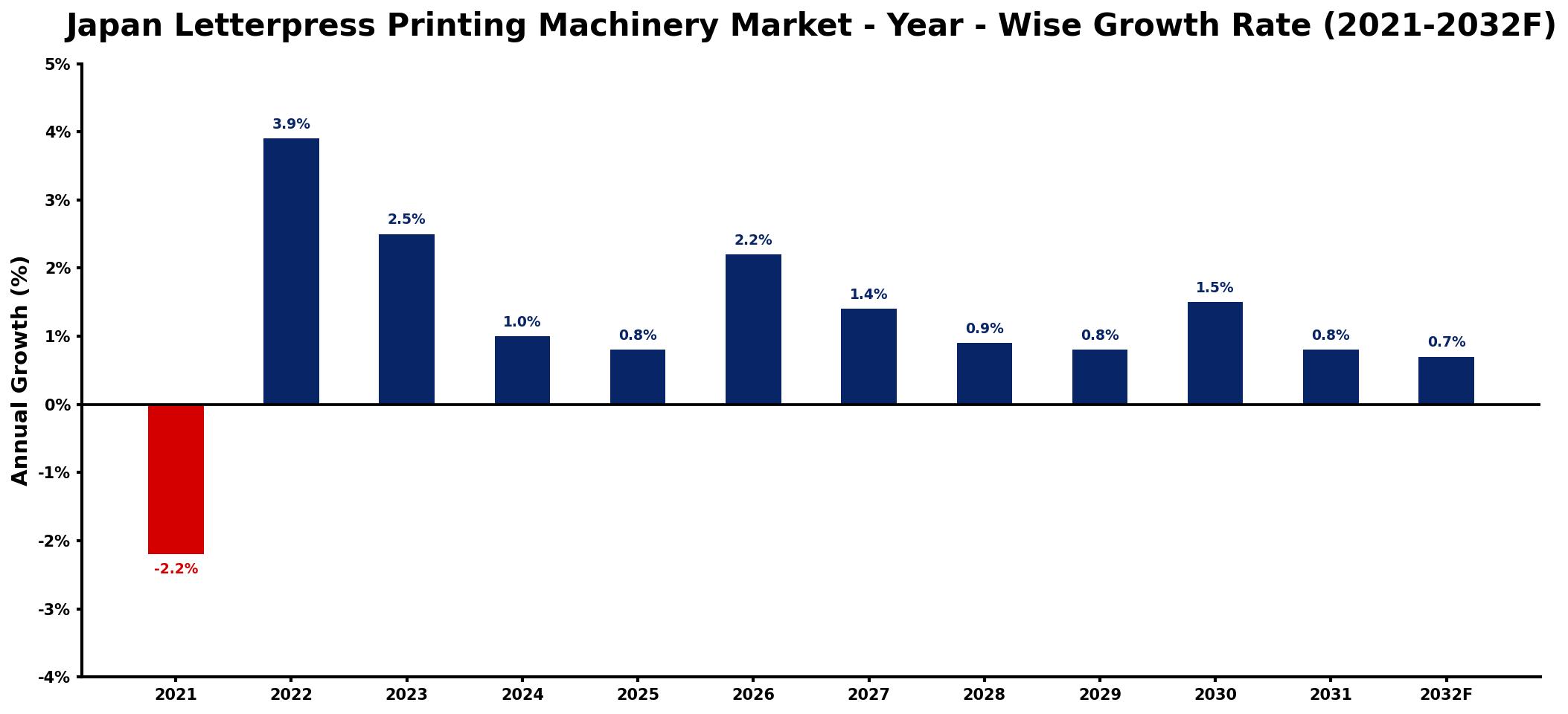
The table below presents the year‑wise growth rates along with the key drivers influencing the market
| Year | Growth Rate | Major Drivers |
| 2021 | -2.2% | diminished orders from key sectors |
| 2022 | 3.9% | surge in digital publication needs |
| 2023 | 2.5% | growing automotive sector requirements |
| 2024 | 1.0% | increased demand for custom designs |
| 2025 | 0.8% | growing trend of sustainable products |
| 2026 | 2.2% | expansion of small business initiatives |
| 2027 | 1.4% | more investments in creative industries |
| 2028 | 0.9% | heightened interest in educational resources |
| 2029 | 0.8% | growth in niche market segments |
| 2030 | 1.5% | enhanced focus on local production |
| 2031 | 0.8% | increased collaboration with designers |
| 2032 | 0.7% | enhanced product quality standards |
Note: Market size estimations and growth projections presented in this report are based on 6Wresearch's proprietary forecasting methodology, utilizing the latest available industry data, government publications, and primary research inputs.
Japan Letterpress Printing Machinery Market Synopsis
In Japan, the letterpress printing machinery market is experiencing a remarkable revival, driven by a cultural shift towards high-quality, tactile printed materials. This trend is particularly pronounced in artisanal sectors where craftsmanship and individuality are highly valued. The increasing demand for personalized products, such as bespoke invitations and premium packaging, is further propelling the market forward.
Furthermore, advancements in technology are reshaping this niche market. Hybrid printing solutions that integrate digital capabilities with traditional letterpress methods are emerging, providing enhanced efficiency and versatility. As consumer preferences evolve, manufacturers are focusing on sustainability, embracing eco-friendly inks and practices to align with the growing environmental consciousness among buyers.
Japan Letterpress Printing Machinery Market Key Takeaways
- The market is witnessing a notable resurgence as artisanal printing gains popularity in Japan.
- Technological innovations, including digital integration and automation, are driving efficiency.
- Customization is critical, as brands seek unique printed products to differentiate themselves.
- Sustainability is a key focus, influencing production processes and purchasing decisions.
- Investment opportunities are emerging in niche segments such as luxury packaging and specialty stationery.
Evaluation of Restraints in Japan Letterpress Printing Machinery Market
Despite the positive outlook, several constraints hinder the growth of the Japan Letterpress Printing Machinery Market. One significant factor is the increasing shift towards digital printing technologies, which offers faster and more cost-effective solutions, thereby diminishing demand for traditional letterpress equipment. Additionally, the high initial investment and maintenance costs associated with letterpress machinery can deter potential buyers. A shortage of skilled operators familiar with this specialized technique further exacerbates challenges within the industry, as does the environmental scrutiny surrounding traditional printing methods and materials.
Japan Letterpress Printing Machinery Market Trends
Currently, the Japan Letterpress Printing Machinery Market is observing a marked trend towards automation and smart technologies. Businesses are increasingly integrating software solutions to streamline their printing processes and enhance productivity. Eco-friendly practices are also gaining traction, leading to a rise in the availability of sustainable inks and materials. Moreover, the demand for customization continues to shape market dynamics, pushing companies to innovate and offer tailored printing solutions that meet specific consumer needs.
Japan Letterpress Printing Machinery Market Opportunities
The Japan Letterpress Printing Machinery Market offers lucrative investment opportunities, particularly for companies aiming to cater to a growing base of consumers seeking high-quality printed products. There is a noticeable shift towards unique and personalized printing solutions, opening avenues for advanced machinery that can fulfill these demands. Targeting niche markets, such as luxury packaging and specialty stationery, will be critical for success. Additionally, collaboration with local artisans and printing companies can leverage Japans reputation for craftsmanship while staying aligned with emerging trends.
Government Initiatives in the Japan Letterpress Printing Machinery Market
The Japanese government is playing an active role in promoting sustainability within the Letterpress Printing Machinery Market through stringent regulations. Policies are in place to ensure that manufacturers adhere to eco-friendly practices, including energy efficiency standards. Moreover, the government offers incentives aimed at encouraging innovation and technological advancements, further enhancing the competitive landscape of the market. These measures not only support growth but also ensure that environmental concerns are prioritized.
Future Insights of the Japan Letterpress Printing Machinery Market
Looking ahead to the period from 2026 to 2032, the Japan Letterpress Printing Machinery Market is projected to continue its moderate growth trajectory. This growth will be driven by the sustained demand for unique and high-quality printing solutions from various sectors, including graphic design and artisanal crafts. Technological advancements, particularly in automation and digital integrations, are expected to enhance operational efficiency and broaden the markets appeal. While competition from digital printing remains a concern, the continued emphasis on sustainability and customization positions the market favorably for the future.
Japan Letterpress Printing Machinery Market Latest Developments (2025 - 2026)
Recent developments in the Japan Letterpress Printing Machinery Market indicate a strong push towards integrating digital technology with traditional printing techniques. Innovations in automation are being adopted, leading to improved efficiency and production quality. Additionally, manufacturers are exploring eco-friendly materials and inks in response to growing environmental awareness. The collaboration between printing companies and technology firms is becoming increasingly common, aimed at enhancing product offerings and expanding market reach.
Japan Letterpress Printing Machinery Market - Key Attractiveness of the Report
- 10 Years of Market Numbers
- Historical Data Starting from 2022 to 2025
- Base Year: 2025
- Forecast Data until 2032
- Key Performance Indicators Impacting the Market
- Major Upcoming Developments and Projects
Key Highlights of the Report:
- Japan Letterpress Printing Machinery Market Outlook
- Market Size of Japan Letterpress Printing Machinery Market, 2025
- Forecast of Japan Letterpress Printing Machinery Market, 2032
- Historical Data and Forecast of Japan Letterpress Printing Machinery Revenues & Volume for the Period 2022-2032F
- Japan Letterpress Printing Machinery Market Trend Evolution
- Japan Letterpress Printing Machinery Market Drivers and Challenges
- Japan Letterpress Printing Machinery Price Trends
- Japan Letterpress Printing Machinery Porter's Five Forces
- Japan Letterpress Printing Machinery Industry Life Cycle
- Historical Data and Forecast of Japan Letterpress Printing Machinery Market Revenues & Volume By Type for the Period 2022-2032F
- Historical Data and Forecast of Japan Letterpress Printing Machinery Market Revenues & Volume By Rotary Letterpress Machine for the Period 2022-2032F
- Historical Data and Forecast of Japan Letterpress Printing Machinery Market Revenues & Volume By Other for the Period 2022-2032F
- Historical Data and Forecast of Japan Letterpress Printing Machinery Market Revenues & Volume By Application for the Period 2022-2032F
- Historical Data and Forecast of Japan Letterpress Printing Machinery Market Revenues & Volume By Securities for the Period 2022-2032F
- Historical Data and Forecast of Japan Letterpress Printing Machinery Market Revenues & Volume By Invitation Card for the Period 2022-2032F
- Historical Data and Forecast of Japan Letterpress Printing Machinery Market Revenues & Volume By Other for the Period 2022-2032F
- Japan Letterpress Printing Machinery Import Export Trade Statistics
- Market Opportunity Assessment By Type
- Market Opportunity Assessment By Application
- Japan Letterpress Printing Machinery Top Companies Market Share
- Japan Letterpress Printing Machinery Competitive Benchmarking By Technical and Operational Parameters
- Japan Letterpress Printing Machinery Company Profiles
- Japan Letterpress Printing Machinery Key Strategic Recommendations






































