Japan Logistics Automation Market Size & Growth Rate (2026-2032)
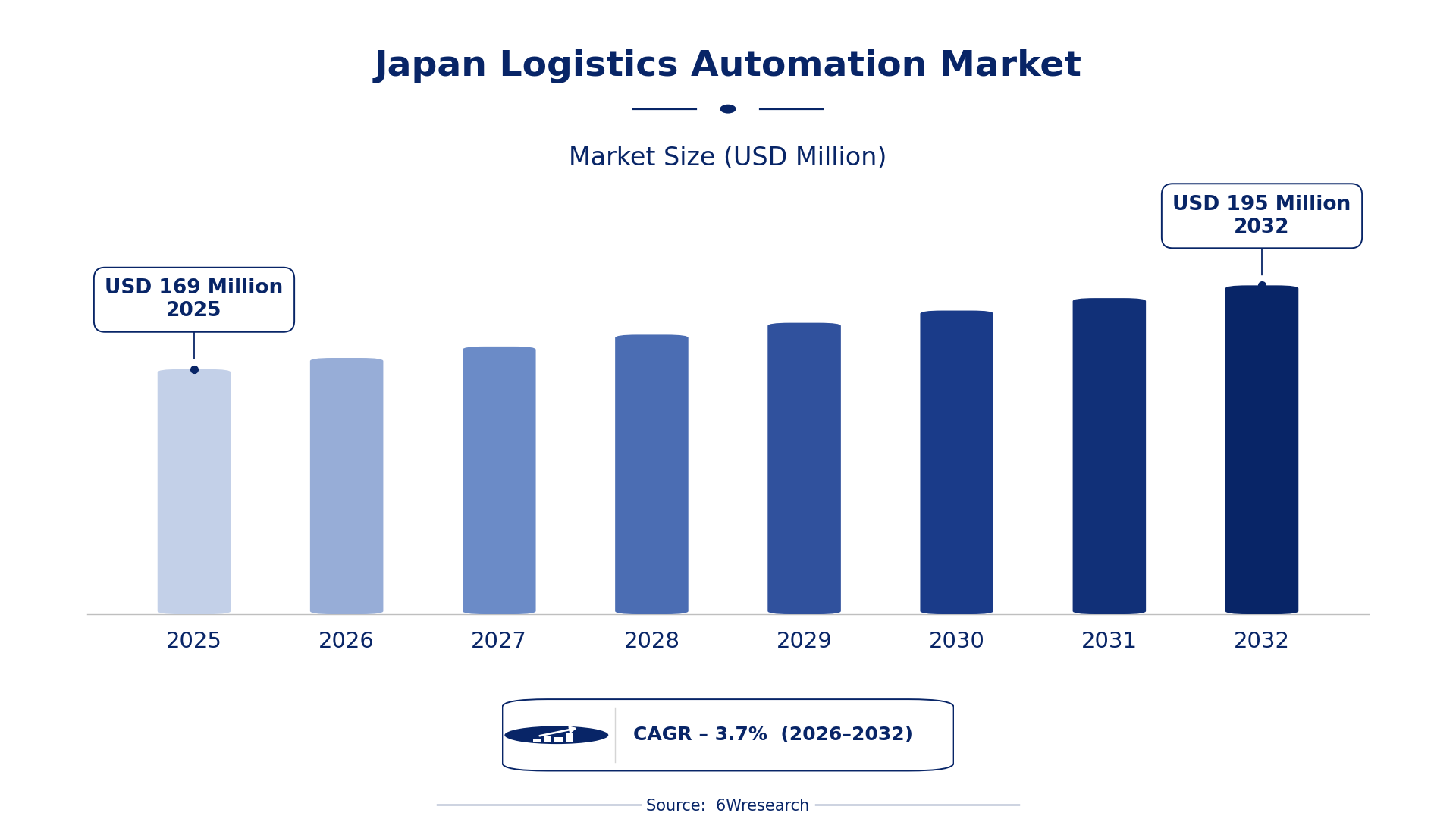
The Japan Logistics Automation Market was estimated at USD 169 Million in 2025 and is projected to reach USD 195 Million by 2032, growing at a CAGR of 3.7% from 2026 to 2032.
Japan Logistics Automation Market Synopsis
The demand for logistics automation in Japan is surging, primarily due to the explosive growth of e-commerce. With consumers increasingly expecting rapid delivery services, businesses are investing heavily in automation solutions to improve their supply chain efficiencies.
In addition to e-commerce, sectors such as automotive and electronics are also fueling the need for sophisticated logistics automation. Companies are adopting advanced technologies, including robotics and IoT devices, to enhance operational performance while reducing costs.
Japan Logistics Automation Market Year-wise Growth Rate and Key Drivers
This graph illustrates the annual growth rates of the Japan Logistics Automation Market from 2021 to 2032, highlighting a steady upward trajectory and projected expansion over the forecast period.
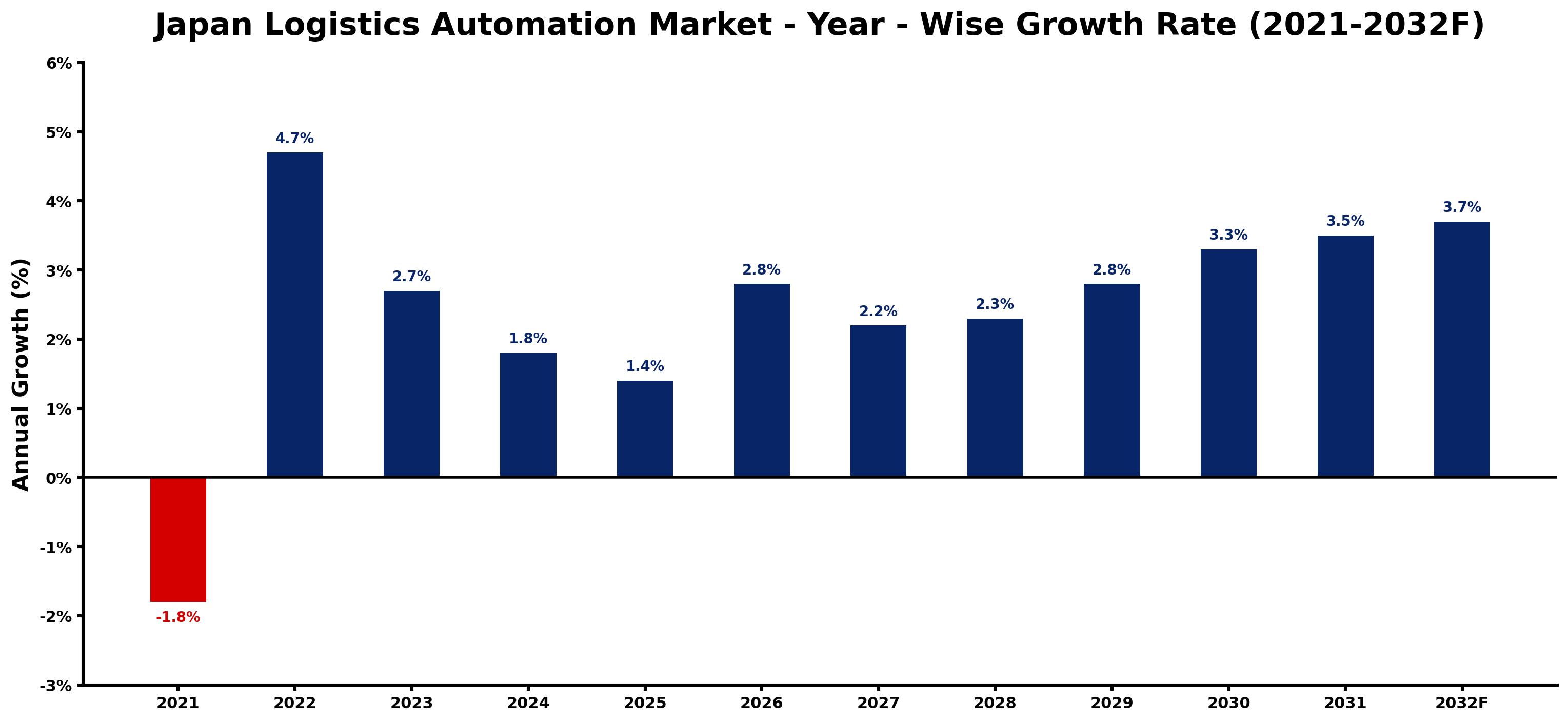
The table below presents the year‑wise growth rates along with the key drivers influencing the market
| Year | Growth Rate | Major Drivers |
| 2021 | -1.8% | Global supply chain issues impacted Japan's logistics sector. |
| 2022 | 4.7% | Government support for automation in supply chain efficiency. |
| 2023 | 2.7% | Increased investment in robotics by Japanese logistics firms. |
| 2024 | 1.8% | Aging workforce driving demand for logistics automation solutions. |
| 2025 | 1.4% | Technological advancements in AI improving warehouse operations. |
| 2026 | 2.8% | Rising consumer expectations for faster delivery in Japan. |
| 2027 | 2.2% | Growing trend of omnichannel retail requiring automated logistics. |
| 2028 | 2.3% | Partnerships between logistics firms and tech startups increasing automation. |
| 2029 | 2.8% | Improvements in IoT technology enhancing inventory management. |
| 2030 | 3.3% | Government initiatives promoting smart manufacturing and logistics. |
| 2031 | 3.5% | Increasing focus on sustainability pushing for efficient logistics. |
| 2032 | 3.7% | Emergence of next-gen delivery robots gaining market traction. |
Note: Market size estimations and growth projections presented in this report are based on 6Wresearch's proprietary forecasting methodology, utilizing the latest available industry data, government publications, and primary research inputs.
Japan Logistics Automation Market Key Takeaways
Below are some of the specific key takeaways from the market, including:
- Technological advancements are driving the adoption of robotics and AI in logistics operations.
- The increasing focus on sustainability is leading to eco-friendly automation solutions.
- Investment opportunities are emerging in warehouse automation and supply chain optimization technologies.
- The government is actively promoting automation through various initiatives and incentives.
- Integration challenges and high initial costs remain significant barriers for many businesses.
Evaluation of Restraints in Japan Logistics Automation Market
Despite the promising growth trajectory, several factors are hindering the Japan Logistics Automation Market. High initial investment costs deter smaller companies from adopting automation technologies. Additionally, the lack of skilled labor to operate complex systems poses a significant challenge. Resistance from traditional operations further complicates the transition to automated solutions. These hurdles, coupled with the need for seamless integration of new technologies with existing systems, create an environment where many companies hesitate to make the necessary changes.
Japan Logistics Automation Market Trends
Several trends are shaping the future of logistics automation in Japan. The integration of artificial intelligence and machine learning is becoming increasingly common for predictive analytics, enabling companies to optimize their supply chains effectively. Robotics is also seeing widespread adoption, particularly in warehouse environments, where automated systems streamline operations.
Another noteworthy trend is the rising importance of sustainability. Companies are prioritizing eco-friendly practices, which include developing green automation solutions that minimize environmental impact. This focus not only meets consumer demand but also aligns with government initiatives aimed at promoting sustainable industrial practices.
Japan Logistics Automation Market Opportunities
The Japan Logistics Automation Market is ripe with investment opportunities. Companies are keen on implementing warehouse automation systems, robotic picking solutions, and AI-driven logistics platforms to enhance efficiency. The increasing pressure to reduce operational costs is driving demand for these technologies.
Additionally, with the government's push for technological adoption in logistics, there is a favorable climate for investors. Automated guided vehicles (AGVs) and inventory management software are just a few areas where significant growth potential exists.
Government Initiatives in the Japan Logistics Automation Market
The Japanese government is taking proactive steps to promote logistics automation through various policy initiatives. These efforts focus on enhancing efficiency in the logistics sector while encouraging innovation and competitiveness. The regulatory framework supports the integration of automation technologies, making it easier for businesses to adapt and thrive in this evolving market.
- A recently completed initiative focused on providing subsidies for small and medium-sized enterprises (SMEs) to adopt automation technologies.
- Currently ongoing is the "Connected Industries" initiative, which aims to foster collaboration among businesses and promote the use of cutting-edge technologies in logistics.
- Upcoming is a planned public-private partnership expected to expand digital infrastructure for logistics operations by 2028.
- Ongoing regulatory changes regarding autonomous vehicles aim to facilitate their integration into logistics processes.
- A new framework for data privacy and security is being developed to ensure safe implementation of automation solutions.
Future Insights of the Japan Logistics Automation Market
Looking ahead to 2026-2032, the Japan Logistics Automation Market is set for substantial growth. The increasing demand for efficient supply chain management and the rising integration of advanced technologies will be key drivers. Companies will likely adopt more automated warehouse systems and invest in robotics to streamline their operations.
Sustainability will continue to be a priority, pushing companies toward greener logistics solutions. As technological advancements progress, businesses that embrace these changes will enhance their competitiveness and adapt to the evolving demands of the market.
Japan Logistics Automation Market Latest Developments
In the last 12-14 months, the Japan Logistics Automation Market has seen a flurry of activity as companies pivot towards advanced automation solutions. The focus on efficiency and sustainability has prompted various organizations to rethink their logistics strategies and invest in new technologies.
- A major technology vendor launched a state-of-the-art robotic picking system in early 2025, significantly improving operational efficiency for warehouses.
- An ongoing initiative to integrate IoT devices for real-time tracking in logistics is currently being piloted across several logistics companies.
- A regional operator is expanding its automated warehouse facilities, with completion expected by mid-2026.
- A partnership between logistics firms and tech startups, aimed at developing AI-driven solutions, was initiated in Q3 2025.
- Plans for a nationwide upgrade of logistics infrastructure are set to begin in late 2026, focusing on digitalization and automation.
Japan Logistics Automation Market - Key Attractiveness of the Report
- 10 Years of Market Numbers
- Historical Data Starting from 2022 to 2025
- Base Year: 2025
- Forecast Data until 2032
- Key Performance Indicators Impacting the Market
- Major Upcoming Developments and Projects
Key Highlights of the Report:
- Japan Logistics Automation Market Outlook
- Market Size of Japan Logistics Automation Market, 2025
- Forecast of Japan Logistics Automation Market, 2032
- Historical Data and Forecast of Japan Logistics Automation Revenues & Volume for the Period 2022-2032F
- Japan Logistics Automation Market Trend Evolution
- Japan Logistics Automation Market Drivers and Challenges
- Japan Logistics Automation Price Trends
- Japan Logistics Automation Porter's Five Forces
- Japan Logistics Automation Industry Life Cycle
- Historical Data and Forecast of Japan Logistics Automation Market Revenues & Volume By Function for the Period 2022-2032F
- Historical Data and Forecast of Japan Logistics Automation Market Revenues & Volume By Inventory and Storage Management for the Period 2022-2032F
- Historical Data and Forecast of Japan Logistics Automation Market Revenues & Volume By Transportation logistics for the Period 2022-2032F
- Historical Data and Forecast of Japan Logistics Automation Market Revenues & Volume By Vertical for the Period 2022-2032F
- Historical Data and Forecast of Japan Logistics Automation Market Revenues & Volume By Retail & eCommerce for the Period 2022-2032F
- Historical Data and Forecast of Japan Logistics Automation Market Revenues & Volume By Manufacturing for the Period 2022-2032F
- Historical Data and Forecast of Japan Logistics Automation Market Revenues & Volume By Healthcare & Pharmaceuticals for the Period 2022-2032F
- Historical Data and Forecast of Japan Logistics Automation Market Revenues & Volume By Food & Beverages for the Period 2022-2032F
- Historical Data and Forecast of Japan Logistics Automation Market Revenues & Volume By Automotive for the Period 2022-2032F
- Historical Data and Forecast of Japan Logistics Automation Market Revenues & Volume By Aerospace and Defense for the Period 2022-2032F
- Historical Data and Forecast of Japan Logistics Automation Market Revenues & Volume By Chemicals for the Period 2022-2032F
- Historical Data and Forecast of Japan Logistics Automation Market Revenues & Volume By Other Verticals (paper and printing, and textiles and clothing) for the Period 2022-2032F
- Historical Data and Forecast of Japan Logistics Automation Market Revenues & Volume By Organization Size for the Period 2022-2032F
- Historical Data and Forecast of Japan Logistics Automation Market Revenues & Volume By SMES for the Period 2022-2032F
- Historical Data and Forecast of Japan Logistics Automation Market Revenues & Volume By Large Enterprises for the Period 2022-2032F
- Historical Data and Forecast of Japan Logistics Automation Market Revenues & Volume By Logistics Type for the Period 2022-2032F
- Historical Data and Forecast of Japan Logistics Automation Market Revenues & Volume By Sales Logistics for the Period 2022-2032F
- Historical Data and Forecast of Japan Logistics Automation Market Revenues & Volume By Production Logistics for the Period 2022-2032F
- Historical Data and Forecast of Japan Logistics Automation Market Revenues & Volume By Recovery Logistics for the Period 2022-2032F
- Historical Data and Forecast of Japan Logistics Automation Market Revenues & Volume By Procurement Logistics for the Period 2022-2032F
- Historical Data and Forecast of Japan Logistics Automation Market Revenues & Volume By Software Application for the Period 2022-2032F
- Historical Data and Forecast of Japan Logistics Automation Market Revenues & Volume By Inventory Management for the Period 2022-2032F
- Historical Data and Forecast of Japan Logistics Automation Market Revenues & Volume By Order Management for the Period 2022-2032F
- Historical Data and Forecast of Japan Logistics Automation Market Revenues & Volume By Yard Management for the Period 2022-2032F
- Historical Data and Forecast of Japan Logistics Automation Market Revenues & Volume By Shipping Management for the Period 2022-2032F
- Historical Data and Forecast of Japan Logistics Automation Market Revenues & Volume By Labor Management for the Period 2022-2032F
- Historical Data and Forecast of Japan Logistics Automation Market Revenues & Volume By Vendor Management for the Period 2022-2032F
- Historical Data and Forecast of Japan Logistics Automation Market Revenues & Volume By Customer Support for the Period 2022-2032F
- Japan Logistics Automation Import Export Trade Statistics
- Market Opportunity Assessment By Function
- Market Opportunity Assessment By Vertical
- Market Opportunity Assessment By Organization Size
- Market Opportunity Assessment By Logistics Type
- Market Opportunity Assessment By Software Application
- Japan Logistics Automation Top Companies Market Share
- Japan Logistics Automation Competitive Benchmarking By Technical and Operational Parameters
- Japan Logistics Automation Company Profiles
- Japan Logistics Automation Key Strategic Recommendations






































