Japan LTE IoT Market Size & Growth Rate (2026-2032)
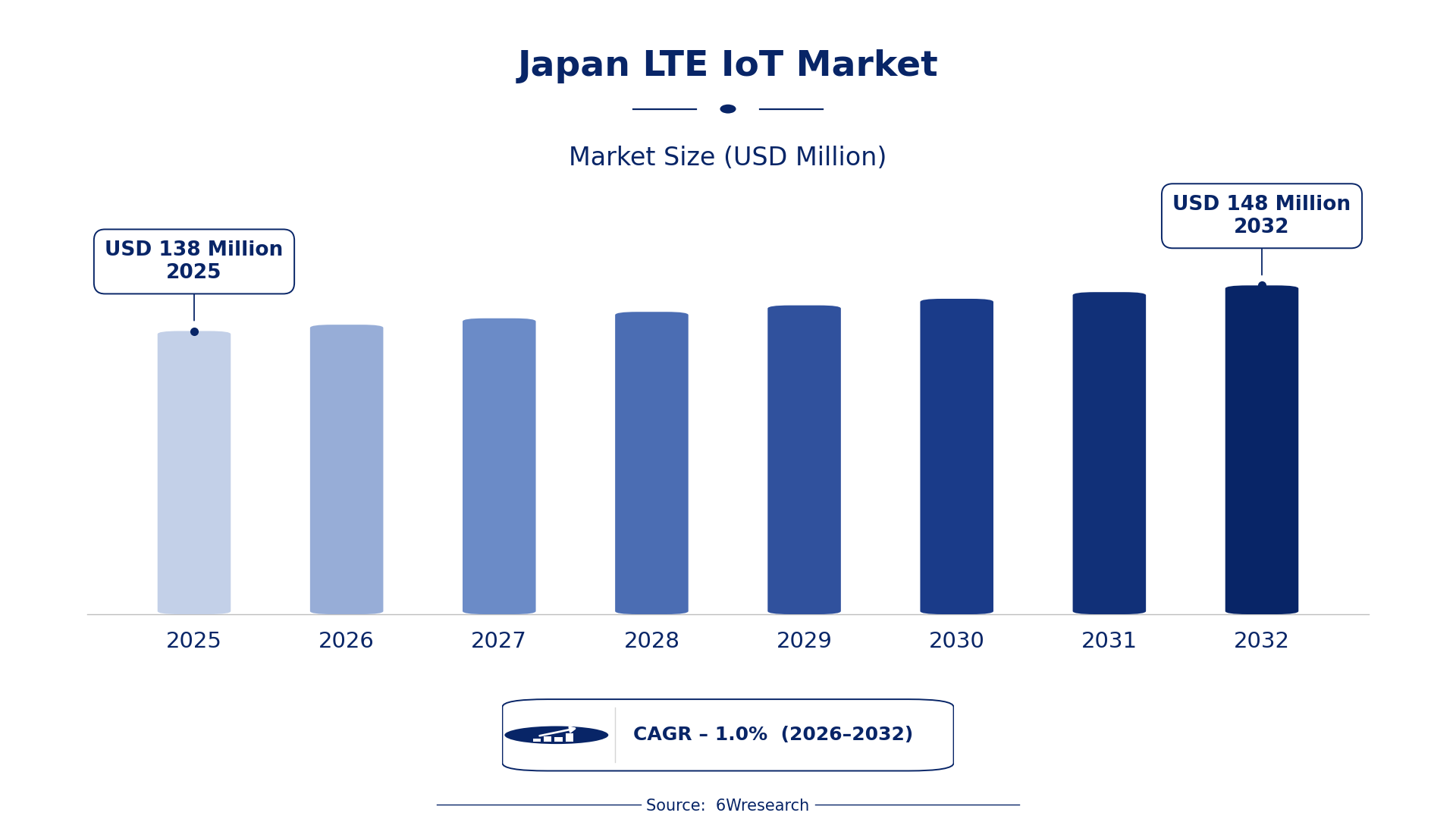
The Japan LTE IoT Market was estimated at USD 138 Million in 2025 and is projected to reach USD 148 Million by 2032, growing at a CAGR of 1.0% from 2026 to 2032.
Japan LTE IoT Market Synopsis
The Japan LTE IoT market has emerged as a significant player in the global IoT scene, driven by increasing demand for reliable connectivity solutions across various sectors. Enhanced network coverage and reliability, a hallmark of LTE technology, are critical for enterprises seeking to implement IoT strategies, particularly in manufacturing and healthcare.
A surge in connected devices is propelling this market forward, with local businesses embracing IoT to enhance operational efficiencies. Government initiatives to facilitate smart city projects are also creating a conducive environment for LTE IoT deployment, underscoring the synergy between public policy and technological advancement in Japan.
Japan LTE IoT Market Year-wise Growth Rate and Key Drivers
This graph illustrates the annual growth rates of the Japan LTE IoT Market from 2021 to 2032, highlighting a steady upward trajectory and projected expansion over the forecast period.
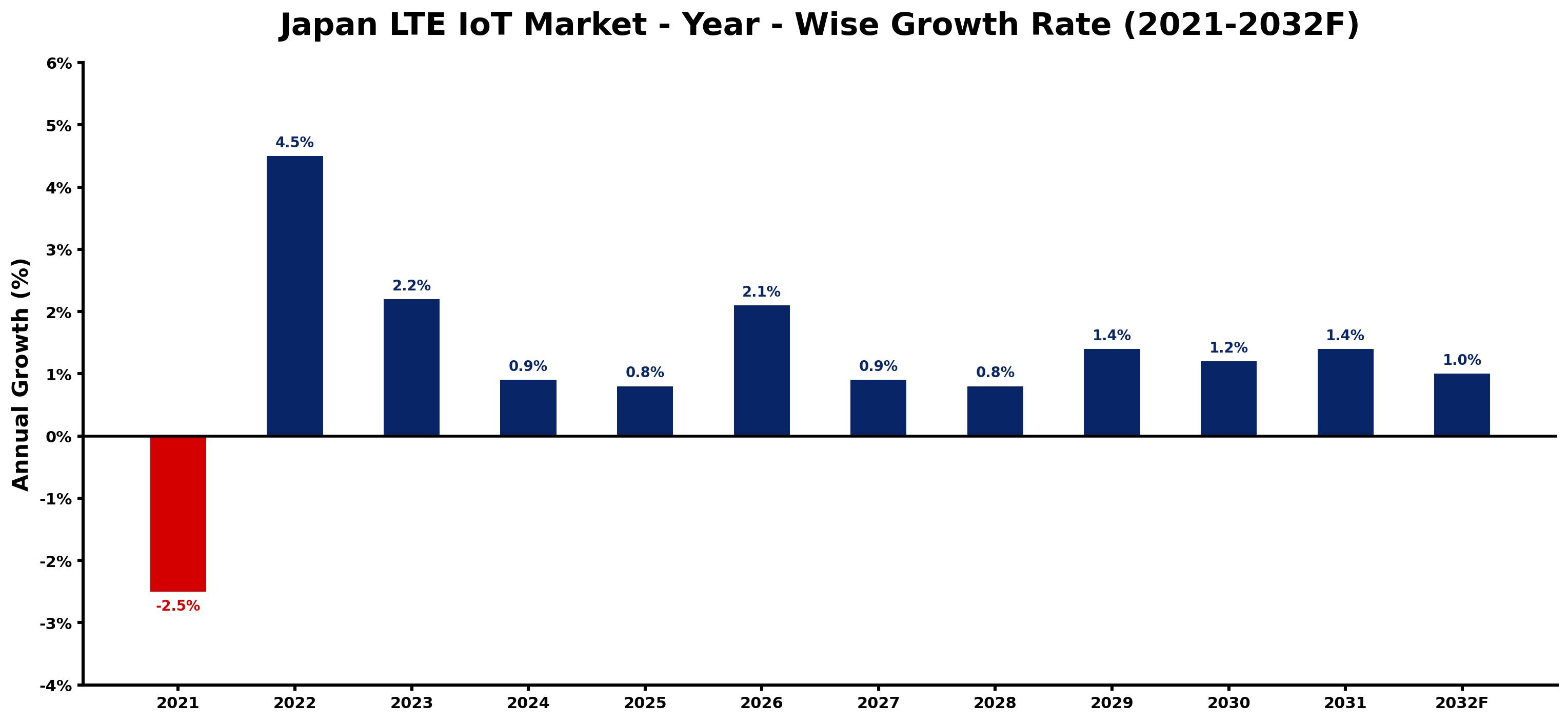
The table below presents the year‑wise growth rates along with the key drivers influencing the market
| Year | Growth Rate | Major Drivers |
| 2021 | -2.5% | Declining demand from traditional manufacturing sectors in Japan. |
| 2022 | 4.5% | Government support for smart agriculture IoT initiatives |
| 2023 | 2.2% | Increased adoption of remote healthcare monitoring technologies |
| 2024 | 0.9% | Growth in connected vehicle technologies and regulations |
| 2025 | 0.8% | Surge in demand for environmental monitoring systems |
| 2026 | 2.1% | Urbanization driving demand for smart logistics solutions |
| 2027 | 0.9% | Boom in wearable health tech integration with IoT |
| 2028 | 0.8% | Regulatory push for enhanced consumer electronics connectivity |
| 2029 | 1.4% | Rising interest in home automation and security solutions |
| 2030 | 1.2% | Growth in industrial IoT applications in manufacturing sector |
| 2031 | 1.4% | Increased focus on energy efficiency in smart homes |
| 2032 | 1.0% | Evolving partnerships between telecoms and IoT service providers |
Note: Market size estimations and growth projections presented in this report are based on 6Wresearch's proprietary forecasting methodology, utilizing the latest available industry data, government publications, and primary research inputs.
Japan LTE IoT Market Key Takeaways
Below are some of the specific key takeaways from the market, including:
- The market is seeing a shift towards LTE Cat-M1 and NB-IoT technologies for low-power, wide-area connectivity.
- Japan's healthcare sector is rapidly adopting LTE IoT solutions for real-time patient monitoring and management.
- Collaboration between telecom providers and IoT solution developers is intensifying to enhance service offerings.
- There is a growing focus on using LTE IoT for critical applications, including autonomous vehicles and smart grids.
- Government incentives are supporting infrastructure investment and encouraging IoT adoption across sectors.
Evaluation of Restraints in Japan LTE IoT Market
Several constraints hinder the growth trajectory of the Japan LTE IoT market. A critical issue is the limited availability of spectrum, which poses challenges for the deployment of new LTE IoT solutions. Furthermore, the high costs associated with upgrading existing infrastructures to support this technology can deter smaller enterprises from adopting IoT solutions. Interoperability and standardization among various networks and devices remain significant hurdles that need addressing to facilitate broader market acceptance.
Japan LTE IoT Market Trends
Current trends indicate a robust growth in the adoption of LTE Cat-M1 and NB-IoT technologies, which are designed to meet the needs of low-power IoT applications. This shift is particularly evident in sectors like agriculture, where remote monitoring solutions are becoming more prevalent. There's also a pronounced focus on ensuring high reliability and low latency in applications that are critical for urban infrastructure, such as smart grid systems.
Partnerships between mobile network operators and IoT developers are gaining traction, further accelerating innovation. These collaborations are crucial for creating tailored solutions that address the specific requirements of various industries in Japan, contributing to the market's ongoing evolution.
Japan LTE IoT Market Opportunities
The landscape is ripe with investment opportunities, particularly in smart cities and industrial automation. There’s a clear demand for dependable, high-speed connectivity solutions that LTE networks can offer. Investors can capitalize on projects that develop intelligent transportation systems or energy management technologies. Additionally, the growing interest in connected vehicles opens doors for innovative applications within the automotive sector, highlighting a broad range of possibilities for growth.
Government Initiatives in the Japan LTE IoT Market
The Japanese government's proactive stance on enhancing the LTE IoT market is evident through various initiatives aimed at promoting the technology. These efforts focus on facilitating collaboration among stakeholders and laying down a robust regulatory framework to encourage innovation. As Japan positions itself as a leader in digital transformation, these policies will play a crucial role in shaping the future of the LTE IoT market.
- A recently completed initiative includes the establishment of the "IoT Acceleration Consortium," which aims to foster collaboration among industry players.
- Currently underway is the allocation of the 920-928 MHz band for low-power wide-area networks to support IoT applications.
- Upcoming plans involve a national digital infrastructure upgrade program expected to enhance LTE IoT capabilities nationwide by 2028.
- The government is providing financial support for companies investing in IoT technology, promoting applications across various sectors such as agriculture and healthcare.
Future Insights of the Japan LTE IoT Market
Looking towards 2026-2032, the Japan LTE IoT market is set to continue its growth trajectory, fueled by increased adoption across various sectors including transportation and agriculture. As advanced LTE technologies become more commonplace, they will facilitate more efficient IoT applications, expanding their reach. The synergy between governmental initiatives and industry needs will drive innovation, opening up avenues for telecommunication providers and solution developers alike to thrive in this dynamic environment.
Japan LTE IoT Market Latest Developments
Recent months have seen notable activity within the Japan LTE IoT market as various stakeholders push forward to harness the potential of this technology. A blend of governmental initiatives and private sector strategies is evident as businesses look to capitalize on IoT capabilities.
- A leading regional operator launched a new LTE IoT platform in early 2025, aimed at streamlining connectivity for smart devices.
- In Q1 2026, a major technology vendor unveiled a series of partnerships with local firms to enhance IoT infrastructure across urban areas.
- Currently ongoing is a large-scale pilot project focusing on smart grid applications that began in mid-2025 and is expected to conclude by late 2026.
- Upcoming initiatives include a series of workshops scheduled for the second half of 2026, aimed at educating businesses on LTE IoT capabilities.
Japan LTE IoT Market - Key Attractiveness of the Report
- 10 Years of Market Numbers
- Historical Data Starting from 2022 to 2025
- Base Year: 2025
- Forecast Data until 2032
- Key Performance Indicators Impacting the Market
- Major Upcoming Developments and Projects
Key Highlights of the Report:
- Japan LTE IoT Market Outlook
- Market Size of Japan LTE IoT Market, 2025
- Forecast of Japan LTE IoT Market, 2032
- Historical Data and Forecast of Japan LTE IoT Revenues & Volume for the Period 2022-2032F
- Japan LTE IoT Market Trend Evolution
- Japan LTE IoT Market Drivers and Challenges
- Japan LTE IoT Price Trends
- Japan LTE IoT Porter's Five Forces
- Japan LTE IoT Industry Life Cycle
- Historical Data and Forecast of Japan LTE IoT Market Revenues & Volume By Technology for the Period 2022-2032F
- Historical Data and Forecast of Japan LTE IoT Market Revenues & Volume By NB-IoT for the Period 2022-2032F
- Historical Data and Forecast of Japan LTE IoT Market Revenues & Volume By LTE-M for the Period 2022-2032F
- Historical Data and Forecast of Japan LTE IoT Market Revenues & Volume By Service for the Period 2022-2032F
- Historical Data and Forecast of Japan LTE IoT Market Revenues & Volume By Professional Services for the Period 2022-2032F
- Historical Data and Forecast of Japan LTE IoT Market Revenues & Volume By Managed Services for the Period 2022-2032F
- Historical Data and Forecast of Japan LTE IoT Market Revenues & Volume By Industry for the Period 2022-2032F
- Historical Data and Forecast of Japan LTE IoT Market Revenues & Volume By Manufacturing for the Period 2022-2032F
- Historical Data and Forecast of Japan LTE IoT Market Revenues & Volume By Energy and utilities for the Period 2022-2032F
- Historical Data and Forecast of Japan LTE IoT Market Revenues & Volume By Transportation and logistics for the Period 2022-2032F
- Historical Data and Forecast of Japan LTE IoT Market Revenues & Volume By Healthcare for the Period 2022-2032F
- Historical Data and Forecast of Japan LTE IoT Market Revenues & Volume By Agriculture for the Period 2022-2032F
- Japan LTE IoT Import Export Trade Statistics
- Market Opportunity Assessment By Technology
- Market Opportunity Assessment By Service
- Market Opportunity Assessment By Industry
- Japan LTE IoT Top Companies Market Share
- Japan LTE IoT Competitive Benchmarking By Technical and Operational Parameters
- Japan LTE IoT Company Profiles
- Japan LTE IoT Key Strategic Recommendations






































