Japan Luxury Fashion Market Size & Growth Rate
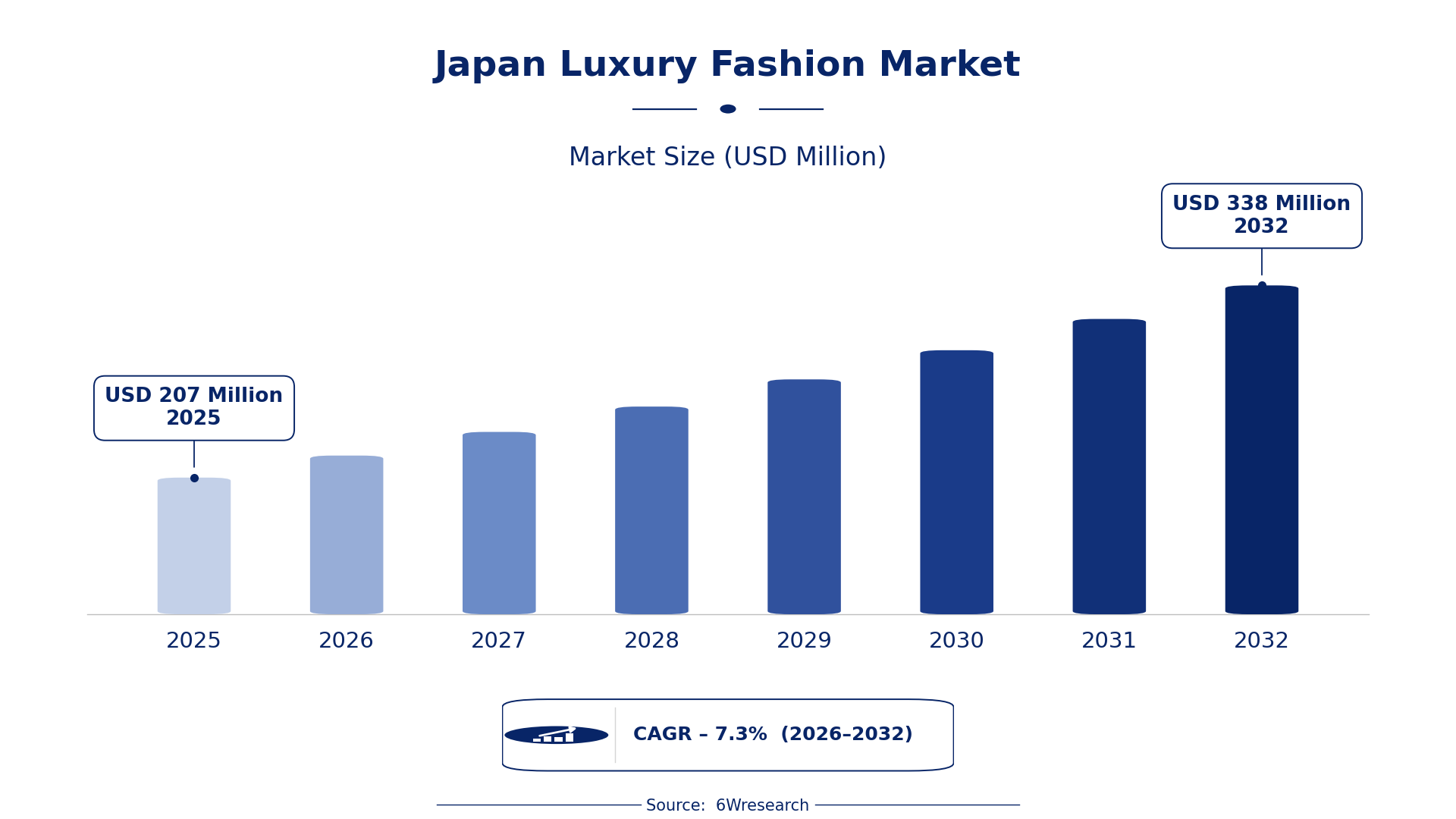
According to 6Wresearch internal database and industry insights, the Japan Luxury Fashion Market was valued at USD 207 Million in 2025 and is projected to reach USD 338 Million by 2032, growing at a CAGR of approximately 7.3% during 2026–2032.
Japan Luxury Fashion Market Highlights
| Report Metric | Details |
| Report Name | Japan Luxury Fashion Market (2026-2032) |
| Market Size 2025 | USD 207 Million |
| Market Size 2032 | USD 338 Million |
| Absolute Growth 2025–2032 | USD 131 Million |
| CAGR 2026–2032 | 7.3% |
| Peak Annual Growth | 8.3% in 2027 |
| Forecast Period | 2026–2032 |
| Historical Data | 2022–2025 |
| Base Year | 2025 |
| Leading Product Type, 2025 | Clothing and Apparel (52% share) |
| Leading Distribution Channel, 2025 | Store-Based (56% share) |
| Leading End User, 2025 | Men (50% share) |
| Fastest-Growing Product Type | Footwear (10.1% CAGR) |
| Fastest-Growing Distribution Channel | Non-Store Based (8.8% CAGR) |
| Fastest-Growing End User | Women (9.1% CAGR) |
| Growing Sector | Luxury Fashion Accessories |
| Key End Users | Affluent consumers, tourists, fashion enthusiasts |
Japan Luxury Fashion Market Year-wise Growth Rate and Key Drivers (2022–2032)
This graph illustrates the annual growth rates of the market from 2022 to 2032, highlighting a steady upward trajectory and projected market expansion over the forecast period.
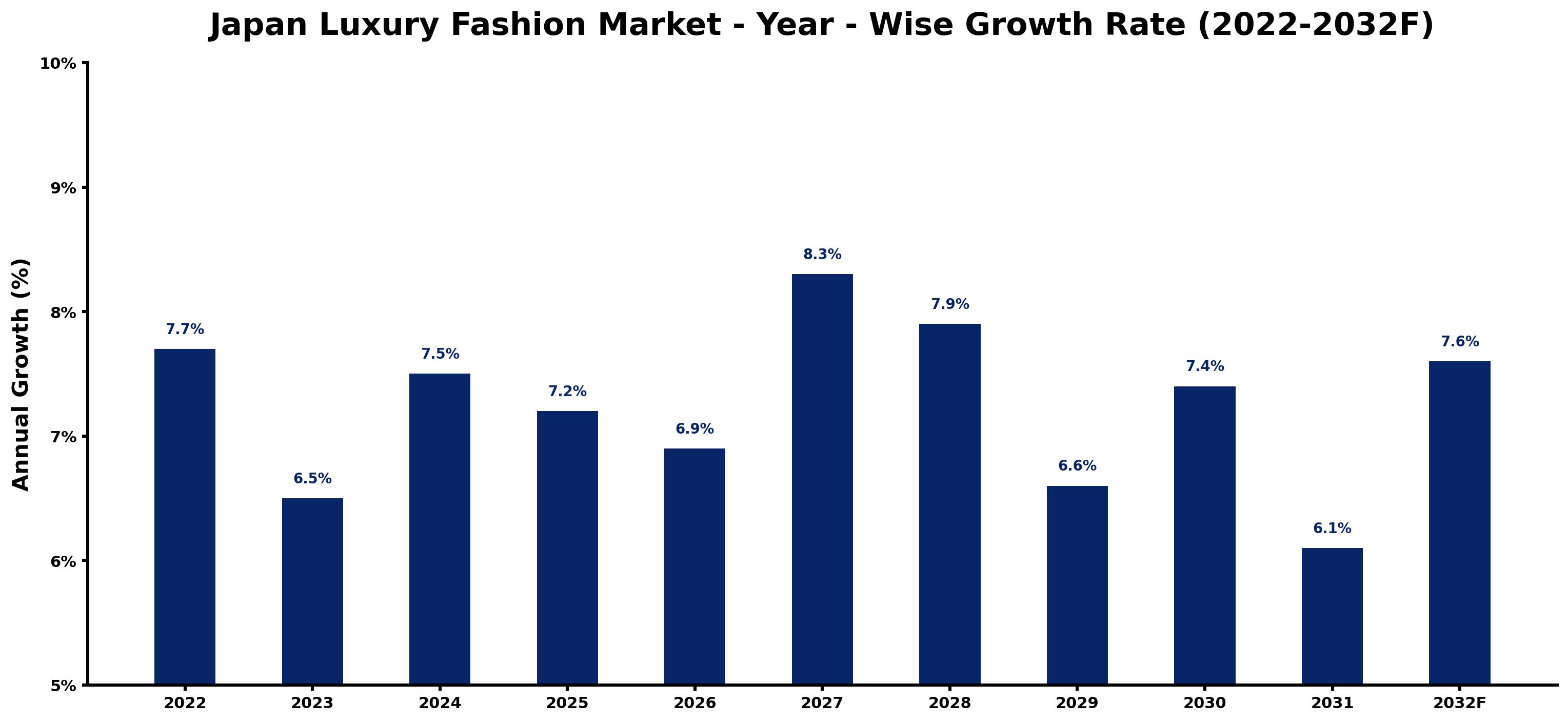
Below, each year's estimated growth is shown next to the factor that most influenced it.
| Year | Estimated Annual Growth (%) | Market Rationale |
| 2022 | 7.7 | The market experienced strong demand from affluent consumers and tourists. |
| 2023 | 6.5 | Growth slowed due to market saturation and increased competition among brands. |
| 2024 | 7.5 | The luxury footwear segment gained momentum, attracting more buyers. |
| 2025 | 7.2 | Consumer spending remained steady, supporting the luxury fashion sector. |
| 2026 | 6.9 | The market will face slower growth as brands adjust to changing consumer preferences. |
| 2027 | 8.3 | Rising disposable incomes and tourism will boost luxury fashion sales. |
| 2028 | 7.9 | Growth is projected to slow as the market stabilises after a peak in demand. |
| 2029 | 6.6 | Consumer interest in sustainable luxury fashion will begin to influence purchases. |
| 2030 | 7.4 | The market will see a resurgence as new collections attract buyers' attention. |
| 2031 | 6.1 | Growth is expected to slow as the market adjusts to evolving fashion trends. |
| 2032 | 7.6 | Increased investment in e-commerce platforms will drive renewed consumer interest. |
Note: Market size estimations and growth projections presented in this report are based on 6Wresearch's proprietary forecasting methodology, utilizing the latest available industry data, government publications, and primary research inputs.
Japan Luxury Fashion Market Synopsis
Luxury fashion in Japan encompasses high-end clothing, footwear, and accessories crafted from premium materials and exceptional craftsmanship. Valued at approximately 2 trillion yen in 2022, the market thrives due to affluent consumers and a vibrant tourism sector. Tokyo, accounting for over 40% of national sales, remains the largest market. Factors such as a growing population of affluent individuals and a 15% increase in online luxury sales in 2023 contribute to the market's expansion.
Market Dynamics Impact Analysis (2026–2032)
| Factor | Type | Impact | Primary Segment Affected |
| Growing affluence among consumers | Driver | High | Clothing and Apparel |
| Expansion of e-commerce platforms | Driver | High | Non-Store Based |
| Increasing demand for luxury footwear | Opportunity | High | Footwear |
| Rising interest in sustainable luxury practices | Opportunity | Medium | Accessories |
| High operational costs for luxury brands | Restraint | High | Clothing and Apparel |
| Strict quality standards affecting production | Restraint | Medium | Footwear |
| Limited availability of premium materials | Challenge | High | Accessories |
| Compliance with evolving regulations | Challenge | Medium | Clothing and Apparel |
Evaluation of Drivers in Japan Luxury Fashion Market (2026–2032)
The factors lifting demand, and the evidence behind each, are summarised below.
| Drivers | Primary Segment Affected | Why It Matters (Evidence) |
| Rising disposable incomes | Clothing and Apparel | This trend encourages consumers to spend more on luxury items, with average spending around 300,000 yen annually. |
| Increased tourism in Japan | Footwear | Tourists contribute to luxury fashion sales, especially in Tokyo, which showcases over 100 luxury brands annually. |
| Growth of online shopping | Non-Store Based | Online luxury fashion sales rose by 15% in 2023, attracting tech-savvy consumers seeking convenience. |
| Cultural emphasis on fashion and status | Accessories | The desire for personal expression drives demand for luxury accessories as status symbols. |
| Investment in marketing and brand heritage | Clothing and Apparel | Brands that effectively communicate their heritage see increased consumer loyalty and sales. |
Rising disposable incomes are the strongest driver of demand, allowing consumers to spend an average of 300,000 yen annually on luxury fashion. Increased tourism, particularly in Tokyo, boosts sales, with over 100 luxury brands showcased during Fashion Week. The growth of online shopping has led to a 15% increase in online luxury sales in 2023, attracting a younger demographic. Investment in marketing strengthens brand heritage, encouraging consumer loyalty and driving purchases.
Evaluation of Restraints in Japan Luxury Fashion Market
The following restraints limit how fast demand can grow.
| Market Restraint | Primary Segment Affected | Why It Matters (Evidence) |
| High operational costs for luxury brands | Clothing and Apparel | These costs limit profit margins, affecting pricing strategies and competitiveness in the market. |
| Strict quality standards affecting production | Footwear | Compliance with JIS and ISO certifications increases production costs and time for luxury footwear. |
| Limited availability of premium materials | Accessories | This scarcity drives up prices and can delay product launches, impacting sales. |
| Market saturation with competing brands | Footwear | An influx of new entrants creates intense competition, making it challenging for established brands. |
| Compliance with evolving regulations | Clothing and Apparel | Navigating complex regulations can lead to increased operational costs for luxury brands. |
Japan Luxury Fashion Market Challenges
High production costs for luxury fashion can lead to retail prices exceeding 400,000 yen, limiting access for many buyers. Supply chain issues from international sourcing can delay product launches, causing retailers to miss key sales periods, potentially resulting in losses of up to 40% in Tokyo. Many producers struggle to implement advanced manufacturing technologies, which can lead to inefficiencies and a competitive disadvantage in a market valued at 2 trillion yen. Strict regulatory requirements, including JIS and ISO certifications, demand significant investment, diverting resources from essential areas like marketing and innovation for producers.
Trends in the Japan Luxury Fashion Market
Below are the shifts with the largest effect on the Japan Luxury Fashion Market.
- Shift from Traditional to Online Shopping: In 2023, online luxury fashion sales increased by 15%, reflecting a shift in consumer purchasing behaviour. This trend is particularly strong in urban areas like Tokyo, where e-commerce platforms are thriving, prompting brands to improve their online presence.
- Growing Focus on Sustainability: The luxury fashion market is increasingly prioritising sustainable practices, with the Japan Luxury Fashion Association promoting eco-friendly initiatives. This shift is seen in the rising demand for sustainable luxury products, appealing to environmentally conscious consumers.
- Rise of Personalisation in Luxury Fashion: Consumers are seeking personalised luxury experiences, leading brands to offer customised products. This trend is prominent in Tokyo, where bespoke services are becoming standard, catering to affluent individuals who value exclusivity.
- Increased Demand for Luxury Footwear: The luxury footwear segment is projected to grow by 10% in 2023, driven by fashion trends and consumer preferences. This growth is particularly strong in urban centres, where footwear is a key fashion statement.
Investment Opportunities in the Japan Luxury Fashion Market
The following areas offer the clearest openings for investors and suppliers in the Japan Luxury Fashion Market.
- Gap in Sustainable Luxury Offerings: With a growing market for sustainable products, brands can invest in eco-friendly luxury lines. The Japan Luxury Fashion Association's initiatives highlight this trend, presenting an opportunity for growth.
- Expansion of E-commerce Platforms: As online luxury sales increase, brands should enhance their digital presence. The timing is ideal, given the 15% growth in online sales in 2023, particularly in urban areas.
- Investment in Bespoke Services: The demand for personalised luxury experiences is rising, creating opportunities for brands to offer customisation. Urban centres like Tokyo are ideal locations for such services, catering to affluent consumers.
- Focus on Footwear Innovation: The luxury footwear segment is projected to grow by 10% in 2023, indicating a need for innovative designs. Brands should invest in unique offerings to capture this expanding market.
Government Initiatives in the Japan Luxury Fashion Market
The Industrial Standardization Act, enacted in 1949 and amended in 2019, governs the quality standards for luxury goods, ensuring that products meet JIS requirements. This law impacts producers by mandating rigorous testing and certification processes to maintain product integrity and consumer trust.
In 2023, the Government of Japan adopted the GX Basic Policy, aiming for JPY 150 trillion in public-private decarbonisation investment over the next decade. The Ministry of Economy, Trade and Industry oversees initiatives that support luxury fashion brands in adopting sustainable practices, providing funding and resources to facilitate compliance.
Future Insight of the Japan Luxury Fashion Market
The emergence of advanced e-commerce platforms will transform how consumers engage with luxury fashion, driving online sales growth by 20% by 2032. A transition towards sustainable production methods will necessitate brands to cater to environmentally conscious buyers, influencing purchasing behaviours. Improved digital marketing tools will enable suppliers to reach affluent consumers more effectively, leveraging analytics for personalised outreach. Tokyo Fashion Week will continue to showcase over 100 luxury brands each year, reinforcing Japan's influential role in the global fashion arena.
Market Segmentation Analysis
Japan Luxury Fashion Market report covers a detailed analysis of the following market segments:
By Product Type – Clothing and Apparel Leads, Footwear Expected to Grow Fastest
According to Dhaval Chaurasia, Assistant Manager at 6Wresearch, Clothing and Apparel accounted for 52% of the market by product type in 2025. Clothing and apparel lead the luxury fashion market in Japan due to their essential role in expressing personal style and social status. Events such as Tokyo Fashion Week, featuring over 100 luxury clothing brands, highlight the strong consumer demand for high-end garments. The quickest growth will come from Footwear, forecast to expand at a CAGR of 10.1% between 2026 and 2032. The footwear segment is set for rapid growth as consumers increasingly seek premium quality and unique designs. With a projected growth rate of 10% in 2023, this segment is becoming a focal point for luxury fashion retailers. Suppliers should focus on expanding their footwear offerings to meet the rising consumer interest in luxury options.
By Distribution Channel – Store-Based Leads, Non-Store Based Expected to Grow Fastest
The largest distribution channel category in 2025 was Store-Based, at 56% of revenue. Store-based channels dominate the luxury fashion market as they provide a tactile shopping experience that affluent consumers appreciate. The presence of approximately 1,500 luxury fashion stores in Japan underscores the importance of physical retail in this sector. Non-Store Based is set to record the highest CAGR in this split, 8.8% over 2026–2032. Non-store based channels are witnessing significant growth, particularly due to the rise in e-commerce, which experienced a 15% increase in online luxury fashion sales in 2023. This trend indicates a shift in consumer preferences towards convenient online shopping. Retailers must strengthen their online strategies to remain competitive in the evolving distribution landscape.
By End User – Men Leads, Women Expected to Grow Fastest
Men held 50% of the Japan Luxury Fashion Market by end user in 2025. Men represent the largest segment in the luxury fashion market, driven by their increasing interest in high-end clothing and accessories. This segment's strong presence is reflected in the substantial spending habits of affluent male consumers in Japan. Over 2026–2032, Women is expected to post the fastest growth, at a CAGR of 9.1%. Women are the fastest-growing segment in luxury fashion, as they increasingly prioritise fashion as a means of self-expression and status. This shift is likely to continue as brands expand their offerings tailored to female consumers. Brands should develop targeted marketing strategies to engage the growing female consumer base effectively.
Key Attractiveness of the Report
- 10 Years of Market Numbers
- Historical Data Starting from 2022 to 2025
- Base Year 2025
- Forecast Data until 2032
- Key Performance Indicators Impacting the Market
- Major Upcoming Developments and Projects
Key Highlights of the Report:
- Japan Luxury Fashion Market Outlook
- Market Size of Japan Luxury Fashion Market, 2025
- Forecast of Japan Luxury Fashion Market, 2032
- Historical Data and Forecast of Japan Luxury Fashion Revenues & Volume for the Period 2022-2032
- Japan Luxury Fashion Market Trend Evolution
- Japan Luxury Fashion Market Drivers and Challenges
- Japan Luxury Fashion Price Trends
- Japan Luxury Fashion Porter's Five Forces
- Japan Luxury Fashion Industry Life Cycle
- Historical Data and Forecast of Japan Luxury Fashion Market Revenues & Volume By Product Type for the Period 2022-2032
- Historical Data and Forecast of Japan Luxury Fashion Market Revenues & Volume By Clothing and Apparel for the Period 2022-2032
- Historical Data and Forecast of Japan Luxury Fashion Market Revenues & Volume By Footwear for the Period 2022-2032
- Historical Data and Forecast of Japan Luxury Fashion Market Revenues & Volume By Accessories for the Period 2022-2032
- Historical Data and Forecast of Japan Luxury Fashion Market Revenues & Volume By Distribution Channel for the Period 2022-2032
- Historical Data and Forecast of Japan Luxury Fashion Market Revenues & Volume By Store-Based for the Period 2022-2032
- Historical Data and Forecast of Japan Luxury Fashion Market Revenues & Volume By Non-Store Based for the Period 2022-2032
- Historical Data and Forecast of Japan Luxury Fashion Market Revenues & Volume By End User for the Period 2022-2032
- Historical Data and Forecast of Japan Luxury Fashion Market Revenues & Volume By Men for the Period 2022-2032
- Historical Data and Forecast of Japan Luxury Fashion Market Revenues & Volume By Women for the Period 2022-2032
- Historical Data and Forecast of Japan Luxury Fashion Market Revenues & Volume By Unisex for the Period 2022-2032
- Japan Luxury Fashion Import Export Trade Statistics
- Market Opportunity Assessment By Product Type
- Market Opportunity Assessment By Distribution Channel
- Market Opportunity Assessment By End User
- Japan Luxury Fashion Top Companies Market Share
- Japan Luxury Fashion Competitive Benchmarking By Technical and Operational Parameters
- Japan Luxury Fashion Company Profiles
- Japan Luxury Fashion Key Strategic Recommendations
Market Covered
Coverage by segment is as follows.
By Product Type
- Clothing and Apparel
- Footwear
- Accessories
By Distribution Channel
- Store-Based
- Non-Store Based
By End User
- Men
- Women
- Unisex































