Japan Luxury Hotel Market Size & Growth Rate
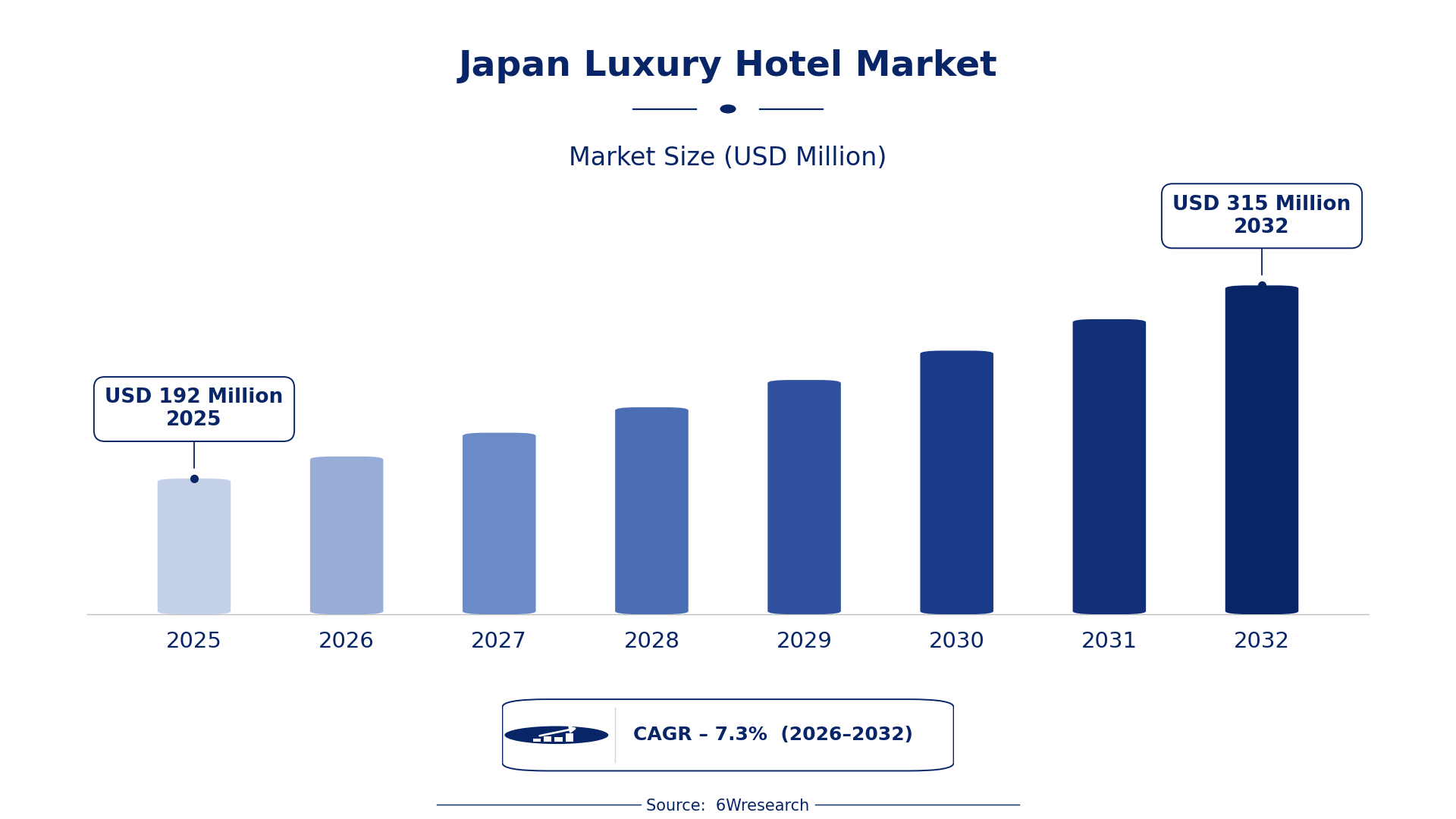
According to 6Wresearch internal database and industry insights, the Japan Luxury Hotel Market was valued at USD 192 Million in 2025 and is projected to reach USD 315 Million by 2032, growing at a CAGR of approximately 7.3% during 2026–2032.
Japan Luxury Hotel Market Highlights
| Report Metric | Details |
| Report Name | Japan Luxury Hotel Market (2026-2032) |
| Market Size 2025 | USD 192 Million |
| Market Size 2032 | USD 315 Million |
| Absolute Growth 2025–2032 | USD 123 Million |
| CAGR 2026–2032 | 7.3% |
| Peak Annual Growth | 8.0% in 2032 |
| Forecast Period | 2026–2032 |
| Historical Data | 2022–2025 |
| Base Year | 2025 |
| Leading Type, 2025 | Resort Hotels (31% share) |
| Leading Service Type, 2025 | Full-Service (50% share) |
| Leading End User, 2025 | Leisure Travelers (51% share) |
| Fastest-Growing Type | Boutique Hotels (10.3% CAGR) |
| Fastest-Growing Service Type | Ultra-Luxury (10.1% CAGR) |
| Fastest-Growing End User | High-Net-Worth Individuals (9.2% CAGR) |
| Growing Sector | Luxury Travel |
| Key End Users | Corporate Travelers, Leisure Travelers, High-Net-Worth Individuals |
Japan Luxury Hotel Market Year-wise Growth Rate and Key Drivers (2022–2032)
This graph illustrates the annual growth rates of the market from 2022 to 2032, highlighting a steady upward trajectory and projected market expansion over the forecast period.
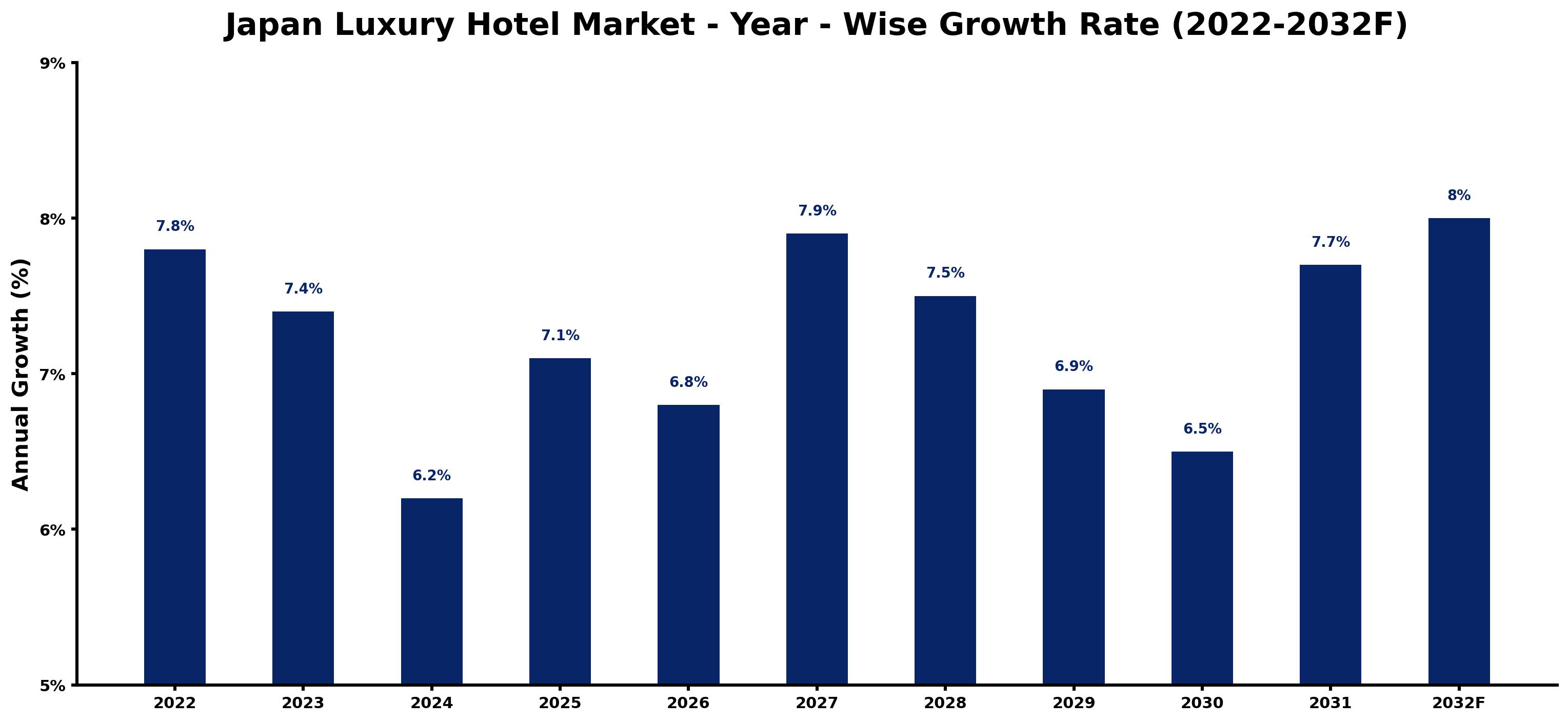
Each row of the following table gives one year's estimated growth and the event or demand shift that explains it.
| Year | Estimated Annual Growth (%) | Market Rationale |
| 2022 | 7.8 | The market experienced strong demand from both domestic and international tourists. |
| 2023 | 7.4 | Demand from corporate clients remained steady, but growth slowed slightly compared to last year. |
| 2024 | 6.2 | The luxury segment faced a temporary slowdown as occupancy rates adjusted to market conditions. |
| 2025 | 7.1 | Increased international travel and corporate events boosted market growth beyond previous levels. |
| 2026 | 6.8 | Growth moderated as the market stabilised after a period of rapid expansion. |
| 2027 | 7.9 | A resurgence in leisure travel and corporate bookings led to a faster growth rate. |
| 2028 | 7.5 | The market continued to grow, although at a slower pace due to market saturation. |
| 2029 | 6.9 | Sustained interest from high-net-worth individuals supported ongoing demand for luxury accommodations. |
| 2030 | 6.5 | Market growth slowed as competition increased among luxury hotels for affluent travelers. |
| 2031 | 7.7 | A renewed focus on unique guest experiences drove growth faster than the previous year. |
| 2032 | 8.0 | The market peaked as investment in luxury amenities attracted more affluent visitors. |
Note: Market size estimations and growth projections presented in this report are based on 6Wresearch's proprietary forecasting methodology, utilizing the latest available industry data, government publications, and primary research inputs.
Japan Luxury Hotel Market Synopsis
Luxury hotels in Japan encompass high-end accommodations that provide premium services and amenities. Catering to affluent travellers, corporate events, and leisure activities, the Japan Luxury Hotel Market is thriving, supported by over 30 million annual international visitors. With an average occupancy rate of around 80%, this segment is a key part of Japan's $40 billion tourism industry, driven by initiatives like the 'Visit Tokyo' campaign and a growing focus on sustainability.
Market Dynamics Impact Analysis (2026–2032)
| Factor | Type | Impact | Primary Segment Affected |
| Rising international tourism and corporate travel demand | Driver | High | Full-Service |
| Growing interest in unique and personalised experiences | Driver | High | Boutique Hotels |
| Increasing investment in sustainability initiatives | Opportunity | Medium | Spa Hotels |
| Expansion of luxury accommodations in key tourist regions | Opportunity | High | Resort Hotels |
| Intense competition among luxury hotels | Restraint | High | Ultra-Luxury |
| High operational costs affecting profitability | Restraint | Medium | Heritage Hotels |
| Challenges in maintaining high service standards | Challenge | High | Business Hotels |
| Dependence on international travel trends | Challenge | Medium | Leisure Travelers |
Evaluation of Drivers in Japan Luxury Hotel Market (2026–2032)
Below are the drivers that matter most for revenue growth, with supporting evidence.
| Drivers | Primary Segment Affected | Why It Matters (Evidence) |
| Increased international travel | Full-Service | Japan's luxury hotels benefit from over 30 million annual international visitors, boosting bookings. |
| Corporate events and conferences | Business Hotels | The rise in corporate travel leads to higher demand for luxury accommodations for business purposes. |
| Focus on wellness and relaxation | Spa Hotels | The popularity of traditional onsen facilities attracts leisure travelers seeking wellness experiences. |
| Unique cultural experiences | Heritage Hotels | Cultural tourism drives demand for heritage hotels, particularly in cities like Kyoto, known for their rich history. |
| Investment in luxury amenities | Ultra-Luxury | High-net-worth individuals seek exclusive experiences, prompting hotels to invest in premium offerings. |
Spending rises because luxury hotels have adapted to changing consumer preferences over the past five years. The influx of over 30 million international visitors annually has increased demand for high-quality accommodations, particularly in major cities like Tokyo. Corporate events have surged, driving bookings in business hotels, while the focus on wellness has popularised spa hotels featuring traditional onsen facilities. Cultural tourism has flourished, attracting guests to heritage hotels in Kyoto. Investment in luxury amenities has also risen, appealing to high-net-worth individuals seeking exclusivity and unique experiences.
Evaluation of Restraints in Japan Luxury Hotel Market
The key brakes on demand, and where they bite hardest, are shown below.
| Market Restraint | Primary Segment Affected | Why It Matters (Evidence) |
| Intense competition leading to price wars | Ultra-Luxury | Competition among luxury hotels can drive down prices, impacting profitability for operators. |
| High operational costs due to premium services | Full-Service | The need to maintain high service standards increases operational costs for luxury hotels. |
| Challenges in staff recruitment and retention | Business Hotels | The luxury sector faces difficulties in attracting skilled staff, affecting service quality. |
| Economic fluctuations impacting travel budgets | Leisure Travelers | Economic downturns can reduce discretionary spending on luxury travel experiences. |
| Regulatory compliance costs | Heritage Hotels | Heritage hotels often incur high costs to comply with preservation regulations. |
Japan Luxury Hotel Market Challenges
High-end buyers face increased operational costs due to a shortage of skilled hospitality staff, stemming from inadequate training programmes in Japan, which can raise recruitment expenses by up to 20%. Suppliers encounter fierce competition from new entrants, leading to price reductions that force established hotels to lower rates by as much as 15%. Regulatory hurdles, such as stringent building codes, extend construction timelines by 30%, delaying new hotel openings for producers. Buyers also contend with fluctuating demand from international tourists, complicating revenue forecasting and causing financial strain for hotels that depend on consistent occupancy rates.
Trends in the Japan Luxury Hotel Market
These developments are changing demand patterns in the Japan Luxury Hotel Market.
- Shift from Traditional to Experiential Luxury: Japanese luxury hotels increasingly focus on providing unique experiences rather than just accommodations. The 'Visit Tokyo' campaign, launched in 2023, promotes immersive cultural experiences, attracting affluent travellers seeking more than just a place to stay.
- Growing Emphasis on Sustainability: Since 2023, luxury hotels in Japan have invested in sustainability initiatives, such as eco-friendly practices and green certifications. This shift is clear as more hotels adopt ISO 9001 standards to appeal to eco-conscious travellers.
- Rise of Boutique Hotels: The boutique hotel segment has gained popularity, with a CAGR of 10.3% projected through 2032. These hotels cater to niche markets, offering personalised services that attract discerning travellers.
- Increased Corporate Event Hosting: The demand for luxury hotels to host corporate events has risen significantly, with many hotels enhancing their facilities to accommodate this trend. The average occupancy rate for luxury hotels is around 80%, reflecting this growing need.
Investment Opportunities in the Japan Luxury Hotel Market
Where to invest in the Japan Luxury Hotel Market: the main openings are set out below.
- Corporate Travelers Seeking Premium Services: Corporate clients increasingly require high-end accommodations for business trips, with an average occupancy rate of 80%. Partnering with business travel agencies can facilitate access to this market.
- Expansion in Kyoto's Heritage Hotel Sector: Kyoto's rich cultural heritage creates opportunities for heritage hotels to thrive. Investing in unique cultural experiences can attract more tourists, particularly during peak seasons.
- Growing Demand for Wellness Facilities: With a rising focus on wellness, spa hotels featuring onsen facilities are in high demand. Investing in these facilities can cater to the increasing number of health-conscious travellers.
- Investment in Ultra-Luxury Experiences: High-net-worth individuals seek exclusive experiences, creating opportunities for ultra-luxury hotels. Collaborating with local artisans can improve offerings and attract this affluent demographic.
Government Initiatives in the Japan Luxury Hotel Market
The Industrial Standardization Act, originally enacted in 1949 and amended in 2019, governs the standards for luxury hotels in Japan. This law ensures that hotels adhere to quality management standards, such as ISO 9001, which is vital for maintaining high service levels and consumer trust.
In 2023, the Japan Tourism Agency launched a program aimed at improving luxury travel experiences. This initiative allocates JPY 150 trillion towards public-private decarbonisation investments over ten years, promoting sustainability in the luxury hotel sector and enhancing guest experiences.
Future Insight of the Japan Luxury Hotel Market
Investment in luxury accommodations will surpass $10 billion by 2032, driven by the influx of over 30 million international visitors and initiatives aimed at enhancing travel experiences. This growth will generate opportunities for suppliers to introduce premium services and unique amenities. Programmes launched by the Japan Tourism Agency will further stimulate demand, encouraging hotels to innovate their offerings. Sustainability practices will become vital, as hotels implement eco-friendly technologies to attract environmentally conscious travellers, aligning with global trends in luxury accommodation.
Market Segmentation Analysis
Japan Luxury Hotel Market report covers a detailed analysis of the following market segments:
By Type – Resort Hotels Lead, Boutique Hotels Expected to Grow Fastest
According to Shubham Deep, Research Manager at 6Wresearch, the largest type category in 2025 was Resort Hotels, at 31% of revenue. Resort hotels dominate the market as they cater to leisure travelers seeking relaxation and recreation, particularly in popular regions like Okinawa. This segment benefits from Japan's robust tourism, attracting over 30 million international visitors annually. Over 2026–2032, Boutique Hotels are expected to post the fastest growth, at a CAGR of 10.3%. Boutique hotels are experiencing rapid growth due to their unique experiences and personalised services, appealing to an increasing number of travellers. The surge in boutique hotel openings in major cities highlights the rising demand for distinctive stays. Suppliers should focus on enhancing unique offerings to meet the growing demand for boutique hotels.
By Service Type – Full-Service Leads, Ultra-Luxury Expected to Grow Fastest
In 2025, Full-Service led the service type split with a 50% share. Full-service hotels lead the market by providing comprehensive services for various types of travellers, including leisure and corporate guests. Their extensive amenities, such as dining and wellness facilities, make them a preferred choice among customers. Ultra-Luxury is projected to grow fastest, at a CAGR of 10.1% during 2026–2032. Ultra-luxury hotels are witnessing rapid growth, targeting high-net-worth individuals who seek exclusivity and bespoke services. The expansion of this segment is evident in the increasing number of ultra-luxury properties being developed in prime locations. Buyers can anticipate a wider range of ultra-luxury options as competition in this segment intensifies.
By End User – Leisure Travelers Lead, High-Net-Worth Individuals Expected to Grow Fastest
Leisure Travelers accounted for 51% of the market by end user in 2025. Leisure travelers constitute the largest segment in the luxury hotel market, seeking premium experiences during vacations in culturally rich cities like Kyoto. Their substantial numbers contribute to high occupancy rates, averaging around 80%. High-Net-Worth Individuals are set to record the highest CAGR in this split, 9.2% over 2026–2032. High-net-worth individuals represent the fastest-growing segment, demanding premium services and exclusivity, which drives luxury hotels to tailor their offerings. This trend reflects the increasing interest in luxury travel experiences among affluent consumers. Suppliers must adapt their services to meet the specific needs of high-net-worth individuals to capture this lucrative market.
Key Attractiveness of the Report
- 10 Years of Market Numbers
- Historical Data Starting from 2022 to 2025
- Base Year 2025
- Forecast Data until 2032
- Key Performance Indicators Impacting the Market
- Major Upcoming Developments and Projects
Key Highlights of the Report:
- Japan Luxury Hotel Market Outlook
- Market Size of Japan Luxury Hotel Market,2025
- Forecast of Japan Luxury Hotel Market, 2032
- Historical Data and Forecast of Japan Luxury Hotel Revenues & Volume for the Period 2022-2032
- Japan Luxury Hotel Market Trend Evolution
- Japan Luxury Hotel Market Drivers and Challenges
- Japan Luxury Hotel Price Trends
- Japan Luxury Hotel Porter's Five Forces
- Japan Luxury Hotel Industry Life Cycle
- Historical Data and Forecast of Japan Luxury Hotel Market Revenues & Volume By Type for the Period 2022-2032
- Historical Data and Forecast of Japan Luxury Hotel Market Revenues & Volume By Business Hotels for the Period 2022-2032
- Historical Data and Forecast of Japan Luxury Hotel Market Revenues & Volume By Resort Hotels for the Period 2022-2032
- Historical Data and Forecast of Japan Luxury Hotel Market Revenues & Volume By Boutique Hotels for the Period 2022-2032
- Historical Data and Forecast of Japan Luxury Hotel Market Revenues & Volume By Heritage Hotels for the Period 2022-2032
- Historical Data and Forecast of Japan Luxury Hotel Market Revenues & Volume By Spa Hotels for the Period 2022-2032
- Historical Data and Forecast of Japan Luxury Hotel Market Revenues & Volume By Service Type for the Period 2022-2032
- Historical Data and Forecast of Japan Luxury Hotel Market Revenues & Volume By Full-Service for the Period 2022-2032
- Historical Data and Forecast of Japan Luxury Hotel Market Revenues & Volume By Boutique for the Period 2022-2032
- Historical Data and Forecast of Japan Luxury Hotel Market Revenues & Volume By Ultra-Luxury for the Period 2022-2032
- Historical Data and Forecast of Japan Luxury Hotel Market Revenues & Volume By End User for the Period 2022-2032
- Historical Data and Forecast of Japan Luxury Hotel Market Revenues & Volume By Corporate Travelers for the Period 2022-2032
- Historical Data and Forecast of Japan Luxury Hotel Market Revenues & Volume By Leisure Travelers for the Period 2022-2032
- Historical Data and Forecast of Japan Luxury Hotel Market Revenues & Volume By High-Net-Worth Individuals for the Period 2022-2032
- Japan Luxury Hotel Import Export Trade Statistics
- Market Opportunity Assessment By Type
- Market Opportunity Assessment By Service Type
- Market Opportunity Assessment By End User
- Japan Luxury Hotel Top Companies Market Share
- Japan Luxury Hotel Competitive Benchmarking By Technical and Operational Parameters
- Japan Luxury Hotel Company Profiles
- Japan Luxury Hotel Key Strategic Recommendations
Market Covered
The report covers the following segments.
By Type
- Business Hotels
- Resort Hotels
- Boutique Hotels
- Heritage Hotels
- Spa Hotels
By Service Type
- Full-Service
- Boutique
- Ultra-Luxury
By End User
- Corporate Travelers
- Leisure Travelers
- High-Net-Worth Individuals






































