Japan Marine Radar Market Size Growth Rate
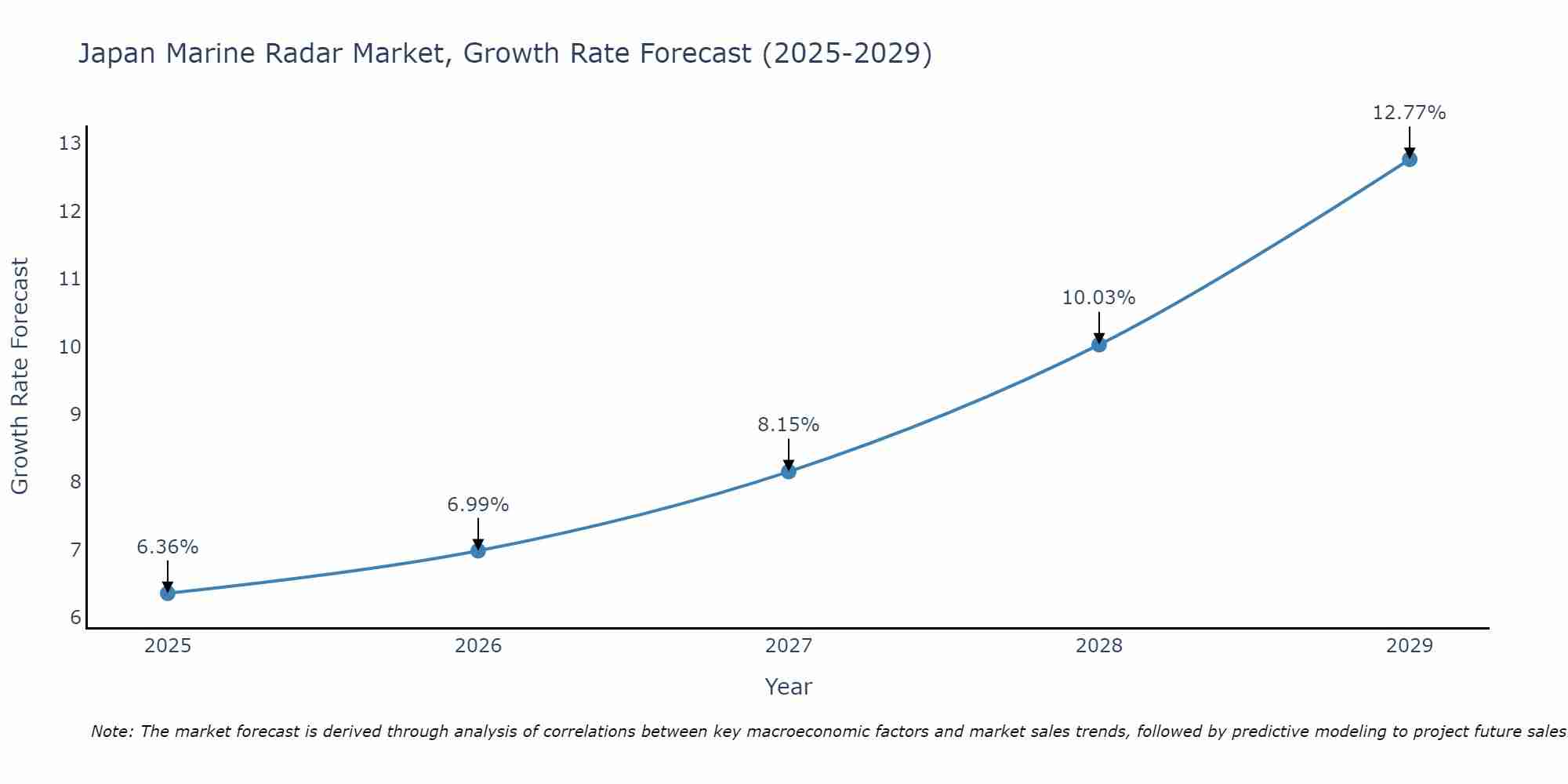
The Japan Marine Radar Market is likely to experience consistent growth rate gains over the period 2025 to 2029. From 6.36% in 2025, the growth rate steadily ascends to 12.77% in 2029.
Japan Marine Radar Market Overview
The Japan Marine Radar Market is a dynamic and growing sector driven by the country`s strong maritime industry and advanced technology adoption. The market is characterized by the presence of key players such as Furuno Electric Co., Ltd., Japan Radio Co., Ltd., and Raytheon Anschütz, offering a wide range of radar systems catering to various maritime applications. The increasing focus on maritime safety and navigation efficiency, coupled with regulatory requirements, is fueling the demand for marine radar systems in Japan. Furthermore, technological advancements such as the integration of radar with other navigation systems, improved detection capabilities, and the development of compact and lightweight radar units are expected to drive market growth. Overall, the Japan Marine Radar Market presents lucrative opportunities for both domestic and international players in the coming years.
Japan Marine Radar Market Trends
The Japan Marine Radar Market is experiencing a shift towards advanced technologies such as solid-state radar systems, which offer higher performance, reliability, and energy efficiency compared to traditional magnetron-based radars. There is also a growing demand for integrated radar systems that incorporate features like automatic target tracking, collision avoidance, and chart plotting for enhanced navigational capabilities. Additionally, the market is witnessing a trend towards digitalization and connectivity, with radar systems being increasingly integrated into broader maritime communication and navigation networks. Vendors in the Japan Marine Radar Market are focusing on developing compact, lightweight radar solutions with improved detection capabilities to cater to the evolving needs of commercial shipping companies, defense organizations, and recreational boaters in the region.
Japan Marine Radar Market Challenges
In the Japan Marine Radar Market, several challenges are prevalent. One key challenge is the increasing competition from foreign manufacturers offering advanced radar technology at competitive prices, putting pressure on local companies to innovate and differentiate their products. Additionally, the strict regulatory environment and certification requirements in Japan can pose barriers to market entry for new radar manufacturers. Another challenge is the rapidly evolving technology landscape, with the shift towards digitalization and integration of radar systems with other maritime technologies, necessitating continuous investment in research and development to stay ahead of the curve. Lastly, the fluctuating global economic conditions and geopolitical uncertainties can impact the market dynamics and consumer demand, requiring companies to remain agile and adaptable in their business strategies.
Japan Marine Radar Market Investment Opportunities
The Japan Marine Radar Market presents promising investment opportunities due to advancements in technology, increased focus on maritime safety, and growing demand for efficient navigation systems. Key areas for investment include the development of high-resolution radar systems with enhanced detection capabilities, integration of artificial intelligence and machine learning for improved target identification, and the expansion of radar applications beyond traditional maritime use to sectors like defense and fisheries. Additionally, investments in research and development to enhance radar performance in adverse weather conditions and crowded waterways can offer significant growth potential. Partnering with local manufacturers and leveraging Japan`s strong maritime industry ecosystem can provide investors with a competitive edge in this evolving market.
Japan Marine Radar Market Government Policy
Government policies related to the Japan Marine Radar Market focus on promoting safety and efficiency in maritime activities. The Japanese government has implemented regulations requiring vessels to be equipped with radar systems to enhance navigation and avoid collisions at sea. In addition, there are strict guidelines on the installation, maintenance, and calibration of marine radar equipment to ensure accuracy and reliability. The government also supports research and development efforts to advance radar technology for maritime applications, fostering innovation and competitiveness in the industry. Overall, these policies aim to uphold high standards of safety, security, and environmental protection in Japan`s waters, driving the growth and sustainability of the Marine Radar Market in the country.
Japan Marine Radar Market Future Outlook
The Japan Marine Radar market is expected to witness steady growth in the coming years, driven by factors such as increasing maritime trade activities, rising demand for enhanced safety and navigation systems, and technological advancements in radar technology. The market is likely to benefit from the government`s focus on maritime infrastructure development and safety regulations. Additionally, the growing adoption of radar systems in fishing vessels and recreational boats is expected to contribute to market expansion. With the ongoing trend towards digitalization and automation in the maritime industry, there is a growing emphasis on integrating marine radar systems with other navigation and communication technologies. Overall, the Japan Marine Radar market is projected to experience sustained growth as the maritime sector continues to prioritize safety, efficiency, and regulatory compliance.
Key Highlights of the Report:
- Japan Marine Radar Market Outlook
- Market Size of Japan Marine Radar Market, 2024
- Forecast of Japan Marine Radar Market, 2031
- Historical Data and Forecast of Japan Marine Radar Revenues & Volume for the Period 2018 - 2031
- Japan Marine Radar Market Trend Evolution
- Japan Marine Radar Market Drivers and Challenges
- Japan Marine Radar Price Trends
- Japan Marine Radar Porter's Five Forces
- Japan Marine Radar Industry Life Cycle
- Historical Data and Forecast of Japan Marine Radar Market Revenues & Volume By Product Type for the Period 2018 - 2031
- Historical Data and Forecast of Japan Marine Radar Market Revenues & Volume By X-Band for the Period 2018 - 2031
- Historical Data and Forecast of Japan Marine Radar Market Revenues & Volume By S-Band for the Period 2018 - 2031
- Historical Data and Forecast of Japan Marine Radar Market Revenues & Volume By Component for the Period 2018 - 2031
- Historical Data and Forecast of Japan Marine Radar Market Revenues & Volume By Transmitter for the Period 2018 - 2031
- Historical Data and Forecast of Japan Marine Radar Market Revenues & Volume By Receiver for the Period 2018 - 2031
- Historical Data and Forecast of Japan Marine Radar Market Revenues & Volume By Antennae for the Period 2018 - 2031
- Historical Data and Forecast of Japan Marine Radar Market Revenues & Volume By Others for the Period 2018 - 2031
- Historical Data and Forecast of Japan Marine Radar Market Revenues & Volume By Application for the Period 2018 - 2031
- Historical Data and Forecast of Japan Marine Radar Market Revenues & Volume By Fishing Vessel for the Period 2018 - 2031
- Historical Data and Forecast of Japan Marine Radar Market Revenues & Volume By Recreational Boat for the Period 2018 - 2031
- Historical Data and Forecast of Japan Marine Radar Market Revenues & Volume By Merchant Marine for the Period 2018 - 2031
- Historical Data and Forecast of Japan Marine Radar Market Revenues & Volume By Others for the Period 2018 - 2031
- Historical Data and Forecast of Japan Marine Radar Market Revenues & Volume By Industry for the Period 2018 - 2031
- Historical Data and Forecast of Japan Marine Radar Market Revenues & Volume By Naval for the Period 2018 - 2031
- Japan Marine Radar Import Export Trade Statistics
- Market Opportunity Assessment By Product Type
- Market Opportunity Assessment By Component
- Market Opportunity Assessment By Application
- Market Opportunity Assessment By Industry
- Japan Marine Radar Top Companies Market Share
- Japan Marine Radar Competitive Benchmarking By Technical and Operational Parameters
- Japan Marine Radar Company Profiles
- Japan Marine Radar Key Strategic Recommendations






































