Japan Material Testing Market Growth Rate
According to 6Wresearch internal database and industry insights, the Japan Material Testing Market is projected to grow at a compound annual growth rate (CAGR) of 5.9% during the forecast period (2026-2032).
Japan Material Testing Market Year-wise Growth Rate and Key Drivers
This graph highlights how the Japan Material Testing Market has steadily grown over the past five years, supported by major growth factors.
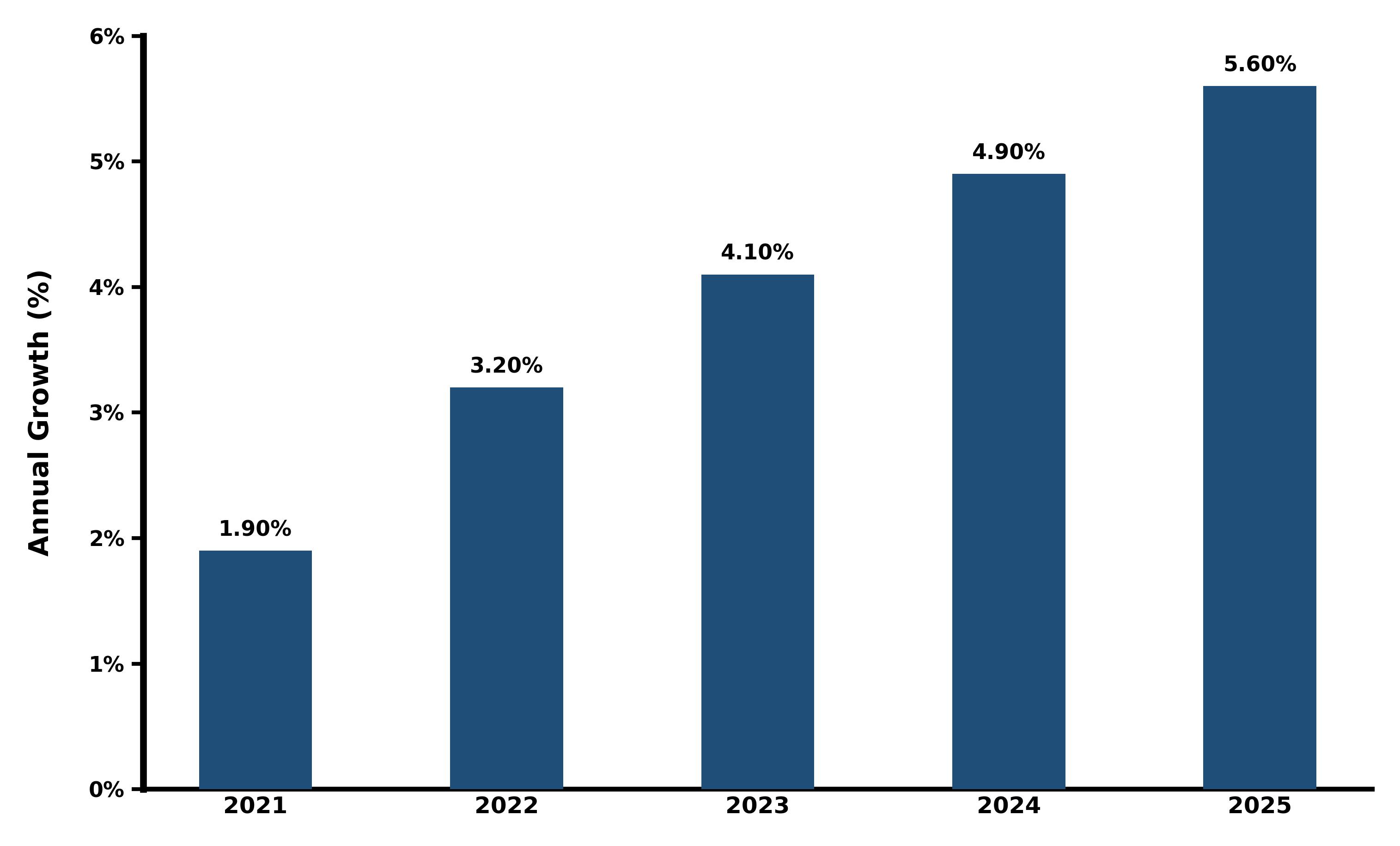
The table below presents the year‑wise growth rates along with the key drivers influencing the market
| Year | Est. Annual Growth (%) | Growth Drivers |
| 2021 | 1.9% | Stable industrial testing operations supported by academic institutions and R&D facilities. |
| 2022 | 3.2% | Manufacturing recovery and growth in automotive and construction material validation. |
| 2023 | 4.1% | Rising investment in smart laboratories and modernization of testing equipment. |
| 2024 | 4.9% | Advancements in automation, robotics, and real-time data analysis in testing processes. |
| 2025 | 5.6% | Expansion of aerospace and infrastructure testing applications with AI-enabled systems. |
Topics Covered in the Japan Material Testing Market Report
The Japan Material Testing Market report thoroughly covers the market by type and end-use industry. The market report provides an unbiased and detailed analysis of ongoing market trends, opportunities/high growth areas, and market drivers, which would help stakeholders devise and align their market strategies according to the current and future market dynamics.
Japan Material Testing Market Highlights
| Report Name | Japan Material Testing Market |
| Forecast period | 2026-2032 |
| CAGR | 5.9% |
| Growing Sector | Automotive Testing & R&D Laboratories |
Japan Material Testing Market Synopsis
The Japan Material Testing Market continues to expand steadily, supported by automation, increased research investments, and compliance with JIS norms. Strong momentum from the automotive, aerospace, and infrastructure sectors drives innovation in material testing equipment. Furthermore, Japan Material Testing Market Growth is being strengthened by AI-powered analytics, robotics, and precision systems that ensure accurate and efficient testing reinforcing Japan reputation for excellence in industrial quality control and technological precision.
Evaluation of Growth Drivers in the Japan Material Testing Market
Below mentioned are some key growth drivers and their impact on market dynamics:
| Drivers | Primary Segments Affected | Why It Matters |
| Strong Industrial R&D Investments | Servohydraulic & Universal Testing Systems | Promotes innovation in material design and validation accuracy. |
| Stringent Product Quality & Safety Standards | Universal & Hardness Testing | Drives adoption of automated systems for regulatory compliance. |
| Expansion in Infrastructure Projects | Universal Testing Machines | Boosts demand for cement, steel, and concrete testing applications. |
| Advanced Automotive Manufacturing | Servohydraulic Testing Systems | Supports high-precision fatigue and performance testing for EV and hybrid materials. |
| Academic-Industrial Partnerships | Hardness & Universal Systems | Enhances skill development and facilitates testing standardization. |
The Japan Material Testing Market is expected to grow steadily, with a CAGR of 5.9% during 2026-2032. The Japan Material Testing Market continues to grow at a steady pace, propelled by advances in automation, high-precision testing, and strict regulatory standards. Widespread implementation of smart testing platforms featuring real-time monitoring and automated analysis is boosting performance reliability across key sectors like automotive, aerospace, and construction. With Japan maintaining a strong focus on material integrity and compliance with global norms, next-generation data-centric testing systems will reinforce its reputation for engineering precision and export dependability.
Evaluation of Restraints in the Japan Material Testing Market
Below mentioned are some major restraints and their influence on market dynamics:
| Restraints | Primary Segments Affected | What This Means |
| High Equipment Cost & Maintenance | Servohydraulic Systems | Limits adoption among small and mid-sized labs. |
| Shortage of Skilled Technicians | All Types | Reduces operational efficiency and precision. |
| Dependence on Imported Components | Servohydraulic & Universal Systems | Increases procurement cost and lead time. |
| Calibration Complexity | Hardness Testing Machines | Adds recurring operational expenditure and downtime. |
| Limited Awareness in SMEs | All Types | Slows transition to advanced automated systems. |
Japan Material Testing Market Challenges
The Japan Material Testing Industry in Japan faces ongoing structural challenges, including high costs for test systems, reliance on imported controllers and actuators, and limited access to talent specializing in fatigue and durability testing. Subsequently, maintaining standardization and calibration quality across disparate facilities can lag behind the pace of rigorous test application. These barriers are particularly challenging for smaller companies and educational research institutions to overcome, which diminishes their capacity to maintain consistency with international testing standards and jeopardizes Japan important role in advanced precision engineering.
Japan Material Testing Market Trends
Some major trends contributing to the development of the Japan Material Testing Market are:
- Smart Laboratories: Advancement in digitally connected, automated laboratories, with real-time analytics and real-time remote operation capabilities.
- Educational Collaboration: An increase in the number of partner programs between universities and manufacturers for the educational training of hands-on materials testing experience and skills.
- Portable and Onsite Testing Solutions: The advancement of portable and compact hardness testers to enable fast onsite and portable inspection and inspection of objects in industrial environments.
Investment Opportunities in the Japan Material Testing Market
Here are some key investment opportunities in the Japan Material Testing Market:
- Automation & AI-Driven Systems: Growing demand for intelligent testing devices with predictive analytics for improved precision.
- Manufacturing in Country: Invest in producing parts locally to reduce reliance on imports and strengthen the supply chain.
- Joint Testing Centers: Collaborating by industry and research institutions in the establishment of specialized R&D centers to advance material technologies, support innovation, and improve Japan competitiveness in high-performance engineering materials.
- Software Development: Opportunities to develop real-time data systems, simulation software, and testing management software.
- Green Material Testing Capabilities: Investing in testing capabilities focused on sustainability of recycled/biobased materials.
Top 5 Leading Players in the Japan Material Testing Market
Here are some top companies contributing to Japan Material Testing Market Share:
1. Shimadzu Corporation
| Company Name | Shimadzu Corporation |
|---|---|
| Headquarters | Kyoto, Japan |
| Established Year | 1875 |
| Official Website | Click Here |
Shimadzu Corporation is a global leader in precision testing and analytical instrumentation, providing tensile, compression, and fatigue testing machines integrated with smart control systems and advanced data analytics. The company serves a wide range of industries, from automotive to aerospace, ensuring high reliability and accuracy in material evaluation.
2. A&D Company, Limited
| Company Name | A&D Company, Limited |
|---|---|
| Headquarters | Tokyo, Japan |
| Established Year | 1977 |
| Official Website | Click Here |
A&D Company, Limited develops advanced mechanical testing systems and digital control technologies for automotive, industrial, and academic applications. The company emphasizes innovation in real-time measurement solutions, combining precision engineering with cutting-edge electronics for enhanced testing accuracy.
3. Mitutoyo Corporation
| Company Name | Mitutoyo Corporation |
|---|---|
| Headquarters | Kanagawa, Japan |
| Established Year | 1934 |
| Official Website | Click Here |
Mitutoyo Corporation specializes in hardness and precision testing instruments that comply with international quality standards. The company provides comprehensive solutions for R&D and industrial laboratories, ensuring exceptional accuracy, repeatability, and performance in materials testing.
4. Instron Japan (ITW Group)
| Company Name | Instron Japan (ITW Group) |
|---|---|
| Headquarters | Kanagawa, Japan |
| Established Year | 1946 |
| Official Website | Click Here |
Instron Japan, part of the ITW Group, is a global leader in dynamic and static materials testing solutions for metals, plastics, composites, and advanced materials. The company integrates AI-based automation and digital analysis tools to deliver high-precision, efficient, and reliable test results.
5. Tokyo Testing Machine Co., Ltd.
| Company Name | Tokyo Testing Machine Co., Ltd. |
|---|---|
| Headquarters | Tokyo, Japan |
| Established Year | 1933 |
| Official Website | Click Here |
Tokyo Testing Machine Co., Ltd. focuses on universal and hardness testing machines designed for the construction, metal, and materials industries. Known for its energy-efficient and high-precision solutions, the company continues to advance Japan’s material testing standards through innovation and technological excellence.
Government Regulations Introduced in the Japan Material Testing Market
According to Japanese government data, the country enforces rigorous compliance through the Japanese Industrial Standards (JIS) to ensure safety and consistency. The Ministry of Economy, Trade, and Industry (METI) promotes advanced testing innovation under the Industrial Standardization Act. National programs such as Society 5.0 encourage AI and digital integration in testing processes, while initiatives under the Green Growth Strategy focus on sustainable material validation and the digital transformation of research and development laboratories across Japan’s industrial ecosystem.
Future Insights of the Japan Material Testing Market
The Japan Material Testing Market is steadily growing due to innovation, automation, and the demand for sustainable material solutions. Lightweight, strong materials continue to be in demand and have created a need to modernize testing infrastructure. The adoption of AI technologies, digital monitoring, and big data tools has enhanced accuracy and reliability across all testing operations. Partnerships between academic institutions and industry leaders continue to strengthen Japan’s position as a leader in advanced material research, providing a pathway toward global certification and precision-based testing solutions across various manufacturing sectors.
Market Segmentation Analysis
The report offers a comprehensive study of the following market segments and their leading categories.
Universal Testing Machines to Dominate the Market – By Type
According to Ritika Kalra, Senior Research Analyst, 6Wresearch, the Universal Testing Machines segment dominates the Japan Material Testing Market due to their extensive applications in tensile, compression, and flexural testing. Their versatility and alignment with JIS and ISO standards make them the preferred choice for both industrial and academic laboratories, ensuring consistency in performance verification.
Automotive to Dominate the Market – By End Use Industry
The Automotive segment holds the largest share owing to Japan’s leadership in vehicle production and strict safety testing standards. Growing demand for lightweight materials and hybrid vehicle components drives the need for advanced fatigue, hardness, and dynamic testing systems to ensure reliability and compliance with global performance benchmarks.
Key Attractiveness of the Report
- 10 Years Market Numbers
- Historical Data Starting from 2022 to 2025
- Base Year: 2025
- Forecast Data until 2032
- Key Performance Indicators Impacting the Market
- Major Upcoming Developments and Projects
Key Highlights of the Report:
- Japan Material Testing Market Outlook
- Market Size of Japan Material Testing Market, 2025
- Forecast of Japan Material Testing Market, 2032
- Historical Data and Forecast of Japan Material Testing Revenues & Volume for the Period 2022-2032
- Japan Material Testing Market Trend Evolution
- Japan Material Testing Market Drivers and Challenges
- Japan Material Testing Price Trends
- Japan Material Testing Porter's Five Forces
- Japan Material Testing Industry Life Cycle
- Historical Data and Forecast of Japan Material Testing Market Revenues & Volume By Type for the Period 2022-2032
- Historical Data and Forecast of Japan Material Testing Market Revenues & Volume By Universal Testing Machines for the Period 2022-2032
- Historical Data and Forecast of Japan Material Testing Market Revenues & Volume By Servohydraulic Testing Machines for the Period 2022-2032
- Historical Data and Forecast of Japan Material Testing Market Revenues & Volume By Hardness Test Equipment for the Period 2022-2032
- Historical Data and Forecast of Japan Material Testing Market Revenues & Volume By End Use Industry for the Period 2022-2032
- Historical Data and Forecast of Japan Material Testing Market Revenues & Volume By Automotive for the Period 2022-2032
- Historical Data and Forecast of Japan Material Testing Market Revenues & Volume By Construction for the Period 2022-2032
- Historical Data and Forecast of Japan Material Testing Market Revenues & Volume By Educational Institutions for the Period 2022-2032
- Japan Material Testing Import Export Trade Statistics
- Market Opportunity Assessment By Type
- Market Opportunity Assessment By End Use Industry
- Japan Material Testing Top Companies Market Share
- Japan Material Testing Competitive Benchmarking By Technical and Operational Parameters
- Japan Material Testing Company Profiles
- Japan Material Testing Key Strategic Recommendations
Market Covered
The report subsequently covers the market by the following segments and subsegments:
By Type
- Universal Testing Machines
- Servohydraulic Testing Machines
- Hardness Test Equipment
By End Use Industry
- Automotive
- Construction
- Educational Institutions






































