Japan Metadata Management Tools Market Size & Growth Rate (2026-2032)
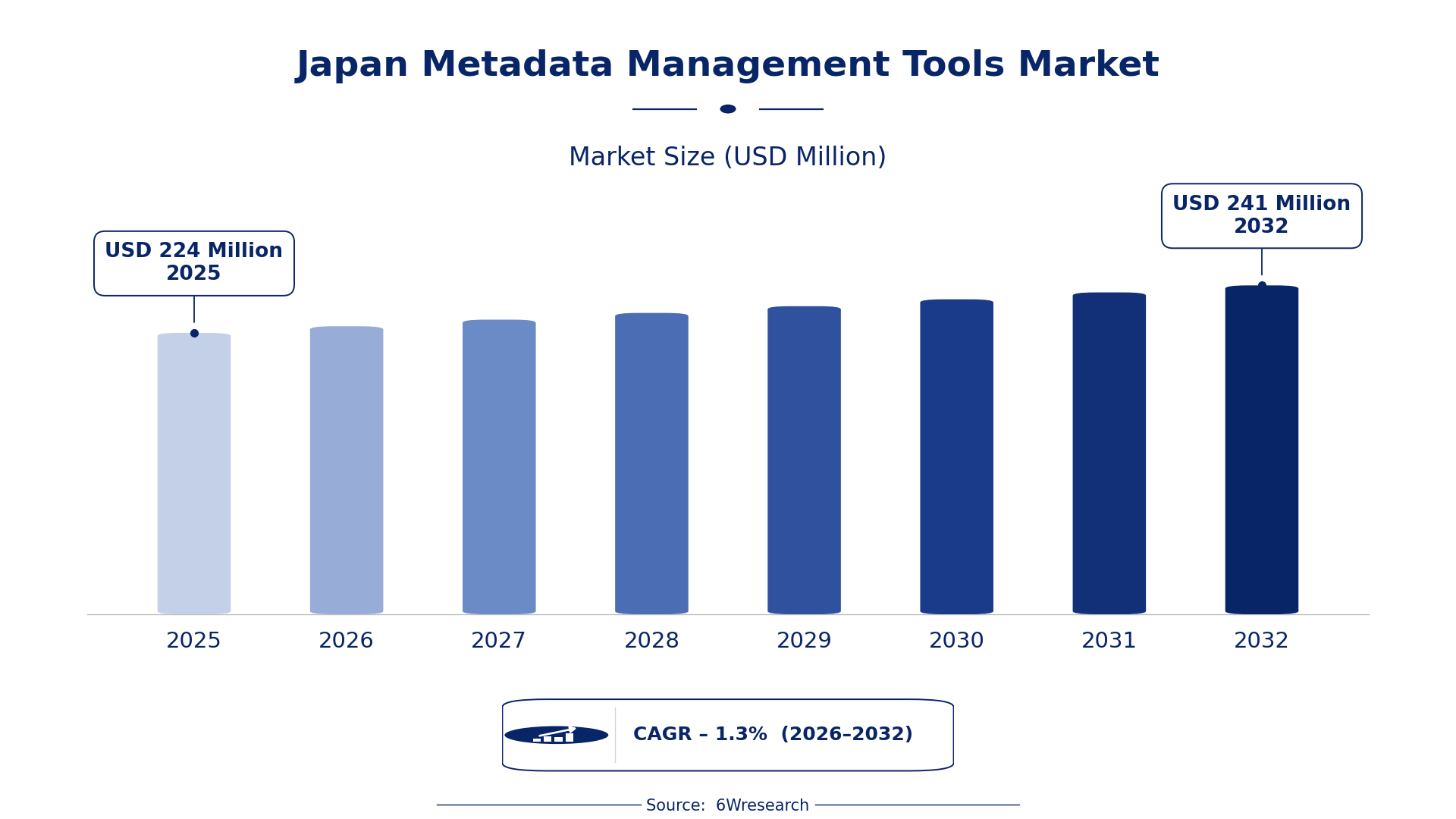
The Japan Metadata Management Tools Market was estimated at USD 224 Million in 2025 and is projected to reach USD 241 Million by 2032, growing at a CAGR of 1.3% from 2026 to 2032.
Japan Metadata Management Tools Market Synopsis
As organizations across Japan increasingly recognize the importance of effective data management, the metadata management tools market is witnessing notable growth. Companies are turning to sophisticated solutions that facilitate better organization, integration, and analysis of their data assets, which is essential for driving strategic decisions and ensuring compliance.
The ongoing shift towards cloud-based solutions is particularly pronounced, as businesses seek flexibility and scalability in their operations. Alongside this, the integration of artificial intelligence and machine learning into metadata management tools is becoming more prevalent, enhancing the capabilities of these solutions and positioning them as vital components of modern data governance frameworks.
Japan Metadata Management Tools Market Year-wise Growth Rate and Key Drivers
This graph illustrates the annual growth rates of the Japan Metadata Management Tools Market from 2021 to 2032, highlighting a steady upward trajectory and projected expansion over the forecast period.
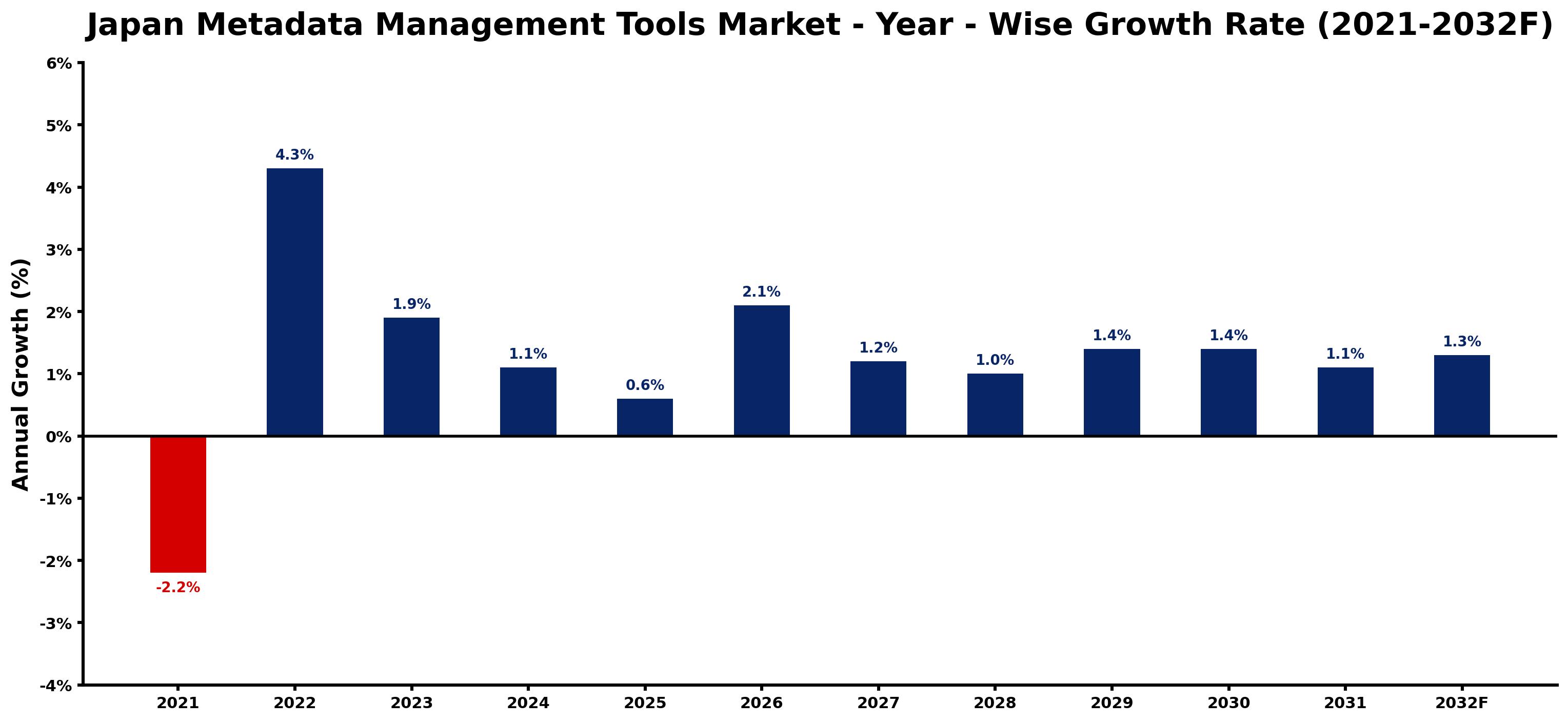
The table below presents the year‑wise growth rates along with the key drivers influencing the market
| Year | Growth Rate | Major Drivers |
| 2021 | -2.2% | Decline in enterprise software investments by Japanese firms |
| 2022 | 4.3% | Increased demand for compliance with APPI regulations |
| 2023 | 1.9% | Growing focus on data governance by major corporations |
| 2024 | 1.1% | Rise in digital transformation initiatives across industries |
| 2025 | 0.6% | Adoption of AI-driven data analytics solutions expanding |
| 2026 | 2.1% | Government support for technology innovation funding initiatives |
| 2027 | 1.2% | Emphasis on data privacy impacting IT investment decisions |
| 2028 | 1.0% | Surge in cloud adoption among SMEs driving metadata needs |
| 2029 | 1.4% | Need for real-time data integration in healthcare sector |
| 2030 | 1.4% | Expanding IoT applications requiring structured metadata frameworks |
| 2031 | 1.1% | Regulatory compliance pressure from financial sector developments |
| 2032 | 1.3% | Growing presence of cybersecurity needs influencing data management |
Note: Market size estimations and growth projections presented in this report are based on 6Wresearch's proprietary forecasting methodology, utilizing the latest available industry data, government publications, and primary research inputs.
Japan Metadata Management Tools Market Key Takeaways
Below are some of the specific key takeaways from the market, including:
- The market is characterized by increasing demand for cloud-based metadata management solutions.
- AI and machine learning integration is driving advancements in data governance and automation.
- Organizations are prioritizing compliance with regulations such as the Personal Information Protection Act.
- User-friendly interfaces are becoming essential for empowering non-technical users.
- Investment opportunities are rising in response to the growing importance of data governance.
Evaluation of Restraints in Japan Metadata Management Tools Market
Despite the positive growth trajectory, the Japan Metadata Management Tools Market faces several barriers. Complexity in data formats and structures continues to challenge organizations, particularly in accommodating diverse data sources prevalent in the Japanese market. Additionally, the need for multilingual support is becoming critical as businesses expand their operations globally. These factors, combined with strict regulations surrounding data privacy and security, create an environment where companies must navigate intricate compliance requirements while striving for efficiency in data management.
Japan Metadata Management Tools Market Trends
The current trends in the Japan Metadata Management Tools Market highlight a significant shift toward more sophisticated data management solutions. The growing adoption of cloud-based tools enhances scalability and provides organizations with flexibility to adapt to changing needs. on top of that, the integration of AI and machine learning capabilities is not just a trend but a necessity for advanced data governance and automation, making these tools indispensable in achieving operational efficiency.
Another emerging trend is the heightened focus on data privacy, driven by regulatory requirements. Companies are increasingly looking for solutions that ensure compliance while maintaining high standards of data quality. As a result, vendors are emphasizing the development of user-friendly interfaces that enable non-technical users to access and manage metadata effectively.
Japan Metadata Management Tools Market Opportunities
Investment opportunities in the Japan Metadata Management Tools Market are expanding as organizations embrace data-driven decision-making. The increasing reliance on big data analytics presents a lucrative avenue for vendors offering advanced metadata management solutions tailored to meet local market demands. Additionally, as regulatory frameworks evolve, there is a growing need for tools that ensure compliance with data privacy laws, such as the Personal Information Protection Act, presenting further opportunities for growth.
Government Initiatives in the Japan Metadata Management Tools Market
The Japanese government is actively fostering an environment conducive to the adoption of metadata management tools through various initiatives. By promoting data quality and interoperability, government policies are shaping the market dynamics significantly. Current priorities include enhancing data governance and ensuring compliance with stringent privacy regulations, which are essential for the secure handling of metadata in both public and private sectors.
- A recently completed initiative involves the implementation of the National Spatial Data Infrastructure (NSDI), aimed at standardizing metadata across various sectors.
- Currently underway is a national digital transformation program focused on enhancing data quality and interoperability among governmental agencies and private organizations.
- A planned public-private partnership is expected to roll out in 2026, aimed at increasing access to digital metadata management tools across industries.
- New regulatory guidelines introduced in 2025 mandate transparency in data handling processes, further incentivizing the adoption of metadata management tools.
Future Insights of the Japan Metadata Management Tools Market
Looking ahead to the 2026-2032 period, the Japan Metadata Management Tools Market is set to continue its growth trajectory. The increasing emphasis on data governance and compliance will drive demand for effective metadata management solutions. Organizations will increasingly require tools that integrate seamlessly with existing infrastructures while providing advanced capabilities for data integration and management. on top of that, advancements in technologies such as AI and machine learning are expected to catalyze the development of more sophisticated tools, enabling organizations to derive actionable insights from their data.
Japan Metadata Management Tools Market Latest Developments
In recent months, the Japan Metadata Management Tools Market has seen a flurry of activity as companies respond to growing demand for advanced data management solutions. As organizations recognize the critical role of metadata management in their data strategies, vendors are actively enhancing their offerings to meet evolving customer needs.
- A major technology vendor launched an upgraded version of its cloud-based metadata management tool in Q1 2025, featuring enhanced AI capabilities for data governance.
- An initiative that began in early 2025 focuses on developing multilingual support features in metadata management tools to cater to diverse user requirements.
- Plans are underway for a comprehensive training program aimed at educating users on effective metadata management practices, expected to roll out in late 2026.
- A partnership between two leading firms, announced in mid-2025, aims to integrate their metadata management solutions to enhance interoperability across sectors.
Japan Metadata Management Tools Market - Key Attractiveness of the Report
- 10 Years of Market Numbers
- Historical Data Starting from 2022 to 2025
- Base Year: 2025
- Forecast Data until 2032
- Key Performance Indicators Impacting the Market
- Major Upcoming Developments and Projects
Key Highlights of the Report:
- Japan Metadata Management Tools Market Outlook
- Market Size of Japan Metadata Management Tools Market, 2025
- Forecast of Japan Metadata Management Tools Market, 2032
- Historical Data and Forecast of Japan Metadata Management Tools Revenues & Volume for the Period 2022-2032F
- Japan Metadata Management Tools Market Trend Evolution
- Japan Metadata Management Tools Market Drivers and Challenges
- Japan Metadata Management Tools Price Trends
- Japan Metadata Management Tools Porter's Five Forces
- Japan Metadata Management Tools Industry Life Cycle
- Historical Data and Forecast of Japan Metadata Management Tools Market Revenues & Volume By Component for the Period 2022-2032F
- Historical Data and Forecast of Japan Metadata Management Tools Market Revenues & Volume By Tools for the Period 2022-2032F
- Historical Data and Forecast of Japan Metadata Management Tools Market Revenues & Volume By Services for the Period 2022-2032F
- Historical Data and Forecast of Japan Metadata Management Tools Market Revenues & Volume By Application for the Period 2022-2032F
- Historical Data and Forecast of Japan Metadata Management Tools Market Revenues & Volume By Data Governance for the Period 2022-2032F
- Historical Data and Forecast of Japan Metadata Management Tools Market Revenues & Volume By Risk and Compliance Management for the Period 2022-2032F
- Historical Data and Forecast of Japan Metadata Management Tools Market Revenues & Volume By Incident Management for the Period 2022-2032F
- Historical Data and Forecast of Japan Metadata Management Tools Market Revenues & Volume By Product and Process Management for the Period 2022-2032F
- Historical Data and Forecast of Japan Metadata Management Tools Market Revenues & Volume By Other Applications for the Period 2022-2032F
- Historical Data and Forecast of Japan Metadata Management Tools Market Revenues & Volume By Business Function for the Period 2022-2032F
- Historical Data and Forecast of Japan Metadata Management Tools Market Revenues & Volume By HR for the Period 2022-2032F
- Historical Data and Forecast of Japan Metadata Management Tools Market Revenues & Volume By Finance for the Period 2022-2032F
- Historical Data and Forecast of Japan Metadata Management Tools Market Revenues & Volume By Marketing and Sales for the Period 2022-2032F
- Historical Data and Forecast of Japan Metadata Management Tools Market Revenues & Volume By Legal for the Period 2022-2032F
- Historical Data and Forecast of Japan Metadata Management Tools Market Revenues & Volume By Operations for the Period 2022-2032F
- Historical Data and Forecast of Japan Metadata Management Tools Market Revenues & Volume By Deployment Mode for the Period 2022-2032F
- Historical Data and Forecast of Japan Metadata Management Tools Market Revenues & Volume By Cloud for the Period 2022-2032F
- Historical Data and Forecast of Japan Metadata Management Tools Market Revenues & Volume By On-premises for the Period 2022-2032F
- Historical Data and Forecast of Japan Metadata Management Tools Market Revenues & Volume By Metadata Type for the Period 2022-2032F
- Historical Data and Forecast of Japan Metadata Management Tools Market Revenues & Volume By Business Metadata for the Period 2022-2032F
- Historical Data and Forecast of Japan Metadata Management Tools Market Revenues & Volume By Technical Metadata for the Period 2022-2032F
- Historical Data and Forecast of Japan Metadata Management Tools Market Revenues & Volume By Operational Metadata for the Period 2022-2032F
- Historical Data and Forecast of Japan Metadata Management Tools Market Revenues & Volume By Vertical for the Period 2022-2032F
- Historical Data and Forecast of Japan Metadata Management Tools Market Revenues & Volume By BFSI for the Period 2022-2032F
- Historical Data and Forecast of Japan Metadata Management Tools Market Revenues & Volume By Retail and Consumer Goods for the Period 2022-2032F
- Historical Data and Forecast of Japan Metadata Management Tools Market Revenues & Volume By Government for the Period 2022-2032F
- Historical Data and Forecast of Japan Metadata Management Tools Market Revenues & Volume By Telecom and IT for the Period 2022-2032F
- Historical Data and Forecast of Japan Metadata Management Tools Market Revenues & Volume By Healthcare and Life Sciences for the Period 2022-2032F
- Historical Data and Forecast of Japan Metadata Management Tools Market Revenues & Volume By Manufacturing for the Period 2022-2032F
- Historical Data and Forecast of Japan Metadata Management Tools Market Revenues & Volume By Energy and Utilities for the Period 2022-2032F
- Historical Data and Forecast of Japan Metadata Management Tools Market Revenues & Volume By Transportation and Logistics for the Period 2022-2032F
- Japan Metadata Management Tools Import Export Trade Statistics
- Market Opportunity Assessment By Component
- Market Opportunity Assessment By Application
- Market Opportunity Assessment By Business Function
- Market Opportunity Assessment By Deployment Mode
- Market Opportunity Assessment By Metadata Type
- Market Opportunity Assessment By Vertical
- Japan Metadata Management Tools Top Companies Market Share
- Japan Metadata Management Tools Competitive Benchmarking By Technical and Operational Parameters
- Japan Metadata Management Tools Company Profiles
- Japan Metadata Management Tools Key Strategic Recommendations






































