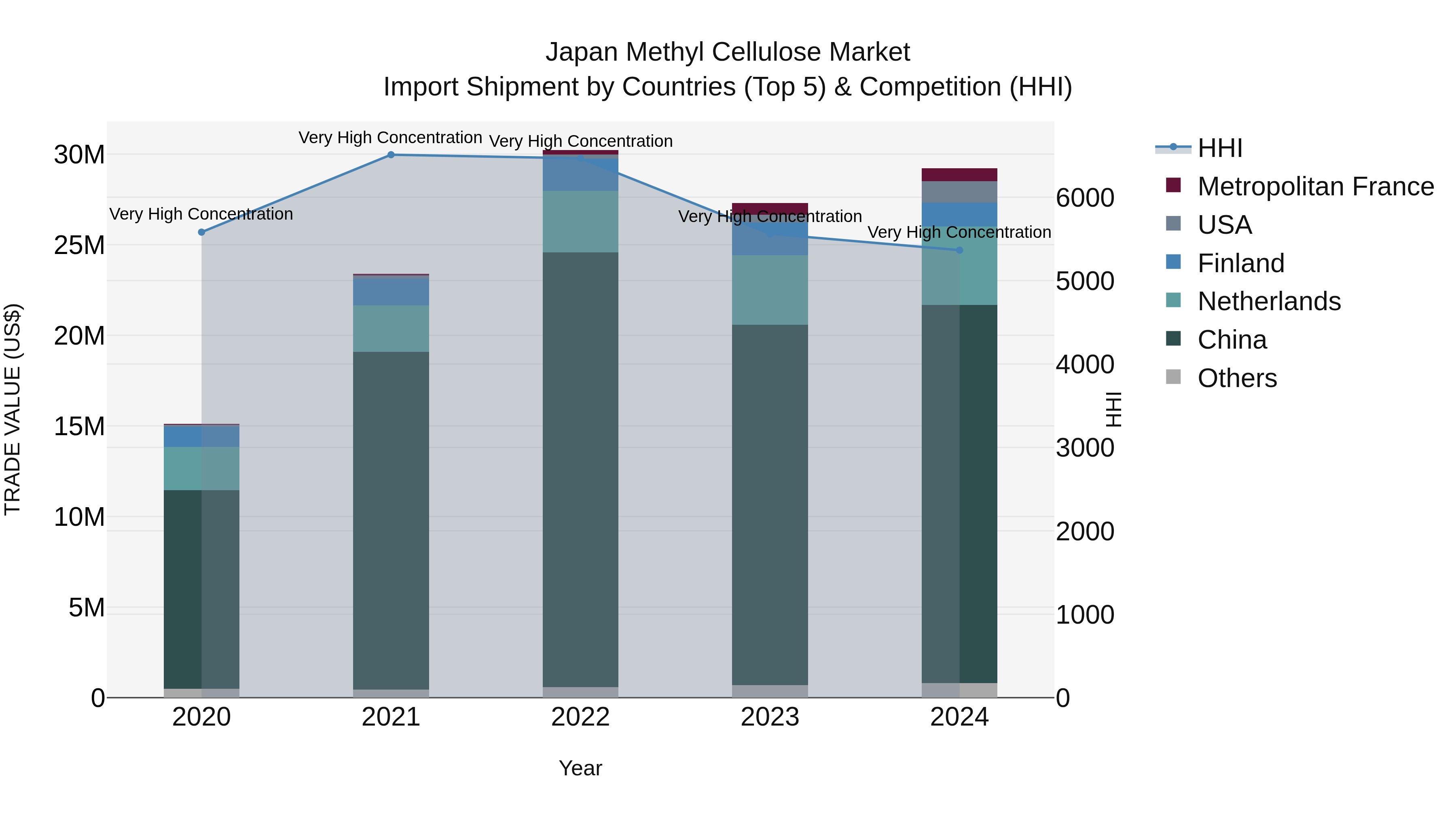
Japan Methyl Cellulose Market Import Shipment by Countries (Top 5) & Competition (HHI)
Japan's methyl cellulose import market saw significant growth in 2024, with top exporting countries being China, Netherlands, Finland, USA, and Metropolitan France. The market continues to exhibit high concentration levels, as indicated by the Herfindahl-Hirschman Index (HHI). The compound annual growth rate (CAGR) from 2020 to 2024 was an impressive 17.93%, showcasing a strong upward trend. Additionally, the growth rate from 2023 to 2024 was recorded at 7.08%, reflecting a sustained momentum in the market. This data suggests a promising outlook for the methyl cellulose import industry in Japan.
Japan Methyl Cellulose Market Overview
The Japan methyl cellulose market is experiencing steady growth due to the extensive use of methyl cellulose in various industries such as food and beverages, pharmaceuticals, construction, and personal care. Methyl cellulose is widely utilized as a thickening and stabilizing agent in food products, as well as in pharmaceutical formulations for its binding and controlled-release properties. In the construction industry, methyl cellulose is used in dry mix mortars and cement-based products to improve workability and water retention. Additionally, the increasing demand for natural and plant-based ingredients in personal care products has further boosted the market for methyl cellulose in Japan. The market is expected to continue its growth trajectory driven by the expanding applications and favorable regulatory environment supporting sustainable and high-quality products.
Japan Methyl Cellulose Market Trends
The Japan methyl cellulose market is experiencing steady growth due to the increasing demand for this versatile compound in various industries such as food and beverages, pharmaceuticals, and construction. The food industry is a key driver of growth, with methyl cellulose being used as a thickening agent, stabilizer, and emulsifier in various products. In the pharmaceutical sector, methyl cellulose is used in drug formulations and as a binder in tablets. Additionally, the construction industry is utilizing methyl cellulose in applications such as mortar and cement to improve workability and water retention properties. Sustainability and environmentally friendly production processes are also emerging trends in the Japan methyl cellulose market, as consumers and businesses alike are placing a greater emphasis on eco-friendly products and practices.
Japan Methyl Cellulose Market Challenges
In the Japan methyl cellulose market, some challenges include increasing competition from alternative products such as guar gum and xanthan gum, fluctuating raw material prices impacting production costs, and regulatory hurdles related to labeling and safety standards. Additionally, the market is influenced by changing consumer preferences towards natural and organic ingredients, which may require manufacturers to reformulate their products. Adapting to these market dynamics while maintaining product quality and price competitiveness poses a significant challenge for players in the Japan methyl cellulose market. Overall, companies operating in this sector need to stay abreast of market trends, invest in research and development, and establish strong relationships with suppliers and regulatory authorities to navigate these challenges effectively.
Japan Methyl Cellulose Market Investment Opportunities
The Japan methyl cellulose market presents several investment opportunities due to the increasing demand for this versatile compound in various industries such as construction, pharmaceuticals, food, and cosmetics. With its properties such as thickening, stabilizing, and water retention capabilities, methyl cellulose is widely used in applications like cement additives, drug formulations, food coatings, and personal care products. Investors can explore opportunities in companies involved in the production, distribution, and research of methyl cellulose, as well as in companies that utilize this compound in their manufacturing processes. Additionally, investing in research and development for innovative applications of methyl cellulose in emerging industries could provide long-term growth potential in the Japanese market.
Japan Methyl Cellulose Market Government Policy
In Japan, the methyl cellulose market is regulated by the Pharmaceutical Affairs Law and Food Sanitation Law, under the jurisdiction of the Ministry of Health, Labour and Welfare. Methyl cellulose is commonly used in food and pharmaceutical industries as a thickener, stabilizer, and emulsifier. The government enforces strict regulations on the quality, safety, and labeling of methyl cellulose products to ensure consumer protection and food safety. Additionally, Japan has established maximum residue limits for methyl cellulose in food products, in line with international standards. The government also promotes research and development in the field of methyl cellulose to explore new applications and enhance its market potential. Overall, government policies in Japan aim to maintain high standards of product quality, safety, and innovation in the methyl cellulose market.
Japan Methyl Cellulose Market Future Outlook
The future outlook for the Japan methyl cellulose market appears promising, fueled by the increasing demand for the product across various industries such as construction, pharmaceuticals, and food. The construction sector, in particular, is expected to drive significant growth as methyl cellulose is widely used in cement and mortar applications for its water retention and thickening properties. Additionally, the food industry`s growing preference for natural and plant-based ingredients is likely to further boost the demand for methyl cellulose as a food additive. With ongoing research and development efforts to enhance the product`s properties and applications, coupled with the country`s strong manufacturing capabilities, the Japan methyl cellulose market is poised for steady growth in the coming years.
Key Highlights of the Report:
- Japan Methyl Cellulose Market Outlook
- Market Size of Japan Methyl Cellulose Market,2024
- Forecast of Japan Methyl Cellulose Market, 2031
- Historical Data and Forecast of Japan Methyl Cellulose Revenues & Volume for the Period 2021-2031
- Japan Methyl Cellulose Market Trend Evolution
- Japan Methyl Cellulose Market Drivers and Challenges
- Japan Methyl Cellulose Price Trends
- Japan Methyl Cellulose Porter's Five Forces
- Japan Methyl Cellulose Industry Life Cycle
- Historical Data and Forecast of Japan Methyl Cellulose Market Revenues & Volume By Type for the Period 2021-2031
- Historical Data and Forecast of Japan Methyl Cellulose Market Revenues & Volume By Powder for the Period 2021-2031
- Historical Data and Forecast of Japan Methyl Cellulose Market Revenues & Volume By Granules for the Period 2021-2031
- Historical Data and Forecast of Japan Methyl Cellulose Market Revenues & Volume By Liquid for the Period 2021-2031
- Historical Data and Forecast of Japan Methyl Cellulose Market Revenues & Volume By Application for the Period 2021-2031
- Historical Data and Forecast of Japan Methyl Cellulose Market Revenues & Volume By Pharmaceuticals for the Period 2021-2031
- Historical Data and Forecast of Japan Methyl Cellulose Market Revenues & Volume By Food Additives for the Period 2021-2031
- Historical Data and Forecast of Japan Methyl Cellulose Market Revenues & Volume By Coatings for the Period 2021-2031
- Historical Data and Forecast of Japan Methyl Cellulose Market Revenues & Volume By End Use for the Period 2021-2031
- Historical Data and Forecast of Japan Methyl Cellulose Market Revenues & Volume By Construction for the Period 2021-2031
- Historical Data and Forecast of Japan Methyl Cellulose Market Revenues & Volume By Personal Care for the Period 2021-2031
- Historical Data and Forecast of Japan Methyl Cellulose Market Revenues & Volume By Paper & Textiles for the Period 2021-2031
- Historical Data and Forecast of Japan Methyl Cellulose Market Revenues & Volume By Purity Level for the Period 2021-2031
- Historical Data and Forecast of Japan Methyl Cellulose Market Revenues & Volume By High Purity for the Period 2021-2031
- Historical Data and Forecast of Japan Methyl Cellulose Market Revenues & Volume By Industrial Grade for the Period 2021-2031
- Historical Data and Forecast of Japan Methyl Cellulose Market Revenues & Volume By Low Purity for the Period 2021-2031
- Historical Data and Forecast of Japan Methyl Cellulose Market Revenues & Volume By Manufacturing Process for the Period 2021-2031
- Historical Data and Forecast of Japan Methyl Cellulose Market Revenues & Volume By Etherification for the Period 2021-2031
- Historical Data and Forecast of Japan Methyl Cellulose Market Revenues & Volume By Hydroxypropylation for the Period 2021-2031
- Historical Data and Forecast of Japan Methyl Cellulose Market Revenues & Volume By Others for the Period 2021-2031
- Japan Methyl Cellulose Import Export Trade Statistics
- Market Opportunity Assessment By Type
- Market Opportunity Assessment By Application
- Market Opportunity Assessment By End Use
- Market Opportunity Assessment By Purity Level
- Market Opportunity Assessment By Manufacturing Process
- Japan Methyl Cellulose Top Companies Market Share
- Japan Methyl Cellulose Competitive Benchmarking By Technical and Operational Parameters
- Japan Methyl Cellulose Company Profiles
- Japan Methyl Cellulose Key Strategic Recommendations






































