Japan Microscopes Market Size, Share & Growth Rate
The Japan Microscopes Market was estimated at USD 217 Million in 2025 and is projected to reach USD 233 Million by 2032, growing at a CAGR of 1.0% from 2026 to 2032. This growth trajectory is underpinned by the increasing investments in life sciences research and the rising demand for high-precision imaging solutions across various sectors, particularly healthcare and material sciences. Additionally, the ongoing shift towards automation and digital integration in microscopy is further enhancing the market's potential.
Japan Microscopes Market Year-wise Growth Rate and Key Drivers
This graph highlights how the Japan Microscopes Market has steadily grown over the years, supported by major growth factors.
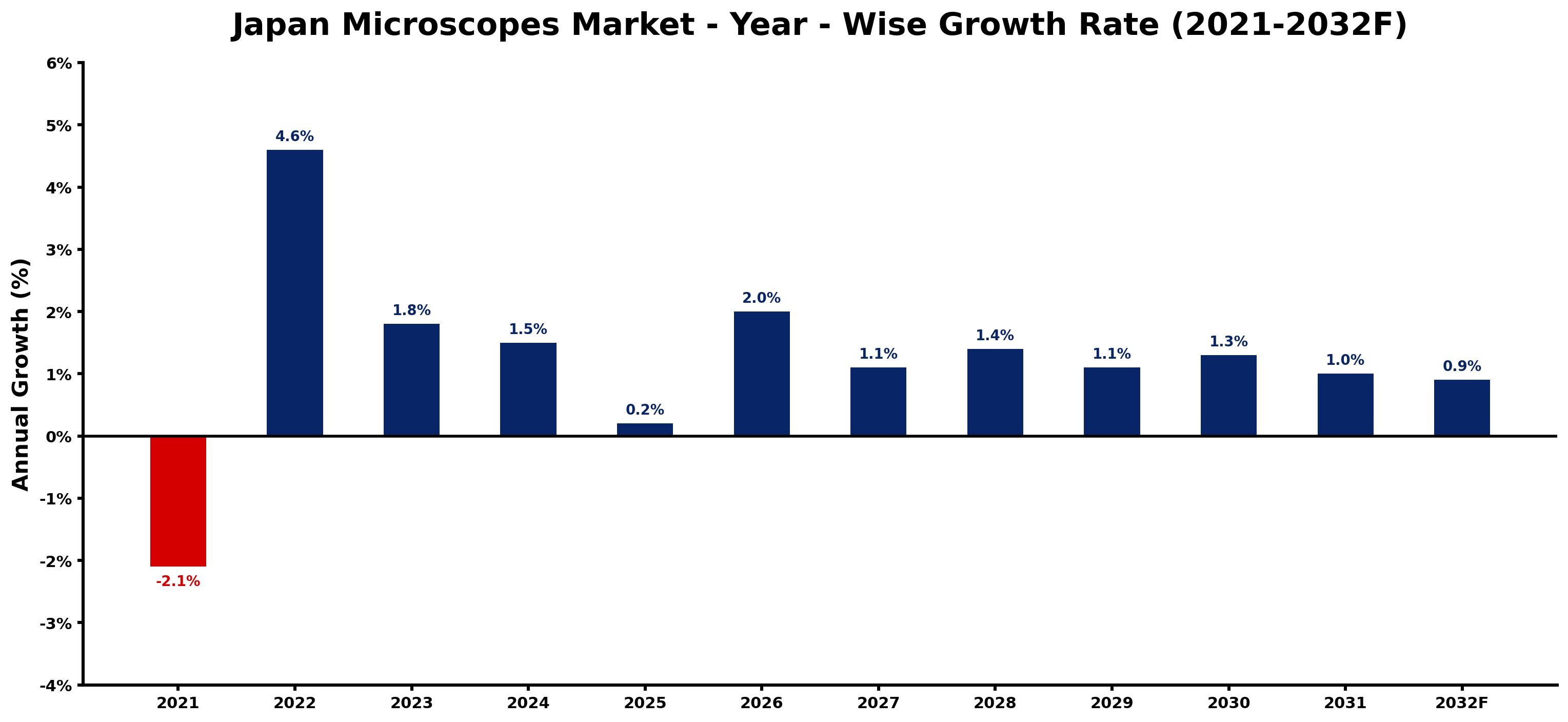
The table below presents the year‑wise growth rates along with the key drivers influencing the market
| Year | Growth Rate | Major Drivers |
| 2021 | -2.1% | Government infrastructure modernization initiatives |
| 2022 | 4.6% | Growing urbanization and commercial development |
| 2023 | 1.8% | Increasing industrial infrastructure investments |
| 2024 | 1.5% | Expansion of transportation and logistics networks |
| 2025 | 0.2% | Growing urbanization and commercial development |
| 2026 | 2.0% | Increasing industrial infrastructure investments |
| 2027 | 1.1% | Growing renewable energy integration projects |
| 2028 | 1.4% | Growing renewable energy integration projects |
| 2029 | 1.1% | Increasing industrial infrastructure investments |
| 2030 | 1.3% | Increasing industrial automation investments |
| 2031 | 1.0% | Increasing industrial infrastructure investments |
| 2032 | 0.9% | Expansion of commercial construction activities |
Note - Market size estimations and growth projections presented in this report are based on 6Wresearch’s advanced forecasting approach, validated with industry datasets as of June 2026.
Japan Microscopes Market Synopsis
The Japanese market for microscopes is witnessing an uptick in demand for high-resolution imaging techniques. With the rapid advancement of nanotechnology applications and increasing emphasis on quality in both research and industrial settings, the need for state-of-the-art microscopes is more critical than ever.
Furthermore, there is a growing interest in portable microscopy solutions, allowing field researchers and healthcare professionals to perform on-the-go analyses. This trend reflects a broader movement toward flexibility and efficiency in microscopy applications.
Japan Microscopes Market Key Takeaways
- The market is driven by advancements in high-resolution imaging and digital microscopy technologies.
- Investments in life sciences and healthcare are significantly influencing market growth.
- Emerging trends include increased demand for portable microscopy solutions.
- Government initiatives support innovation and compliance in the microscopy sector.
- Challenges remain from competition and the need for continual technological adaptation.
Evaluation of Restraints in Japan Microscopes Market
Despite a favorable growth outlook, the Japan Microscopes Market faces several restraints. Intense competition from both domestic and international manufacturers has created price pressures, compelling companies to enhance their value propositions continually. Moreover, rapid technological advancements often lead to shorter product life cycles, complicating inventory management and strategic planning for manufacturers. There is also the ongoing challenge of adhering to stringent regulatory standards while maintaining high-quality output, further complicating operations for companies in this space.
Japan Microscopes Market Trends
Currently, the market is observing a pronounced shift toward advanced imaging technologies, notably in the adoption of digital and scanning electron microscopes. The integration of artificial intelligence into microscopy tools is also gaining traction, allowing for enhanced data analysis and improved productivity. Additionally, there is a notable interest in high-resolution techniques like super-resolution microscopy and atomic force microscopy, crucial for sectors demanding precise imaging solutions.
Japan Microscopes Market Opportunities
Opportunities abound in the Japan Microscopes Market, particularly in high-resolution imaging systems and portable microscopy solutions. The surge in research activities and a burgeoning industrial manufacturing sector present a fertile ground for growth. Additionally, as sectors like electronics and semiconductors increasingly require cutting-edge microscopy equipment for precise operations, investments in these technologies are likely to yield substantial returns.
Government Initiatives in the Japan Microscopes Market
Japan's government implements various policies to ensure high standards of safety and quality in the microscopy market. Key regulations include the Pharmaceutical Affairs Law and the Medical Device Law, which enforce strict quality control measures and require necessary certifications for microscopes used in healthcare and research. Furthermore, initiatives promoting research and development in microscopy are supported through funding opportunities and collaborative programs aimed at fostering innovation.
Future Insights of the Japan Microscopes Market
Looking ahead to 2026-2032, the Japan Microscopes Market is poised for steady expansion, driven by continued technological advancements and a growing demand for high-quality solutions across various industries. The emphasis on precision imaging and ongoing research and development activities will further propel market growth. Companies are likely to focus on innovation and strategic partnerships to enhance their competitive edge, ultimately positioning the market for a robust future.
Japan Microscopes Market Latest Developments (May 2025 - June 2026)
Recently, the microscopy sector has seen a marked increase in collaborations between research institutions and manufacturers to develop next-generation imaging technologies. Additionally, there has been an uptick in investments focused on enhancing the portability of microscopy solutions, catering to the increasing demand for on-site analysis in various sectors. Manufacturers are also increasingly adopting AI and machine learning capabilities in their devices to streamline data analysis and improve overall efficiency.
Japan Microscopes Market - Key Attractiveness of the Report
- 10 Years of Market Numbers
- Historical Data Starting from 2022 to 2025
- Base Year: 2025
- Forecast Data until 2032
- Key Performance Indicators Impacting the Market
- Major Upcoming Developments and Projects
Key Highlights of the Report:
- Japan Microscopes Market Outlook
- Market Size of Japan Microscopes Market, 2025
- Forecast of Japan Microscopes Market, 2032
- Historical Data and Forecast of Japan Microscopes Revenues & Volume for the Period 2022-2032F
- Japan Microscopes Market Trend Evolution
- Japan Microscopes Market Drivers and Challenges
- Japan Microscopes Price Trends
- Japan Microscopes Porter's Five Forces
- Japan Microscopes Industry Life Cycle
- Historical Data and Forecast of Japan Microscopes Market Revenues & Volume By Product Type for the Period 2022-2032F
- Historical Data and Forecast of Japan Microscopes Market Revenues & Volume By Optical for the Period 2022-2032F
- Historical Data and Forecast of Japan Microscopes Market Revenues & Volume By Electron for the Period 2022-2032F
- Historical Data and Forecast of Japan Microscopes Market Revenues & Volume By Scanning Probe for the Period 2022-2032F
- Historical Data and Forecast of Japan Microscopes Market Revenues & Volume By Others for the Period 2022-2032F
- Historical Data and Forecast of Japan Microscopes Market Revenues & Volume By Applications for the Period 2022-2032F
- Historical Data and Forecast of Japan Microscopes Market Revenues & Volume By Material Science for the Period 2022-2032F
- Historical Data and Forecast of Japan Microscopes Market Revenues & Volume By Nanotechnology for the Period 2022-2032F
- Historical Data and Forecast of Japan Microscopes Market Revenues & Volume By Life Science for the Period 2022-2032F
- Historical Data and Forecast of Japan Microscopes Market Revenues & Volume By Semiconductors for the Period 2022-2032F
- Historical Data and Forecast of Japan Microscopes Market Revenues & Volume By Others for the Period 2022-2032F
- Japan Microscopes Import Export Trade Statistics
- Market Opportunity Assessment By Product Type
- Market Opportunity Assessment By Applications
- Japan Microscopes Top Companies Market Share
- Japan Microscopes Competitive Benchmarking By Technical and Operational Parameters
- Japan Microscopes Company Profiles
- Japan Microscopes Key Strategic Recommendations






































