Japan Microscopy Market Size, Share & Growth Rate
The Japan Microscopy Market was estimated at USD 185 Million in 2025 and is projected to reach USD 198 Million by 2032, growing at a CAGR of 1.0% from 2026 to 2032. This steady growth trajectory is propelled by the increasing investments in R&D within the life sciences and material sciences sectors, as well as a burgeoning demand for advanced imaging technologies across various applications such as healthcare and electronics.
Japan Microscopy Market Year-wise Growth Rate and Key Drivers
This graph highlights how the Japan Microscopy Market has steadily grown over the years, supported by major growth factors.
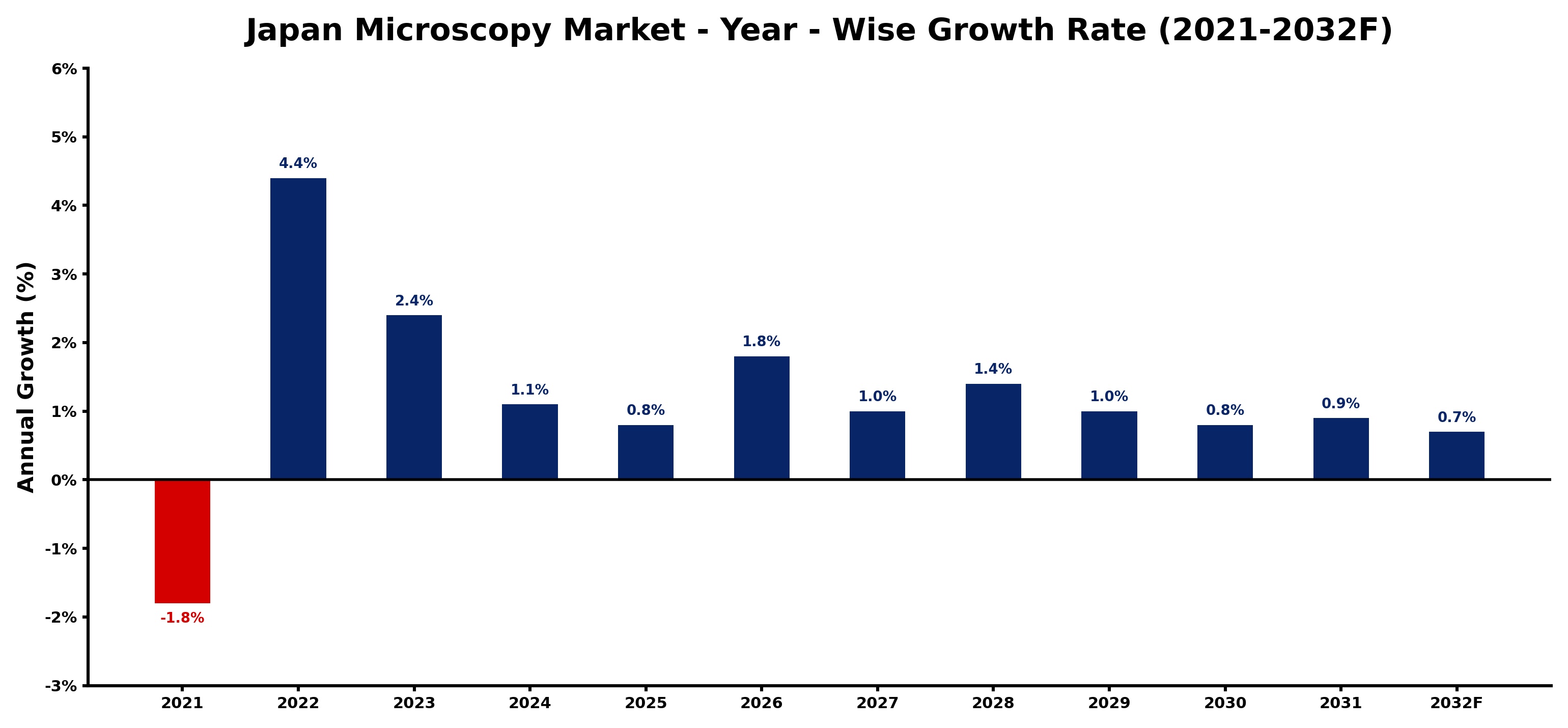
The table below presents the year‑wise growth rates along with the key drivers influencing the market
| Year | Growth Rate | Major Drivers |
| 2021 | -1.8% | Supply chain disruptions hindered essential microscopy equipment manufacturing |
| 2022 | 4.4% | Technology integration in microscopy accelerates quality control in manufacturing |
| 2023 | 2.4% | Accelerated semiconductor fabrication demands advanced microscopy technology investments |
| 2024 | 1.1% | OEM partnerships drive advanced microscopy tool production and distribution |
| 2025 | 0.8% | Microscopy manufacturing upgrades boosted semiconductor inspection capabilities significantly |
| 2026 | 1.8% | Microscopy technology upgrades enhanced semiconductor manufacturing inspection capabilities |
| 2027 | 1.0% | Domestic semiconductor manufacturing investments drive advanced microscopy equipment demand |
| 2028 | 1.4% | Microscopy equipment upgrades drive precision measurement in semiconductor manufacturing |
| 2029 | 1.0% | Export driven semiconductor advancements boost microscopy equipment demand |
| 2030 | 0.8% | University research funding boosts high resolution microscopy equipment purchases |
| 2031 | 0.9% | Local semiconductor manufacturing boosts microscopy equipment demand significantly |
| 2032 | 0.7% | Strategic investments in microscopy enhance semiconductor manufacturing capabilities |
Note - Market size estimations and growth projections presented in this report are based on 6Wresearch’s advanced forecasting approach, validated with industry datasets as of June 2026.
Japan Microscopy Market Synopsis
The foremost force driving the Japan Microscopy Market today is the surge in research activities in pharmaceuticals and nanotechnology. This landscape is ripe for innovation, as both academic institutions and industrial players collaborate to develop cutting-edge microscopy solutions that cater to specific needs.
Moreover, government support through strategic initiatives and funding is vital for advancing microscopy technologies. These efforts not only foster innovation but also enhance the expertise of professionals in the industry, creating a robust framework for sustainable growth.
Japan Microscopy Market Key Takeaways
- The market is significantly influenced by advancements in imaging technology and increased R&D spending.
- Key sectors driving demand include life sciences, material sciences, and semiconductor manufacturing.
- Collaborations between academia and industry are essential for innovation and product development.
- The market faces challenges such as high equipment costs and competition from international players.
- Regulatory standards and government initiatives play a crucial role in market sustainability.
Evaluation of Restraints in Japan Microscopy Market
While the Japan Microscopy Market presents significant growth opportunities, several restraints limit its potential. The increasing influx of foreign competitors with advanced technologies intensifies pressure on domestic manufacturers to innovate continuously. Additionally, the substantial financial burden associated with acquiring state-of-the-art microscopy equipment can deter smaller research institutions and universities from investing. There is also a notable shortage of skilled professionals proficient in advanced microscopy techniques, creating a talent gap that hinders further advancements.
Japan Microscopy Market Trends
Several transformative trends are shaping the Japan Microscopy Market. The adoption of advanced microscopy techniques, such as super-resolution and electron microscopy, is on the rise, driven by the need for high-resolution imaging across multiple fields. There is also an increasing demand for portable and user-friendly microscopes aimed at on-site and point-of-care applications, facilitating access to advanced imaging solutions. Furthermore, the integration of AI and machine learning technologies into microscopy systems is enhancing automation in image analysis, thus boosting research efficiency.
Japan Microscopy Market Opportunities
The Japan Microscopy Market holds vast potential for investment, particularly in high-end electron microscopes designed for nanotechnology research and advanced confocal microscopes tailored for life sciences. Companies focusing on digital microscopy solutions and software development for data analysis are also well-positioned for growth. Partnering with academic institutions for innovation or collaborating with industry players on product development further amplifies these opportunities, paving the way for cutting-edge advancements in the microscopy field.
Government Initiatives in the Japan Microscopy Market
The Japanese government has been actively involved in fostering the microscopy market through various supportive policies. By prioritizing strategic investments in R&D, it aims to enhance technological capabilities in microscopy. Funding initiatives for academic institutions and research centers promote innovation and collaboration, while training programs are designed to develop the skills of professionals in the microscopy sector. These efforts collectively aim to stimulate growth, competitiveness, and sustainability within the market.
Future Insights of the Japan Microscopy Market
Looking ahead to 2026-2032, the Japan Microscopy Market is poised for steady growth, driven by continuous technological advancements and the escalating demand for high-resolution imaging solutions. Expanding applications in healthcare, pharmaceuticals, and electronics will further enhance market prospects. The ongoing governmental initiatives supporting R&D are expected to create a favorable environment for further innovation. However, the high costs associated with advanced systems and the emergence of alternative imaging technologies may present challenges to this growth trajectory.
Japan Microscopy Market Latest Developments (May 2025 - June 2026)
Recent developments in the Japan Microscopy Market indicate a trend towards enhancing the integration of artificial intelligence in microscopy systems, aimed at improving efficiency in image analysis. Additionally, several partnerships between academic institutions and industry stakeholders are emerging, fostering collaboration that aims to drive innovation. There is also a noticeable shift towards portable microscopy solutions that cater to on-the-go applications, reflecting the growing demand for accessibility in advanced imaging technologies.
Japan Microscopy Market - Key Attractiveness of the Report
- 10 Years of Market Numbers
- Historical Data Starting from 2022 to 2025
- Base Year: 2025
- Forecast Data until 2032
- Key Performance Indicators Impacting the Market
- Major Upcoming Developments and Projects
Key Highlights of the Report:
- Japan Microscopy Market Outlook
- Market Size of Japan Microscopy Market, 2025
- Forecast of Japan Microscopy Market, 2032
- Historical Data and Forecast of Japan Microscopy Revenues & Volume for the Period 2022-2032F
- Japan Microscopy Market Trend Evolution
- Japan Microscopy Market Drivers and Challenges
- Japan Microscopy Price Trends
- Japan Microscopy Porter's Five Forces
- Japan Microscopy Industry Life Cycle
- Historical Data and Forecast of Japan Microscopy Market Revenues & Volume By Product for the Period 2022-2032F
- Historical Data and Forecast of Japan Microscopy Market Revenues & Volume By Microscopes for the Period 2022-2032F
- Historical Data and Forecast of Japan Microscopy Market Revenues & Volume By Software for the Period 2022-2032F
- Historical Data and Forecast of Japan Microscopy Market Revenues & Volume By Accessories for the Period 2022-2032F
- Historical Data and Forecast of Japan Microscopy Market Revenues & Volume By Type for the Period 2022-2032F
- Historical Data and Forecast of Japan Microscopy Market Revenues & Volume By Optical Microscopes for the Period 2022-2032F
- Historical Data and Forecast of Japan Microscopy Market Revenues & Volume By Electron Microscopes for the Period 2022-2032F
- Historical Data and Forecast of Japan Microscopy Market Revenues & Volume By Scanning Probe Microscopes for the Period 2022-2032F
- Historical Data and Forecast of Japan Microscopy Market Revenues & Volume By Other Microscopes for the Period 2022-2032F
- Historical Data and Forecast of Japan Microscopy Market Revenues & Volume By Applications for the Period 2022-2032F
- Historical Data and Forecast of Japan Microscopy Market Revenues & Volume By Semiconductors for the Period 2022-2032F
- Historical Data and Forecast of Japan Microscopy Market Revenues & Volume By Life Sciences for the Period 2022-2032F
- Historical Data and Forecast of Japan Microscopy Market Revenues & Volume By Material Sciences for the Period 2022-2032F
- Historical Data and Forecast of Japan Microscopy Market Revenues & Volume By Nanotechnology for the Period 2022-2032F
- Historical Data and Forecast of Japan Microscopy Market Revenues & Volume By Other Applications for the Period 2022-2032F
- Historical Data and Forecast of Japan Microscopy Market Revenues & Volume By End-users for the Period 2022-2032F
- Historical Data and Forecast of Japan Microscopy Market Revenues & Volume By Industries for the Period 2022-2032F
- Historical Data and Forecast of Japan Microscopy Market Revenues & Volume By Research Institutes for the Period 2022-2032F
- Historical Data and Forecast of Japan Microscopy Market Revenues & Volume By Other end-users for the Period 2022-2032F
- Japan Microscopy Import Export Trade Statistics
- Market Opportunity Assessment By Product
- Market Opportunity Assessment By Type
- Market Opportunity Assessment By Applications
- Market Opportunity Assessment By End-users
- Japan Microscopy Top Companies Market Share
- Japan Microscopy Competitive Benchmarking By Technical and Operational Parameters
- Japan Microscopy Company Profiles
- Japan Microscopy Key Strategic Recommendations






































