Japan Middleware Market Size & Growth Rate (2026-2032)
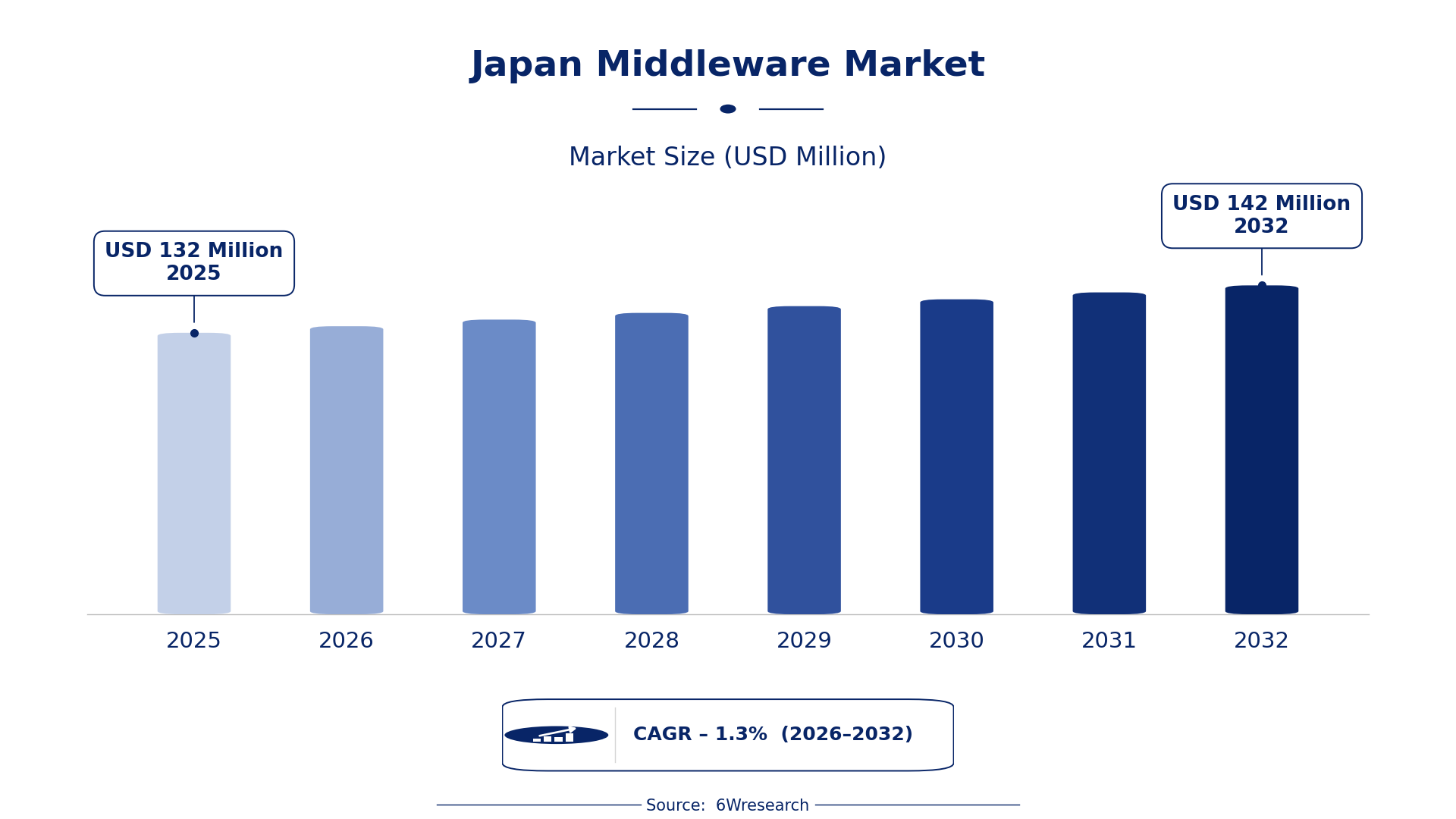
The Japan Middleware Market was estimated at USD 132 Million in 2025 and is projected to reach USD 142 Million by 2032, growing at a CAGR of 1.3% from 2026 to 2032.
Japan Middleware Market Synopsis
The accelerating shift towards cloud computing is the dominant force shaping the Japan Middleware Market. As businesses increasingly embrace digital transformation, the demand for middleware solutions that facilitate seamless integration and data exchange continues to grow.
This demand is further propelled by the rising adoption of IoT and AI technologies, which require advanced middleware solutions to manage complex data flows. Companies in Japan are seeking to streamline operations and enhance efficiency, creating a fertile ground for innovative middleware offerings.
Japan Middleware Market Year-wise Growth Rate and Key Drivers
This graph illustrates the annual growth rates of the Japan Middleware Market from 2021 to 2032, highlighting a steady upward trajectory and projected expansion over the forecast period.
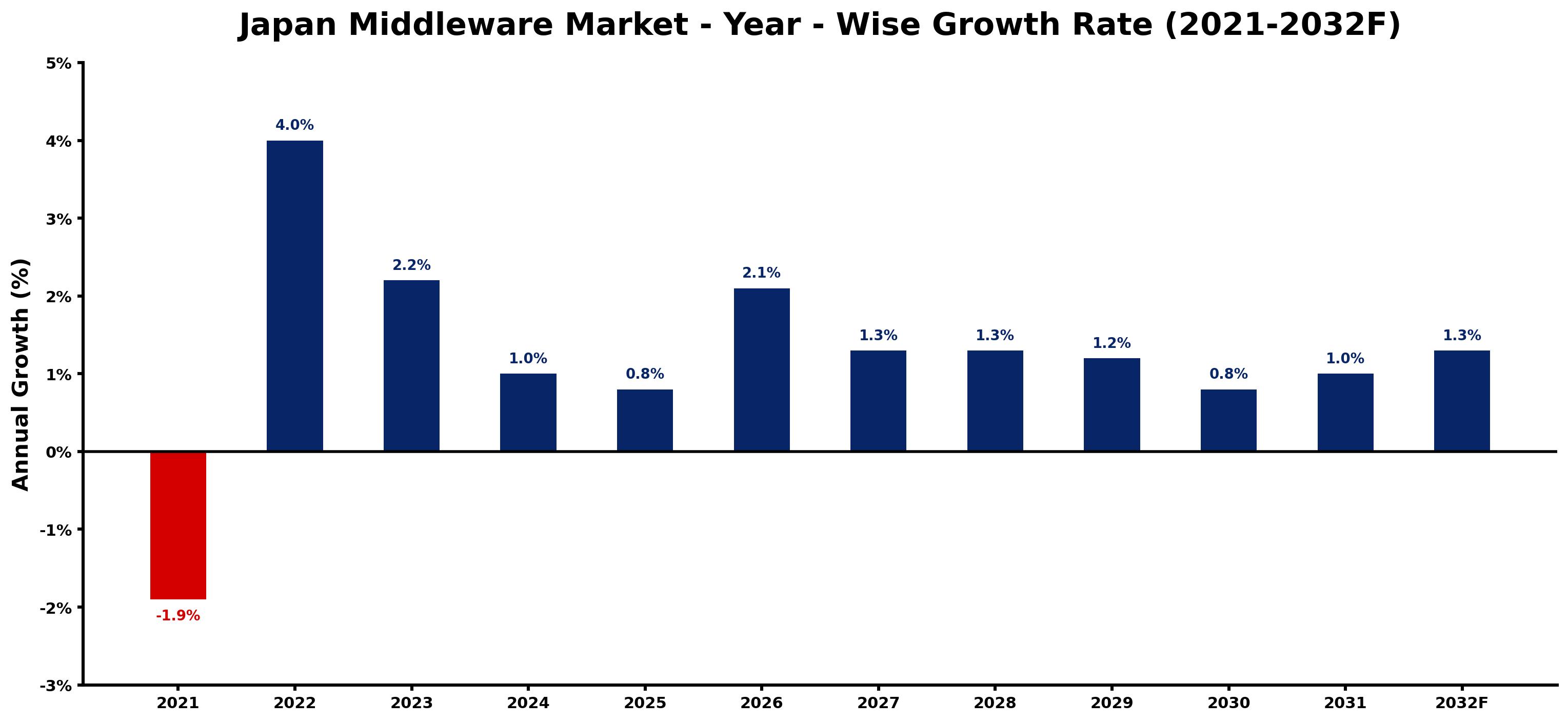
The table below presents the year‑wise growth rates along with the key drivers influencing the market
| Year | Growth Rate | Major Drivers |
| 2021 | -1.9% | Japan's stringent privacy regulations limit middleware adoption. |
| 2022 | 4.0% | Japan's digital government initiatives boost integration solutions. |
| 2023 | 2.2% | Growing AI adoption drives middleware system enhancements. |
| 2024 | 1.0% | Increased remote work demands optimized cloud connectivity solutions. |
| 2025 | 0.8% | Rising cybersecurity regulations increase middleware security needs. |
| 2026 | 2.1% | Economic recovery boosts investments in IT infrastructure solutions. |
| 2027 | 1.3% | Local startups leveraging middleware for innovation growth. |
| 2028 | 1.3% | Widespread IoT adoption catalyzes data integration requirements. |
| 2029 | 1.2% | Aging population necessitates healthcare middleware technology advancements. |
| 2030 | 0.8% | Increased focus on cross-industry collaboration stimulates integration. |
| 2031 | 1.0% | Boost in e-commerce activities drives demand for middleware. |
| 2032 | 1.3% | Education sector revamping digital platforms sparks middleware growth. |
Note: Market size estimations and growth projections presented in this report are based on 6Wresearch's proprietary forecasting methodology, utilizing the latest available industry data, government publications, and primary research inputs.
Japan Middleware Market Key Takeaways
Below are some of the specific key takeaways from the market, including:
- Cloud computing adoption is a primary driver of middleware demand in Japan.
- Businesses are increasingly focusing on real-time data processing capabilities.
- The market is witnessing a trend toward hybrid cloud environments.
- Cybersecurity measures are becoming a critical consideration for middleware solutions.
- AI-driven middleware is gaining traction as organizations aim for improved automation.
Evaluation of Restraints in Japan Middleware Market
Despite the positive outlook, the Japan Middleware Market faces several restraints that could hinder growth. Intense competition among both domestic and international vendors makes it challenging for new entrants to gain traction. on top of that, the rapid pace of technological advancements demands continuous innovation from existing players, which can strain resources. Cybersecurity concerns related to complex middleware solutions also pose a significant challenge, as organizations must ensure data integrity and protection. Additionally, interoperability issues between different middleware platforms and the integration of legacy systems can complicate deployment. A cultural inclination towards in-house development rather than outsourcing middleware solutions further restricts market penetration for external vendors.
Japan Middleware Market Trends
Several trends are currently shaping the Japan Middleware Market. The shift towards hybrid cloud environments is gaining momentum as organizations strive to balance cost efficiency and flexibility. There's an increasing demand for middleware that supports real-time data processing, driven by the necessity for quick decision-making in competitive industries. As cybersecurity becomes more critical, companies are prioritizing middleware solutions that enhance security measures. Additionally, the growing integration of AI technologies into middleware is transforming how businesses operate, facilitating improved automation and insights.
Japan Middleware Market Opportunities
Opportunities abound in the Japan Middleware Market for vendors willing to innovate. The rising demand for advanced middleware solutions that offer seamless integration, scalability, and flexibility presents a lucrative avenue for growth. Companies can capitalize on the growing trend of AI-driven middleware, which enhances decision-making capabilities and automates processes. Collaborations with local businesses and investing in R&D can lead to the development of tailored solutions that meet the unique needs of Japanese enterprises, setting the stage for long-term success.
Government Initiatives in the Japan Middleware Market
Government policies are playing a vital role in shaping the middleware market in Japan. With initiatives aimed at promoting IoT and AI integration across various sectors, the government is creating a supportive framework for technological advancement. The emphasis on public-private collaborations further facilitates innovation, ensuring that the middleware market is aligned with national digital transformation goals.
- A recently completed initiative under the "Connected Industries" strategy focuses on funding R&D for middleware solutions.
- A current program aims to facilitate partnerships between technology vendors and local businesses to boost middleware adoption.
- A planned public-private initiative is expected to expand access to IoT infrastructure by 2028, enhancing middleware deployment capabilities.
- The government is working on a regulatory framework introduced in 2025 to support interoperability among middleware platforms.
- Another ongoing effort is the development of a national digital infrastructure upgrade program to enhance data connectivity.
Future Insights of the Japan Middleware Market
Looking ahead to 2026-2032, the Japan Middleware Market is expected to experience steady growth fueled by continued advancements in cloud computing, big data analytics, and IoT technologies. As organizations increasingly look for solutions to manage complex integrations, the demand for middleware that offers security, scalability, and flexibility will rise. With government initiatives supporting digital transformation, vendors are likely to focus on developing innovative products tailored to the evolving needs of Japanese businesses, thereby driving market expansion.
Japan Middleware Market Latest Developments
Recent activity in the Japan Middleware Market indicates a strong push towards innovation and collaboration. Over the last year, various initiatives and advancements have emerged, reflecting the market's dynamic nature. Companies are focusing on enhancing their offerings to meet the demands of an increasingly digital economy.
- A major technology vendor launched a new middleware solution focused on real-time analytics in early 2025, significantly enhancing operational efficiency for clients.
- An ongoing partnership between regional operators is currently underway to develop advanced integration tools designed to support hybrid cloud environments.
- A planned rollout expected to begin in late 2026 will introduce a series of middleware updates aimed at enhancing cybersecurity features.
- A regional operator is currently expanding its middleware service capabilities to support IoT applications, with initiatives that began in Q1 2025.
- A collaborative project initiated in mid-2025 is focused on developing AI-driven middleware solutions tailored for the retail sector.
Japan Middleware Market - Key Attractiveness of the Report
- 10 Years of Market Numbers
- Historical Data Starting from 2022 to 2025
- Base Year: 2025
- Forecast Data until 2032
- Key Performance Indicators Impacting the Market
- Major Upcoming Developments and Projects
Government policies, particularly the "Connected Industries" strategy and the "Society 5.0" initiative, are crucial in promoting middleware adoption. They support R&D funding and encourage collaboration between private and public sectors, which drives technological innovation.
Key Highlights of the Report:
- Japan Middleware Market Outlook
- Market Size of Japan Middleware Market, 2025
- Forecast of Japan Middleware Market, 2032
- Historical Data and Forecast of Japan Middleware Revenues & Volume for the Period 2022-2032F
- Japan Middleware Market Trend Evolution
- Japan Middleware Market Drivers and Challenges
- Japan Middleware Price Trends
- Japan Middleware Porter's Five Forces
- Japan Middleware Industry Life Cycle
- Historical Data and Forecast of Japan Middleware Market Revenues & Volume By Product Type for the Period 2022-2032F
- Historical Data and Forecast of Japan Middleware Market Revenues & Volume By Communication Middleware for the Period 2022-2032F
- Historical Data and Forecast of Japan Middleware Market Revenues & Volume By Platform Middleware for the Period 2022-2032F
- Historical Data and Forecast of Japan Middleware Market Revenues & Volume By Integration Middleware for the Period 2022-2032F
- Historical Data and Forecast of Japan Middleware Market Revenues & Volume By Others for the Period 2022-2032F
- Historical Data and Forecast of Japan Middleware Market Revenues & Volume By Deployment Types for the Period 2022-2032F
- Historical Data and Forecast of Japan Middleware Market Revenues & Volume By On-Premise for the Period 2022-2032F
- Historical Data and Forecast of Japan Middleware Market Revenues & Volume By Hosted for the Period 2022-2032F
- Historical Data and Forecast of Japan Middleware Market Revenues & Volume By Hybrid for the Period 2022-2032F
- Historical Data and Forecast of Japan Middleware Market Revenues & Volume By Organization Size for the Period 2022-2032F
- Historical Data and Forecast of Japan Middleware Market Revenues & Volume By Small businesses for the Period 2022-2032F
- Historical Data and Forecast of Japan Middleware Market Revenues & Volume By Medium businesses for the Period 2022-2032F
- Historical Data and Forecast of Japan Middleware Market Revenues & Volume By Enterprises for the Period 2022-2032F
- Historical Data and Forecast of Japan Middleware Market Revenues & Volume By Large enterprises for the Period 2022-2032F
- Historical Data and Forecast of Japan Middleware Market Revenues & Volume By Verticals for the Period 2022-2032F
- Historical Data and Forecast of Japan Middleware Market Revenues & Volume By Banking, financial services and insurance (BFSI) for the Period 2022-2032F
- Historical Data and Forecast of Japan Middleware Market Revenues & Volume By Consumer Goods and Retail for the Period 2022-2032F
- Historical Data and Forecast of Japan Middleware Market Revenues & Volume By IT and telecom for the Period 2022-2032F
- Historical Data and Forecast of Japan Middleware Market Revenues & Volume By Manufacturing for the Period 2022-2032F
- Historical Data and Forecast of Japan Middleware Market Revenues & Volume By Oil and Gas for the Period 2022-2032F
- Historical Data and Forecast of Japan Middleware Market Revenues & Volume By Healthcare for the Period 2022-2032F
- Historical Data and Forecast of Japan Middleware Market Revenues & Volume By Government for the Period 2022-2032F
- Japan Middleware Import Export Trade Statistics
- Market Opportunity Assessment By Product Type
- Market Opportunity Assessment By Deployment Types
- Market Opportunity Assessment By Organization Size
- Market Opportunity Assessment By Verticals
- Japan Middleware Top Companies Market Share
- Japan Middleware Competitive Benchmarking By Technical and Operational Parameters
- Japan Middleware Company Profiles
- Japan Middleware Key Strategic Recommendations






































