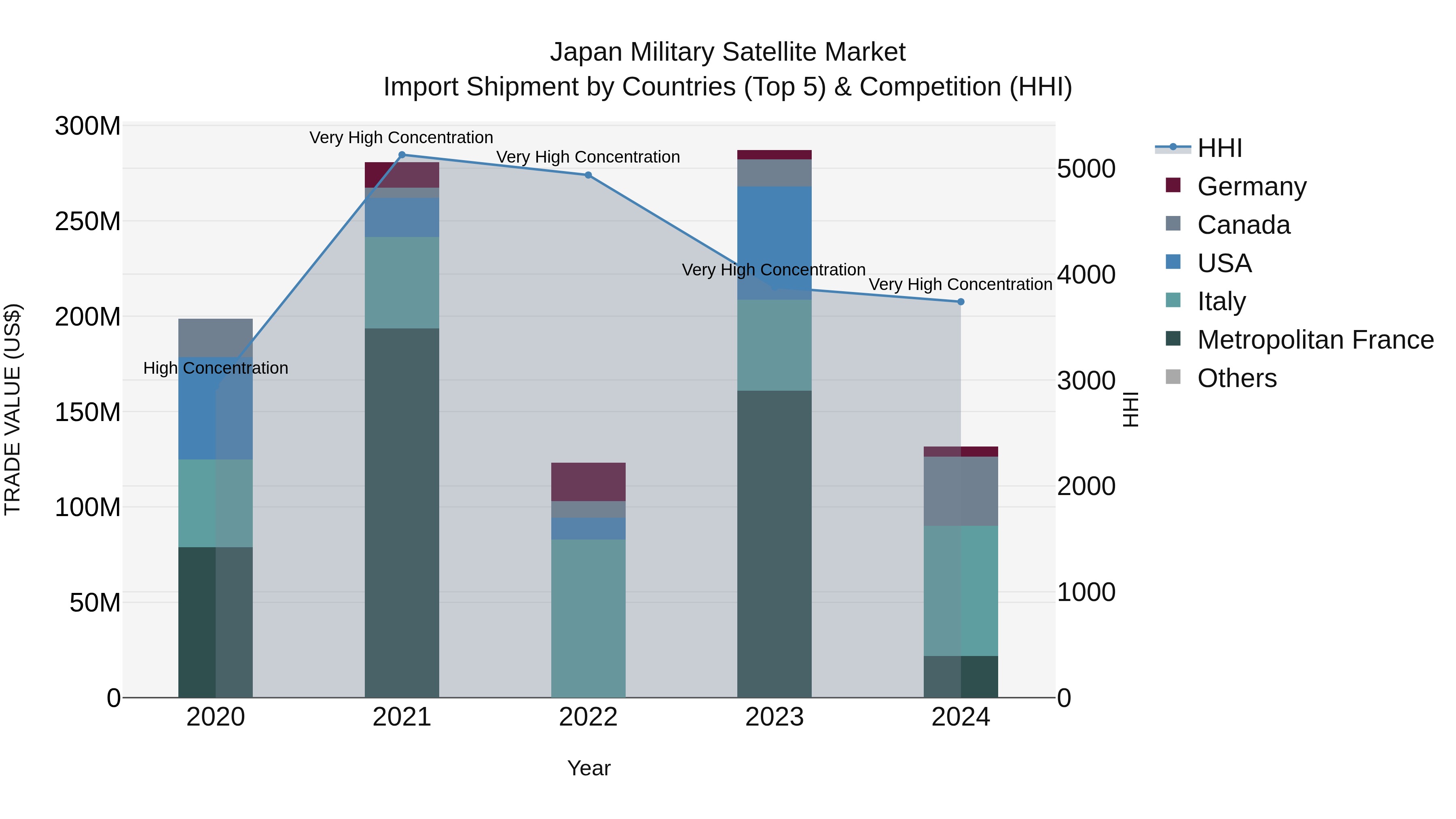
Japan Military Satellite Market Import Shipment by Countries (Top 5) & Competition (HHI)
Japan's military satellite import shipments in 2024 saw a notable concentration with top exporting countries being Italy, Canada, Metropolitan France, Germany, and the USA. Despite a negative Compound Annual Growth Rate (CAGR) of -9.77% from 2020 to 2024, the industry experienced a significant decline in growth rate from 2023 to 2024 at -54.11%. This data highlights the evolving dynamics of Japan's military satellite imports and the competitive landscape dominated by key exporting nations.
Japan Military Satellite Market Overview
The Japan Military Satellite Market is a crucial component of the country`s defense strategy, with a focus on enhancing national security and surveillance capabilities. The market is driven by the increasing need for advanced satellite technology to monitor regional threats, support communication networks, and enable real-time intelligence gathering. Japan`s investment in cutting-edge satellites for military purposes, such as reconnaissance and missile detection, is expected to drive growth in the market. Key players in the Japan Military Satellite Market include major aerospace and defense companies, as well as government agencies collaborating on satellite development projects. With a strong emphasis on technological innovation and defense modernization, the Japan Military Satellite Market is poised for continued expansion to meet the evolving security challenges in the region.
Japan Military Satellite Market Trends and Opportunities
The Japan Military Satellite Market is experiencing significant growth driven by the country`s increasing focus on enhancing its space capabilities for defense and surveillance purposes. The demand for advanced satellite technologies such as high-resolution imaging, secure communication, and real-time intelligence gathering is driving investments in satellite development and deployment. Japan`s partnerships with international space agencies and private satellite companies are creating opportunities for collaboration and technology transfer. Additionally, the growing threat of cyber attacks and space debris is driving the development of innovative solutions for satellite security and sustainability. Overall, the Japan Military Satellite Market presents opportunities for technology advancements, strategic partnerships, and market expansion in the evolving space industry landscape.
Japan Military Satellite Market Challenges
In the Japan Military Satellite Market, several challenges are prevalent. One major obstacle is the increasing competition from other countries in the region, leading to a need for continuous innovation and technological advancements to stay ahead. Additionally, strict regulations and government policies can hinder the growth and development of satellite technologies in the military sector. Limited budget allocations for defense also pose a challenge, making it crucial for companies to operate efficiently and cost-effectively. Furthermore, ensuring cybersecurity and protection against potential threats is a constant concern, requiring substantial investments in secure communication systems. Overall, navigating these challenges requires a strategic approach, strong partnerships, and a deep understanding of the market dynamics in the Japan Military Satellite industry.
Japan Military Satellite Market Drivers
The Japan Military Satellite Market is primarily driven by the increasing need for advanced communication and surveillance capabilities to ensure national security and defense preparedness. The growing geopolitical tensions in the Asia-Pacific region, particularly with North Korea and China, are prompting Japan to invest in sophisticated satellite systems for intelligence gathering, early warning systems, and secure military communications. Additionally, the Japanese government`s focus on modernizing its defense infrastructure and enhancing its capabilities through space-based technologies is driving the demand for military satellites. Moreover, the rising threats of cyber attacks and the need for secure and resilient communication networks are further fueling the growth of the military satellite market in Japan.
Japan Military Satellite Market Government Policies
In Japan, government policies related to the military satellite market are primarily focused on enhancing national security and defense capabilities. The Japanese government has been investing in the development and deployment of advanced satellite technology to bolster its surveillance, communication, and reconnaissance capabilities. Some key policies include promoting collaboration between the government, military, and private sector to drive innovation and technological advancements in the military satellite sector. Additionally, Japan has been actively participating in international partnerships and agreements to strengthen its space capabilities and ensure interoperability with allied nations. The government`s emphasis on leveraging satellite technology for defense purposes aligns with its strategic priorities of ensuring national security and contributing to regional stability in the Asia-Pacific region.
Japan Military Satellite Market Future Outlook
The Japan Military Satellite Market is expected to see steady growth in the coming years, driven by increasing investments in defense technology and national security. With a growing focus on modernizing its military capabilities and enhancing its space-based surveillance and communication systems, Japan is likely to procure more advanced military satellites. Furthermore, the rising geopolitical tensions in the region and the need for secure and reliable communication channels are expected to further boost the demand for military satellites in Japan. The market is also likely to benefit from collaborations with international partners and advancements in satellite technology, enabling Japan to strengthen its defense capabilities through enhanced satellite-based reconnaissance and communication systems. Overall, the future outlook for the Japan Military Satellite Market appears promising, with opportunities for growth and innovation on the horizon.
Key Highlights of the Report:
- Japan Military Satellite Market Outlook
- Market Size of Japan Military Satellite Market, 2024
- Forecast of Japan Military Satellite Market, 2031
- Historical Data and Forecast of Japan Military Satellite Revenues & Volume for the Period 2021- 2031
- Japan Military Satellite Market Trend Evolution
- Japan Military Satellite Market Drivers and Challenges
- Japan Military Satellite Price Trends
- Japan Military Satellite Porter's Five Forces
- Japan Military Satellite Industry Life Cycle
- Historical Data and Forecast of Japan Military Satellite Market Revenues & Volume By Satellite Mass for the Period 2021- 2031
- Historical Data and Forecast of Japan Military Satellite Market Revenues & Volume By 10-100kg for the Period 2021- 2031
- Historical Data and Forecast of Japan Military Satellite Market Revenues & Volume By 100-500kg for the Period 2021- 2031
- Historical Data and Forecast of Japan Military Satellite Market Revenues & Volume By 500-1000kg for the Period 2021- 2031
- Historical Data and Forecast of Japan Military Satellite Market Revenues & Volume By Below 10 Kg for the Period 2021- 2031
- Historical Data and Forecast of Japan Military Satellite Market Revenues & Volume By Above 1000kg for the Period 2021- 2031
- Historical Data and Forecast of Japan Military Satellite Market Revenues & Volume By Orbit Class for the Period 2021- 2031
- Historical Data and Forecast of Japan Military Satellite Market Revenues & Volume By GEO for the Period 2021- 2031
- Historical Data and Forecast of Japan Military Satellite Market Revenues & Volume By LEO for the Period 2021- 2031
- Historical Data and Forecast of Japan Military Satellite Market Revenues & Volume By MEO for the Period 2021- 2031
- Japan Military Satellite Import Export Trade Statistics
- Market Opportunity Assessment By Satellite Mass
- Market Opportunity Assessment By Orbit Class
- Japan Military Satellite Top Companies Market Share
- Japan Military Satellite Competitive Benchmarking By Technical and Operational Parameters
- Japan Military Satellite Company Profiles
- Japan Military Satellite Key Strategic Recommendations






































