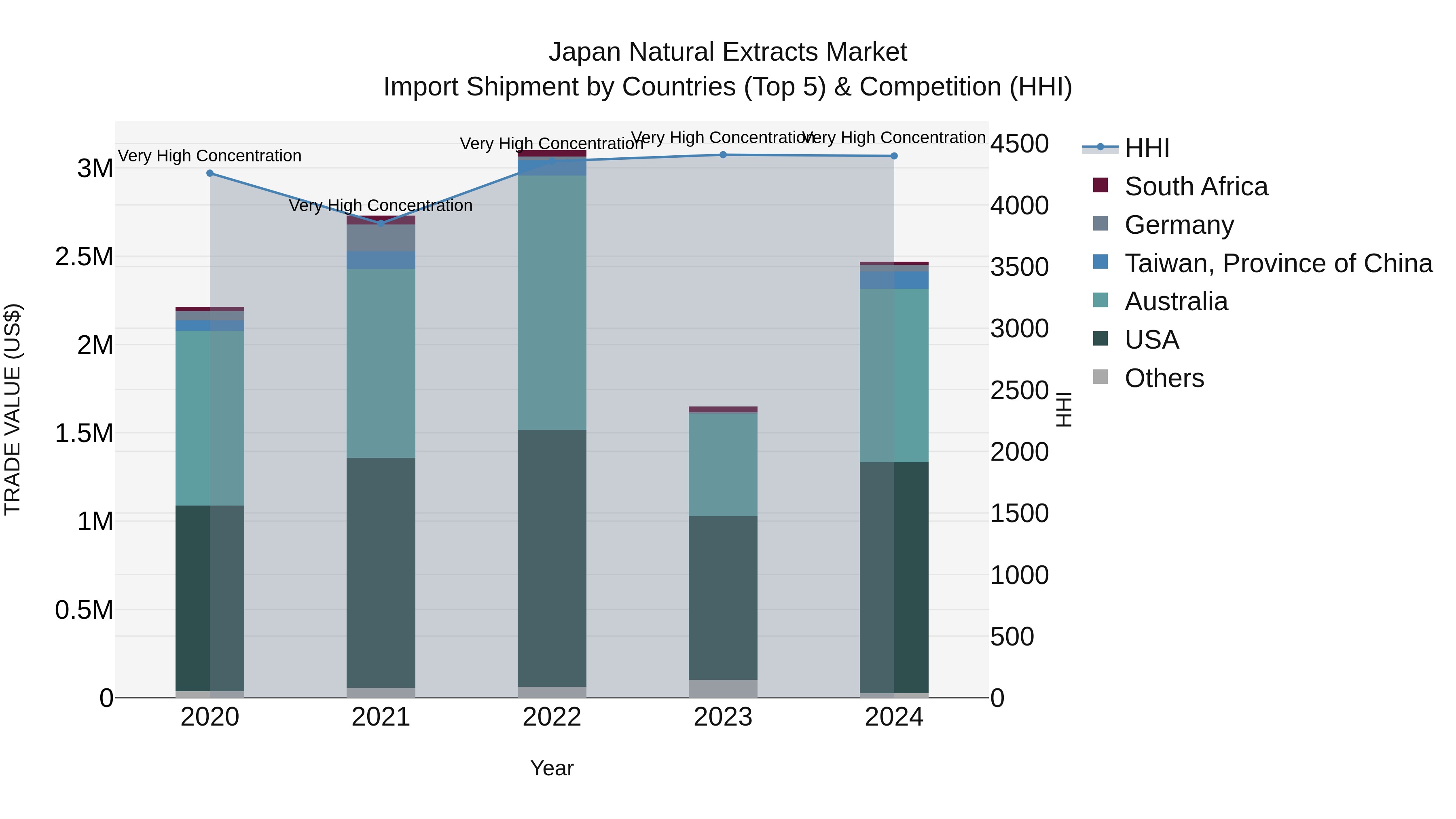
Japan Natural Extracts Market Import Shipment by Countries (Top 5) & Competition (HHI)
The Japan natural extracts import market continues to thrive, with significant contributions from top exporting countries such as the USA, Australia, Taiwan, Germany, and South Africa. The high Herfindahl-Hirschman Index (HHI) indicates a concentrated market landscape in 2024. With a steady Compound Annual Growth Rate (CAGR) of 2.78% from 2020 to 2024, the market experienced a remarkable growth spurt in 2024, with a growth rate of 49.75% from the previous year. This trend underscores the strong demand for natural extracts in Japan and the increasing global competition among exporting nations.
Japan Natural Extracts Market Synopsis
The Japan Natural Extracts Market is witnessing steady growth driven by increasing consumer preference for natural and organic products. With a growing awareness of the health benefits of natural ingredients, there is a rising demand for natural extracts in various industries such as food and beverage, cosmetics, and pharmaceuticals. Key natural extracts in high demand include green tea, ginseng, aloe vera, and seaweed, known for their medicinal and nutritional properties. Manufacturers are focusing on innovation and product development to cater to the evolving consumer preferences. The market is also influenced by regulatory initiatives promoting the use of natural ingredients and sustainable sourcing practices. Overall, the Japan Natural Extracts Market is poised for continued growth, driven by the shift towards healthier and environmentally friendly products.
Japan Natural Extracts Market Trends
The Japan Natural Extracts Market is experiencing a growing demand for plant-based and herbal ingredients in various industries such as food and beverages, cosmetics, and pharmaceuticals. Consumers are increasingly seeking products with natural and sustainable ingredients, driving the market for natural extracts sourced from plants like green tea, matcha, seaweed, and traditional Japanese herbs. There is a rising interest in functional ingredients with health benefits, leading to the popularity of superfood extracts like turmeric, ginger, and ginseng. Manufacturers are focusing on innovation and research to develop new applications for natural extracts, such as in functional foods, nutraceuticals, and personal care products. The market is also witnessing a shift towards clean labeling and transparency, with consumers prioritizing products that are free from synthetic additives and chemicals.
Japan Natural Extracts Market Challenges
In the Japan Natural Extracts Market, one of the key challenges faced is ensuring sustainable sourcing practices and maintaining quality standards. With increasing consumer demand for natural and organic products, there is pressure on suppliers to ethically source raw materials while also adhering to strict regulations on product quality and safety. This requires significant investment in supply chain management, quality control processes, and certifications to guarantee the authenticity and efficacy of natural extracts. Additionally, competition from synthetic alternatives and fluctuating market prices for raw materials pose challenges for companies operating in this market. To succeed, businesses must navigate these complexities by establishing transparent supply chains, building strong relationships with suppliers, and continuously innovating to meet evolving consumer preferences and regulatory requirements.
Japan Natural Extracts Market Investment Opportunities
The Japan Natural Extracts Market presents promising investment opportunities across various sectors, including cosmetics, food and beverage, pharmaceuticals, and personal care. With the rising consumer demand for natural and organic products, there is a growing interest in utilizing natural extracts derived from plants, herbs, and fruits in these industries. Investors can explore opportunities in supplying high-quality natural extracts to manufacturers, investing in research and development for new extraction techniques, or partnering with local producers to source unique botanical ingredients. Additionally, there is potential for expansion into the export market as Japanese natural extracts are gaining popularity globally for their perceived health benefits and superior quality. Overall, the Japan Natural Extracts Market offers a diverse range of investment prospects driven by the increasing consumer preference for natural products.
Jordan Agar Market Government Policies
Government policies related to the Japan Natural Extracts Market focus on promoting sustainable sourcing practices, quality control, and consumer safety. The Japanese government has implemented regulations to ensure the proper identification, labeling, and safety of natural extracts used in various industries, including food, cosmetics, and pharmaceuticals. Additionally, there are initiatives to support research and development in the natural extracts sector, encouraging innovation and the development of new products. Government agencies work closely with industry stakeholders to establish standards for the cultivation, extraction, and processing of natural extracts, aiming to protect the environment and preserve biodiversity. Overall, Japan`s policies aim to foster a competitive and sustainable natural extracts market while ensuring the safety and quality of products for consumers.
Japan Natural Extracts Market Future Outlook
The Japan Natural Extracts Market is poised for steady growth in the coming years, driven by increasing consumer awareness of the health benefits associated with natural ingredients. Rising demand for clean-label products, coupled with a growing preference for organic and sustainable ingredients, is expected to fuel the market expansion. Additionally, the beauty and personal care industry in Japan is increasingly incorporating natural extracts in their products, further boosting market growth. With a focus on innovation and product development, key players in the market are likely to introduce new and diverse natural extracts to cater to evolving consumer preferences. Overall, the Japan Natural Extracts Market is anticipated to experience sustained growth and offer lucrative opportunities for businesses operating in this sector.
Key Highlights of the Report:
- Japan Natural Extracts Market Outlook
- Market Size of Japan Natural Extracts Market, 2024
- Forecast of Japan Natural Extracts Market, 2031
- Historical Data and Forecast of Japan Natural Extracts Revenues & Volume for the Period 2021 - 2031
- Japan Natural Extracts Market Trend Evolution
- Japan Natural Extracts Market Drivers and Challenges
- Japan Natural Extracts Price Trends
- Japan Natural Extracts Porter's Five Forces
- Japan Natural Extracts Industry Life Cycle
- Historical Data and Forecast of Japan Natural Extracts Market Revenues & Volume By Product for the Period 2021 - 2031
- Historical Data and Forecast of Japan Natural Extracts Market Revenues & Volume By Essential Oils for the Period 2021 - 2031
- Historical Data and Forecast of Japan Natural Extracts Market Revenues & Volume By Oleoresins for the Period 2021 - 2031
- Historical Data and Forecast of Japan Natural Extracts Market Revenues & Volume By Herbal Extracts for the Period 2021 - 2031
- Historical Data and Forecast of Japan Natural Extracts Market Revenues & Volume By Natural Colors for the Period 2021 - 2031
- Historical Data and Forecast of Japan Natural Extracts Market Revenues & Volume By Dried Crops for the Period 2021 - 2031
- Historical Data and Forecast of Japan Natural Extracts Market Revenues & Volume By Application for the Period 2021 - 2031
- Historical Data and Forecast of Japan Natural Extracts Market Revenues & Volume By Personal Care & Cosmetics for the Period 2021 - 2031
- Historical Data and Forecast of Japan Natural Extracts Market Revenues & Volume By Food & Beverage for the Period 2021 - 2031
- Historical Data and Forecast of Japan Natural Extracts Market Revenues & Volume By Animal Feed for the Period 2021 - 2031
- Historical Data and Forecast of Japan Natural Extracts Market Revenues & Volume By Pharmaceuticals for the Period 2021 - 2031
- Historical Data and Forecast of Japan Natural Extracts Market Revenues & Volume By Nutraceuticals for the Period 2021 - 2031
- Historical Data and Forecast of Japan Natural Extracts Market Revenues & Volume By Others for the Period 2021 - 2031
- Japan Natural Extracts Import Export Trade Statistics
- Market Opportunity Assessment By Product
- Market Opportunity Assessment By Application
- Japan Natural Extracts Top Companies Market Share
- Japan Natural Extracts Competitive Benchmarking By Technical and Operational Parameters
- Japan Natural Extracts Company Profiles
- Japan Natural Extracts Key Strategic Recommendations






































