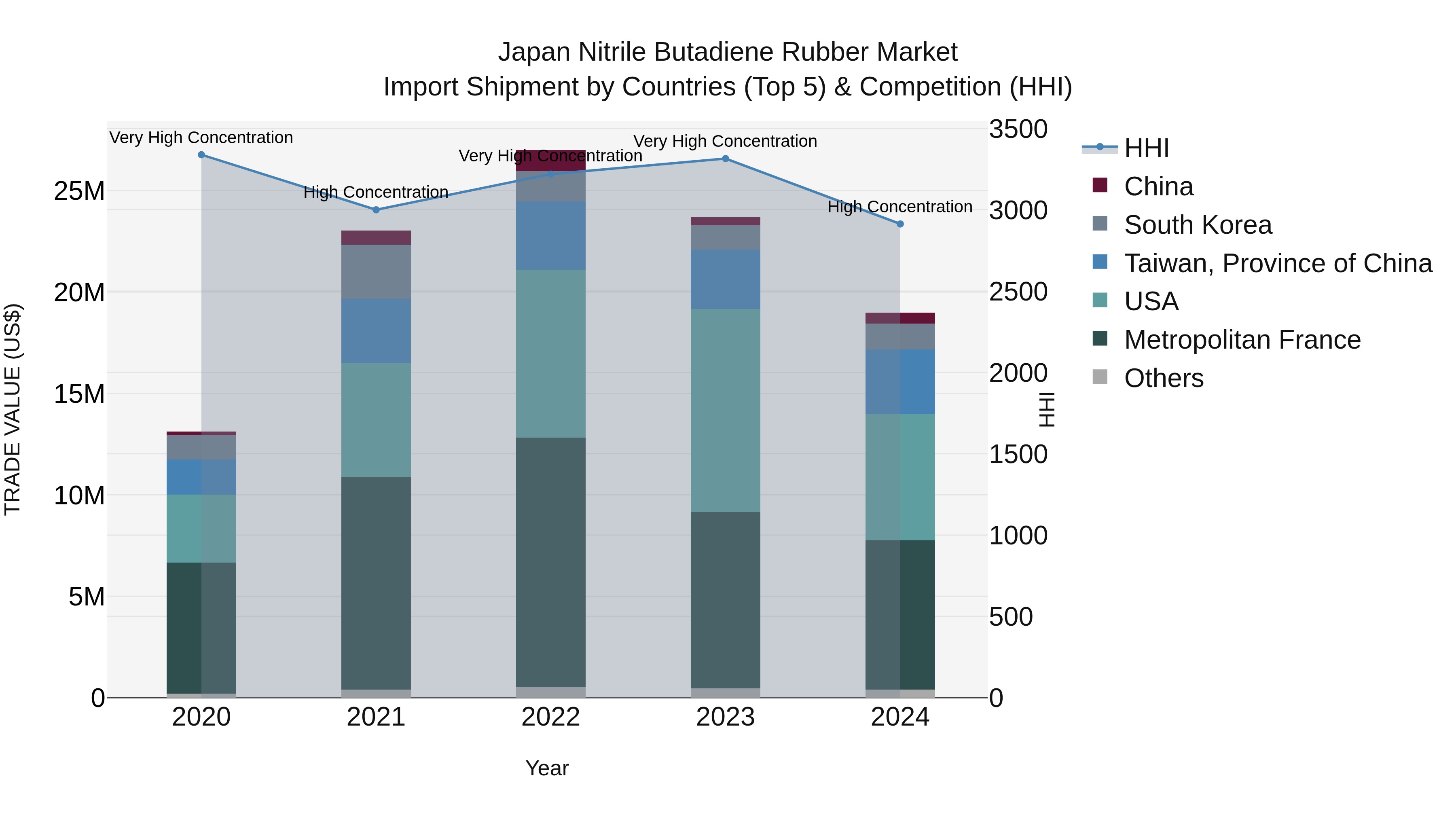
Japan Nitrile Butadiene Rubber Market Import Shipment by Countries (Top 5) & Competition (HHI)
Japan's import shipments of nitrile butadiene rubber in 2024 continued to be dominated by Metropolitan France, USA, Taiwan, South Korea, and China. Despite a decrease in growth rate from the previous year, the industry maintained a strong compound annual growth rate of 9.65% from 2020 to 2024. The market concentration, as measured by the HHI, remained high in 2024, indicating a competitive landscape among the top exporting countries. This data suggests a stable yet dynamic market for nitrile butadiene rubber imports into Japan.
Japan Nitrile Butadiene Rubber Market Synopsis
The Japan Nitrile Butadiene Rubber (NBR) market is witnessing steady growth due to the increasing demand from various end-use industries such as automotive, oil & gas, and industrial manufacturing. NBR, known for its excellent oil and chemical resistance properties, is extensively used in the production of automotive components, hoses, seals, and gaskets, among others. The market is also driven by the growing emphasis on product innovation and development to meet the evolving industry requirements. Key players in the Japan NBR market are focusing on expanding their production capacities and investing in research and development activities to introduce advanced NBR grades with enhanced performance characteristics. Additionally, stringent regulations promoting the use of environmentally friendly materials are expected to further drive the adoption of NBR in Japan.
Japan Nitrile Butadiene Rubber Market Trends
The Japan Nitrile Butadiene Rubber (NBR) market is experiencing steady growth driven by the increasing demand across various industries such as automotive, electronics, and healthcare. The market is witnessing a shift towards high-performance NBR grades to meet the stringent quality standards in these sectors. Additionally, there is a growing focus on developing bio-based NBR products to address environmental concerns and sustainability goals. Technological advancements in NBR manufacturing processes, along with innovations in product formulations to enhance properties like oil resistance and durability, are also key trends in the market. Collaborations between manufacturers and end-users to co-develop customized NBR solutions tailored to specific applications are becoming more prevalent, indicating a move towards more customer-centric approaches in the Japan NBR market.
Japan Nitrile Butadiene Rubber Market Challenges
In the Japan Nitrile Butadiene Rubber (NBR) market, challenges include increasing competition from other synthetic rubber types, fluctuating raw material prices, and the need to meet stringent environmental regulations. NBR faces competition from materials like styrene-butadiene rubber and ethylene-propylene rubber, which offer similar properties at potentially lower costs. The volatility of butadiene prices, a key raw material for NBR production, can impact the profitability of manufacturers. Additionally, Japanese regulations on emissions and waste disposal are becoming stricter, requiring NBR producers to invest in sustainable practices and technologies. Adapting to these challenges by focusing on innovation, cost efficiency, and sustainability will be crucial for companies operating in the Japan NBR market.
Japan Nitrile Butadiene Rubber Market Investment Opportunities
The Japan Nitrile Butadiene Rubber (NBR) market presents several investment opportunities due to increasing demand from various end-use industries such as automotive, industrial, and healthcare. With the growing emphasis on high-performance and durable materials, there is a rising need for NBR in manufacturing components like gaskets, seals, hoses, and O-rings. Investing in NBR production facilities or manufacturers in Japan can be lucrative given the country`s advanced technology and expertise in rubber manufacturing. Additionally, the shift towards eco-friendly and sustainable materials in the region opens up opportunities for investing in research and development of bio-based NBR products. Overall, the Japan NBR market offers potential for growth and innovation, making it an attractive prospect for investors looking to capitalize on the country`s industrial and technological advancements.
Jordan Agar Market Government Policies
The Japanese government has implemented various policies to support the Nitrile Butadiene Rubber (NBR) market in the country. Some key initiatives include promoting research and development activities to enhance the competitiveness of the domestic NBR industry, providing financial incentives and subsidies to manufacturers investing in NBR production facilities, and fostering partnerships between industry players and research institutions to drive innovation in NBR technology. Additionally, the government has imposed regulations to ensure environmental sustainability and safety standards within the NBR sector, encouraging companies to adopt eco-friendly production practices and comply with stringent quality control measures. These policies aim to strengthen the Japanese NBR market, enhance its global presence, and contribute to the overall growth and sustainability of the industry.
Japan Nitrile Butadiene Rubber Market Future Outlook
The Japan Nitrile Butadiene Rubber (NBR) market is expected to witness steady growth in the coming years due to increasing demand from industries such as automotive, construction, and healthcare. The growing adoption of NBR in automotive components, seals, and gaskets, coupled with the rise in construction activities and the expanding healthcare sector, will drive market growth. Additionally, the focus on product innovation and development of advanced NBR grades with improved properties like resistance to oil, heat, and chemicals will further boost market expansion. However, challenges such as fluctuating raw material prices and competition from alternative materials may impact market growth to some extent. Overall, the Japan NBR market is poised for growth, supported by diverse end-use applications and technological advancements.
Key Highlights of the Report:
- Japan Nitrile Butadiene Rubber Market Outlook
- Market Size of Japan Nitrile Butadiene Rubber Market, 2021
- Forecast of Japan Nitrile Butadiene Rubber Market, 2031
- Historical Data and Forecast of Japan Nitrile Butadiene Rubber Revenues & Volume for the Period 2018 - 2031
- Japan Nitrile Butadiene Rubber Market Trend Evolution
- Japan Nitrile Butadiene Rubber Market Drivers and Challenges
- Japan Nitrile Butadiene Rubber Price Trends
- Japan Nitrile Butadiene Rubber Porter's Five Forces
- Japan Nitrile Butadiene Rubber Industry Life Cycle
- Historical Data and Forecast of Japan Nitrile Butadiene Rubber Market Revenues & Volume By Product for the Period 2018 - 2031
- Historical Data and Forecast of Japan Nitrile Butadiene Rubber Market Revenues & Volume By Hoses for the Period 2018 - 2031
- Historical Data and Forecast of Japan Nitrile Butadiene Rubber Market Revenues & Volume By Belts for the Period 2018 - 2031
- Historical Data and Forecast of Japan Nitrile Butadiene Rubber Market Revenues & Volume By Cables for the Period 2018 - 2031
- Historical Data and Forecast of Japan Nitrile Butadiene Rubber Market Revenues & Volume By Molded & Extruded Products for the Period 2018 - 2031
- Historical Data and Forecast of Japan Nitrile Butadiene Rubber Market Revenues & Volume By Seals & O-rings for the Period 2018 - 2031
- Historical Data and Forecast of Japan Nitrile Butadiene Rubber Market Revenues & Volume By Rubber Compounds for the Period 2018 - 2031
- Historical Data and Forecast of Japan Nitrile Butadiene Rubber Market Revenues & Volume By Adhesives & Sealants for the Period 2018 - 2031
- Historical Data and Forecast of Japan Hoses Nitrile Butadiene Rubber Market Revenues & Volume By Gloves for the Period 2018 - 2031
- Historical Data and Forecast of Japan Nitrile Butadiene Rubber Market Revenues & Volume By End-Use for the Period 2018 - 2031
- Historical Data and Forecast of Japan Nitrile Butadiene Rubber Market Revenues & Volume By Automotive for the Period 2018 - 2031
- Historical Data and Forecast of Japan Nitrile Butadiene Rubber Market Revenues & Volume By Mechanical Engineering for the Period 2018 - 2031
- Historical Data and Forecast of Japan Nitrile Butadiene Rubber Market Revenues & Volume By Oil & Gas for the Period 2018 - 2031
- Historical Data and Forecast of Japan Nitrile Butadiene Rubber Market Revenues & Volume By Metallurgy & Mining for the Period 2018 - 2031
- Historical Data and Forecast of Japan Nitrile Butadiene Rubber Market Revenues & Volume By Construction for the Period 2018 - 2031
- Historical Data and Forecast of Japan Nitrile Butadiene Rubber Market Revenues & Volume By Medical for the Period 2018 - 2031
- Historical Data and Forecast of Japan Nitrile Butadiene Rubber Market Revenues & Volume By Others for the Period 2018 - 2031
- Japan Nitrile Butadiene Rubber Import Export Trade Statistics
- Market Opportunity Assessment By Product
- Market Opportunity Assessment By End-Use
- Japan Nitrile Butadiene Rubber Top Companies Market Share
- Japan Nitrile Butadiene Rubber Competitive Benchmarking By Technical and Operational Parameters
- Japan Nitrile Butadiene Rubber Company Profiles
- Japan Nitrile Butadiene Rubber Key Strategic Recommendations






































