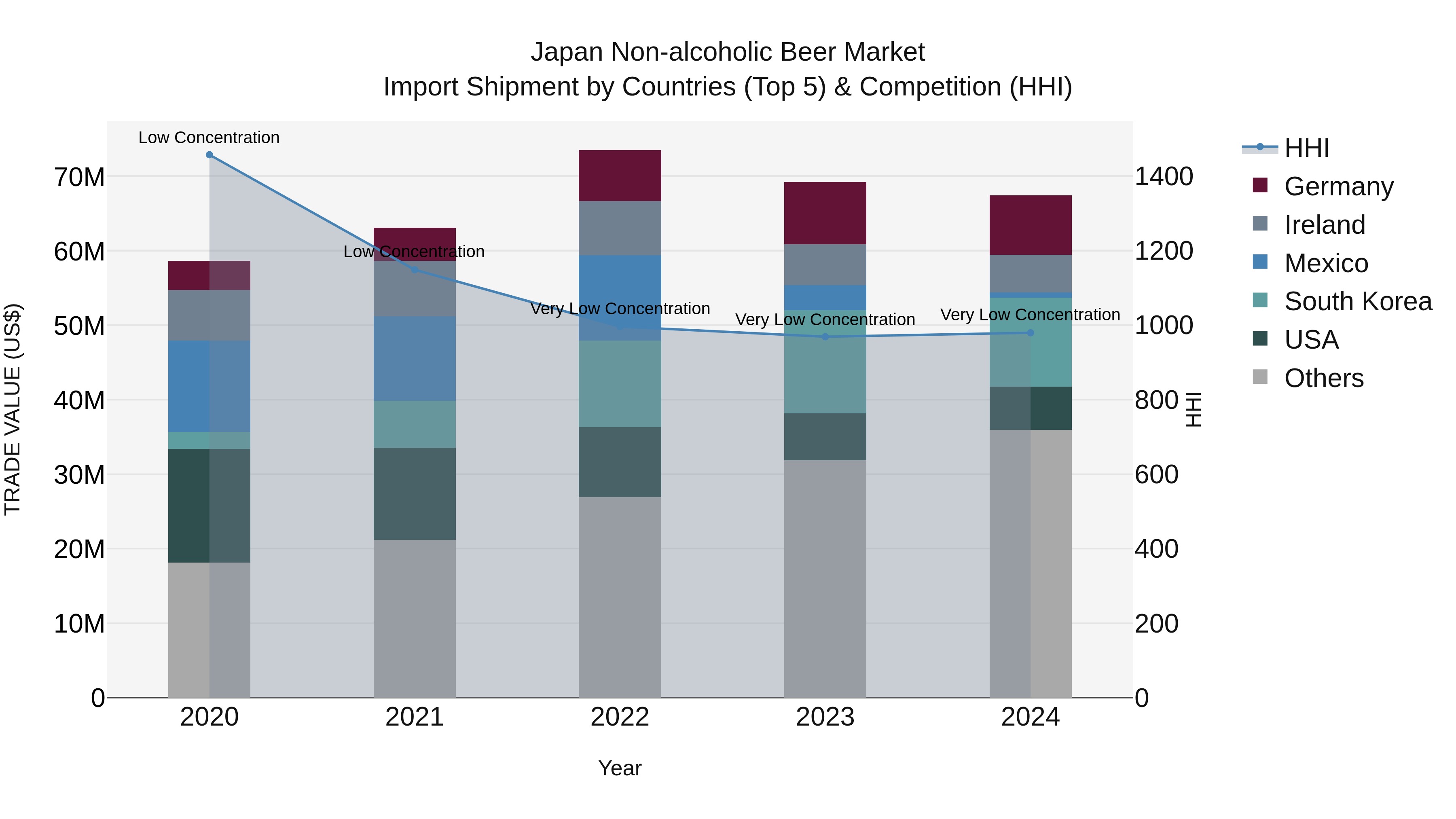
Japan Non-alcoholic Beer Market Import Shipment by Countries (Top 5) & Competition (HHI)
In 2024, Japan saw significant non-alcoholic beer import shipments primarily from South Korea, China, Germany, USA, and Ireland. Despite the top exporting countries, the market concentration, as measured by the Herfindahl-Hirschman Index (HHI), remained very low, indicating a competitive landscape. The compound annual growth rate (CAGR) from 2020 to 2024 stood at a steady 3.56%, showcasing sustained growth. However, there was a slight decline in the growth rate from 2023 to 2024 at -2.55%, suggesting a potential market adjustment or temporary slowdown in demand for non-alcoholic beer imports in Japan.
Key Highlights of the Report:
- Japan Non-Alcoholic Beer Market Outlook
- Market Size of Japan Non-Alcoholic Beer Market,2024
- Forecast of Japan Non-Alcoholic Beer Market, 2031
- Historical Data and Forecast of Japan Non-Alcoholic Beer Revenues & Volume for the Period 2021-2031
- Japan Non-Alcoholic Beer Market Trend Evolution
- Japan Non-Alcoholic Beer Market Drivers and Challenges
- Japan Non-Alcoholic Beer Price Trends
- Japan Non-Alcoholic Beer Porter's Five Forces
- Japan Non-Alcoholic Beer Industry Life Cycle
- Historical Data and Forecast of Japan Non-Alcoholic Beer Market Revenues & Volume By Type for the Period 2021-2031
- Historical Data and Forecast of Japan Non-Alcoholic Beer Market Revenues & Volume By Malted Beverages for the Period 2021-2031
- Historical Data and Forecast of Japan Non-Alcoholic Beer Market Revenues & Volume By Ale-Based for the Period 2021-2031
- Historical Data and Forecast of Japan Non-Alcoholic Beer Market Revenues & Volume By Hybrid Beverages for the Period 2021-2031
- Historical Data and Forecast of Japan Non-Alcoholic Beer Market Revenues & Volume By Specialty for the Period 2021-2031
- Historical Data and Forecast of Japan Non-Alcoholic Beer Market Revenues & Volume By Category for the Period 2021-2031
- Historical Data and Forecast of Japan Non-Alcoholic Beer Market Revenues & Volume By Lager for the Period 2021-2031
- Historical Data and Forecast of Japan Non-Alcoholic Beer Market Revenues & Volume By Stout for the Period 2021-2031
- Historical Data and Forecast of Japan Non-Alcoholic Beer Market Revenues & Volume By Pilsner for the Period 2021-2031
- Historical Data and Forecast of Japan Non-Alcoholic Beer Market Revenues & Volume By Others for the Period 2021-2031
- Historical Data and Forecast of Japan Non-Alcoholic Beer Market Revenues & Volume By Packaging for the Period 2021-2031
- Historical Data and Forecast of Japan Non-Alcoholic Beer Market Revenues & Volume By Bottles for the Period 2021-2031
- Historical Data and Forecast of Japan Non-Alcoholic Beer Market Revenues & Volume By Cans for the Period 2021-2031
- Historical Data and Forecast of Japan Non-Alcoholic Beer Market Revenues & Volume By Kegs for the Period 2021-2031
- Historical Data and Forecast of Japan Non-Alcoholic Beer Market Revenues & Volume By Cartons for the Period 2021-2031
- Historical Data and Forecast of Japan Non-Alcoholic Beer Market Revenues & Volume By Distribution Channel for the Period 2021-2031
- Historical Data and Forecast of Japan Non-Alcoholic Beer Market Revenues & Volume By Supermarkets for the Period 2021-2031
- Historical Data and Forecast of Japan Non-Alcoholic Beer Market Revenues & Volume By Online Stores for the Period 2021-2031
- Historical Data and Forecast of Japan Non-Alcoholic Beer Market Revenues & Volume By Restaurants & Bars for the Period 2021-2031
- Historical Data and Forecast of Japan Non-Alcoholic Beer Market Revenues & Volume By Specialty Stores for the Period 2021-2031
- Japan Non-Alcoholic Beer Import Export Trade Statistics
- Market Opportunity Assessment By Type
- Market Opportunity Assessment By Category
- Market Opportunity Assessment By Packaging
- Market Opportunity Assessment By Distribution Channel
- Japan Non-Alcoholic Beer Top Companies Market Share
- Japan Non-Alcoholic Beer Competitive Benchmarking By Technical and Operational Parameters
- Japan Non-Alcoholic Beer Company Profiles
- Japan Non-Alcoholic Beer Key Strategic Recommendations






































