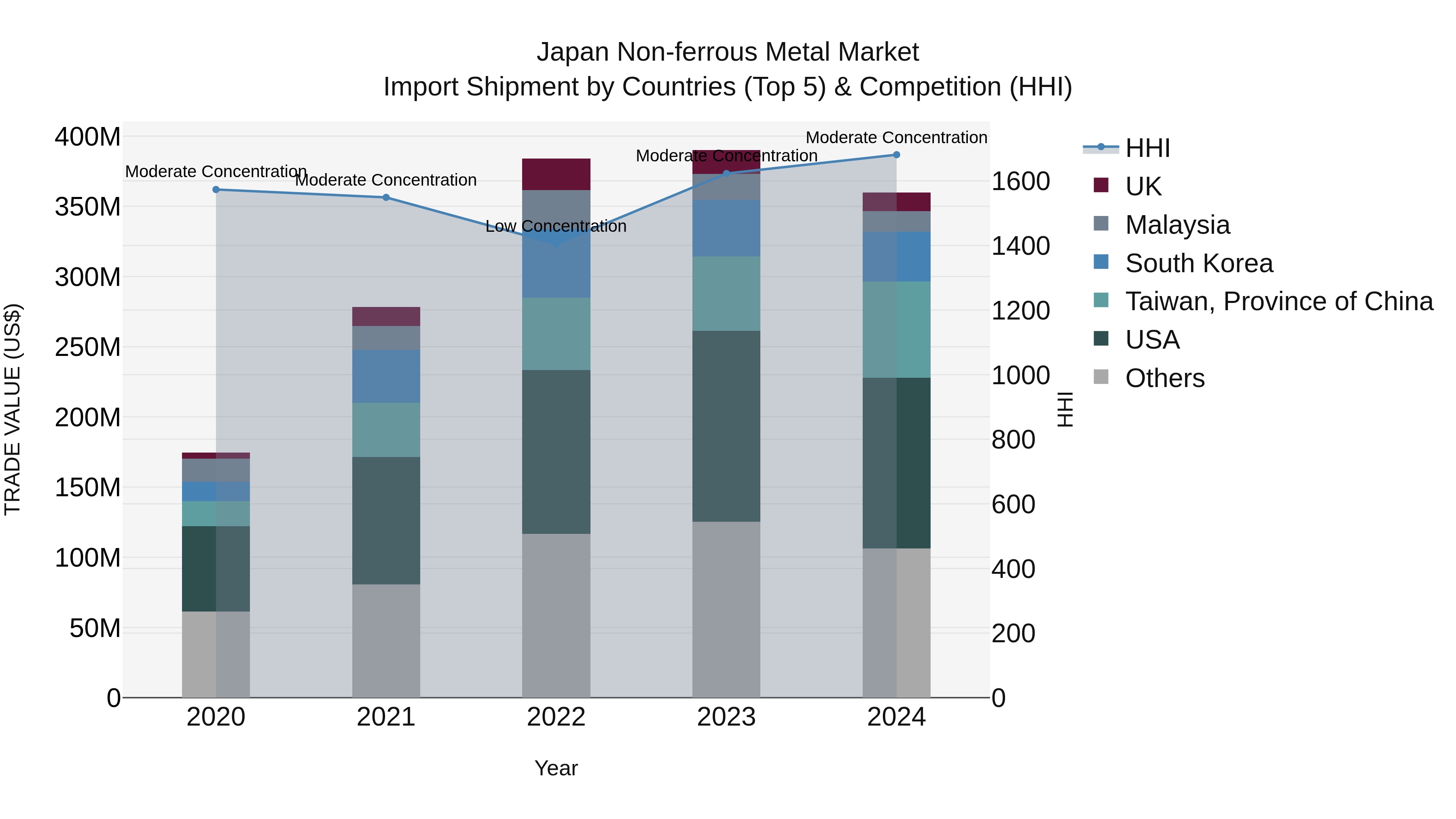
Japan Non-ferrous Metal Market Import Shipment by Countries (Top 5) & Competition (HHI)
Japan's non-ferrous metal import shipments in 2024 continued to show strong growth with a notable CAGR of 19.8% from 2020 to 2024. Despite a slight decline in growth rate from 2023 to 2024 at -7.77%, the market remained stable with moderate concentration indicated by the Herfindahl-Hirschman Index (HHI). Key exporting countries to Japan included the USA, Taiwan, South Korea, Malaysia, and the UK, showcasing a diverse import market for non-ferrous metals.
Key Highlights of the Report:
- Japan Non-ferrous Metal Market Outlook
- Market Size of Japan Non-ferrous Metal Market, 2024
- Forecast of Japan Non-ferrous Metal Market, 2026
- Historical Data and Forecast of Japan Non-ferrous Metal Revenues & Volume for the Period 2021 - 2031
- Japan Non-ferrous Metal Market Trend Evolution
- Japan Non-ferrous Metal Market Drivers and Challenges
- Japan Non-ferrous Metal Price Trends
- Japan Non-ferrous Metal Porter's Five Forces
- Japan Non-ferrous Metal Industry Life Cycle
- Historical Data and Forecast of Japan Non-ferrous Metal Market Revenues & Volume By Types for the Period 2021 - 2031
- Historical Data and Forecast of Japan Non-ferrous Metal Market Revenues & Volume By Aluminum for the Period 2021 - 2031
- Historical Data and Forecast of Japan Non-ferrous Metal Market Revenues & Volume By Copper for the Period 2021 - 2031
- Historical Data and Forecast of Japan Non-ferrous Metal Market Revenues & Volume By Lead for the Period 2021 - 2031
- Historical Data and Forecast of Japan Non-ferrous Metal Market Revenues & Volume By Tin for the Period 2021 - 2031
- Historical Data and Forecast of Japan Non-ferrous Metal Market Revenues & Volume By Nickel for the Period 2021 - 2031
- Historical Data and Forecast of Japan Non-ferrous Metal Market Revenues & Volume By Titanium for the Period 2021 - 2031
- Historical Data and Forecast of Japan Non-ferrous Metal Market Revenues & Volume By Zinc for the Period 2021 - 2031
- Historical Data and Forecast of Japan Non-ferrous Metal Market Revenues & Volume By Applications for the Period 2021 - 2031
- Historical Data and Forecast of Japan Non-ferrous Metal Market Revenues & Volume By Automobile Industry for the Period 2021 - 2031
- Historical Data and Forecast of Japan Non-ferrous Metal Market Revenues & Volume By Electronic Power Industry for the Period 2021 - 2031
- Historical Data and Forecast of Japan Non-ferrous Metal Market Revenues & Volume By Construction Industry for the Period 2021 - 2031
- Historical Data and Forecast of Japan Non-ferrous Metal Market Revenues & Volume By Other for the Period 2021 - 2031
- Japan Non-ferrous Metal Import Export Trade Statistics
- Market Opportunity Assessment By Types
- Market Opportunity Assessment By Applications
- Japan Non-ferrous Metal Top Companies Market Share
- Japan Non-ferrous Metal Competitive Benchmarking By Technical and Operational Parameters
- Japan Non-ferrous Metal Company Profiles
- Japan Non-ferrous Metal Key Strategic Recommendations






































