Japan Oilfield Air Drilling Market Size, Share & Growth Rate
The Japan Oilfield Air Drilling Market was estimated at USD 189 Million in 2025 and is projected to reach USD 234 Million by 2032, growing at a CAGR of 3.1% from 2026 to 2032. This anticipated growth is primarily driven by the oil and gas industry's escalating demand for innovative drilling technologies that maximize efficiency while minimizing environmental impact. As companies in Japan embrace cost-effective and sustainable solutions, air drilling methods are becoming increasingly appealing.
Japan Oilfield Air Drilling Market Year-wise Growth Rate and Key Drivers
This graph highlights how the Japan Oilfield Air Drilling Market has steadily grown over the years, supported by major growth factors.
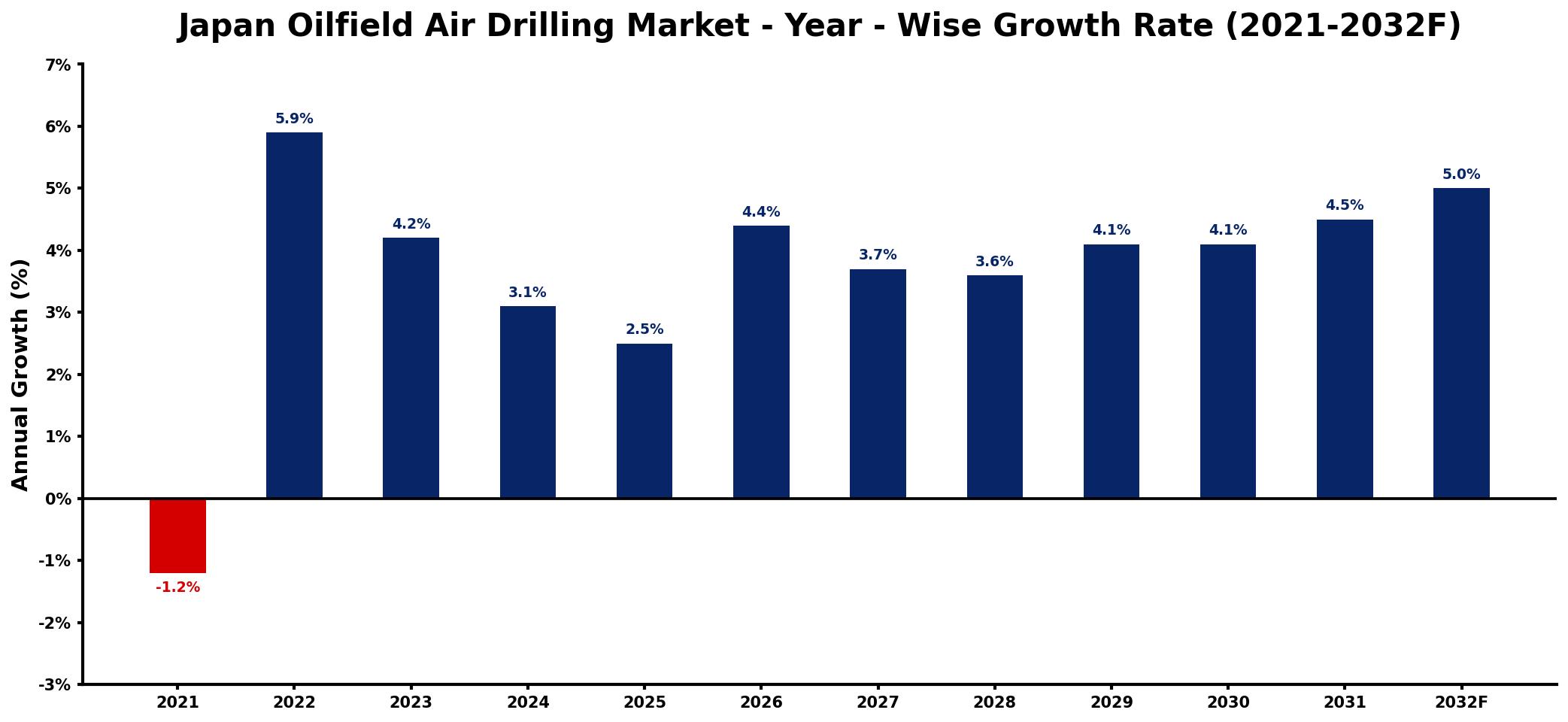
The table below presents the year‑wise growth rates along with the key drivers influencing the market
| Year | Growth Rate | Major Drivers |
| 2021 | -1.2% | Global energy demand declines significantly |
| 2022 | 5.9% | Investment in renewable energy increases |
| 2023 | 4.2% | Technological advancements drive efficiency |
| 2024 | 3.1% | Rising global energy consumption observed |
| 2025 | 2.5% | Infrastructure development enhances capacity |
| 2026 | 4.4% | Increased exploration activities reported |
| 2027 | 3.7% | Strategic partnerships foster growth opportunities |
| 2028 | 3.6% | Regulatory support boosts market confidence |
| 2029 | 4.1% | Enhanced resource management practices adopted |
| 2030 | 4.1% | Sustainability initiatives attract investments |
| 2031 | 4.5% | Emerging markets drive new projects |
| 2032 | 5.0% | Innovative solutions create competitive advantages |
Note: Market size estimations and growth projections presented in this report are based on 6Wresearch's proprietary forecasting methodology, utilizing the latest available industry data, government publications, and primary research inputs.
Japan Oilfield Air Drilling Market Synopsis
The Japan Oilfield Air Drilling Market is currently on a growth trajectory, spurred by the urgent need for effective and environmentally responsible drilling techniques within the sector. With air drilling offering substantial benefits—including faster penetration rates and reduced formation damage—its appeal in Japanese oilfields is gaining momentum.
Investments in research and development are crucial as key industry stakeholders aim to refine air drilling technologies. Moreover, government policies emphasizing sustainability and environmental protection are further supporting advancements in this area, setting the stage for a robust market future.
Japan Oilfield Air Drilling Market Key Takeaways
- Air drilling technology significantly enhances drilling efficiency, reducing formation damage.
- Growing emphasis on environmental sustainability shapes innovative drilling solutions.
- Government regulations are encouraging investments in eco-friendly practices and technologies.
- Strategic partnerships and collaborations are increasing within the sector, enhancing market presence.
- The demand for advanced air drilling methods is expected to rise, driven by the need for cost-effective solutions.
Evaluation of Restraints in Japan Oilfield Air Drilling Market
Despite its promising growth potential, the Japan Oilfield Air Drilling Market faces several notable restraints. Regulatory hurdles present significant challenges, as the Japanese government enforces stringent regulations to mitigate environmental impacts associated with drilling operations. These regulations can affect the operational flexibility of air drilling projects, potentially slowing their adoption. Furthermore, public concern regarding air and noise pollution from drilling activities adds a layer of complexity in achieving community acceptance. Technological constraints related to depth capability compared to traditional methods may also hinder market progress. Overcoming these barriers will necessitate innovation, increased stakeholder engagement, and proactive regulatory alignment.
Japan Oilfield Air Drilling Market Trends
The landscape of the Japan Oilfield Air Drilling Market is being shaped by key trends that indicate a shift towards enhanced operational efficiency. A marked trend is the heightened adoption of air drilling techniques, credited with reduced formation damage and improved rate of penetration. Concurrently, technological advancements in air drilling equipment are prioritizing safety and performance, aligning with industry-wide safety mandates.
Moreover, the growing focus on environmental sustainability is driving the development of more eco-friendly air drilling solutions, reflecting the industry's commitment to reducing its ecological footprint. Strategic partnerships and collaborations among industry players are becoming more common, enhancing market competitiveness and driving innovation.
Japan Oilfield Air Drilling Market Opportunities
Investment opportunities abound in the Japan Oilfield Air Drilling Market, particularly as the nation pivots towards sustainable energy solutions. Companies specializing in air drilling technologies stand to benefit from increased demand for innovative drilling techniques that emphasize efficiency and eco-friendliness. Research and development initiatives aimed at enhancing air drilling capabilities present significant avenues for investment, targeting technological breakthroughs that optimize performance.
Additionally, forging strategic collaborations with local oilfield service providers could yield synergies that enhance operational effectiveness. Aligning with government initiatives focused on clean energy practices also offers promising pathways for investors seeking to capitalize on emerging market trends.
Government Initiatives in the Japan Oilfield Air Drilling Market
The Japanese government has implemented various initiatives aimed at promoting sustainable practices within the oilfield air drilling sector. These initiatives emphasize environmental conservation, encouraging companies to adopt cleaner technologies through regulatory frameworks and financial incentives. The government actively supports research into advanced drilling methods, prioritizing safety and efficiency. By incentivizing companies that contribute to sustainable development, Japan seeks to cultivate a robust oilfield air drilling market that aligns with its broader environmental objectives.
Future Insights of the Japan Oilfield Air Drilling Market
Looking ahead to 2026-2032, the Japan Oilfield Air Drilling Market is expected to experience steady growth, driven by ongoing advancements in technology and the increasing demand for efficient, cost-effective drilling solutions. The industry's focus on reducing reliance on imported energy sources will further accelerate the adoption of air drilling techniques, as domestic production becomes a priority. As key players invest in technological improvements and environmentally friendly practices, the market is poised for significant innovation and expansion.
Japan Oilfield Air Drilling Market Latest Developments (2025 - 2026)
Recent developments within the Japan Oilfield Air Drilling Market highlight a progressive trend towards increased technological integration and efficiency. Industry players are actively exploring advanced air drilling techniques aimed at minimizing environmental impact while enhancing operational output. Collaborations among various stakeholders are rising, fostering innovation that aligns with Japan's commitment to sustainability. Additionally, ongoing adjustments to government policies are expected to further support the sector's growth trajectory.
Japan Oilfield Air Drilling Market - Key Attractiveness of the Report
- 10 Years of Market Numbers
- Historical Data Starting from 2022 to 2025
- Base Year: 2025
- Forecast Data until 2032
- Key Performance Indicators Impacting the Market
- Major Upcoming Developments and Projects
Key Highlights of the Report:
- Japan Oilfield Air Drilling Market Outlook
- Market Size of Japan Oilfield Air Drilling Market, 2025
- Forecast of Japan Oilfield Air Drilling Market, 2032
- Historical Data and Forecast of Japan Oilfield Air Drilling Revenues & Volume for the Period 2022-2032F
- Japan Oilfield Air Drilling Market Trend Evolution
- Japan Oilfield Air Drilling Market Drivers and Challenges
- Japan Oilfield Air Drilling Price Trends
- Japan Oilfield Air Drilling Porter's Five Forces
- Japan Oilfield Air Drilling Industry Life Cycle
- Historical Data and Forecast of Japan Oilfield Air Drilling Market Revenues & Volume By Type for the Period 2022-2032F
- Historical Data and Forecast of Japan Oilfield Air Drilling Market Revenues & Volume By Dust for the Period 2022-2032F
- Historical Data and Forecast of Japan Oilfield Air Drilling Market Revenues & Volume By Aerated fluid for the Period 2022-2032F
- Historical Data and Forecast of Japan Oilfield Air Drilling Market Revenues & Volume By Foam for the Period 2022-2032F
- Historical Data and Forecast of Japan Oilfield Air Drilling Market Revenues & Volume By Mist for the Period 2022-2032F
- Historical Data and Forecast of Japan Oilfield Air Drilling Market Revenues & Volume By Nitrogen membrane for the Period 2022-2032F
- Japan Oilfield Air Drilling Import Export Trade Statistics
- Market Opportunity Assessment By Type
- Japan Oilfield Air Drilling Top Companies Market Share
- Japan Oilfield Air Drilling Competitive Benchmarking By Technical and Operational Parameters
- Japan Oilfield Air Drilling Company Profiles
- Japan Oilfield Air Drilling Key Strategic Recommendations






































