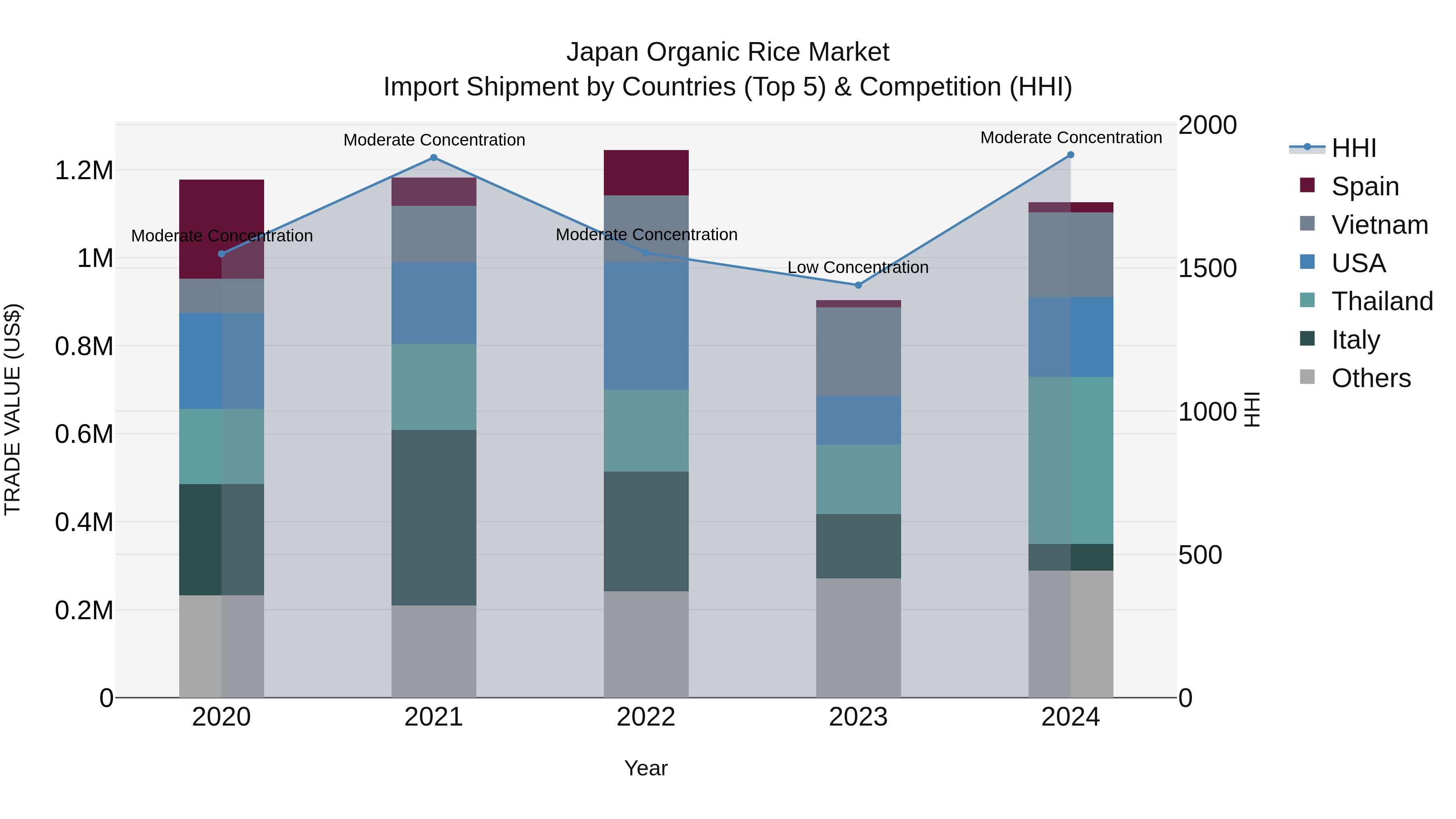
Japan Organic Rice Market Import Shipment by Countries (Top 5) & Competition (HHI)
Japan's organic rice import market saw significant growth in 2024, with top exporting countries being Thailand, Vietnam, USA, Sri Lanka, and China. The market showed a shift from low to moderate concentration, indicating increased competition among suppliers. Despite a negative compound annual growth rate (CAGR) from 2020 to 2024, the market experienced a notable growth rate of 24.6% from 2023 to 2024. This suggests a growing demand for organic rice in Japan, with key players expanding their presence and offerings in the market.
Japan Organic Rice Market Overview
The Japan Organic Rice Market is experiencing steady growth driven by increasing consumer preference for healthier and environmentally sustainable food options. Organic rice production in Japan adheres to strict regulations ensuring the absence of synthetic chemicals and genetically modified organisms, attracting health-conscious consumers. The market is characterized by a growing number of organic rice farmers adopting sustainable farming practices and utilizing traditional cultivation methods. Key players in the market are focusing on product innovation, packaging, and marketing strategies to cater to the evolving consumer demand for organic rice products. Rising awareness about the benefits of organic rice, coupled with government support for organic farming initiatives, is expected to further propel the growth of the Japan Organic Rice Market in the coming years.
Japan Organic Rice Market Trends and Opportunities
The Japan Organic Rice Market is experiencing a growing demand due to increasing consumer awareness about health and environmental sustainability. Consumers are seeking organic rice for its perceived health benefits, such as being free from pesticides and chemicals. This trend is supported by the government`s initiatives to promote organic farming and sustainable agriculture practices. Opportunities lie in expanding organic rice production to meet the rising demand, developing innovative organic rice products to cater to diverse consumer preferences, and leveraging e-commerce platforms for wider market reach. With a strong emphasis on quality and authenticity, there is potential for organic rice producers to differentiate themselves in the market and establish themselves as trusted providers of premium organic rice products in Japan.
Japan Organic Rice Market Challenges
In the Japan Organic Rice Market, some challenges include limited availability of organic farmland due to high land costs and strict regulations, which can hinder the expansion of organic rice cultivation. Additionally, consumer awareness and education about the benefits of organic rice are relatively low compared to other countries, leading to lower demand. Market competition from imported organic rice, particularly from neighboring countries like China and Thailand, also poses a challenge for domestic organic rice producers. Furthermore, the premium pricing of organic rice compared to conventional rice can be a deterrent for price-sensitive consumers. Overall, increasing consumer awareness, addressing land constraints, and enhancing competitiveness in terms of pricing and quality are key challenges that need to be addressed for the growth of the Japan Organic Rice Market.
Japan Organic Rice Market Drivers
The Japan Organic Rice Market is primarily driven by the increasing consumer awareness and demand for healthier and environmentally sustainable food options. Consumers are becoming more concerned about the use of chemicals and pesticides in conventional rice farming, leading to a shift towards organic rice which is produced without synthetic inputs. Additionally, the growing trend of lifestyle diseases and food-related allergies is prompting consumers to choose organic rice for its perceived health benefits. Government initiatives promoting organic farming practices and certifications are also boosting the market growth. Furthermore, the rising disposable income levels and changing dietary preferences towards organic and natural products are driving the demand for organic rice in Japan. Overall, the market is expected to continue growing as consumers prioritize health, sustainability, and quality in their food choices.
Japan Organic Rice Market Government Policies
The Japanese government has implemented various policies to promote the organic rice market in the country. These policies include financial support for farmers transitioning to organic practices, subsidies for organic certification, and the establishment of organic farming standards and regulations. Additionally, the government has introduced labeling requirements to ensure transparency and consumer trust in organic rice products. Furthermore, initiatives such as organic farming education programs and research support aim to increase awareness and improve organic rice production techniques. Overall, these government policies demonstrate a commitment to fostering the growth of the organic rice market in Japan by providing support to farmers, ensuring product quality, and enhancing consumer confidence in organic rice products.
Japan Organic Rice Market Future Outlook
The Japan Organic Rice Market is expected to witness steady growth in the coming years, driven by increasing consumer awareness regarding the benefits of organic products and a growing preference for healthier food options. The government`s initiatives to promote organic farming practices and sustainable agriculture are also likely to boost the market. Additionally, rising concerns about food safety and environmental sustainability are encouraging more farmers to switch to organic rice cultivation methods. As a result, the market is projected to see a rise in demand for organic rice products, including both domestically produced and imported varieties. However, challenges such as higher production costs and limited availability of organic rice seeds may hinder the market`s growth to some extent. Overall, the Japan Organic Rice Market is poised for expansion, supported by evolving consumer preferences and a shift towards sustainable food production practices.
Key Highlights of the Report:
- Japan Organic Rice Market Outlook
- Market Size of Japan Organic Rice Market, 2024
- Forecast of Japan Organic Rice Market, 2031
- Historical Data and Forecast of Japan Organic Rice Revenues & Volume for the Period 2021- 2031
- Japan Organic Rice Market Trend Evolution
- Japan Organic Rice Market Drivers and Challenges
- Japan Organic Rice Price Trends
- Japan Organic Rice Porter's Five Forces
- Japan Organic Rice Industry Life Cycle
- Historical Data and Forecast of Japan Organic Rice Market Revenues & Volume By Type for the Period 2021- 2031
- Historical Data and Forecast of Japan Organic Rice Market Revenues & Volume By Polished Glutinous Rice (Sticky Rice) for the Period 2021- 2031
- Historical Data and Forecast of Japan Organic Rice Market Revenues & Volume By Indica (long-shaped Rice) for the Period 2021- 2031
- Historical Data and Forecast of Japan Organic Rice Market Revenues & Volume By Polished Round-grained Rice for the Period 2021- 2031
- Historical Data and Forecast of Japan Organic Rice Market Revenues & Volume By Application for the Period 2021- 2031
- Historical Data and Forecast of Japan Organic Rice Market Revenues & Volume By Direct Edible for the Period 2021- 2031
- Historical Data and Forecast of Japan Organic Rice Market Revenues & Volume By Deep Processing for the Period 2021- 2031
- Historical Data and Forecast of Japan Organic Rice Market Revenues & Volume By End User for the Period 2021- 2031
- Historical Data and Forecast of Japan Organic Rice Market Revenues & Volume By Bakery & Confectionary for the Period 2021- 2031
- Historical Data and Forecast of Japan Organic Rice Market Revenues & Volume By Beverages for the Period 2021- 2031
- Historical Data and Forecast of Japan Organic Rice Market Revenues & Volume By Desert & Dairy Products for the Period 2021- 2031
- Historical Data and Forecast of Japan Organic Rice Market Revenues & Volume By Meat for the Period 2021- 2031
- Historical Data and Forecast of Japan Organic Rice Market Revenues & Volume By Poultry & Seafood Products for the Period 2021- 2031
- Historical Data and Forecast of Japan Organic Rice Market Revenues & Volume By Infant Formula for the Period 2021- 2031
- Historical Data and Forecast of Japan Organic Rice Market Revenues & Volume By Others for the Period 2021- 2031
- Japan Organic Rice Import Export Trade Statistics
- Market Opportunity Assessment By Type
- Market Opportunity Assessment By Application
- Market Opportunity Assessment By End User
- Japan Organic Rice Top Companies Market Share
- Japan Organic Rice Competitive Benchmarking By Technical and Operational Parameters
- Japan Organic Rice Company Profiles
- Japan Organic Rice Key Strategic Recommendations






































