Japan Over the Top Market Size & Growth Rate (2026-2032)
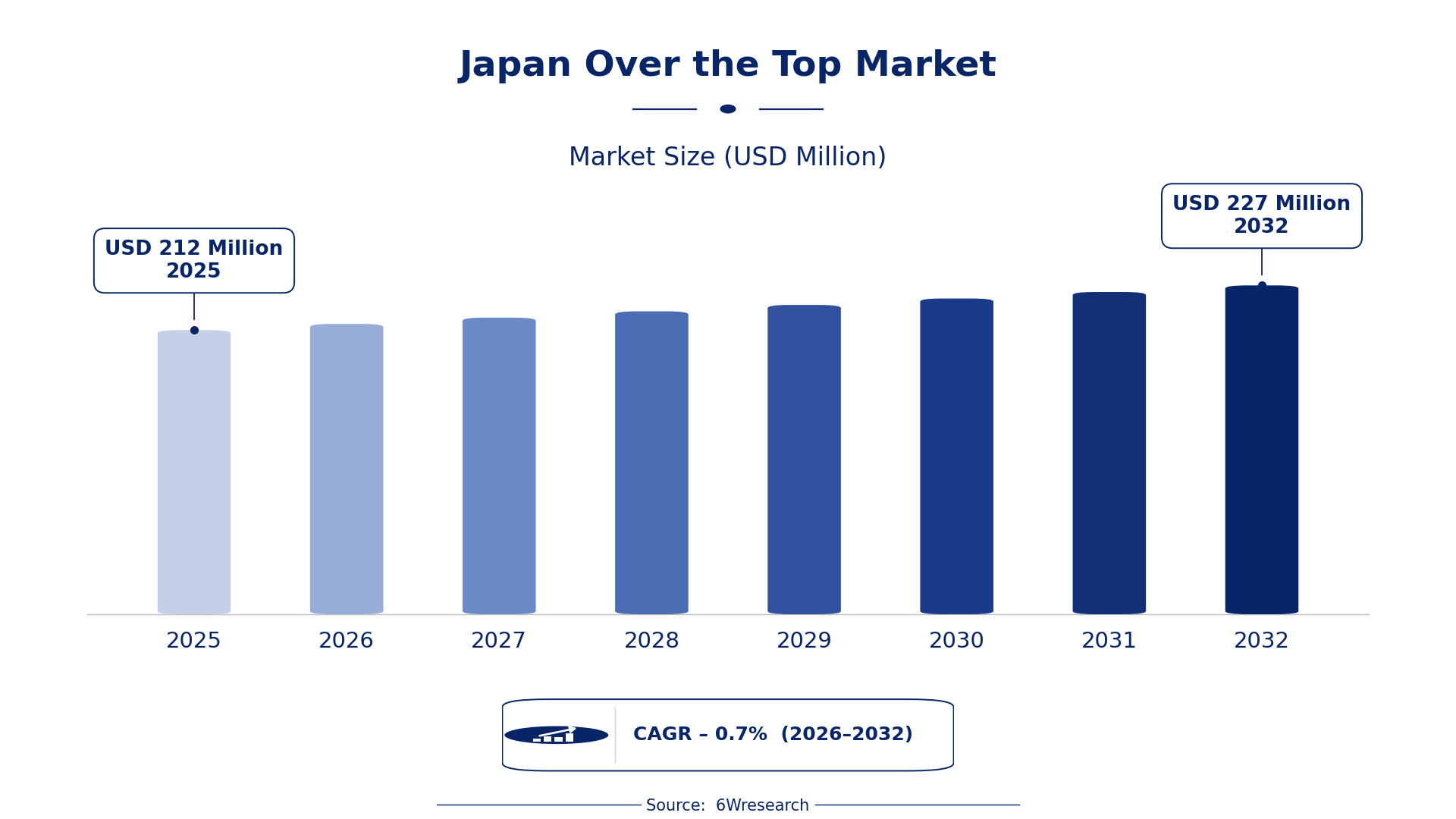
The Japan Over the Top Market was estimated at USD 212 Million in 2025 and is projected to reach USD 227 Million by 2032, growing at a CAGR of 0.7% from 2026 to 2032.
Japan Over the Top Market Synopsis
The Japan Over the Top (OTT) market has seen considerable momentum fueled by the rising popularity of streaming services among consumers. As international and local platforms vie for attention, the competitive dynamics are intensifying, presenting both challenges and opportunities in content creation.
Looking ahead, the market's trajectory suggests sustained expansion, primarily driven by a demographic increasingly favoring on-demand content over traditional media. The influx of niche platforms catering to specialized interests marks a shift in consumer preferences, underscoring the need for innovative content strategies.
Japan Over the Top Market Year-wise Growth Rate and Key Drivers
This graph illustrates the annual growth rates of the Japan Over the Top Market from 2021 to 2032, highlighting a steady upward trajectory and projected expansion over the forecast period.
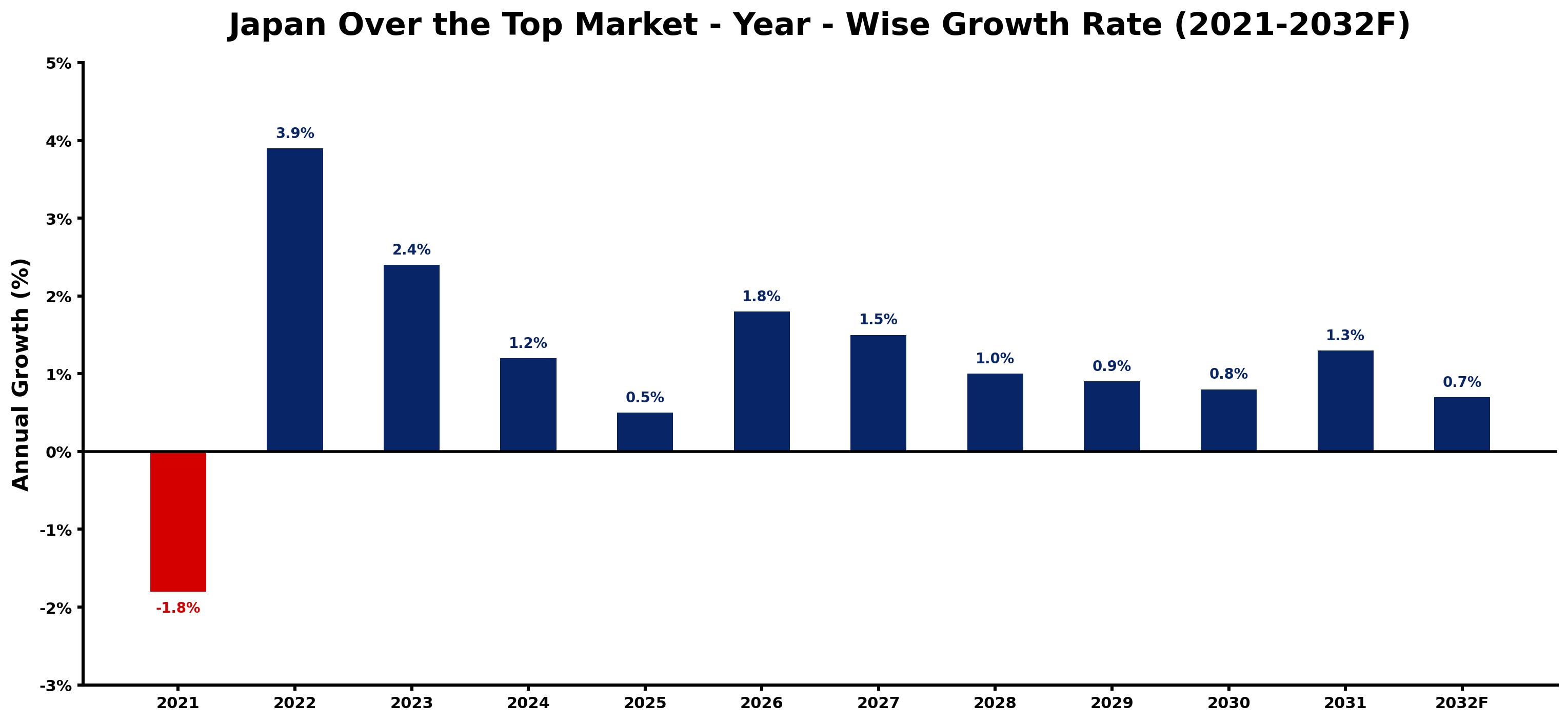
The table below presents the year‑wise growth rates along with the key drivers influencing the market
| Year | Growth Rate | Major Drivers |
| 2021 | -1.8% | Tight content regulations by the Ministry of Internal Affairs |
| 2022 | 3.9% | Launch of government-supported digital content accessibility initiatives. |
| 2023 | 2.4% | Increased subscription options for diverse binge-watching preferences. |
| 2024 | 1.2% | Boost in local anime production driving content consumption. |
| 2025 | 0.5% | Regulatory easing promoting international streaming service entry. |
| 2026 | 1.8% | Surge in household fiber-optic broadband connections boosting quality. |
| 2027 | 1.5% | Popularity of local variety shows attracting wider audience base. |
| 2028 | 1.0% | Continued growth of esports tournaments increasing streaming interest. |
| 2029 | 0.9% | Emergence of innovative interactive viewing experiences gaining traction. |
| 2030 | 0.8% | Focus on incorporating AR/VR content for user engagement. |
| 2031 | 1.3% | Rising interest in original Japanese dramas promoting subscriptions. |
| 2032 | 0.7% | Government initiatives supporting digital media literacy for seniors. |
Note: Market size estimations and growth projections presented in this report are based on 6Wresearch's proprietary forecasting methodology, utilizing the latest available industry data, government publications, and primary research inputs.
Japan Over the Top Market Key Takeaways
Below are some of the specific key takeaways from the market, including:
- Strong growth trajectory anticipated, with a projected market size of USD 227 Million by 2032.
- Increased competition among both international and local OTT providers enhances consumer choice.
- Emerging trends favoring personalized content and interactive user experiences are reshaping engagement.
- Mobile and smart TV adoption are key drivers of OTT service consumption.
- Content diversification, particularly original series, is critical for market players to succeed.
Evaluation of Restraints in Japan Over the Top Market
Despite the promising outlook, several factors restrain growth within the Japan OTT market. The fierce competition creates a cluttered environment where gaining subscriber loyalty becomes a daunting challenge. Regulatory constraints further complicate the landscape, as content distribution limitations can hinder market entrants from fully capitalizing on opportunities. Cultural nuances also demand tailored content strategies that resonate with the local audience, necessitating investments in original programming and marketing that reflect Japanese preferences. Finally, ensuring a consistent and satisfactory user experience across a myriad of devices and varying internet speeds remains an operational hurdle.
Japan Over the Top Market Trends
Several trends are shaping the Japan OTT market today. One prominent trend is the shift towards personalized content recommendations, which enhance user engagement. Another noteworthy development is the increasing reliance on mobile platforms and smart TVs, which are becoming primary access points for consumers. Additionally, as internet infrastructure continues to improve, the demand for high-quality streaming experiences will rise, forcing providers to innovate continually.
The trend of creating original content is gaining traction as platforms seek differentiation in a saturated market. Furthermore, interactive and social features are emerging as ways to foster community and shared viewing experiences, particularly among younger demographics. These evolving trends suggest that the market is becoming more sophisticated and tailored to consumer demands.
Japan Over the Top Market Opportunities
Investment prospects in the Japan OTT market remain robust due to a tech-savvy population and high internet penetration. The ongoing pivot toward online streaming presents ample opportunities for both established players and new entrants. Local content creation is a vital area for growth, as unique storytelling that aligns with Japanese cultural preferences can capture audience attention.
Emerging technologies also hold promise; advancements in AI and machine learning can enhance user experiences through more accurate recommendations. Collaborations between OTT platforms and telecommunication companies can further expand reach, creating mutually beneficial arrangements that drive audience engagement and revenue growth.
Government Initiatives in the Japan Over the Top Market
Government regulation in Japan plays a crucial role in the development of the OTT market. The Ministry of Internal Affairs and Communications (MIC) focuses on fostering competition while ensuring consumer protection and fair business practices. This regulatory posture is vital for maintaining a dynamic market that can adapt to consumer needs and technological advancements.
- A recently completed initiative by the MIC in 2025 introduced comprehensive guidelines addressing data privacy and content regulation, aiming to bolster consumer confidence in OTT services.
- Currently underway is a nationwide program promoting collaboration among industry stakeholders to ensure transparency and fairness in content distribution.
- A planned initiative expected to roll out in 2027 will focus on enhancing digital infrastructure, significantly benefiting OTT providers seeking to expand their reach.
- Ongoing discussions about network neutrality aim to establish a regulatory framework that supports equitable access to streaming services for consumers and providers alike.
- Future plans to introduce measures aimed at supporting the production of localized content highlight the government’s commitment to enhancing the quality and variety of available offerings.
Future Insights of the Japan Over the Top Market
As we look towards 2026 and beyond, the Japan OTT market is expected to continue on its growth path. The combination of improved internet connectivity, an increasingly digital-first consumer base, and a rising preference for on-demand content will serve as the foundation for this expansion. Strategic partnerships will likely become more prevalent, enabling providers to enrich their content offerings and enhance the viewer experience. Furthermore, as technology advances, the possibilities for interactive features and personalized content will expand, ultimately driving user engagement and loyalty in a competitive environment.
Japan Over the Top Market Latest Developments
Recent developments in the Japan OTT market reflect a sector poised for transformation, with key players adapting to changing consumer preferences and technological advancements. Over the last year, several noteworthy initiatives and strategies have emerged as companies strive to capture greater market share.
- A leading regional operator launched a localized content initiative in late 2025, focusing on anime and original series tailored to Japanese audiences.
- A major technology vendor began rolling out enhancements to streaming quality in Q2 2025, aimed at improving the user experience on mobile platforms.
- An upcoming collaboration between a popular streaming service and a local production studio is planned for 2026, expected to introduce new original series that highlight Japanese culture.
- An initiative that commenced in early 2025 to integrate advanced AI-based recommendation systems is currently underway, enhancing content discovery for users.
- By mid-2026, a rollout of improved data privacy measures is anticipated, aligning with the recent regulatory guidelines introduced by the MIC.
Japan Over the Top Market - Key Attractiveness of the Report
- 10 Years of Market Numbers
- Historical Data Starting from 2022 to 2025
- Base Year: 2025
- Forecast Data until 2032
- Key Performance Indicators Impacting the Market
- Major Upcoming Developments and Projects
Key Highlights of the Report:
- Japan Over the Top Market Outlook
- Market Size of Japan Over the Top Market, 2025
- Forecast of Japan Over the Top Market, 2032
- Historical Data and Forecast of Japan Over the Top Revenues & Volume for the Period 2022-2032F
- Japan Over the Top Market Trend Evolution
- Japan Over the Top Market Drivers and Challenges
- Japan Over the Top Price Trends
- Japan Over the Top Porter's Five Forces
- Japan Over the Top Industry Life Cycle
- Historical Data and Forecast of Japan Over the Top Market Revenues & Volume By Type for the Period 2022-2032F
- Historical Data and Forecast of Japan Over the Top Market Revenues & Volume By Game Streaming for the Period 2022-2032F
- Historical Data and Forecast of Japan Over the Top Market Revenues & Volume By Audio Streaming for the Period 2022-2032F
- Historical Data and Forecast of Japan Over the Top Market Revenues & Volume By Video Streaming for the Period 2022-2032F
- Historical Data and Forecast of Japan Over the Top Market Revenues & Volume By Communication for the Period 2022-2032F
- Historical Data and Forecast of Japan Over the Top Market Revenues & Volume By Monetization Model for the Period 2022-2032F
- Historical Data and Forecast of Japan Over the Top Market Revenues & Volume By Subscription-based for the Period 2022-2032F
- Historical Data and Forecast of Japan Over the Top Market Revenues & Volume By Advertising-based for the Period 2022-2032F
- Historical Data and Forecast of Japan Over the Top Market Revenues & Volume By Transaction-based for the Period 2022-2032F
- Historical Data and Forecast of Japan Over the Top Market Revenues & Volume By Streaming Device for the Period 2022-2032F
- Historical Data and Forecast of Japan Over the Top Market Revenues & Volume By Smartphones and Tablets for the Period 2022-2032F
- Historical Data and Forecast of Japan Over the Top Market Revenues & Volume By Desktops and Laptops for the Period 2022-2032F
- Historical Data and Forecast of Japan Over the Top Market Revenues & Volume By IPTV and Consoles for the Period 2022-2032F
- Historical Data and Forecast of Japan Over the Top Market Revenues & Volume By Vertical for the Period 2022-2032F
- Historical Data and Forecast of Japan Over the Top Market Revenues & Volume By Media and Entertainment for the Period 2022-2032F
- Historical Data and Forecast of Japan Over the Top Market Revenues & Volume By Education and Learning for the Period 2022-2032F
- Historical Data and Forecast of Japan Over the Top Market Revenues & Volume By Gaming for the Period 2022-2032F
- Historical Data and Forecast of Japan Over the Top Market Revenues & Volume By Service Utilities for the Period 2022-2032F
- Japan Over the Top Import Export Trade Statistics
- Market Opportunity Assessment By Type
- Market Opportunity Assessment By Monetization Model
- Market Opportunity Assessment By Streaming Device
- Market Opportunity Assessment By Vertical
- Japan Over the Top Top Companies Market Share
- Japan Over the Top Competitive Benchmarking By Technical and Operational Parameters
- Japan Over the Top Company Profiles
- Japan Over the Top Key Strategic Recommendations






































