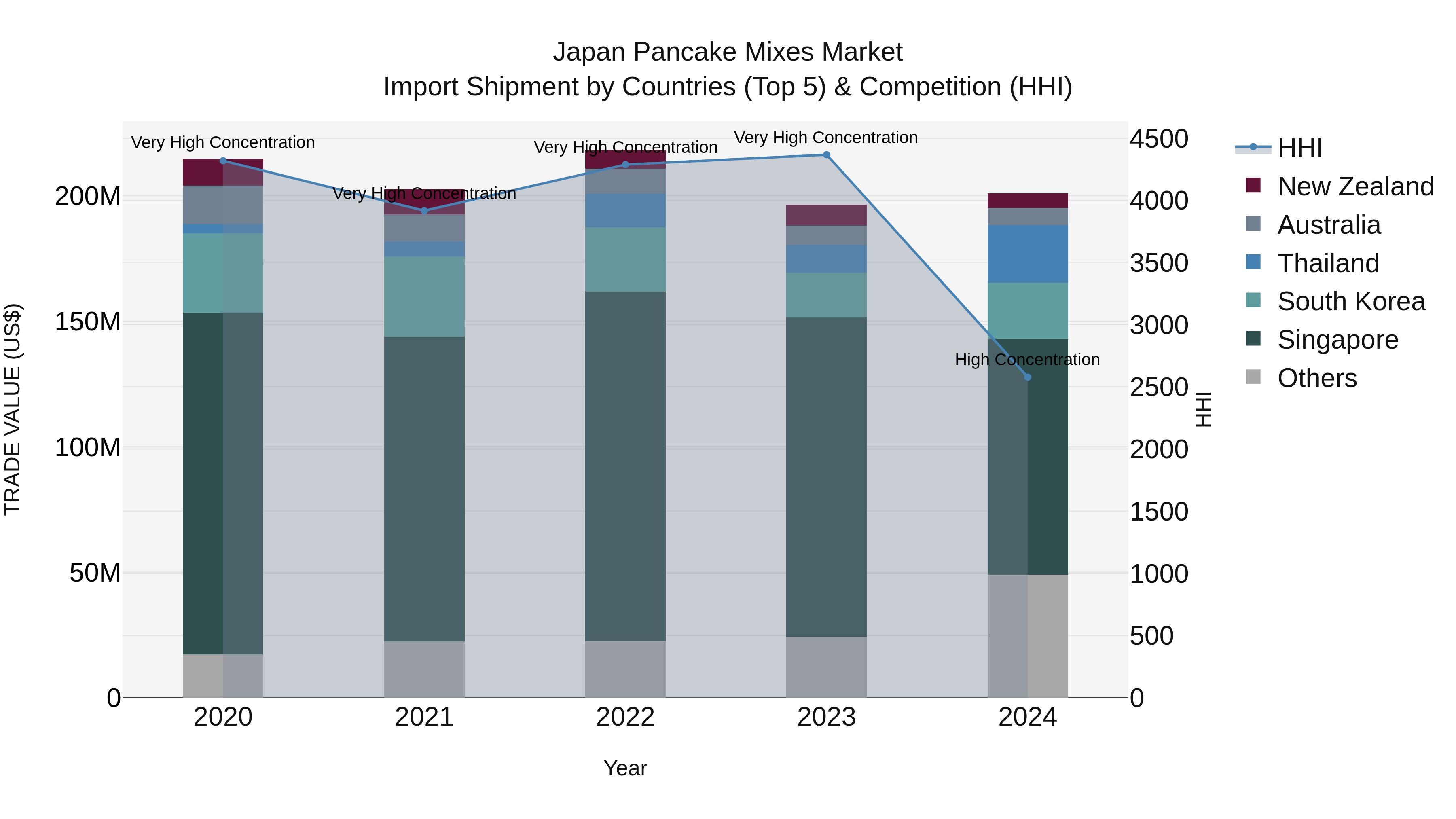
Japan Pancake Mixes Market Import Shipment by Countries (Top 5) & Competition (HHI)
Japan's pancake mix import market continues to see strong participation from Singapore, Thailand, South Korea, Malaysia, and Vietnam. The high Herfindahl-Hirschman Index (HHI) concentration in 2023 has transitioned to high concentration in 2024, indicating a competitive landscape among the exporting countries. Despite a slight decline in the compound annual growth rate (CAGR) from 2020-2024 at -1.64%, there was a positive growth rate of 2.3% from 2023-2024, suggesting a potential turnaround in the market dynamics. Market players should monitor these trends closely for strategic decision-making.
Japan Pancake Mixes Market Synopsis
The Japan pancake mixes market is witnessing steady growth driven by the increasing adoption of convenience foods and the rising trend of home baking. Consumers are increasingly looking for easy-to-make breakfast options that offer both convenience and quality. The market is characterized by a wide variety of pancake mix products catering to different dietary preferences such as gluten-free, organic, and low-sugar options. Key players in the market are focusing on product innovation, packaging design, and marketing strategies to attract consumers. The growing influence of Western food culture in Japan, especially among the younger population, is also contributing to the popularity of pancake mixes. Overall, the Japan pancake mixes market is expected to continue its growth trajectory as consumers seek convenient yet high-quality breakfast solutions.
Japan Pancake Mixes Market Trends
The Japan pancake mixes market is currently experiencing a surge in demand due to the growing popularity of homemade and gourmet breakfast options. Consumers are increasingly seeking convenient yet high-quality products to create delicious pancakes at home. Key trends in the market include the introduction of innovative flavors and ingredients, such as matcha and sweet potato, as well as the emphasis on healthier and organic options. Opportunities for market growth lie in targeting health-conscious consumers with gluten-free and low-sugar pancake mixes, as well as expanding distribution channels to reach a wider audience. Collaborations with popular cafes and restaurants for co-branded products can also help to drive sales and increase brand visibility in the competitive market landscape.
Japan Pancake Mixes Market Challenges
In the Japan Pancake Mixes Market, challenges include intense competition from both domestic and international brands, leading to price wars and pressure on profit margins. Additionally, there is a growing trend towards healthier eating habits, prompting consumers to seek alternatives to traditional pancake mixes that may be perceived as unhealthy. Meeting the evolving preferences of consumers for convenience, quality, and variety while maintaining affordability poses a challenge for market players. Furthermore, fluctuations in raw material prices and supply chain disruptions can impact the production and distribution of pancake mixes in Japan. Adapting to changing consumer preferences, maintaining product quality, and navigating competitive pressures are key challenges faced by companies operating in the Japan Pancake Mixes Market.
Japan Pancake Mixes Market Investment Opportunities
The Japan Pancake Mixes Market is being driven by several key factors. Firstly, the increasing trend of homemade cooking and baking among consumers is boosting the demand for convenient and easy-to-use pancake mixes. Additionally, the growing popularity of Western-style breakfasts and brunches in Japan is fueling the demand for pancake mixes as a convenient and tasty option. The influence of social media and food bloggers showcasing creative pancake recipes is also driving consumer interest in experimenting with different flavors and toppings. Furthermore, the availability of a wide range of pancake mix varieties, including gluten-free and organic options, is attracting health-conscious consumers looking for healthier breakfast alternatives. Overall, these factors are contributing to the growth of the Japan Pancake Mixes Market.
Japan Pancake Mixes Market Government Polices
The Japan Pancake Mixes Market is subject to government regulations related to food safety, packaging, labeling, and advertising. The Food Sanitation Act and the Food Labeling Act govern the quality and safety standards of pancake mixes, ensuring that they meet specified requirements for ingredients, nutritional information, and allergen labeling. Additionally, the Consumer Affairs Agency oversees advertising practices to prevent false or misleading claims about pancake mixes. Import and export regulations also play a role in shaping the market, with the Ministry of Agriculture, Forestry and Fisheries monitoring trade activities. Overall, government policies in Japan aim to safeguard consumer health, promote fair competition among pancake mix manufacturers, and maintain transparency in the marketplace.
Japan Pancake Mixes Market Future Outlook
The Japan Pancake Mixes Market is expected to witness steady growth in the coming years, driven by factors such as changing consumer preferences, increasing demand for convenient and easy-to-prepare breakfast options, and the growing popularity of homemade pancakes. The market is likely to see a surge in product innovation, with manufacturers introducing new flavors, healthier options, and premium offerings to cater to diverse consumer needs. Additionally, the rising trend of home baking and cooking during the COVID-19 pandemic has further boosted the demand for pancake mixes in Japan. As a result, the market is anticipated to expand, with key players focusing on marketing strategies, product diversification, and expanding distribution channels to capitalize on the growing demand for pancake mixes among Japanese consumers.
Key Highlights of the Report:
- Japan Pancake Mixes Market Outlook
- Market Size of Japan Pancake Mixes Market, 2024
- Forecast of Japan Pancake Mixes Market, 2031
- Historical Data and Forecast of Japan Pancake Mixes Revenues & Volume for the Period 2021- 2031
- Japan Pancake Mixes Market Trend Evolution
- Japan Pancake Mixes Market Drivers and Challenges
- Japan Pancake Mixes Price Trends
- Japan Pancake Mixes Porter's Five Forces
- Japan Pancake Mixes Industry Life Cycle
- Historical Data and Forecast of Japan Pancake Mixes Market Revenues & Volume By Distribution Channel for the Period 2021- 2031
- Historical Data and Forecast of Japan Pancake Mixes Market Revenues & Volume By Supermarket/Hypermarkets for the Period 2021- 2031
- Historical Data and Forecast of Japan Pancake Mixes Market Revenues & Volume By Convenience Stores for the Period 2021- 2031
- Historical Data and Forecast of Japan Pancake Mixes Market Revenues & Volume By Specialist Retailers for the Period 2021- 2031
- Historical Data and Forecast of Japan Pancake Mixes Market Revenues & Volume By Online Retail for the Period 2021- 2031
- Historical Data and Forecast of Japan Pancake Mixes Market Revenues & Volume By Other Channels for the Period 2021- 2031
- Japan Pancake Mixes Import Export Trade Statistics
- Market Opportunity Assessment By Distribution Channel
- Japan Pancake Mixes Top Companies Market Share
- Japan Pancake Mixes Competitive Benchmarking By Technical and Operational Parameters
- Japan Pancake Mixes Company Profiles
- Japan Pancake Mixes Key Strategic Recommendations






































