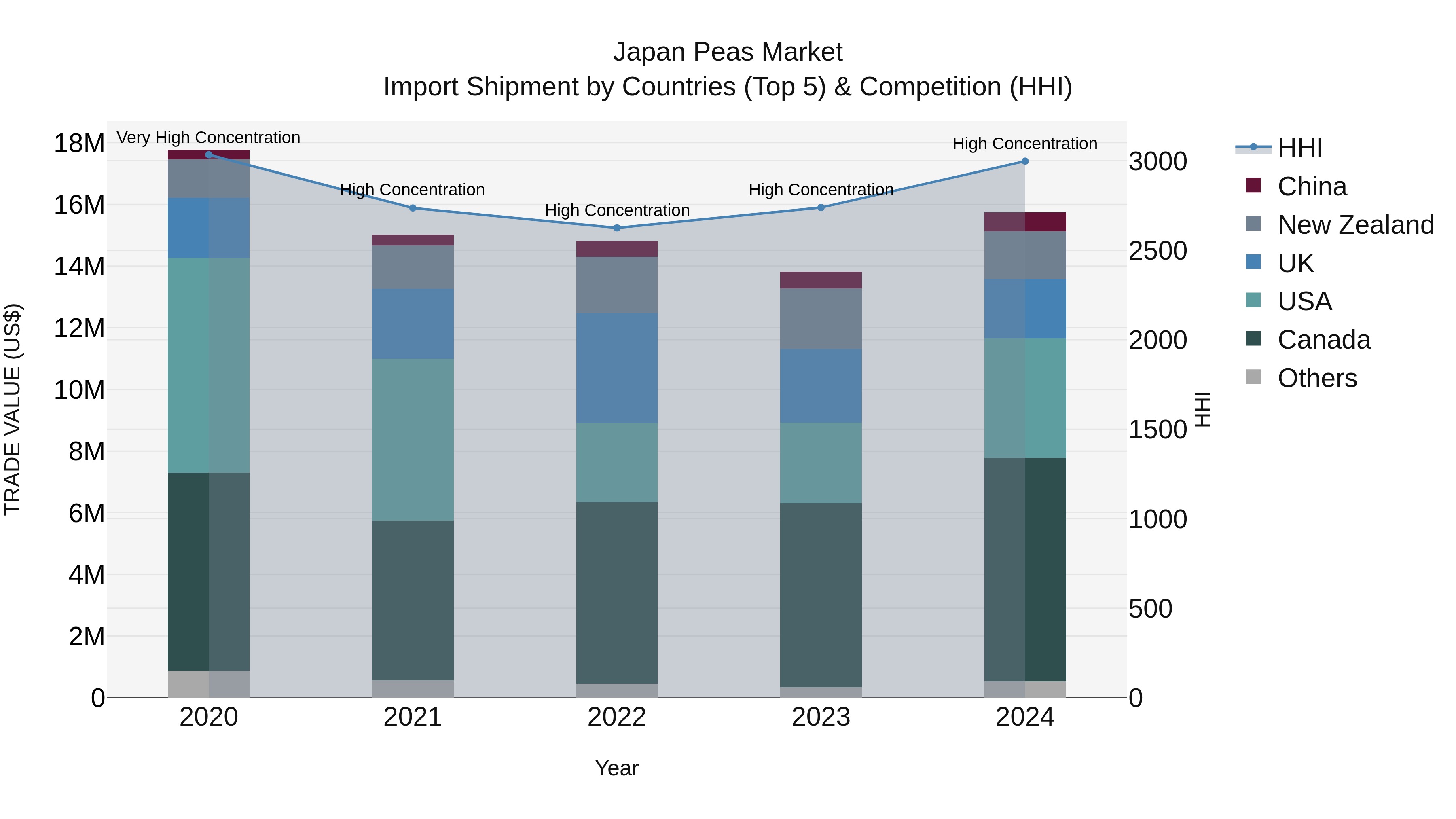
Japan Peas Market Import Shipment by Countries (Top 5) & Competition (HHI)
In 2024, Japan continued to import a significant amount of peas, with top exporters being Canada, USA, UK, New Zealand, and China. The market remained concentrated, as indicated by the high Herfindahl-Hirschman Index (HHI). Despite a negative compound annual growth rate (CAGR) from 2020-24, there was a notable growth spurt in 2024 with a 13.9% increase in import shipments. This suggests a potential shift in market dynamics and opportunities for suppliers to capitalize on the growing demand for peas in Japan.
Japan Peas Market Overview
The Japan peas market is characterized by a growing demand for plant-based protein sources driven by health-conscious consumers and a rising awareness of sustainability. Green peas, chickpeas, and black-eyed peas are commonly consumed in Japan, both as standalone dishes and as ingredients in various traditional and modern recipes. The market is witnessing a trend towards pea-based snacks, plant-based meat alternatives, and pea protein supplements. Key players in the Japan peas market include food manufacturers, retailers, and importers who are increasingly focusing on offering innovative pea-based products to cater to changing consumer preferences. Additionally, the government`s initiatives to promote sustainable agriculture and reduce meat consumption are further supporting the growth of the peas market in Japan.
Japan Peas Market Trends
The Japan peas market is experiencing a growing demand for plant-based protein sources, with peas gaining popularity due to their nutritional benefits and sustainability. Consumers are increasingly seeking alternatives to animal-based products, driving the demand for products like pea protein powders, plant-based meat substitutes, and snacks made from peas. Health-conscious consumers are also attracted to peas for their high protein and fiber content, as well as their low environmental impact. Additionally, the rise of vegan and vegetarian diets in Japan is further fueling the demand for pea-based products in the market. As a result, companies are focusing on innovating and expanding their product offerings to cater to this growing trend in the Japan peas market.
Japan Peas Market Challenges
In the Japan peas market, one of the main challenges faced is the competition from other popular food products such as soybeans and edamame. Peas are not traditionally a staple food in Japanese cuisine, which makes it challenging to increase consumer awareness and demand for peas. Additionally, there are issues related to import regulations and tariffs that can affect the cost and availability of peas in the market. Furthermore, changing consumer preferences towards healthier and plant-based foods present both an opportunity and a challenge for peas, as they need to position themselves effectively in this evolving market landscape to compete with other plant-based protein sources. Overall, overcoming these challenges will require targeted marketing efforts, product innovation, and building strong distribution channels in Japan.
Japan Peas Market Investment Opportunities
In the Japan peas market, there are several investment opportunities worth exploring. One potential opportunity lies in the growing demand for plant-based protein sources, including peas, driven by the increasing consumer preference for healthier and sustainable food options. Investing in pea protein production facilities or partnering with existing pea processing companies to expand their operations could be lucrative. Additionally, there is a rising trend of incorporating pea ingredients in various food products such as plant-based meat alternatives, dairy alternatives, snacks, and beverages, presenting opportunities for investment in product development and marketing. Furthermore, with government initiatives promoting sustainable agriculture practices and increasing focus on self-sufficiency in food production, investing in sustainable farming methods for pea cultivation could also yield positive returns in the Japan peas market.
Japan Peas Market Government Policy
The Japanese government implements policies to support and regulate the peas market. This includes subsidies for pea farmers to ensure stable production and prices, as well as quality control measures to maintain high standards for domestically grown peas. Import regulations are in place to protect local producers, with tariffs and quotas imposed on foreign peas entering the market. Additionally, the government promotes research and development initiatives to improve pea cultivation techniques and enhance overall market competitiveness. Overall, Japan`s peas market is influenced by a combination of support for domestic producers and measures to safeguard against external competition, ensuring a balance between supply and demand in the market.
Japan Peas Market Future Outlook
The future outlook for the Japan peas market appears promising, driven by increasing consumer demand for plant-based protein sources and the growing trend towards healthier eating habits. Peas, being a rich source of protein, fiber, and essential nutrients, are gaining popularity in various food products such as plant-based meat alternatives, snacks, and soups. Additionally, the emphasis on sustainability and environmental concerns is expected to further boost the demand for peas as they are considered a more environmentally friendly crop compared to animal-based protein sources. With ongoing innovation in product development and marketing strategies to promote the benefits of peas, the Japan peas market is likely to experience steady growth in the coming years, offering opportunities for both domestic producers and international suppliers to capitalize on this trend.
Key Highlights of the Report:
- Japan Peas Market Outlook
- Market Size of Japan Peas Market, 2024
- Forecast of Japan Peas Market, 2031
- Historical Data and Forecast of Japan Peas Revenues & Volume for the Period 2021 - 2031
- Japan Peas Market Trend Evolution
- Japan Peas Market Drivers and Challenges
- Japan Peas Price Trends
- Japan Peas Porter's Five Forces
- Japan Peas Industry Life Cycle
- Historical Data and Forecast of Japan Peas Market Revenues & Volume By Type for the Period 2021 - 2031
- Historical Data and Forecast of Japan Peas Market Revenues & Volume By Field Peas for the Period 2021 - 2031
- Historical Data and Forecast of Japan Peas Market Revenues & Volume By Garden Peas for the Period 2021 - 2031
- Historical Data and Forecast of Japan Peas Market Revenues & Volume By Others for the Period 2021 - 2031
- Historical Data and Forecast of Japan Peas Market Revenues & Volume By Application for the Period 2021 - 2031
- Historical Data and Forecast of Japan Peas Market Revenues & Volume By Food for the Period 2021 - 2031
- Historical Data and Forecast of Japan Peas Market Revenues & Volume By Others for the Period 2021 - 2031
- Historical Data and Forecast of Japan Peas Market Revenues & Volume By Distribution Channel for the Period 2021 - 2031
- Historical Data and Forecast of Japan Peas Market Revenues & Volume By Online for the Period 2021 - 2031
- Historical Data and Forecast of Japan Peas Market Revenues & Volume By Offline for the Period 2021 - 2031
- Historical Data and Forecast of Japan Peas Market Revenues & Volume By Others for the Period 2021 - 2031
- Japan Peas Import Export Trade Statistics
- Market Opportunity Assessment By Type
- Market Opportunity Assessment By Application
- Market Opportunity Assessment By Distribution Channel
- Japan Peas Top Companies Market Share
- Japan Peas Competitive Benchmarking By Technical and Operational Parameters
- Japan Peas Company Profiles
- Japan Peas Key Strategic Recommendations






































