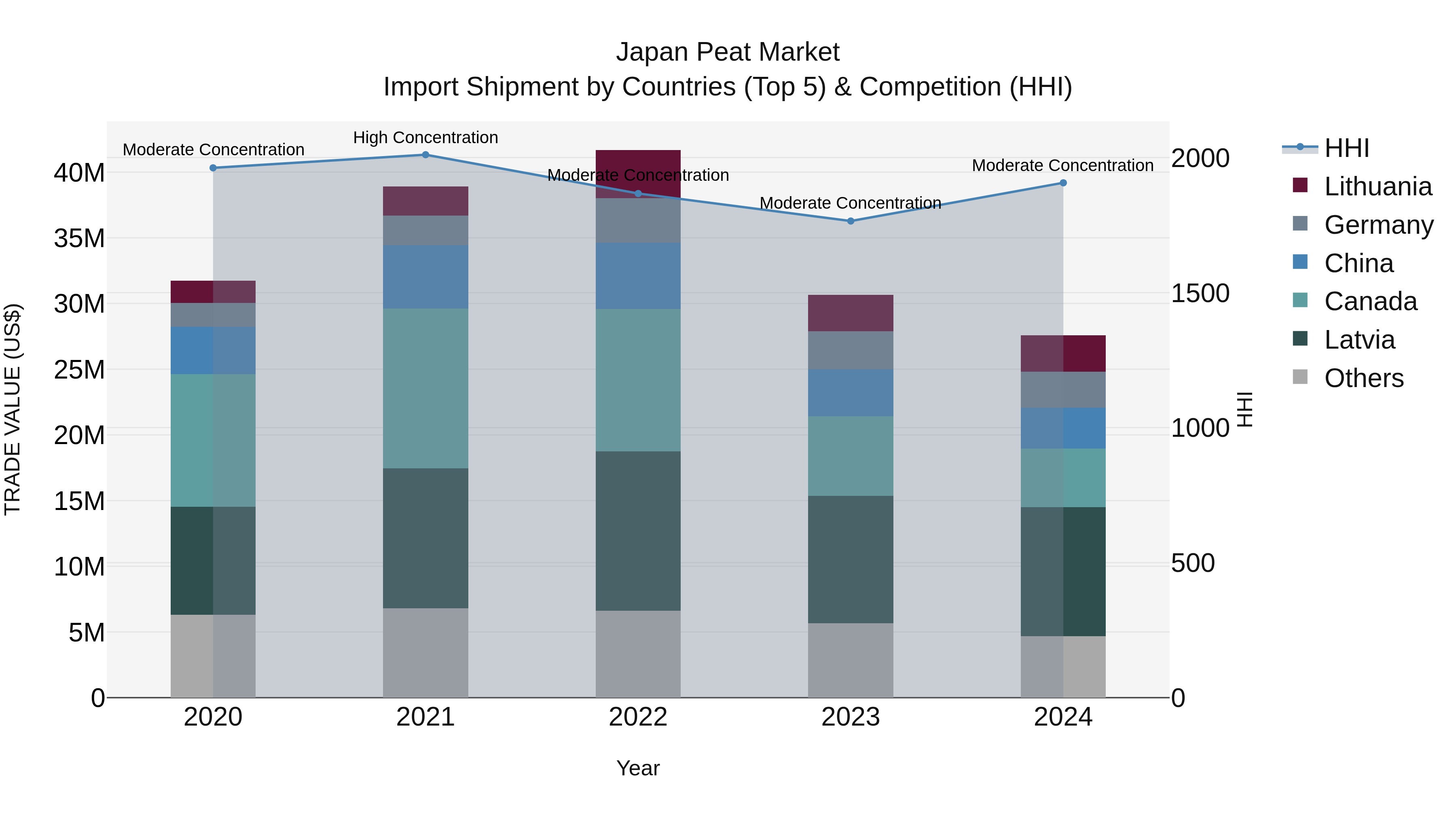
Japan Peat Market Import Shipment by Countries (Top 5) & Competition (HHI)
Japan's peat import market in 2024 continued to see significant contributions from top exporting countries including Latvia, Canada, China, Lithuania, and Germany. Despite a negative Compound Annual Growth Rate (CAGR) of -3.45% from 2020 to 2024 and a growth rate of -10.02% in 2023-24, the market concentration, as measured by the Herfindahl-Hirschman Index (HHI), remained at a moderate level. This suggests a stable competitive landscape in the peat import industry in Japan, with a diverse range of suppliers meeting the country's demand.
Japan Peat Market Overview
The Japan Peat Market is witnessing steady growth due to the increasing demand for peat moss as a soil amendment in agriculture and horticulture sectors. Peat is valued for its ability to improve soil structure, retain moisture, and enhance nutrient availability for plant growth. The market is also driven by the growing popularity of peat-based products in gardening and landscaping applications. However, environmental concerns surrounding peat extraction and its impact on carbon emissions are prompting a shift towards sustainable alternatives. This has led to a rising interest in peat substitutes such as coir, compost, and biochar among Japanese consumers. Overall, the Japan Peat Market is expected to continue evolving with a focus on sustainability and eco-friendly practices in the coming years.
Japan Peat Market Trends
The Japan peat market is experiencing a shift towards sustainable and environmentally-friendly practices, driven by increasing awareness of the importance of peatlands for biodiversity and climate change mitigation. There is a growing demand for responsibly sourced peat products that are certified as being harvested in a sustainable manner. Additionally, the Japanese government`s focus on promoting eco-friendly alternatives is influencing market players to explore peat substitutes and develop innovative solutions. Companies are also investing in research and development to create peat-free gardening products to cater to the environmentally-conscious consumer base. Overall, the Japan peat market is witnessing a transition towards more sustainable practices and products in response to evolving consumer preferences and regulatory pressures.
Japan Peat Market Challenges
In the Japan peat market, several challenges are faced, including environmental concerns related to peat extraction, declining availability of peat resources, and increasing regulations on peat usage. Environmental organizations have been advocating against peat extraction due to its negative impact on ecosystems and biodiversity. The limited availability of peat resources in Japan has led to concerns about sustainability and long-term supply. Additionally, the government has been implementing stricter regulations on peat usage, such as restrictions on peat mining and peatland conservation efforts. These challenges have forced businesses in the Japan peat market to explore alternative materials, improve sustainability practices, and adapt to changing regulations to remain competitive in the industry.
Japan Peat Market Investment Opportunities
The Japan Peat Market presents various investment opportunities for investors looking to capitalize on the growing demand for peat products in the region. With a focus on sustainable and organic gardening practices gaining popularity, there is a rising demand for peat moss as a soil conditioner and growing medium. Investing in peat extraction and processing facilities, as well as peat-based product manufacturing companies, could offer promising returns. Additionally, as Japan aims to reduce its dependence on fossil fuels, there is potential for investment in renewable energy projects utilizing peat as a biomass fuel source. Collaborating with local agricultural businesses or horticultural companies to develop innovative peat-based products tailored to the Japanese market could also be a lucrative investment strategy in the Japan Peat Market.
Japan Peat Market Government Policy
The Japanese government has implemented various policies to regulate and promote sustainable peatland management in the country. The Act on the Promotion of Peatland Conservation and Wise Use aims to conserve peatlands by restricting drainage and promoting restoration efforts. Additionally, the Law Concerning the Promotion of Utilization of Biomass Derived from Plants and Animals requires the sustainable use of biomass resources, including peat, to reduce greenhouse gas emissions. Furthermore, Japan is a signatory to the Ramsar Convention, which designates wetlands, including peatlands, as protected areas. These policies emphasize the importance of conserving peatlands for biodiversity, carbon sequestration, and water resources, aligning with global efforts to combat climate change and promote sustainable development.
Japan Peat Market Future Outlook
The Japan peat market is expected to witness moderate growth in the coming years. There is a growing demand for peat in various industries, including agriculture, horticulture, and energy. The increasing focus on sustainable practices and organic farming is driving the demand for peat as a soil conditioner and growing medium. However, environmental concerns surrounding the extraction of peat and its impact on carbon emissions are likely to restrict market growth to some extent. The market is also facing competition from alternative soil amendments and growing mediums. Overall, the Japan peat market is projected to expand steadily, with a shift towards sustainable peat extraction practices and the development of innovative peat-based products to meet the evolving needs of consumers and industries.
Key Highlights of the Report:
- Japan Peat Market Outlook
- Market Size of Japan Peat Market, 2021
- Forecast of Japan Peat Market, 2031
- Historical Data and Forecast of Japan Peat Revenues & Volume for the Period 2021 - 2031
- Japan Peat Market Trend Evolution
- Japan Peat Market Drivers and Challenges
- Japan Peat Price Trends
- Japan Peat Porter's Five Forces
- Japan Peat Industry Life Cycle
- Historical Data and Forecast of Japan Peat Market Revenues & Volume By Type for the Period 2021 - 2031
- Historical Data and Forecast of Japan Peat Market Revenues & Volume By Coco Peat for the Period 2021 - 2031
- Historical Data and Forecast of Japan Peat Market Revenues & Volume By Sod Peat for the Period 2021 - 2031
- Historical Data and Forecast of Japan Peat Market Revenues & Volume By Other for the Period 2021 - 2031
- Historical Data and Forecast of Japan Peat Market Revenues & Volume By Material Type for the Period 2021 - 2031
- Historical Data and Forecast of Japan Peat Market Revenues & Volume By Fibric for the Period 2021 - 2031
- Historical Data and Forecast of Japan Peat Market Revenues & Volume By Hemic for the Period 2021 - 2031
- Historical Data and Forecast of Japan Peat Market Revenues & Volume By Sapric for the Period 2021 - 2031
- Historical Data and Forecast of Japan Peat Market Revenues & Volume By Others for the Period 2021 - 2031
- Historical Data and Forecast of Japan Peat Market Revenues & Volume By Application for the Period 2021 - 2031
- Historical Data and Forecast of Japan Peat Market Revenues & Volume By Agriculture for the Period 2021 - 2031
- Historical Data and Forecast of Japan Peat Market Revenues & Volume By Fuel & Energy for the Period 2021 - 2031
- Historical Data and Forecast of Japan Peat Market Revenues & Volume By Others for the Period 2021 - 2031
- Japan Peat Import Export Trade Statistics
- Market Opportunity Assessment By Type
- Market Opportunity Assessment By Material Type
- Market Opportunity Assessment By Application
- Japan Peat Top Companies Market Share
- Japan Peat Competitive Benchmarking By Technical and Operational Parameters
- Japan Peat Company Profiles
- Japan Peat Key Strategic Recommendations






































