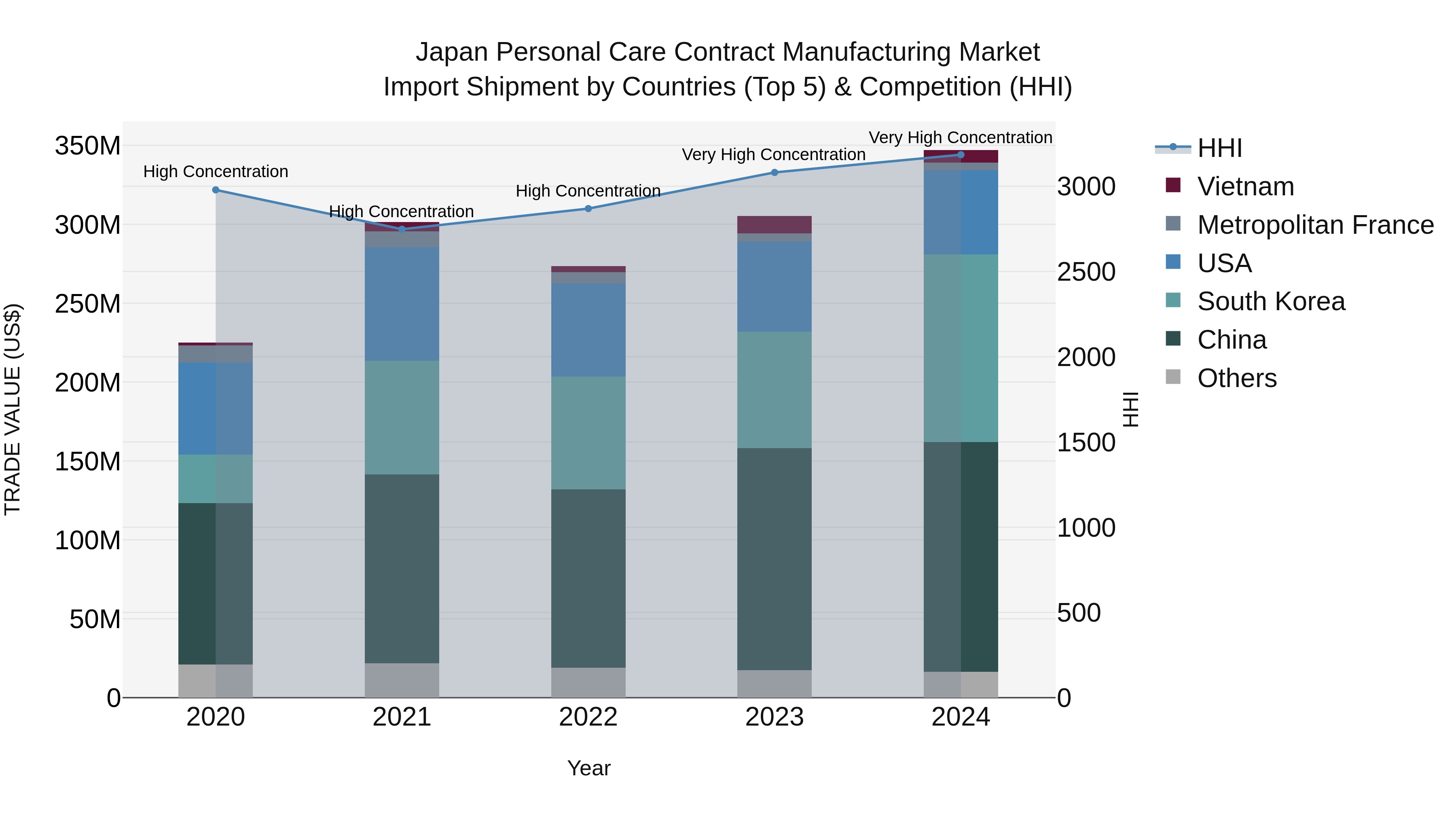
Japan Personal Care Contract Manufacturing Market Import Shipment by Countries (Top 5) & Competition (HHI)
The Japan personal care contract manufacturing import market continues to see significant growth, with a high concentration of imports from top exporting countries including China, South Korea, USA, Vietnam, and Metropolitan France. The high Herfindahl-Hirschman Index (HHI) indicates a concentrated market landscape. The compound annual growth rate (CAGR) from 2020 to 2024 stands at a robust 11.43%, with a notable growth rate of 13.69% in 2024 alone. These figures underscore the strong demand for personal care products and the strategic importance of these key exporting countries in meeting Japan's market needs.
Japan Personal Care Contract Manufacturing Market Synopsis
The Japan Personal Care Contract Manufacturing Market is a thriving sector characterized by a high demand for private label personal care products. Contract manufacturers in Japan offer a wide range of services including formulation development, packaging, and regulatory support. The market is driven by the increasing consumer preference for customized and niche personal care products, leading brands to outsource manufacturing to specialist companies. Key players in the market focus on innovation, quality, and compliance with strict regulations. The industry is witnessing growth due to the rising awareness of skincare and hygiene, driving the demand for contract manufacturing services. With a focus on cutting-edge technologies and sustainable practices, the Japan Personal Care Contract Manufacturing Market is poised for further expansion in the coming years.
Japan Personal Care Contract Manufacturing Market Trends
In the Japan Personal Care Contract Manufacturing Market, there is a growing trend towards eco-friendly and sustainable practices. Consumers are increasingly seeking products that are not only effective but also environmentally conscious, leading contract manufacturers to focus on developing sustainable formulations and packaging solutions. Another key trend is the rising demand for custom and personalized products, driving manufacturers to offer a variety of options to cater to individual preferences. Additionally, there is a growing interest in natural and organic ingredients, with consumers becoming more mindful of the ingredients used in their personal care products. Contract manufacturers in Japan are adapting to these trends by incorporating innovative technologies and processes to meet the evolving needs of both consumers and brands seeking their services.
Japan Personal Care Contract Manufacturing Market Challenges
In the Japan Personal Care Contract Manufacturing Market, challenges such as strict regulations and compliance requirements, especially in terms of product quality and safety standards, can pose significant obstacles for manufacturers. Additionally, the increasing demand for innovative and customized products from consumers puts pressure on contract manufacturers to invest in research and development capabilities to stay competitive. Limited availability of skilled labor and the need for continuous technological advancements further add complexity to the market. Moreover, fluctuations in raw material prices and global supply chain disruptions can impact production costs and lead to supply chain challenges. Overall, navigating these challenges while meeting client expectations and maintaining profitability remains a key concern for players in the Japan Personal Care Contract Manufacturing Market.
Japan Personal Care Contract Manufacturing Market Investment Opportunities
The Japan Personal Care Contract Manufacturing Market presents promising investment opportunities due to the growing demand for high-quality personal care products in the region. With consumers becoming increasingly conscious about ingredients, sustainability, and customization in their beauty and personal care products, there is a need for contract manufacturers that can offer innovative formulations and packaging solutions. Investing in contract manufacturing companies that specialize in skincare, haircare, and cosmetic products can be lucrative, as they can cater to both local Japanese brands and international companies looking to enter the Japanese market. Additionally, focusing on technologies such as clean beauty, natural ingredients, and eco-friendly packaging can further enhance the attractiveness of investments in this market segment.
Jordan Agar Market Government Policies
The Japan Personal Care Contract Manufacturing Market is primarily regulated by the Pharmaceutical Affairs Law and the Cosmetic Affairs Law, overseen by the Ministry of Health, Labour and Welfare (MHLW). These laws govern the manufacturing, labeling, and distribution of personal care products to ensure consumer safety and product quality. Contract manufacturing companies in Japan must comply with strict regulations regarding ingredients, production processes, and packaging to meet the standards set by the MHLW. Additionally, companies are required to obtain manufacturing licenses and adhere to Good Manufacturing Practices (GMP) to operate in the market. The government`s focus on consumer protection and product quality underscores the importance of compliance and transparency in the Japan Personal Care Contract Manufacturing Market.
Japan Personal Care Contract Manufacturing Market Future Outlook
The Japan Personal Care Contract Manufacturing Market is poised for steady growth in the coming years, driven by increasing consumer demand for personalized and innovative beauty products. With a growing aging population and rising awareness of skincare and wellness, there is a rising need for high-quality and specialized personal care products. Contract manufacturing offers companies the flexibility to outsource production while focusing on branding and marketing efforts. Furthermore, the market is expected to benefit from advancements in technology, such as AI and automation, enhancing production efficiency and product customization. Overall, the Japan Personal Care Contract Manufacturing Market is forecasted to expand as companies seek to enhance their product offerings and cater to the evolving preferences of consumers.
Key Highlights of the Report:
- Japan Personal Care Contract Manufacturing Market Outlook
- Market Size of Japan Personal Care Contract Manufacturing Market, 2024
- Forecast of Japan Personal Care Contract Manufacturing Market, 2031
- Historical Data and Forecast of Japan Personal Care Contract Manufacturing Revenues & Volume for the Period 2021- 2031
- Japan Personal Care Contract Manufacturing Market Trend Evolution
- Japan Personal Care Contract Manufacturing Market Drivers and Challenges
- Japan Personal Care Contract Manufacturing Price Trends
- Japan Personal Care Contract Manufacturing Porter's Five Forces
- Japan Personal Care Contract Manufacturing Industry Life Cycle
- Historical Data and Forecast of Japan Personal Care Contract Manufacturing Market Revenues & Volume By Service for the Period 2021- 2031
- Historical Data and Forecast of Japan Personal Care Contract Manufacturing Market Revenues & Volume By Manufacturing for the Period 2021- 2031
- Historical Data and Forecast of Japan Personal Care Contract Manufacturing Market Revenues & Volume By Custom Formulations for the Period 2021- 2031
- Historical Data and Forecast of Japan Personal Care Contract Manufacturing Market Revenues & Volume By Packaging for the Period 2021- 2031
- Historical Data and Forecast of Japan Personal Care Contract Manufacturing Market Revenues & Volume By Others for the Period 2021- 2031
- Historical Data and Forecast of Japan Personal Care Contract Manufacturing Market Revenues & Volume By Formulations for the Period 2021- 2031
- Historical Data and Forecast of Japan Personal Care Contract Manufacturing Market Revenues & Volume By Solutions for the Period 2021- 2031
- Historical Data and Forecast of Japan Personal Care Contract Manufacturing Market Revenues & Volume By Creams/Emulsions for the Period 2021- 2031
- Historical Data and Forecast of Japan Personal Care Contract Manufacturing Market Revenues & Volume By Lotions for the Period 2021- 2031
- Historical Data and Forecast of Japan Personal Care Contract Manufacturing Market Revenues & Volume By Suspensions for the Period 2021- 2031
- Historical Data and Forecast of Japan Personal Care Contract Manufacturing Market Revenues & Volume By Ointments/Pastes for the Period 2021- 2031
- Historical Data and Forecast of Japan Personal Care Contract Manufacturing Market Revenues & Volume By Powders for the Period 2021- 2031
- Historical Data and Forecast of Japan Personal Care Contract Manufacturing Market Revenues & Volume By Gels for the Period 2021- 2031
- Historical Data and Forecast of Japan Personal Care Contract Manufacturing Market Revenues & Volume By Category for the Period 2021- 2031
- Historical Data and Forecast of Japan Personal Care Contract Manufacturing Market Revenues & Volume By Mass Product for the Period 2021- 2031
- Historical Data and Forecast of Japan Personal Care Contract Manufacturing Market Revenues & Volume By Premium Product for the Period 2021- 2031
- Historical Data and Forecast of Japan Personal Care Contract Manufacturing Market Revenues & Volume By Professional Products for the Period 2021- 2031
- Japan Personal Care Contract Manufacturing Import Export Trade Statistics
- Market Opportunity Assessment By Service
- Market Opportunity Assessment By Formulations
- Market Opportunity Assessment By Category
- Japan Personal Care Contract Manufacturing Top Companies Market Share
- Japan Personal Care Contract Manufacturing Competitive Benchmarking By Technical and Operational Parameters
- Japan Personal Care Contract Manufacturing Company Profiles
- Japan Personal Care Contract Manufacturing Key Strategic Recommendations






































