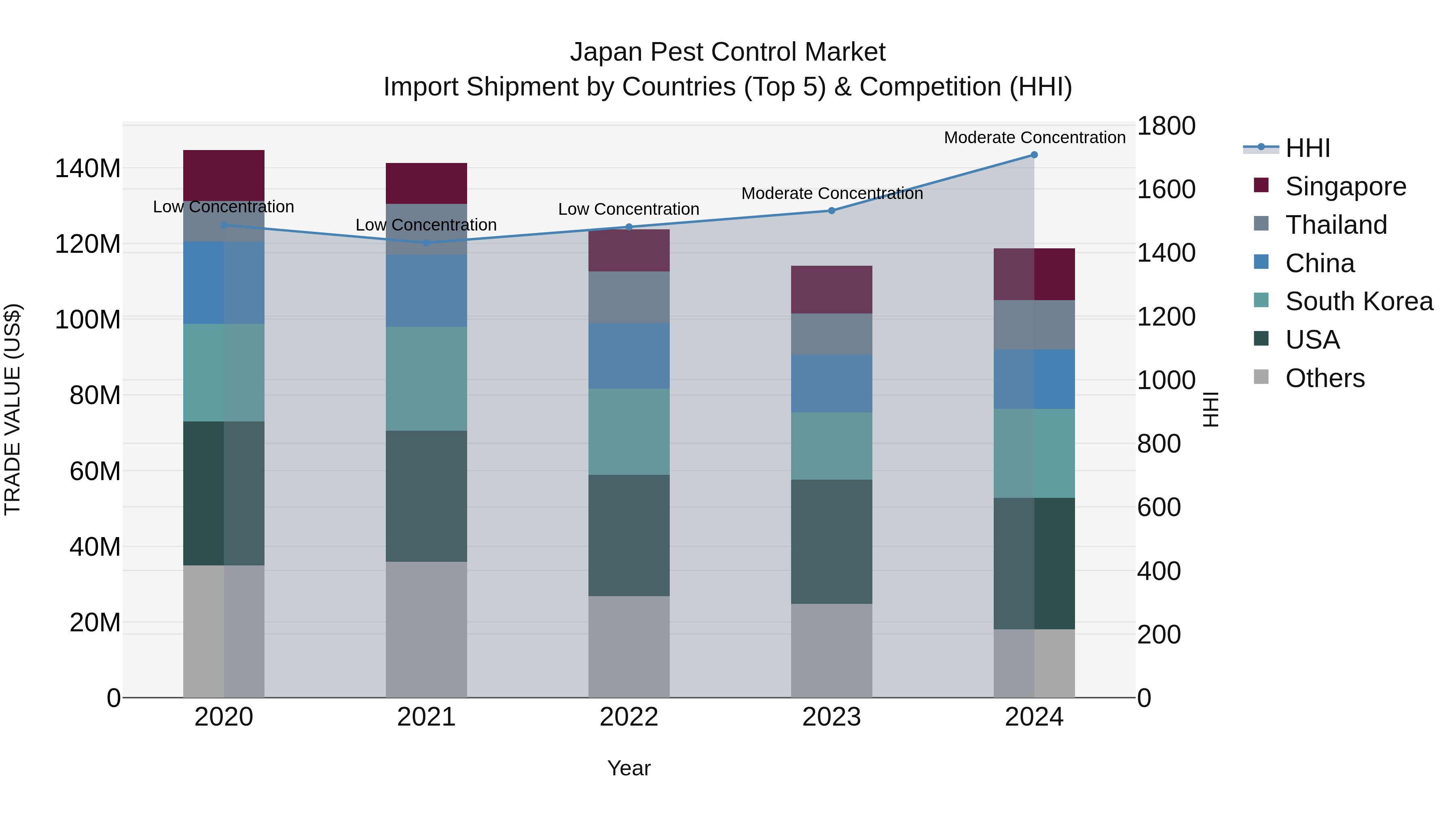
Japan Pest Control Market Import Shipment by Countries (Top 5) & Competition (HHI)
Japan's pest control import shipments in 2024 saw key contributions from the USA, South Korea, China, Singapore, and Thailand. Despite moderate concentration indicated by the Herfindahl-Hirschman Index (HHI), the industry experienced a slight decline with a compound annual growth rate (CAGR) of -4.83% from 2020 to 2024. However, there was a positive growth rate of 3.99% from 2023 to 2024, indicating a potential rebound in the market. The diverse mix of exporting countries reflects a competitive landscape in Japan's pest control sector.
Japan Pest Control Market Synopsis
The Japan Pest Control Market is a rapidly growing industry driven by factors such as increasing urbanization, rising prevalence of pest-related diseases, and growing awareness about the importance of pest control in maintaining hygiene and health standards. The market is characterized by a wide range of services including insect control, rodent control, bird control, and termite control, with a strong emphasis on environmentally-friendly and sustainable pest management solutions. Key players in the market are constantly innovating to develop advanced pest control products and services, leveraging technology such as IoT and data analytics for more effective pest monitoring and control. Government regulations and initiatives aimed at promoting integrated pest management practices further contribute to the growth of the market, making Japan a lucrative market for pest control companies.
Japan Pest Control Market Trends
The Japan pest control market is experiencing significant growth driven by increasing awareness about the health risks associated with pest infestations and the rising demand for sustainable and eco-friendly pest control solutions. Integrated pest management (IPM) practices, which focus on minimizing pesticide use and promoting natural pest control methods, are gaining popularity among both residential and commercial customers. Technological advancements in pest control products and services, such as the use of smart sensors and data analytics for more targeted treatments, are also shaping the market landscape. Additionally, the ongoing urbanization and expansion of food processing industries in Japan are fueling the demand for professional pest control services to ensure compliance with hygiene and safety standards. Overall, the Japan pest control market is poised for continued growth and innovation in the coming years.
Japan Pest Control Market Challenges
In the Japan Pest Control Market, some of the key challenges include strict regulations and restrictions on the use of certain chemicals, increasing consumer demand for environmentally-friendly and non-toxic pest control solutions, and competition from both established local companies and international players entering the market. Additionally, the aging population in Japan presents a unique challenge as older individuals may be more susceptible to health risks associated with traditional pest control methods. Furthermore, the seasonality of certain pests in Japan can lead to fluctuating demand for pest control services, making it challenging for companies to maintain a consistent revenue stream throughout the year. Overall, companies operating in the Japan Pest Control Market need to adapt to changing consumer preferences, navigate regulatory hurdles, and differentiate themselves in a competitive landscape to succeed in this market.
Japan Pest Control Market Investment Opportunities
The Japan pest control market offers various investment opportunities due to the increasing awareness and demand for pest management services. With a growing emphasis on hygiene and sanitation in residential, commercial, and industrial sectors, there is a need for innovative and eco-friendly pest control solutions. Investing in companies that specialize in integrated pest management techniques, sustainable practices, and digital technology for efficient pest control services could be lucrative. Additionally, there is potential for growth in the development of organic and natural pest control products to cater to the rising demand for eco-conscious solutions. Collaborating with local pest control service providers or entering joint ventures to leverage expertise and expand market reach could also be beneficial for investors looking to capitalize on the evolving pest control industry in Japan.
Japan Pest Control Market Future Outlook
The Japan Pest Control Market is expected to witness steady growth in the coming years due to increasing awareness about the health risks associated with pest infestations. Factors such as urbanization, growth in the hospitality industry, and changing consumer preferences towards maintaining clean environments are driving the demand for pest control services in the country. Additionally, the implementation of strict regulations regarding pest control practices and the rising prevalence of vector-borne diseases are further boosting market growth. Technological advancements in pest control methods, such as the use of eco-friendly products and digital monitoring systems, are also anticipated to fuel the market expansion. Overall, the Japan Pest Control Market is projected to experience sustained growth as the need for effective pest management solutions continues to rise.
Key Highlights of the Report:
- Japan Pest Control Market Outlook
- Market Size of Japan Pest Control Market, 2021
- Forecast of Japan Pest Control Market, 2031
- Historical Data and Forecast of Japan Pest Control Revenues & Volume for the Period 2018 - 2031
- Japan Pest Control Market Trend Evolution
- Japan Pest Control Market Drivers and Challenges
- Japan Pest Control Price Trends
- Japan Pest Control Porter's Five Forces
- Japan Pest Control Industry Life Cycle
- Historical Data and Forecast of Japan Pest Control Market Revenues & Volume By Pest Type for the Period 2018 - 2031
- Historical Data and Forecast of Japan Pest Control Market Revenues & Volume By Insects for the Period 2018 - 2031
- Historical Data and Forecast of Japan Pest Control Market Revenues & Volume By Termites for the Period 2018 - 2031
- Historical Data and Forecast of Japan Pest Control Market Revenues & Volume By Rodents for the Period 2018 - 2031
- Historical Data and Forecast of Japan Pest Control Market Revenues & Volume By Wildlife for the Period 2018 - 2031
- Historical Data and Forecast of Japan Pest Control Market Revenues & Volume By Other pest types (birds, reptiles, and mollusks) for the Period 2018 - 2031
- Historical Data and Forecast of Japan Pest Control Market Revenues & Volume By Control Method for the Period 2018 - 2031
- Historical Data and Forecast of Japan Pest Control Market Revenues & Volume By Chemical for the Period 2018 - 2031
- Historical Data and Forecast of Japan Pest Control Market Revenues & Volume By Biological for the Period 2018 - 2031
- Historical Data and Forecast of Japan Pest Control Market Revenues & Volume By Mechanical for the Period 2018 - 2031
- Historical Data and Forecast of Japan Pest Control Market Revenues & Volume By Software & services for the Period 2018 - 2031
- Historical Data and Forecast of Japan Pest Control Market Revenues & Volume By Mode of Application for the Period 2018 - 2031
- Historical Data and Forecast of Japan Pest Control Market Revenues & Volume By Powder for the Period 2018 - 2031
- Historical Data and Forecast of Japan Pest Control Market Revenues & Volume By Sprays for the Period 2018 - 2031
- Historical Data and Forecast of Japan Pest Control Market Revenues & Volume By Pellets for the Period 2018 - 2031
- Historical Data and Forecast of Japan Pest Control Market Revenues & Volume By Traps for the Period 2018 - 2031
- Historical Data and Forecast of Japan Pest Control Market Revenues & Volume By Baits for the Period 2018 - 2031
- Historical Data and Forecast of Japan Pest Control Market Revenues & Volume By Application: for the Period 2018 - 2031
- Historical Data and Forecast of Japan Pest Control Market Revenues & Volume By Residential for the Period 2018 - 2031
- Historical Data and Forecast of Japan Pest Control Market Revenues & Volume By Commercial for the Period 2018 - 2031
- Historical Data and Forecast of Japan Pest Control Market Revenues & Volume By Livestock for the Period 2018 - 2031
- Historical Data and Forecast of Japan Pest Control Market Revenues & Volume By Industrial for the Period 2018 - 2031
- Historical Data and Forecast of Japan Pest Control Market Revenues & Volume By Other applications (non-commercial institutions, storage & transport facilities, and public landscapes) for the Period 2018 - 2031
- Japan Pest Control Import Export Trade Statistics
- Market Opportunity Assessment By Pest Type
- Market Opportunity Assessment By Control Method
- Market Opportunity Assessment By Mode of Application
- Market Opportunity Assessment By Application:
- Japan Pest Control Top Companies Market Share
- Japan Pest Control Competitive Benchmarking By Technical and Operational Parameters
- Japan Pest Control Company Profiles
- Japan Pest Control Key Strategic Recommendations






































