Japan Photosensitive Semiconductor Device Market Size, Share & Growth Rate
The Japan Photosensitive Semiconductor Device Market was estimated at USD 358 Million in 2025 and is projected to reach USD 439 Million by 2032, growing at a CAGR of 3.0% from 2026 to 2032. This growth trajectory is significantly influenced by the burgeoning applications of photosensitive semiconductor devices across automotive, consumer electronics, and industrial sectors. Additionally, the accelerating integration of IoT and artificial intelligence technologies is further propelling the demand for advanced sensors, creating a fertile ground for innovation and expansion within the market.
Japan Photosensitive Semiconductor Device Market Year-wise Growth Rate and Key Drivers
This graph highlights how the Japan Photosensitive Semiconductor Device Market has steadily grown over the years, supported by major growth factors.
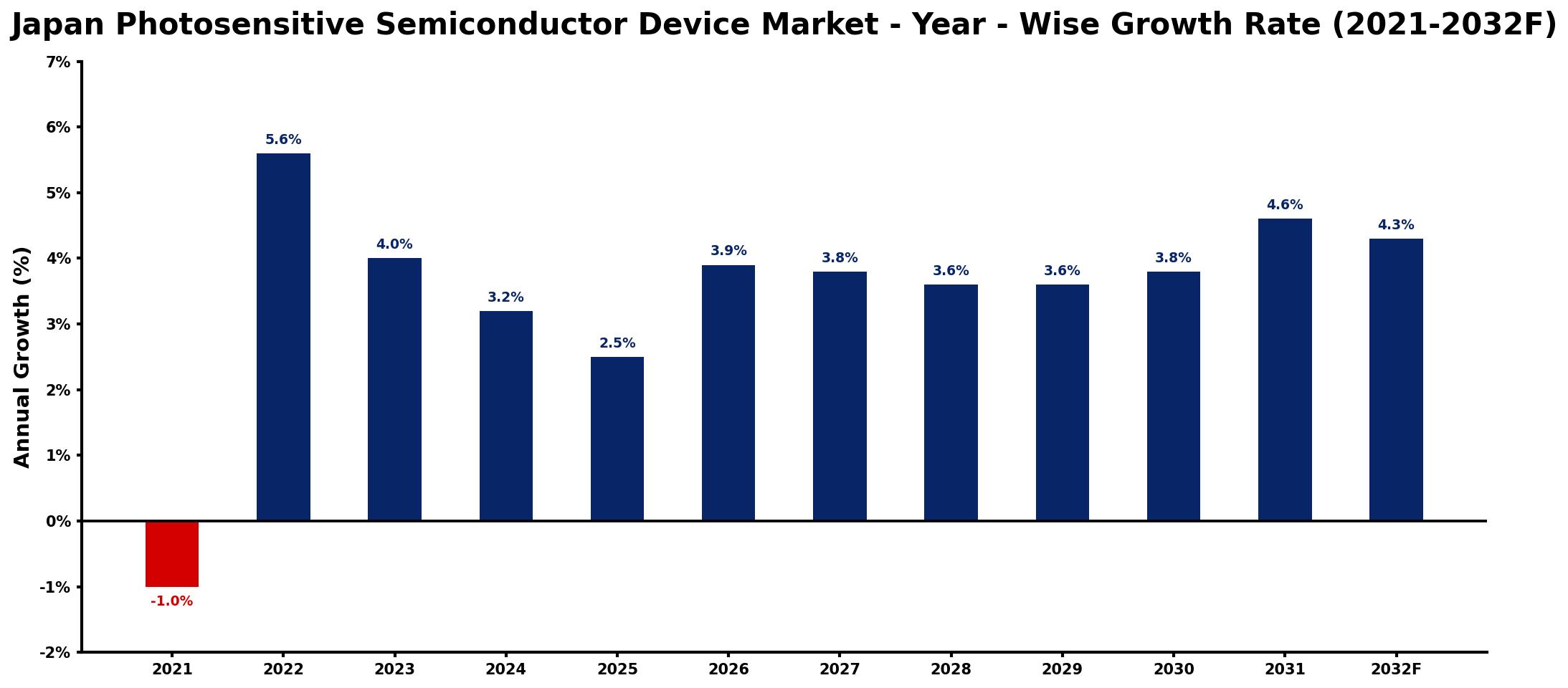
The table below presents the year‑wise growth rates along with the key drivers influencing the market
| Year | Growth Rate | Major Drivers |
| 2021 | -1.0% | Reduced investments in new technologies |
| 2022 | 5.6% | Growing demand for renewable energy |
| 2023 | 4.0% | Expansion of smart city initiatives |
| 2024 | 3.2% | Increased adoption of automation |
| 2025 | 2.5% | Rising interest in energy efficiency |
| 2026 | 3.9% | Emergence of advanced manufacturing techniques |
| 2027 | 3.8% | Growth in electric vehicle market |
| 2028 | 3.6% | Surge in IoT applications |
| 2029 | 3.6% | Enhanced focus on sustainable solutions |
| 2030 | 3.8% | Advancements in research and development |
| 2031 | 4.6% | Increased collaboration in technology sectors |
| 2032 | 4.3% | Higher government support for innovation |
Note: Market size estimations and growth projections presented in this report are based on 6Wresearch's proprietary forecasting methodology, utilizing the latest available industry data, government publications, and primary research inputs.
Japan Photosensitive Semiconductor Device Market Synopsis
Recently, the Japan Photosensitive Semiconductor Device Market has experienced a robust surge, driven by technological advancements and escalating applications in various fields. As we look ahead, the market is set to further evolve with a shift towards increasingly sophisticated and integrated sensors that meet the demands of smart devices and automated systems.
The momentum of growth reflects the dual pressures of innovation and consumer expectations. The market's future seems particularly promising, with the ongoing trend of miniaturization and the strong push towards smart cities and autonomous vehicles. These developments are essential for maintaining Japan's competitive edge in the global semiconductor landscape.
Japan Photosensitive Semiconductor Device Market Key Takeaways
- Significant growth is anticipated in the market due to the rising demand for high-performance sensors.
- Integration with AI and IoT technologies is becoming a major focus for manufacturers.
- Government initiatives are creating a supportive environment for innovation and investment.
- The market is characterized by intense competition and rapidly evolving technology.
- Miniaturization trends are driving the development of compact and efficient devices.
Evaluation of Restraints in Japan Photosensitive Semiconductor Device Market
Despite the positive outlook, several challenges restrain the Japan Photosensitive Semiconductor Device Market. Intense competition from global players creates pressure on margins and necessitates constant innovation. Additionally, the rapid pace of technological change leads to shorter product lifecycles, compelling manufacturers to invest heavily in research and development to stay relevant. Furthermore, compliance with regulatory standards can be a daunting task, hampering the swift market entry of new products.
Japan Photosensitive Semiconductor Device Market Trends
The market is currently witnessing a shift towards the adoption of cutting-edge technologies such as CMOS image sensors and photodiodes. This trend is largely driven by applications in automotive systems, consumer electronics, and industrial automation. Furthermore, there's an increasing emphasis on developing high-sensitivity sensors with low power consumption, particularly in response to emerging trends in autonomous driving and smart technologies.
Moreover, manufacturers are focusing on the integration of artificial intelligence into their products to create more intelligent and efficient sensing solutions. This convergence of technologies is set to redefine the capabilities and functionalities of photosensitive devices, enhancing their appeal across a myriad of applications.
Japan Photosensitive Semiconductor Device Market Opportunities
Opportunities abound for investment in the Japan Photosensitive Semiconductor Device Market, primarily due to the surging demand in automotive, consumer electronics, and healthcare sectors. The focus on advanced technologies presents a lucrative avenue for companies specializing in the development of innovative semiconductor devices. Additionally, government initiatives aimed at promoting smart technologies and enhancing research and development are anticipated to further bolster market growth, attracting both domestic and international investments.
Government Initiatives in the Japan Photosensitive Semiconductor Device Market
The Japanese government has been proactive in fostering the growth of the Photosensitive Semiconductor Device Market. Initiatives include financial incentives for research and development in semiconductor technologies, as well as regulatory frameworks to ensure product quality and safety. The government also encourages collaboration between industry players and academic institutions, driving innovation and enhancing Japans competitive positioning in the global semiconductor market.
Future Insights of the Japan Photosensitive Semiconductor Device Market
Looking ahead to the period between 2026 and 2032, the Japan Photosensitive Semiconductor Device Market is anticipated to witness steady growth. This expansion will be supported by increasing demand for sensors in automotive applications and an accelerated shift towards smart devices and solutions. The ongoing advancements in image sensing technologies and the strong emphasis on automation will position Japanese companies favorably to meet evolving consumer needs and capture a significant share of the global market.
Japan Photosensitive Semiconductor Device Market Latest Developments (2025 - 2026)
In recent months, the Japan Photosensitive Semiconductor Device Market has seen significant developments driven by technological advancements and industry collaborations. Companies are launching new high-performance sensors designed to meet the rigorous demands of emerging applications. Additionally, partnerships between manufacturers and technology firms are becoming more common, focusing on integrating AI and IoT into semiconductor devices to enhance functionality and efficiency. These trends indicate a dynamic and rapidly evolving market landscape.
Japan Photosensitive Semiconductor Device Market - Key Attractiveness of the Report
- 10 Years of Market Numbers
- Historical Data Starting from 2022 to 2025
- Base Year: 2025
- Forecast Data until 2032
- Key Performance Indicators Impacting the Market
- Major Upcoming Developments and Projects
Key Highlights of the Report:
- Japan Photosensitive Semiconductor Device Market Outlook
- Market Size of Japan Photosensitive Semiconductor Device Market, 2025
- Forecast of Japan Photosensitive Semiconductor Device Market, 2032
- Historical Data and Forecast of Japan Photosensitive Semiconductor Device Revenues & Volume for the Period 2022-2032F
- Japan Photosensitive Semiconductor Device Market Trend Evolution
- Japan Photosensitive Semiconductor Device Market Drivers and Challenges
- Japan Photosensitive Semiconductor Device Price Trends
- Japan Photosensitive Semiconductor Device Porter's Five Forces
- Japan Photosensitive Semiconductor Device Industry Life Cycle
- Historical Data and Forecast of Japan Photosensitive Semiconductor Device Market Revenues & Volume By Device for the Period 2022-2032F
- Historical Data and Forecast of Japan Photosensitive Semiconductor Device Market Revenues & Volume By Photocell for the Period 2022-2032F
- Historical Data and Forecast of Japan Photosensitive Semiconductor Device Market Revenues & Volume By Photodiode for the Period 2022-2032F
- Historical Data and Forecast of Japan Photosensitive Semiconductor Device Market Revenues & Volume By Phototransistor for the Period 2022-2032F
- Historical Data and Forecast of Japan Photosensitive Semiconductor Device Market Revenues & Volume By Photoresistor for the Period 2022-2032F
- Historical Data and Forecast of Japan Photosensitive Semiconductor Device Market Revenues & Volume By Photo IC for the Period 2022-2032F
- Historical Data and Forecast of Japan Photosensitive Semiconductor Device Market Revenues & Volume By End User for the Period 2022-2032F
- Historical Data and Forecast of Japan Photosensitive Semiconductor Device Market Revenues & Volume By Automotive and Transportation for the Period 2022-2032F
- Historical Data and Forecast of Japan Photosensitive Semiconductor Device Market Revenues & Volume By Consumer Electronics for the Period 2022-2032F
- Historical Data and Forecast of Japan Photosensitive Semiconductor Device Market Revenues & Volume By Aerospace and Defence for the Period 2022-2032F
- Historical Data and Forecast of Japan Photosensitive Semiconductor Device Market Revenues & Volume By Healthcare for the Period 2022-2032F
- Historical Data and Forecast of Japan Photosensitive Semiconductor Device Market Revenues & Volume By Industrial for the Period 2022-2032F
- Historical Data and Forecast of Japan Photosensitive Semiconductor Device Market Revenues & Volume By Security and Survelliance for the Period 2022-2032F
- Japan Photosensitive Semiconductor Device Import Export Trade Statistics
- Market Opportunity Assessment By Device
- Market Opportunity Assessment By End User
- Japan Photosensitive Semiconductor Device Top Companies Market Share
- Japan Photosensitive Semiconductor Device Competitive Benchmarking By Technical and Operational Parameters
- Japan Photosensitive Semiconductor Device Company Profiles
- Japan Photosensitive Semiconductor Device Key Strategic Recommendations






































