Japan Physical Security Market Size & Growth Rate (2026-2032)
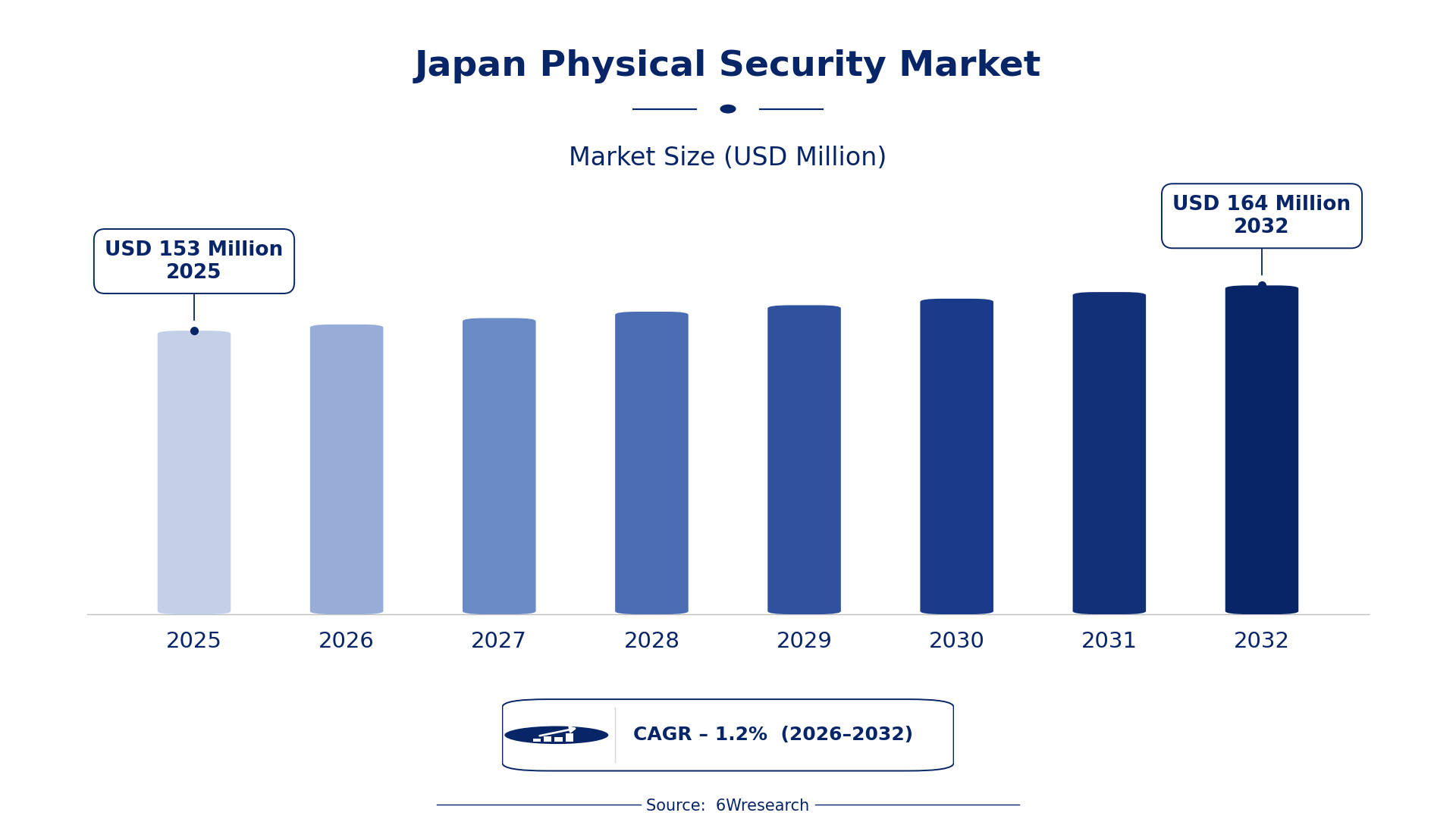
The Japan Physical Security Market was estimated at USD 153 Million in 2025 and is projected to reach USD 164 Million by 2032, growing at a CAGR of 1.2% from 2026 to 2032.
Japan Physical Security Market Synopsis
The integration of advanced technology is the strongest force shaping the Japan Physical Security Market today. As concerns over safety and security escalate across various sectors, from government facilities to private businesses, the demand for sophisticated security solutions continues to rise.
Video surveillance, access control systems, and intruder detection technologies are at the forefront of this evolution. Companies are increasingly investing in AI and IoT capabilities, enhancing the efficiency of security measures and paving the way for smarter, interconnected security solutions.
Japan Physical Security Market Year-wise Growth Rate and Key Drivers
This graph illustrates the annual growth rates of the Japan Physical Security Market from 2021 to 2032, highlighting a steady upward trajectory and projected expansion over the forecast period.
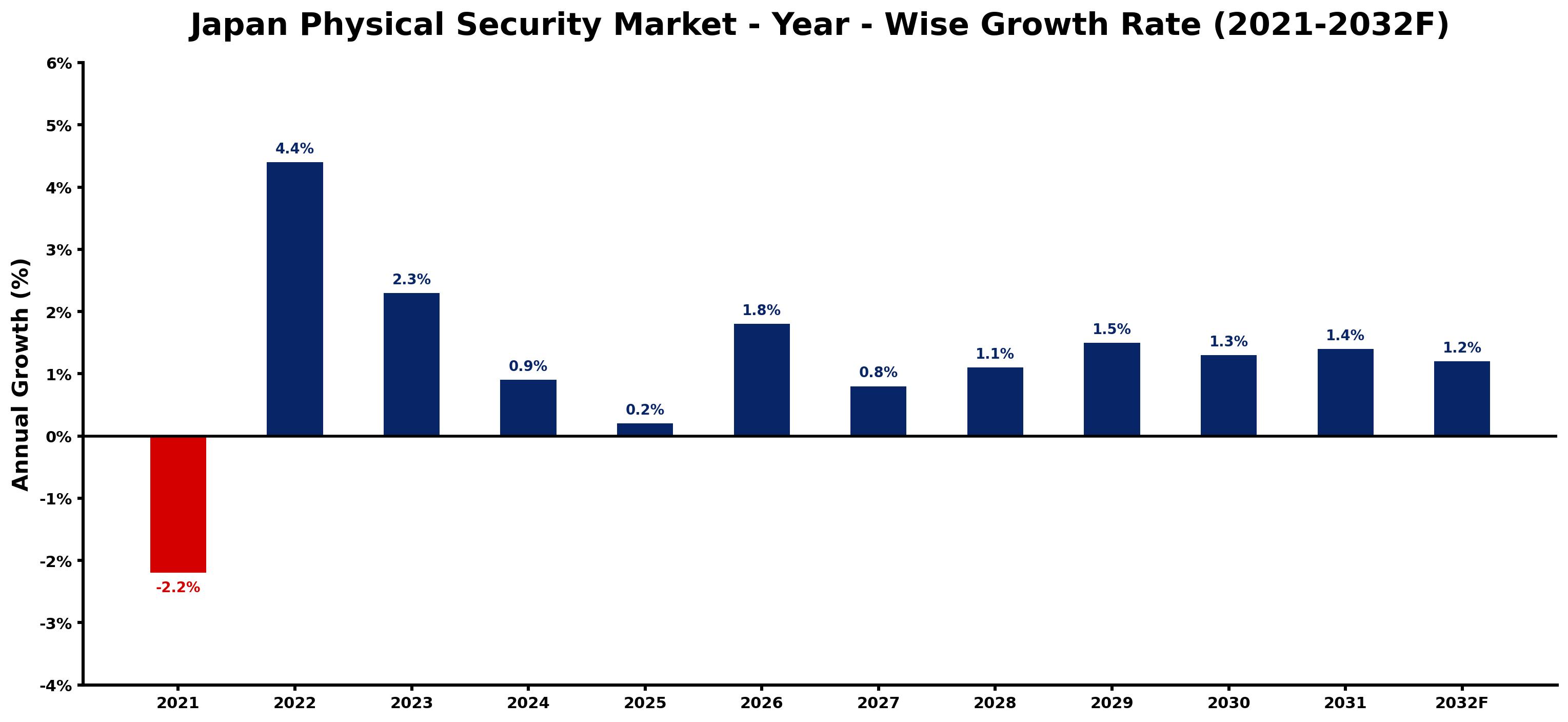
The table below presents the year‑wise growth rates along with the key drivers influencing the market
| Year | Growth Rate | Major Drivers |
| 2021 | -2.2% | Delays in implementation of the Tokyo 2020 security plan |
| 2022 | 4.4% | Tokyo 2020 Olympics boosting crowd control technology needs. |
| 2023 | 2.3% | Increased cyber-physical security threats post-pandemic drive demand. |
| 2024 | 0.9% | Government incentives for integrating AI in security systems. |
| 2025 | 0.2% | Aging population prompts focus on elder care security solutions. |
| 2026 | 1.8% | Strengthening anti-terrorism laws requiring enhanced surveillance solutions. |
| 2027 | 0.8% | Local government funding for city-wide emergency response upgrades. |
| 2028 | 1.1% | Rise in public awareness of security through education programs. |
| 2029 | 1.5% | Growth in smart home technology adoption enhancing residential security. |
| 2030 | 1.3% | Implementation of stricter regulations for workplace safety standards. |
| 2031 | 1.4% | Focus on disaster preparedness increases demand for physical security. |
| 2032 | 1.2% | Emergence of new tech startups developing innovative security solutions. |
Note: Market size estimations and growth projections presented in this report are based on 6Wresearch's proprietary forecasting methodology, utilizing the latest available industry data, government publications, and primary research inputs.
Japan Physical Security Market Key Takeaways
Below are some of the specific key takeaways from the market, including:
- Growing integration of AI technologies to improve monitoring and threat detection.
- Increasing demand for cloud-based security solutions, particularly after the COVID-19 pandemic.
- Focus on enhancing cybersecurity measures within physical security systems.
- Partnerships and collaborations among companies are becoming common strategies for market expansion.
- Government initiatives are fostering innovation and investment in security infrastructure.
Evaluation of Restraints in Japan Physical Security Market
High implementation costs and a shortage of skilled professionals pose significant constraints in the Japan Physical Security Market. on top of that, Japan's strict regulatory environment can create hurdles for foreign security firms looking to establish a foothold. Compliance with privacy laws and addressing cybersecurity vulnerabilities also remain critical challenges that firms must navigate to succeed.
Japan Physical Security Market Trends
The trend toward integrating AI and analytics into physical security solutions is reshaping how security measures are implemented. The rise of cloud-based security systems provides flexibility and scalability, making them attractive to organizations seeking robust remote monitoring capabilities. on top of that, an increasing focus on cybersecurity within physical security systems reflects a growing recognition of the need to safeguard sensitive data from cyber threats.
Japan Physical Security Market Opportunities
Opportunities for investment are diverse, spanning video surveillance, access control, and intrusion detection technologies. Companies developing advanced security technologies that embrace AI and biometrics are well-positioned for growth. Additionally, the ongoing adoption of smart city initiatives offers substantial potential for expanding physical security infrastructure, particularly with major events such as the Tokyo Olympics in focus.
Government Initiatives in the Japan Physical Security Market
Government policies significantly shape the Japan Physical Security Market, emphasizing the importance of modern security measures to counter various threats. Enhanced regulations promote the adoption of advanced technologies while ensuring the privacy of citizens. Such initiatives encourage collaboration between public and private sectors, essential for bolstering the country’s security framework.
- A recently completed national program aimed at upgrading video surveillance infrastructure across urban areas.
- A currently ongoing initiative to implement biometric access control systems in government buildings to enhance security.
- A planned public-private partnership set to launch in 2026 focused on integrating smart technology into urban security measures.
- New regulations introduced in 2025 that mandate stronger cybersecurity protocols for businesses incorporating physical security technologies.
- An ongoing government review of data protection laws to ensure compliance with emerging security technologies.
Future Insights of the Japan Physical Security Market
As the Japan Physical Security Market moves toward 2032, the outlook remains positive, bolstered by a persistent demand for enhanced security solutions. Emerging technologies such as AI and cloud-based systems will continue to drive innovation, leading to more sophisticated and interconnected security infrastructures. Stakeholders can expect an ongoing emphasis on compliance and efficiency as security threats evolve, making the market ripe for ongoing growth.
Japan Physical Security Market Latest Developments
In the past year, the Japan Physical Security Market has witnessed notable activity as companies adapt to changing security dynamics. The emphasis has shifted toward technological enhancements that integrate physical and digital security measures more effectively, driven by both market demand and government initiatives.
- A major technology vendor launched a new AI-driven surveillance solution in Q1 2025, focusing on enhancing real-time threat detection.
- In early 2025, a leading regional operator began a rollout of cloud-based security systems for residential sectors, enhancing flexibility and accessibility.
- Currently underway is a collaboration between various security firms to develop a standardized framework for integrating cybersecurity protocols into physical security systems.
- A planned initiative set for late 2026 will focus on expanding remote monitoring capabilities across major urban areas, enhancing public safety.
- In mid-2025, a cybersecurity upgrade program was initiated for small and medium-sized enterprises, providing funding for integrating robust security systems.
Japan Physical Security Market - Key Attractiveness of the Report
- 10 Years of Market Numbers
- Historical Data Starting from 2022 to 2025
- Base Year: 2025
- Forecast Data until 2032
- Key Performance Indicators Impacting the Market
- Major Upcoming Developments and Projects
The growth is primarily driven by increasing concerns regarding safety, advancements in technology, and the government’s push for improved security measures across sectors.
Key Highlights of the Report:
- Japan Physical Security Market Outlook
- Market Size of Japan Physical Security Market, 2025
- Forecast of Japan Physical Security Market, 2032
- Historical Data and Forecast of Japan Physical Security Revenues & Volume for the Period 2022-2032F
- Japan Physical Security Market Trend Evolution
- Japan Physical Security Market Drivers and Challenges
- Japan Physical Security Price Trends
- Japan Physical Security Porter's Five Forces
- Japan Physical Security Industry Life Cycle
- Historical Data and Forecast of Japan Physical Security Market Revenues & Volume By Component for the Period 2022-2032F
- Historical Data and Forecast of Japan Physical Security Market Revenues & Volume By Systems (PACS, PSIM, PIAM, Video Surveillance, Fire and Life Safety) for the Period 2022-2032F
- Historical Data and Forecast of Japan Physical Security Market Revenues & Volume By Services for the Period 2022-2032F
- Historical Data and Forecast of Japan Physical Security Market Revenues & Volume By Vertical for the Period 2022-2032F
- Historical Data and Forecast of Japan Physical Security Market Revenues & Volume By BFSI for the Period 2022-2032F
- Historical Data and Forecast of Japan Physical Security Market Revenues & Volume By Government for the Period 2022-2032F
- Historical Data and Forecast of Japan Physical Security Market Revenues & Volume By Retail for the Period 2022-2032F
- Historical Data and Forecast of Japan Physical Security Market Revenues & Volume By Transportation for the Period 2022-2032F
- Historical Data and Forecast of Japan Physical Security Market Revenues & Volume By Residential for the Period 2022-2032F
- Historical Data and Forecast of Japan Physical Security Market Revenues & Volume By Telecom and IT for the Period 2022-2032F
- Historical Data and Forecast of Japan Physical Security Market Revenues & Volume By Other Verticals (Healthcare, Manufacturing, Energy and Utilities, and Education). for the Period 2022-2032F
- Historical Data and Forecast of Japan Physical Security Market Revenues & Volume By Organization Size for the Period 2022-2032F
- Historical Data and Forecast of Japan Physical Security Market Revenues & Volume By SMEs for the Period 2022-2032F
- Historical Data and Forecast of Japan Physical Security Market Revenues & Volume By Large Enterprises for the Period 2022-2032F
- Japan Physical Security Import Export Trade Statistics
- Market Opportunity Assessment By Component
- Market Opportunity Assessment By Vertical
- Market Opportunity Assessment By Organization Size
- Japan Physical Security Top Companies Market Share
- Japan Physical Security Competitive Benchmarking By Technical and Operational Parameters
- Japan Physical Security Company Profiles
- Japan Physical Security Key Strategic Recommendations






































