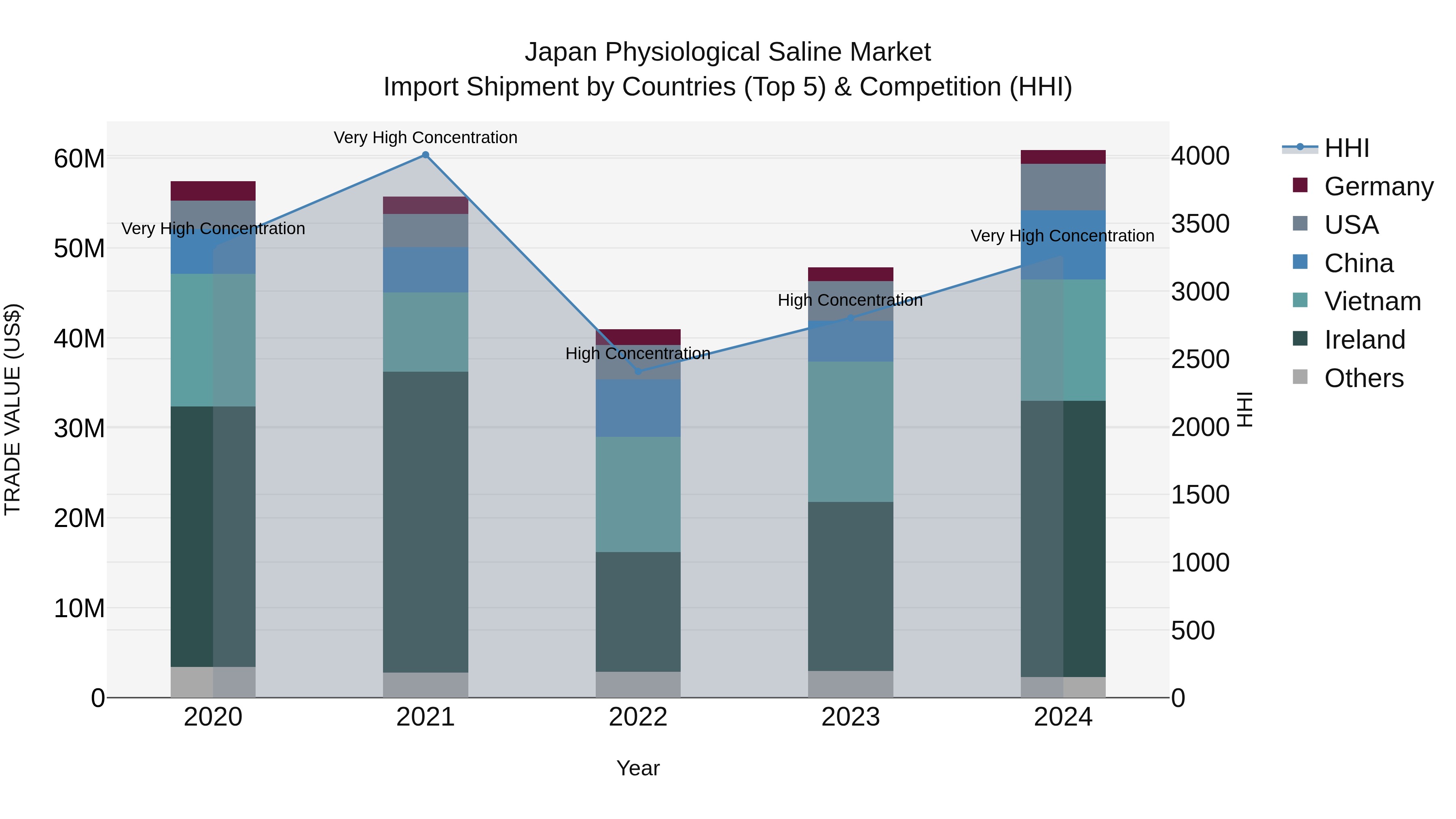
Japan Physiological Saline Market Import Shipment by Countries (Top 5) & Competition (HHI)
The import shipments of physiological saline into Japan have shown a significant increase in concentration levels, with the top exporting countries being Ireland, Vietnam, China, USA, and Germany. The high Herfindahl-Hirschman Index (HHI) in 2023 indicates market concentration, which escalated to very high levels in 2024. This growth trend is further supported by a Compound Annual Growth Rate (CAGR) of 1.46% from 2020 to 2024, with a notable growth rate of 27.21% from 2023 to 2024. This data suggests a growing demand for physiological saline in Japan, with key players dominating the market.
Japan Physiological Saline Market Synopsis
The Japan Physiological Saline Market is experiencing steady growth driven by factors such as increasing prevalence of chronic diseases, rising geriatric population, and expanding healthcare infrastructure. Physiological saline, also known as normal saline, is widely used in medical applications such as intravenous drips, wound cleaning, and medication dilution. The market is characterized by the presence of key players offering a wide range of products catering to the healthcare sector. Growing awareness about the importance of sterile solutions in medical procedures is further fueling market growth. The trend towards home healthcare and self-administration of medications is also contributing to the market expansion. Overall, the Japan Physiological Saline Market is poised for continued growth in the foreseeable future.
Japan Physiological Saline Market Trends
The Japan Physiological Saline Market is experiencing growth due to increasing awareness about the importance of hydration and electrolyte balance, particularly in healthcare settings. Demand for physiological saline for medical procedures, wound care, and hydration therapy is driving market expansion. Key opportunities in the market include the rising prevalence of chronic diseases requiring intravenous hydration, the growth of the aging population in Japan, and the expanding use of physiological saline in cosmetic procedures. Manufacturers have the opportunity to innovate and diversify product offerings to cater to specific medical needs and preferences, such as sterile packaging for single-use applications and advanced formulations for specialized medical procedures. Collaboration with healthcare providers and ongoing research and development efforts can further enhance market penetration and growth in the Japan Physiological Saline Market.
Japan Physiological Saline Market Challenges
In the Japan Physiological Saline Market, several challenges are faced, including intense competition among existing players leading to price wars and margin pressures. Additionally, there is a growing trend towards alternative solutions such as oral rehydration therapy, which poses a threat to the sales of physiological saline products. Regulatory hurdles and compliance requirements also contribute to the challenges faced by companies operating in this market. Furthermore, the increasing focus on cost containment in the healthcare sector in Japan puts pressure on healthcare providers to seek more cost-effective solutions, potentially impacting the demand for physiological saline products. Overall, companies in the Japan Physiological Saline Market need to navigate these challenges effectively to maintain their market share and profitability.
Japan Physiological Saline Market Investment Opportunities
The Japan Physiological Saline Market is primarily driven by factors such as the increasing prevalence of chronic diseases requiring saline solutions for treatment, growing demand for intravenous fluids in healthcare settings, and rising awareness about the importance of hydration and electrolyte balance in maintaining overall health. Additionally, advancements in medical technology and the expanding elderly population in Japan are contributing to the market growth. The COVID-19 pandemic has further boosted the demand for physiological saline solutions for hydration and intravenous administration in hospitals and clinics. Overall, the market is expected to continue growing due to these factors driving the need for physiological saline solutions in various healthcare applications.
Japan Physiological Saline Market Government Polices
The Japan Physiological Saline Market is influenced by various government policies aimed at ensuring product safety and quality. The Ministry of Health, Labour and Welfare (MHLW) oversees regulations related to pharmaceuticals and medical devices, including physiological saline solutions. These regulations include standards for manufacturing practices, labeling requirements, and quality control measures to safeguard public health. Additionally, the Pharmaceuticals and Medical Devices Agency (PMDA) plays a key role in evaluating and approving saline products for market entry. The government also promotes research and development in the healthcare sector to drive innovation and improve the quality of physiological saline solutions available in the market. Overall, government policies in Japan prioritize the safety, efficacy, and quality of physiological saline products to protect consumer health and maintain market integrity.
Japan Physiological Saline Market Future Outlook
The Japan Physiological Saline Market is expected to witness steady growth in the coming years, driven by the increasing demand for saline solutions in various medical applications such as intravenous infusions, wound cleaning, and contact lens solutions. With a growing aging population and rising healthcare spending, the demand for physiological saline is likely to remain robust. Additionally, technological advancements in the healthcare sector are leading to the development of innovative saline solutions with enhanced functionalities, further boosting market growth. However, factors such as stringent regulations and the availability of alternative products may pose challenges to market expansion. Overall, the Japan Physiological Saline Market is anticipated to exhibit a positive trajectory, with opportunities for market players to capitalize on the growing demand for high-quality saline products.
Key Highlights of the Report:
- Japan Physiological Saline Market Outlook
- Market Size of Japan Physiological Saline Market, 2024
- Forecast of Japan Physiological Saline Market, 2031
- Historical Data and Forecast of Japan Physiological Saline Revenues & Volume for the Period 2021- 2031
- Japan Physiological Saline Market Trend Evolution
- Japan Physiological Saline Market Drivers and Challenges
- Japan Physiological Saline Price Trends
- Japan Physiological Saline Porter's Five Forces
- Japan Physiological Saline Industry Life Cycle
- Historical Data and Forecast of Japan Physiological Saline Market Revenues & Volume By Product Type for the Period 2021- 2031
- Historical Data and Forecast of Japan Physiological Saline Market Revenues & Volume By Flexible Bag for the Period 2021- 2031
- Historical Data and Forecast of Japan Physiological Saline Market Revenues & Volume By Plastic Bottles for the Period 2021- 2031
- Historical Data and Forecast of Japan Physiological Saline Market Revenues & Volume By Glass Bottles for the Period 2021- 2031
- Historical Data and Forecast of Japan Physiological Saline Market Revenues & Volume By Application for the Period 2021- 2031
- Historical Data and Forecast of Japan Physiological Saline Market Revenues & Volume By Chronic Diseases for the Period 2021- 2031
- Historical Data and Forecast of Japan Physiological Saline Market Revenues & Volume By Acute Health Conditions for the Period 2021- 2031
- Historical Data and Forecast of Japan Physiological Saline Market Revenues & Volume By Skin Abrasions and Burns for the Period 2021- 2031
- Historical Data and Forecast of Japan Physiological Saline Market Revenues & Volume By End Users for the Period 2021- 2031
- Historical Data and Forecast of Japan Physiological Saline Market Revenues & Volume By Hospitals for the Period 2021- 2031
- Historical Data and Forecast of Japan Physiological Saline Market Revenues & Volume By Clinics for the Period 2021- 2031
- Historical Data and Forecast of Japan Physiological Saline Market Revenues & Volume By Recovery Centers for the Period 2021- 2031
- Historical Data and Forecast of Japan Physiological Saline Market Revenues & Volume By Others for the Period 2021- 2031
- Japan Physiological Saline Import Export Trade Statistics
- Market Opportunity Assessment By Product Type
- Market Opportunity Assessment By Application
- Market Opportunity Assessment By End Users
- Japan Physiological Saline Top Companies Market Share
- Japan Physiological Saline Competitive Benchmarking By Technical and Operational Parameters
- Japan Physiological Saline Company Profiles
- Japan Physiological Saline Key Strategic Recommendations






































