Japan Piano Market Size Growth Rate
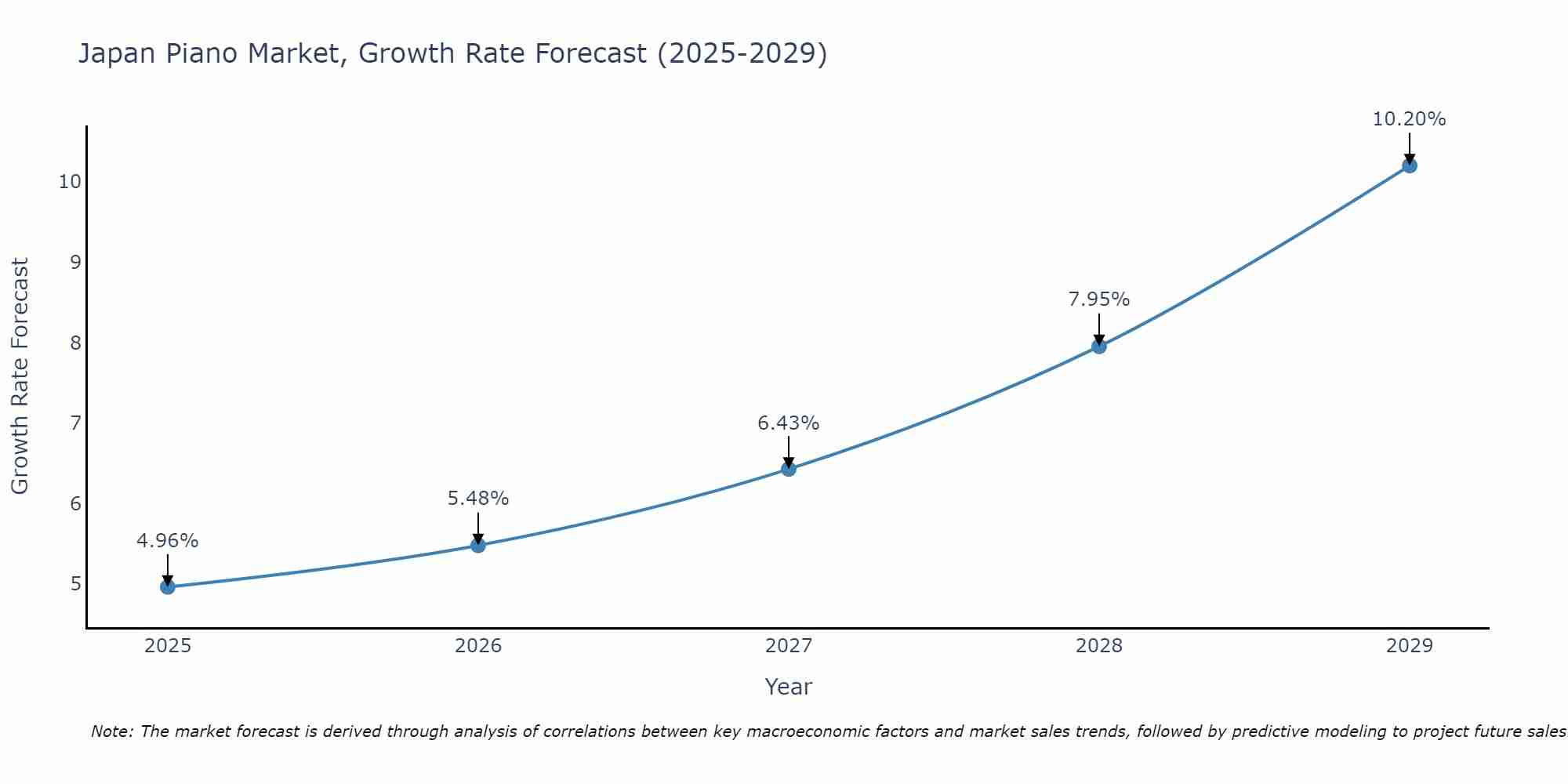
The Japan Piano Market is likely to experience consistent growth rate gains over the period 2025 to 2029. The growth rate starts at 4.96% in 2025 and reaches 10.20% by 2029.
Japan Piano Market Overview
The Japan Piano Market is a mature and well-established market with a strong demand for both acoustic and digital pianos. Acoustic pianos, particularly grand pianos, are highly coveted by professional musicians and affluent households for their superior sound quality and craftsmanship. On the other hand, digital pianos are increasingly popular due to their portability, versatility, and technological features such as MIDI connectivity and built-in sound effects. Yamaha and Kawai are dominant players in the Japanese piano market, known for their high-quality instruments and innovative technologies. The market also sees a growing trend towards hybrid pianos, which combine the traditional feel of an acoustic piano with the digital features of a digital piano. Overall, the Japan Piano Market continues to thrive with a diverse range of offerings catering to various customer preferences and needs.
Japan Piano Market Trends
The Japan Piano Market is witnessing several key trends. Firstly, there is a growing demand for digital pianos and hybrid pianos that combine traditional acoustic elements with digital technology, offering features like headphone connectivity and recording capabilities. Secondly, there is an increasing focus on sustainability and eco-friendly practices in piano manufacturing, with more companies using renewable materials and energy-efficient processes. Additionally, there is a rise in online piano sales and virtual piano lessons, driven by the shift to digital platforms due to the pandemic. Lastly, there is a trend towards smaller and more compact pianos to cater to urban living spaces. Overall, these trends indicate a dynamic and evolving market that is adapting to changing consumer preferences and technological advancements.
Japan Piano Market Challenges
In the Japan Piano Market, several challenges are faced by manufacturers and retailers. One key challenge is the declining interest in traditional instruments among younger generations, who are more inclined towards digital technology and modern forms of entertainment. This shift in consumer preferences has led to a decrease in demand for acoustic pianos, impacting sales and profitability for industry players. Additionally, the high cost of purchasing and maintaining a piano, as well as the limited living space in urban areas, present obstacles to market growth. Competition from electronic keyboards and other musical instruments further intensifies the challenges in the Japan Piano Market, requiring companies to innovate and adapt their strategies to attract and retain customers in a changing market landscape.
Japan Piano Market Investment Opportunities
The Japan Piano Market offers various investment opportunities due to the country`s strong cultural affinity for music and high demand for quality musical instruments. Investing in piano manufacturing companies or distributors can be lucrative, especially considering Japan`s reputation for producing high-quality pianos known for their craftsmanship and precision. Additionally, there is a growing trend in Japan towards music education and appreciation, leading to increased sales of pianos for both professional and personal use. Investing in piano retail stores, music schools, or online platforms specializing in pianos and musical instruments can also be profitable. Overall, the Japan Piano Market presents opportunities for investors looking to capitalize on the country`s musical heritage and consumer demand for premium pianos.
Japan Piano Market Government Policy
The Japan Piano Market is primarily regulated by the government through import/export policies, taxation, and environmental regulations. Import of pianos into Japan is subject to customs duties and regulations to ensure compliance with safety and quality standards. Additionally, the government imposes consumption taxes on the sale of pianos, affecting pricing and consumer demand. Environmental regulations also play a role, particularly in the use of sustainable materials and disposal of pianos at the end of their lifecycle. Overall, government policies in Japan aim to promote fair competition, protect consumer interests, and ensure environmental sustainability in the piano market.
Japan Piano Market Future Outlook
The future outlook for the Japan Piano Market is expected to remain stable with steady growth driven by factors such as a growing interest in music education, increasing disposable income, and a cultural appreciation for music. The market is likely to see continued demand for high-quality acoustic pianos, as well as an increasing interest in digital pianos and hybrid models that offer modern features. Manufacturers are likely to focus on technological advancements to cater to changing consumer preferences, such as connectivity options and interactive learning features. Overall, the Japan Piano Market is anticipated to experience moderate growth in the coming years, with opportunities for innovation and expansion in both traditional acoustic pianos and digital piano segments.
Key Highlights of the Report:
- Japan Piano Market Outlook
- Market Size of Japan Piano Market, 2024
- Forecast of Japan Piano Market, 2031
- Historical Data and Forecast of Japan Piano Revenues & Volume for the Period 2021 - 2031
- Japan Piano Market Trend Evolution
- Japan Piano Market Drivers and Challenges
- Japan Piano Price Trends
- Japan Piano Porter's Five Forces
- Japan Piano Industry Life Cycle
- Historical Data and Forecast of Japan Piano Market Revenues & Volume By Type for the Period 2021 - 2031
- Historical Data and Forecast of Japan Piano Market Revenues & Volume By Grand Piano for the Period 2021 - 2031
- Historical Data and Forecast of Japan Piano Market Revenues & Volume By Upright Piano for the Period 2021 - 2031
- Historical Data and Forecast of Japan Piano Market Revenues & Volume By Application for the Period 2021 - 2031
- Historical Data and Forecast of Japan Piano Market Revenues & Volume By Learning and Teaching for the Period 2021 - 2031
- Historical Data and Forecast of Japan Piano Market Revenues & Volume By Entertainment for the Period 2021 - 2031
- Historical Data and Forecast of Japan Piano Market Revenues & Volume By Other for the Period 2021 - 2031
- Japan Piano Import Export Trade Statistics
- Market Opportunity Assessment By Type
- Market Opportunity Assessment By Application
- Japan Piano Top Companies Market Share
- Japan Piano Competitive Benchmarking By Technical and Operational Parameters
- Japan Piano Company Profiles
- Japan Piano Key Strategic Recommendations






































