Japan Ploughing and Cultivating Machinery Market Size, Share & Growth Rate
The Japan Ploughing and Cultivating Machinery Market was estimated at USD 237 Million in 2025 and is projected to reach USD 256 Million by 2032, growing at a CAGR of 1.1% from 2026 to 2032. This growth trajectory is primarily driven by the increasing adoption of advanced agricultural technologies among Japanese farmers, aimed at enhancing efficiency and productivity in farming operations. The strong governmental push for modernization and sustainability in agriculture further supports this upward trend.
Japan Ploughing and Cultivating Machinery Market Year-wise Growth Rate and Key Drivers
This graph highlights how the Japan Ploughing and Cultivating Machinery Market has steadily grown over the years, supported by major growth factors.
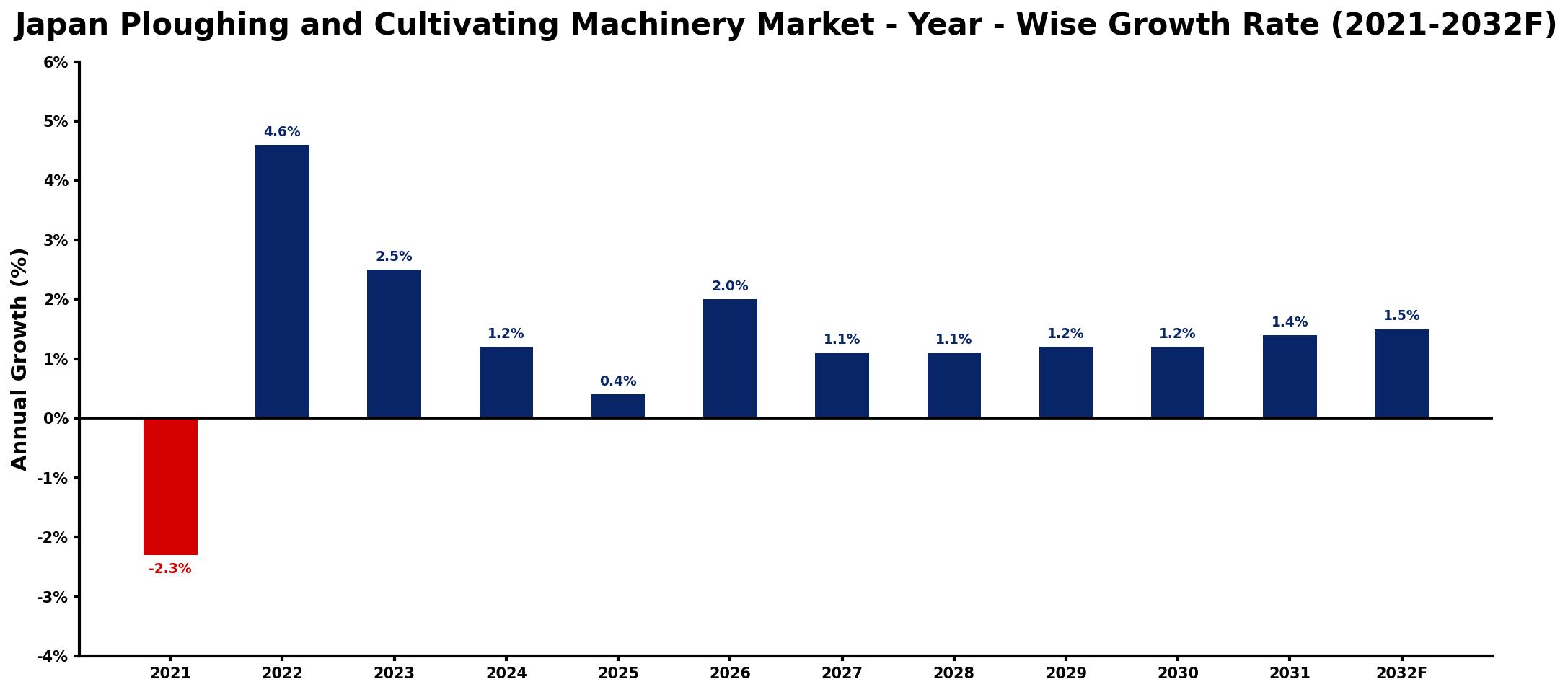
The table below presents the year‑wise growth rates along with the key drivers influencing the market
| Year | Growth Rate | Major Drivers |
| 2021 | -2.3% | decreased agricultural investment levels |
| 2022 | 4.6% | rising demand for automation solutions |
| 2023 | 2.5% | expansion in precision farming technologies |
| 2024 | 1.2% | increased focus on sustainable practices |
| 2025 | 0.4% | growing interest in smart agriculture |
| 2026 | 2.0% | higher adoption of eco-friendly solutions |
| 2027 | 1.1% | enhanced government support initiatives |
| 2028 | 1.1% | expanding rural infrastructure developments |
| 2029 | 1.2% | increased research and development funding |
| 2030 | 1.2% | growing market for organic farming |
| 2031 | 1.4% | rising trend of urban agriculture |
| 2032 | 1.5% | expanding export opportunities in Asia |
Note: Market size estimations and growth projections presented in this report are based on 6Wresearch's proprietary forecasting methodology, utilizing the latest available industry data, government publications, and primary research inputs.
Japan Ploughing and Cultivating Machinery Market Synopsis
Technological advancement is the most significant force shaping the Japan Ploughing and Cultivating Machinery Market. Farmers are increasingly turning to precision agriculture methods that utilize sophisticated machinery equipped with GPS and automation features, fostering higher efficiency in ploughing and cultivating tasks.
Moreover, there is a notable shift towards sustainable farming practices, pushing manufacturers to innovate eco-friendly machinery solutions. This focus not only aims to enhance productivity but also addresses growing environmental concerns associated with traditional farming practices.
Japan Ploughing and Cultivating Machinery Market Key Takeaways
- The market is characterized by a strong emphasis on technological advancements, focusing on precision agriculture.
- Government initiatives are actively promoting the modernization of agricultural equipment across Japan.
- There is an increasing demand for eco-friendly machinery in response to sustainability trends.
- Customization and modularity in machinery designs are gaining traction to meet diverse farmer needs.
- The competitive landscape is intensifying, with domestic and international players vying for market share.
Evaluation of Restraints in Japan Ploughing and Cultivating Machinery Market
Despite its growth potential, the Japan Ploughing and Cultivating Machinery Market is confronted with several restraints. Intense competition among domestic manufacturers and international players is leading to price wars, which can significantly compress profit margins. Moreover, the aging demographic of farmers poses a challenge as the younger generation shows less inclination towards agriculture. Additionally, the pressure to meet stringent environmental regulations demands continuous innovation, which requires substantial investment in research and development, straining the resources of many companies. The evolving expectations surrounding sustainability further complicate this landscape, making it essential for manufacturers to adapt quickly to maintain competitiveness.
Japan Ploughing and Cultivating Machinery Market Trends
The market is witnessing a pronounced trend towards more sophisticated and efficient ploughing and cultivating equipment. Demand for precision agriculture solutions is on the rise, driven by the need to optimize farming practices and maximize output. Equipment that integrates advanced features such as sensors and automation is becoming more prevalent. Additionally, the eco-friendly machinery trend is growing, with farmers increasingly opting for equipment that minimizes environmental impact. Customization in machinery is also trending, allowing farmers to tailor equipment to their specific operational needs, enhancing the overall efficiency and effectiveness of their farming practices.
Japan Ploughing and Cultivating Machinery Market Opportunities
The Japan Ploughing and Cultivating Machinery Market is ripe with investment opportunities as the agricultural landscape evolves. The demand for innovative equipment designed for precision farming is escalating, presenting openings for investors focusing on high-tech machinery. Moreover, the governments emphasis on sustainable practices and modernization initiatives offers a pathway for investment in eco-friendly machinery. Companies producing automated and smart farming solutions are likely to see increased interest, fueled by rising productivity needs and technological advancements, making them attractive propositions for future growth.
Government Initiatives in the Japan Ploughing and Cultivating Machinery Market
Japanese government policies are integral to the growth of the Ploughing and Cultivating Machinery Market. Initiatives aimed at modernizing agricultural practices include subsidies for the acquisition of advanced machinery and tax incentives encouraging technological adoption. The government is also focusing on sustainable practices by promoting eco-friendly farming equipment and enhancing research and development support within the agricultural sector. These policies not only bolster productivity but also address the critical need for safety and quality in agricultural outputs, ensuring a robust framework for industry growth.
Future Insights of the Japan Ploughing and Cultivating Machinery Market
Looking ahead to the period from 2026 to 2032, the Japan Ploughing and Cultivating Machinery Market is anticipated to experience steady growth, driven by ongoing technological advancements and increased focus on precision agriculture. The urgency to enhance productivity in the agricultural sector, especially amid a labor shortage, will push the market towards more efficient and sustainable machinery solutions. Government support for agricultural mechanization, combined with rising trends in organic farming, is expected to create fertile ground for innovation and investment opportunities, positioning the market for a prosperous future.
Japan Ploughing and Cultivating Machinery Market Latest Developments (2025 - 2026)
Recent developments in the Japan Ploughing and Cultivating Machinery Market highlight a continuous shift towards adopting cutting-edge technologies. Innovations in GPS-guided systems and automation features are being integrated into new machinery designs, significantly enhancing operational efficiency. Furthermore, increasing collaboration between agricultural technology companies and traditional machinery manufacturers is emerging as a trend, with a focus on developing tailored solutions that meet the specific demands of modern farming practices. This evolving landscape reflects the industry's response to both market pressures and changing consumer preferences.
Japan Ploughing and Cultivating Machinery Market - Key Attractiveness of the Report
- 10 Years of Market Numbers
- Historical Data Starting from 2022 to 2025
- Base Year: 2025
- Forecast Data until 2032
- Key Performance Indicators Impacting the Market
- Major Upcoming Developments and Projects
Key Highlights of the Report:
- Japan Ploughing and Cultivating Machinery Market Outlook
- Market Size of Japan Ploughing and Cultivating Machinery Market, 2025
- Forecast of Japan Ploughing and Cultivating Machinery Market, 2032
- Historical Data and Forecast of Japan Ploughing and Cultivating Machinery Revenues & Volume for the Period 2022-2032F
- Japan Ploughing and Cultivating Machinery Market Trend Evolution
- Japan Ploughing and Cultivating Machinery Market Drivers and Challenges
- Japan Ploughing and Cultivating Machinery Price Trends
- Japan Ploughing and Cultivating Machinery Porter's Five Forces
- Japan Ploughing and Cultivating Machinery Industry Life Cycle
- Historical Data and Forecast of Japan Ploughing and Cultivating Machinery Market Revenues & Volume By Type for the Period 2022-2032F
- Historical Data and Forecast of Japan Ploughing and Cultivating Machinery Market Revenues & Volume By Ploughs for the Period 2022-2032F
- Historical Data and Forecast of Japan Ploughing and Cultivating Machinery Market Revenues & Volume By Harrows for the Period 2022-2032F
- Historical Data and Forecast of Japan Ploughing and Cultivating Machinery Market Revenues & Volume By Others for the Period 2022-2032F
- Historical Data and Forecast of Japan Ploughing and Cultivating Machinery Market Revenues & Volume By Application for the Period 2022-2032F
- Historical Data and Forecast of Japan Ploughing and Cultivating Machinery Market Revenues & Volume By Soil Loosening for the Period 2022-2032F
- Historical Data and Forecast of Japan Ploughing and Cultivating Machinery Market Revenues & Volume By Clod Size Reduction for the Period 2022-2032F
- Historical Data and Forecast of Japan Ploughing and Cultivating Machinery Market Revenues & Volume By Clod Sorting for the Period 2022-2032F
- Historical Data and Forecast of Japan Ploughing and Cultivating Machinery Market Revenues & Volume By Others for the Period 2022-2032F
- Japan Ploughing and Cultivating Machinery Import Export Trade Statistics
- Market Opportunity Assessment By Type
- Market Opportunity Assessment By Application
- Japan Ploughing and Cultivating Machinery Top Companies Market Share
- Japan Ploughing and Cultivating Machinery Competitive Benchmarking By Technical and Operational Parameters
- Japan Ploughing and Cultivating Machinery Company Profiles
- Japan Ploughing and Cultivating Machinery Key Strategic Recommendations






































