Japan Policy Management in Telecom Market Size & Growth Rate (2026-2032)
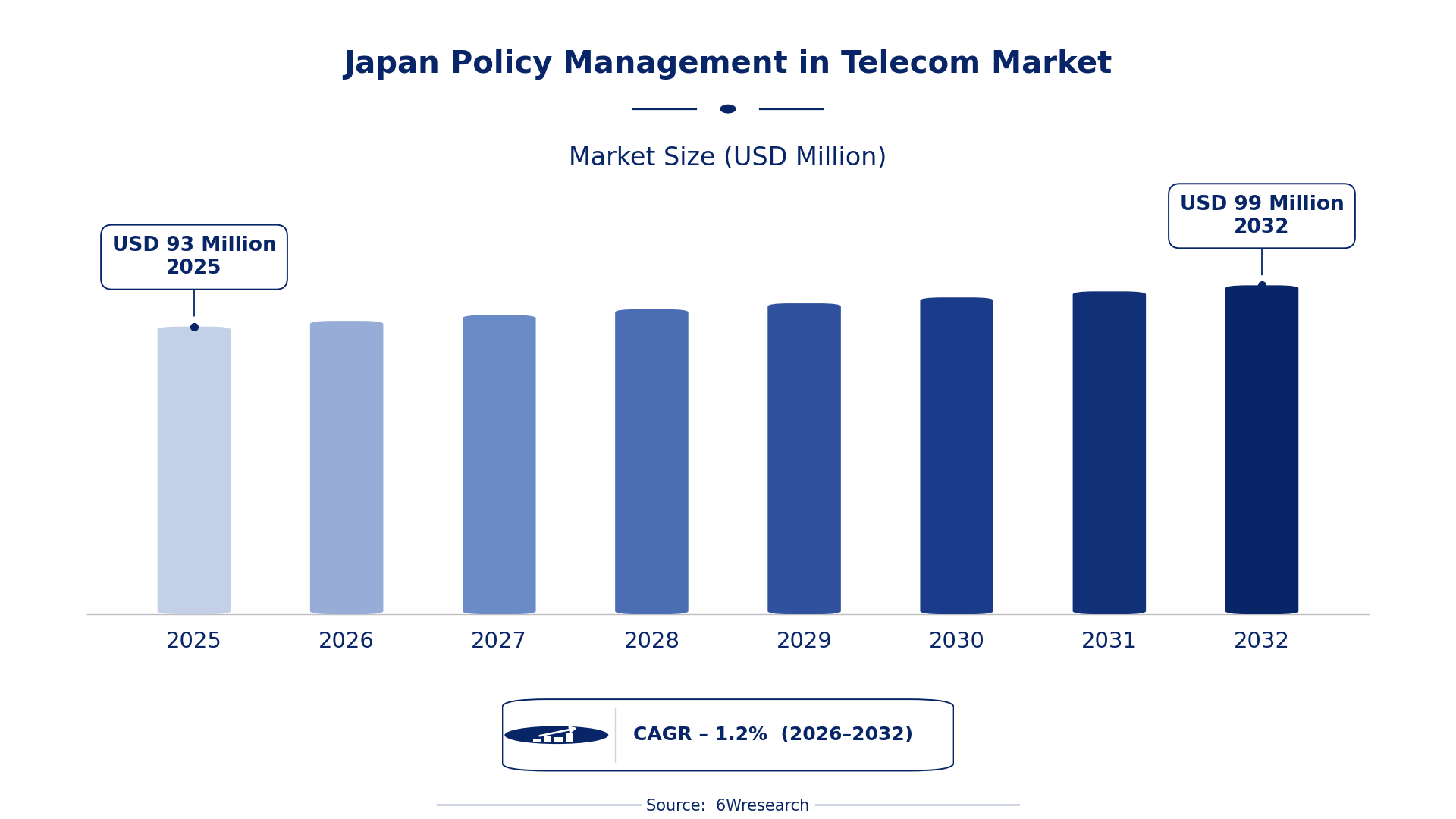
The Japan Policy Management in Telecom Market was estimated at USD 93 Million in 2025 and is projected to reach USD 99 Million by 2032, growing at a CAGR of 1.2% from 2026 to 2032.
Japan Policy Management in Telecom Market Synopsis
The Japanese telecom sector is currently navigating a climate of rigorous regulatory scrutiny. This environment demands compliance not only to enhance consumer protection but also to foster innovation and competition among telecom operators. As demand for advanced telecom services escalates, policy management has emerged as a critical operational pillar for businesses striving to optimize their network capabilities.
In a market marked by rapid technological advancements, such as the rollout of 5G, adherence to government mandates is essential for sustaining service quality and data security. Telecom companies in Japan face the dual challenge of keeping pace with evolving technologies while remaining compliant with stringent policies governing pricing, data protection, and network reliability.
Japan Policy Management in Telecom Market Year-wise Growth Rate and Key Drivers
This graph illustrates the annual growth rates of the Japan Policy Management in Telecom Market from 2021 to 2032, highlighting a steady upward trajectory and projected expansion over the forecast period.
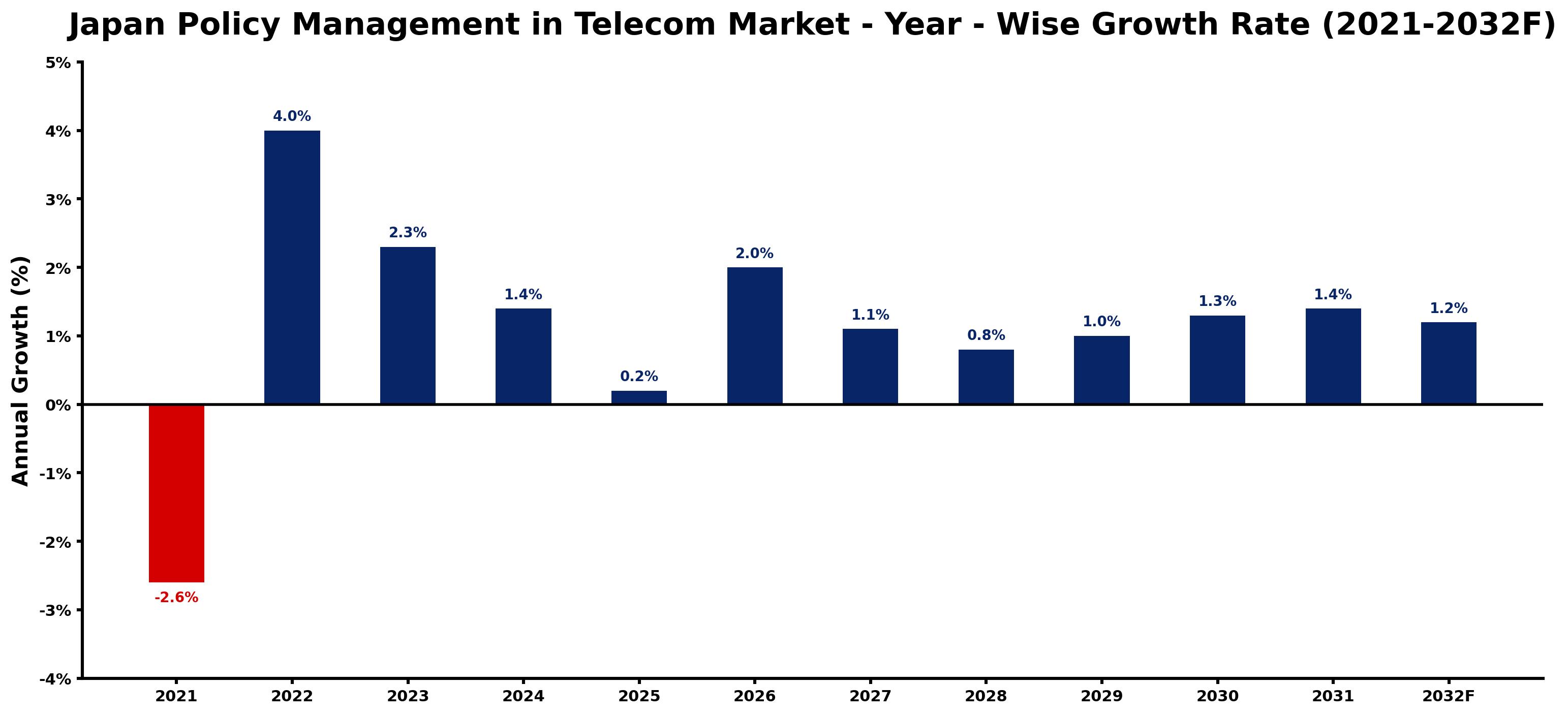
The table below presents the year‑wise growth rates along with the key drivers influencing the market
| Year | Growth Rate | Major Drivers |
| 2021 | -2.6% | Ministry of Internal Affairs cut telecom subsidy programs. |
| 2022 | 4.0% | Implementation of new telecom regulations by MIC |
| 2023 | 2.3% | Increased 5G rollout enhancing service quality |
| 2024 | 1.4% | Growing consumer preference for mobile broadband services |
| 2025 | 0.2% | Government incentives for rural telecom network expansion |
| 2026 | 2.0% | Introduction of telecom tariff reforms by JCG |
| 2027 | 1.1% | Increasing investment in cybersecurity solutions for telecom |
| 2028 | 0.8% | Adoption of AI technologies for telecom service improvements |
| 2029 | 1.0% | Rising mobile application usage driving data service demand |
| 2030 | 1.3% | Launch of policy framework for telecom sustainability |
| 2031 | 1.4% | Heightened competition among major telecom operators |
| 2032 | 1.2% | Boost in telecom employment supporting sector development |
Note: Market size estimations and growth projections presented in this report are based on 6Wresearch's proprietary forecasting methodology, utilizing the latest available industry data, government publications, and primary research inputs.
Japan Policy Management in Telecom Market Key Takeaways
Below are some of the specific key takeaways from the market, including:
- The market is witnessing increasing regulatory emphasis on data privacy and security, shaping operational strategies.
- 5G technology deployment is driving demand for innovative policy management solutions among telecom operators.
- Investment in policy management software is crucial for enhancing network performance and customer satisfaction.
- The evolving regulatory landscape necessitates agility and responsiveness from telecom companies.
- Government initiatives are geared toward fostering a competitive telecom environment while ensuring consumer rights are protected.
Evaluation of Restraints in Japan Policy Management in Telecom Market
A primary restraint in the Japan Policy Management in Telecom Market lies in the labyrinth of regulations that telecom companies must navigate. The rapid pace of regulatory changes creates uncertainty, complicating long-term planning and capital investment strategies. As policies shift in response to technological advancements and consumer expectations, companies must continuously adapt their operational frameworks to remain compliant. The complexity of integrating new compliance measures into existing systems can strain resources, hindering innovation and responsiveness to market dynamics.
Japan Policy Management in Telecom Market Trends
Currently, telecom operators in Japan are adjusting to an environment marked by heightened regulatory oversight concerning consumer data protection. This trend is a direct response to the increasing digitization of services and the persistent threat of cyber-attacks. The focus on enhancing service quality through competitive pricing policies is also prominent, alongside a push for more transparent billing practices. Investment in next-generation technologies, particularly related to 5G, is becoming a necessity for maintaining competitive advantages, while operators explore ways to streamline policy management processes to improve efficiency.
Japan Policy Management in Telecom Market Opportunities
There are notable investment opportunities within the Japan Policy Management in Telecom Market. Companies that specialize in advanced policy management solutions stand to gain as telecom operators increasingly seek to optimize network traffic and enhance service delivery. Furthermore, the proliferation of 5G networks demands robust policy management frameworks capable of handling complex data environments. The escalating need for cybersecurity solutions within telecom infrastructures also presents a ripe avenue for investment as companies prioritize safeguarding consumer data and services.
Government Initiatives in the Japan Policy Management in Telecom Market
The Japanese government actively shapes the telecom sector through various policies aimed at enhancing competition and protecting consumer interests. This strategic involvement is essential for ensuring that telecom operators not only comply with regulatory requirements but also innovate and improve service quality. The regulatory framework emphasizes the importance of transparency, particularly in pricing and service delivery, while fostering advancements in technology.
- A recently completed initiative focused on implementing stricter data privacy regulations as part of the Consumer Protection Act, enhancing consumer rights in the telecom space.
- Currently ongoing is a national digital infrastructure upgrade programme aimed at improving broadband connectivity and 5G deployment across rural and urban areas.
- A planned public-private partnership expected to initiate by 2027 will focus on establishing standards for next-generation telecommunications technologies.
- A regulatory framework introduced in 2025 mandates transparency in telecom billing, aimed at fostering trust and fairness in consumer pricing.
- The Ministry of Internal Affairs and Communications has launched a campaign promoting cybersecurity measures for telecom networks, focusing on enhancing resilience against cyber threats.
Future Insights of the Japan Policy Management in Telecom Market
Looking ahead, the Japan Policy Management in Telecom Market is set for gradual expansion, driven largely by the increasing sophistication of telecom services and rising data consumption. The implementation of 5G technology will fundamentally alter the operational landscape, necessitating more intricate policy management systems. Telecom companies that invest in cutting-edge policy solutions will be best positioned to thrive in a climate where regulatory compliance and consumer expectations are continually evolving. As a result, a focus on innovation and adaptive strategies will be crucial for sustained growth in the sector.
Japan Policy Management in Telecom Market Latest Developments
Over the past year, the Japan Policy Management in Telecom Market has witnessed significant activity, particularly regarding compliance with new data protection regulations and advancements in 5G technology. Companies have been rapidly adapting to these changes to enhance service delivery while ensuring compliance with governmental policies. The focus remains on improving consumer trust through transparent practices and innovative solutions.
- A major telecom operator launched a new policy management software aimed at enhancing data security protocols, initiated in early 2025 and expected to be fully operational by late 2025.
- An initiative that began in mid-2025 is currently underway, focusing on training personnel in compliance with evolving cybersecurity regulations to bolster operational resilience.
- A rollout expected to begin in Q3 2026 will focus on expanding fiber-optic networks in underserved regions, increasing accessibility and service quality.
- A recent partnership was formed between multiple technology firms in early 2025 to develop AI-driven policy management tools, aimed at improving decision-making and responsiveness to regulatory changes.
- In early 2025, a pilot project was launched to test new billing transparency measures with selected telecom consumers, aiming for broader implementation based on feedback.
Japan Policy Management in Telecom Market - Key Attractiveness of the Report
- 10 Years of Market Numbers
- Historical Data Starting from 2022 to 2025
- Base Year: 2025
- Forecast Data until 2032
- Key Performance Indicators Impacting the Market
- Major Upcoming Developments and Projects
Key Highlights of the Report:
- Japan Policy Management in Telecom Market Outlook
- Market Size of Japan Policy Management in Telecom Market, 2025
- Forecast of Japan Policy Management in Telecom Market, 2032
- Historical Data and Forecast of Japan Policy Management in Telecom Revenues & Volume for the Period 2022-2032F
- Japan Policy Management in Telecom Market Trend Evolution
- Japan Policy Management in Telecom Market Drivers and Challenges
- Japan Policy Management in Telecom Price Trends
- Japan Policy Management in Telecom Porter's Five Forces
- Japan Policy Management in Telecom Industry Life Cycle
- Historical Data and Forecast of Japan Policy Management in Telecom Market Revenues & Volume By Network for the Period 2022-2032F
- Historical Data and Forecast of Japan Policy Management in Telecom Market Revenues & Volume By Fixed for the Period 2022-2032F
- Historical Data and Forecast of Japan Policy Management in Telecom Market Revenues & Volume By Wireless for the Period 2022-2032F
- Historical Data and Forecast of Japan Policy Management in Telecom Market Revenues & Volume By Component for the Period 2022-2032F
- Historical Data and Forecast of Japan Policy Management in Telecom Market Revenues & Volume By Solutions for the Period 2022-2032F
- Historical Data and Forecast of Japan Policy Management in Telecom Market Revenues & Volume By Services for the Period 2022-2032F
- Historical Data and Forecast of Japan Policy Management in Telecom Market Revenues & Volume By Deployment for the Period 2022-2032F
- Historical Data and Forecast of Japan Policy Management in Telecom Market Revenues & Volume By Cloud for the Period 2022-2032F
- Historical Data and Forecast of Japan Policy Management in Telecom Market Revenues & Volume By On-Premises for the Period 2022-2032F
- Japan Policy Management in Telecom Import Export Trade Statistics
- Market Opportunity Assessment By Network
- Market Opportunity Assessment By Component
- Market Opportunity Assessment By Deployment
- Japan Policy Management in Telecom Top Companies Market Share
- Japan Policy Management in Telecom Competitive Benchmarking By Technical and Operational Parameters
- Japan Policy Management in Telecom Company Profiles
- Japan Policy Management in Telecom Key Strategic Recommendations






































