Japan Printed Electronics Market Size, Share & Growth Rate
The Japan Printed Electronics Market was estimated at USD 114 Million in 2025 and is projected to reach USD 122 Million by 2032, growing at a CAGR of 1.0% from 2026 to 2032. This steady growth trajectory is fueled by technological advancements and an increasing demand for flexible electronic solutions across multiple industries. Moreover, government initiatives aimed at fostering innovation in electronics and a growing emphasis on sustainable practices are also key factors contributing to this upward trend.
Japan Printed Electronics Market Year-wise Growth Rate and Key Drivers
This graph highlights how the Japan Printed Electronics Market has steadily grown over the years, supported by major growth factors.
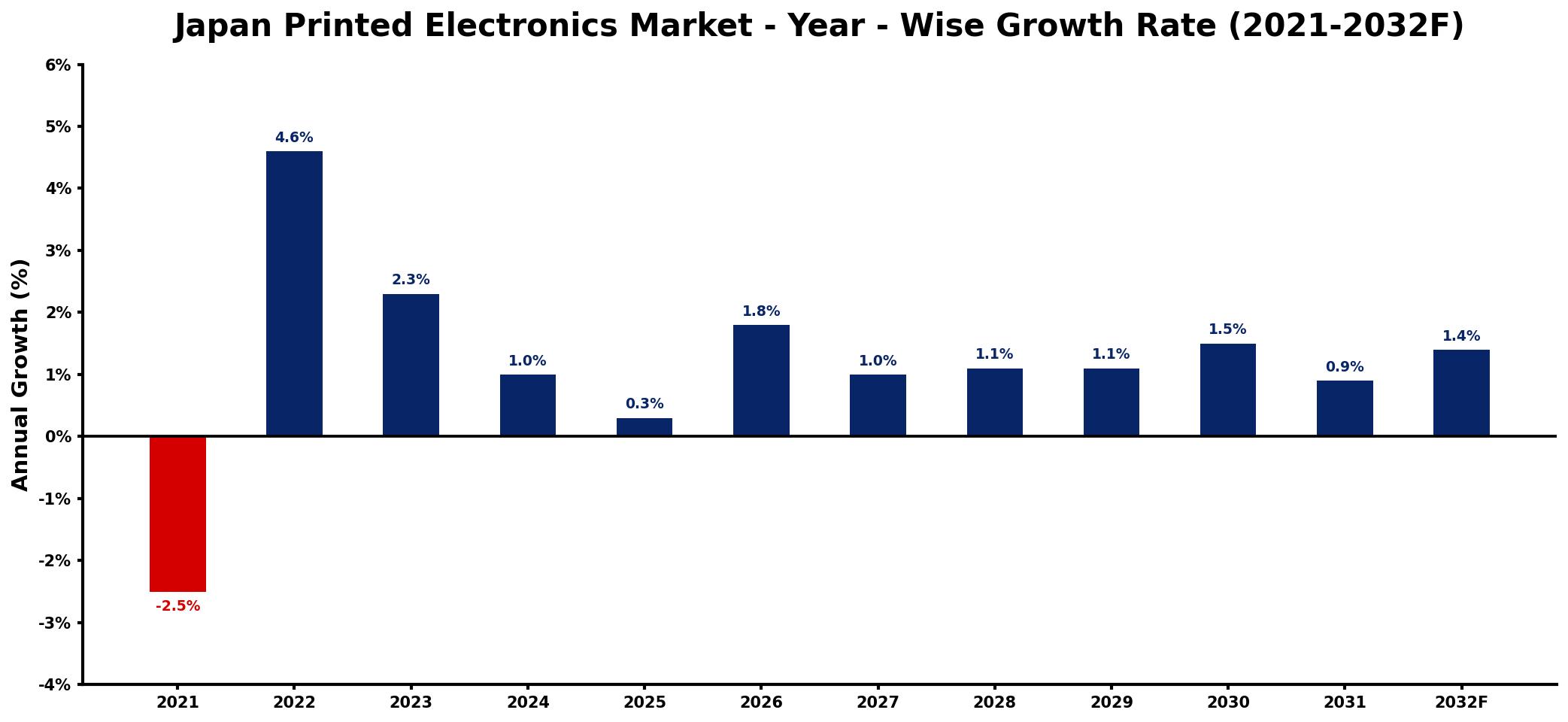
The table below presents the year‑wise growth rates along with the key drivers influencing the market
| Year | Growth Rate | Major Drivers |
| 2021 | -2.5% | decreased investment in innovative technologies |
| 2022 | 4.6% | rising demand for smart packaging |
| 2023 | 2.3% | increased applications in healthcare |
| 2024 | 1.0% | growing interest in wearable technology |
| 2025 | 0.3% | expansion of sustainable manufacturing practices |
| 2026 | 1.8% | increased domestic production output |
| 2027 | 1.0% | increased focus on automation solutions |
| 2028 | 1.1% | increased pharmaceutical industry usage |
| 2029 | 1.1% | rising use in automotive sectors |
| 2030 | 1.5% | growing automotive sector requirements |
| 2031 | 0.9% | increased investment in research initiatives |
| 2032 | 1.4% | growth in interactive advertising mediums |
Note: Market size estimations and growth projections presented in this report are based on 6Wresearch's proprietary forecasting methodology, utilizing the latest available industry data, government publications, and primary research inputs.
Japan Printed Electronics Market Synopsis
While the Japan Printed Electronics Market has experienced notable growth in recent years, fueled by advances in printed sensor technologies and flexible displays, the future holds even greater potential. As industries such as healthcare and automotive embrace these innovative solutions, the market is expected to evolve rapidly.
With a robust manufacturing base and strong technological expertise, Japan is poised to capitalize on emerging opportunities in the printed electronics space. As sustainability becomes a primary focus, the market will likely witness a paradigm shift toward eco-friendly materials and processes, further enhancing its growth prospects.
Japan Printed Electronics Market Key Takeaways
- The market is set for steady growth, driven by technological advancements and demand for flexible electronics.
- Key applications include displays, sensors, batteries, and RFID tags, reflecting a broad scope for innovation.
- Collaboration between academia and industry is vital for research and development, pushing the boundaries of printed electronics.
- Investment opportunities abound in sectors like flexible displays and sustainable materials.
- Government support through funding and collaboration initiatives enhances competitiveness in the market.
Evaluation of Restraints in Japan Printed Electronics Market
Despite the promising outlook, the Japan Printed Electronics Market faces significant challenges that may impede its growth trajectory. High initial investment costs for manufacturing and R&D pose barriers, particularly for smaller players. Furthermore, a lack of specialized expertise in advanced printing technologies hampers innovation. Concerns regarding the reliability of printed electronics relative to conventional products and the competitive pressure from traditional manufacturers also contribute to market hesitance. Regulatory hurdles, particularly related to environmental standards and intellectual property, further complicate the operating environment. Addressing these issues will require strategic partnerships, ongoing innovation, and supportive governmental frameworks.
Japan Printed Electronics Market Trends
Several trends are currently shaping the Japan Printed Electronics Market. The increasing adoption of flexible and wearable electronics is paving the way for diverse applications across healthcare and consumer electronics. Moreover, advancements in printed sensor technologies are set to enhance functionality in automotive applications. The growing demand for organic light-emitting diode (OLED) displays is reshaping consumer expectations, while an emphasis on sustainability is leading to the development of eco-friendly materials and printing processes.
Japan Printed Electronics Market Opportunities
Investment opportunities in the Japan Printed Electronics Market are abundant, particularly in areas like flexible displays, sensors, and RFID technology. As the demand for lightweight, energy-efficient devices continues to escalate, companies are eager to explore innovative printed electronics solutions. The governments support for R&D initiatives further strengthens the attractiveness of this market. Forward-thinking investors can capitalize on advancements in materials and technologies to develop cost-effective, sustainable solutions that appeal to modern consumers.
Government Initiatives in the Japan Printed Electronics Market
The Japanese government actively promotes the growth of the printed electronics market through a variety of supportive initiatives. These include funding for research and development projects, subsidies for companies engaging in innovative technologies, and fostering collaboration between industry and research institutions. Additionally, regulatory frameworks are implemented to ensure the quality and safety of printed electronics products. Through international partnerships, Japan is enhancing its knowledge exchange, thereby strengthening its competitive positioning in this rapidly evolving industry.
Future Insights of the Japan Printed Electronics Market
Looking ahead, the Japan Printed Electronics Market is expected to expand significantly through 2026-2032. This growth will be driven by the increasing demand for flexible and lightweight electronic products in sectors like healthcare, automotive, and consumer electronics. With a continuous influx of innovations and advancements in technology, new applications and products are likely to emerge. Strategic collaborations and ongoing governmental support are anticipated to further enhance the market's dynamics, positioning Japan as a pivotal player in the global printed electronics landscape.
Japan Printed Electronics Market Latest Developments (2025 - 2026)
Recent developments in the Japan Printed Electronics Market indicate a growing focus on advanced materials and sustainable practices. Industry players are increasingly collaborating with academic institutions to foster innovation and drive commercialization of cutting-edge printed electronics solutions. There is also a notable push towards enhancing the quality and reliability of printed products to better compete with traditional electronics. These evolving dynamics underscore the market's commitment to maintaining a competitive edge and responding to consumer demands effectively.
Japan Printed Electronics Market - Key Attractiveness of the Report
- 10 Years of Market Numbers
- Historical Data Starting from 2022 to 2025
- Base Year: 2025
- Forecast Data until 2032
- Key Performance Indicators Impacting the Market
- Major Upcoming Developments and Projects
Key Highlights of the Report:
- Japan Printed Electronics Market Outlook
- Market Size of Japan Printed Electronics Market, 2025
- Forecast of Japan Printed Electronics Market, 2032
- Historical Data and Forecast of Japan Printed Electronics Revenues & Volume for the Period 2022-2032F
- Japan Printed Electronics Market Trend Evolution
- Japan Printed Electronics Market Drivers and Challenges
- Japan Printed Electronics Price Trends
- Japan Printed Electronics Porter's Five Forces
- Japan Printed Electronics Industry Life Cycle
- Historical Data and Forecast of Japan Printed Electronics Market Revenues & Volume By Material for the Period 2022-2032F
- Historical Data and Forecast of Japan Printed Electronics Market Revenues & Volume By Ink for the Period 2022-2032F
- Historical Data and Forecast of Japan Printed Electronics Market Revenues & Volume By Substrate for the Period 2022-2032F
- Historical Data and Forecast of Japan Printed Electronics Market Revenues & Volume By Technology for the Period 2022-2032F
- Historical Data and Forecast of Japan Printed Electronics Market Revenues & Volume By Screen for the Period 2022-2032F
- Historical Data and Forecast of Japan Printed Electronics Market Revenues & Volume By Inkjet for the Period 2022-2032F
- Historical Data and Forecast of Japan Printed Electronics Market Revenues & Volume By Flexographic for the Period 2022-2032F
- Historical Data and Forecast of Japan Printed Electronics Market Revenues & Volume By Gravure for the Period 2022-2032F
- Historical Data and Forecast of Japan Printed Electronics Market Revenues & Volume By Device for the Period 2022-2032F
- Historical Data and Forecast of Japan Printed Electronics Market Revenues & Volume By Displays for the Period 2022-2032F
- Historical Data and Forecast of Japan Printed Electronics Market Revenues & Volume By Photovoltaic for the Period 2022-2032F
- Historical Data and Forecast of Japan Printed Electronics Market Revenues & Volume By Lighting for the Period 2022-2032F
- Historical Data and Forecast of Japan Printed Electronics Market Revenues & Volume By RFID for the Period 2022-2032F
- Historical Data and Forecast of Japan Printed Electronics Market Revenues & Volume By Others for the Period 2022-2032F
- Japan Printed Electronics Import Export Trade Statistics
- Market Opportunity Assessment By Material
- Market Opportunity Assessment By Technology
- Market Opportunity Assessment By Device
- Japan Printed Electronics Top Companies Market Share
- Japan Printed Electronics Competitive Benchmarking By Technical and Operational Parameters
- Japan Printed Electronics Company Profiles
- Japan Printed Electronics Key Strategic Recommendations






































