Japan Quantum Cryptography Market Size & Growth Rate (2026-2032)
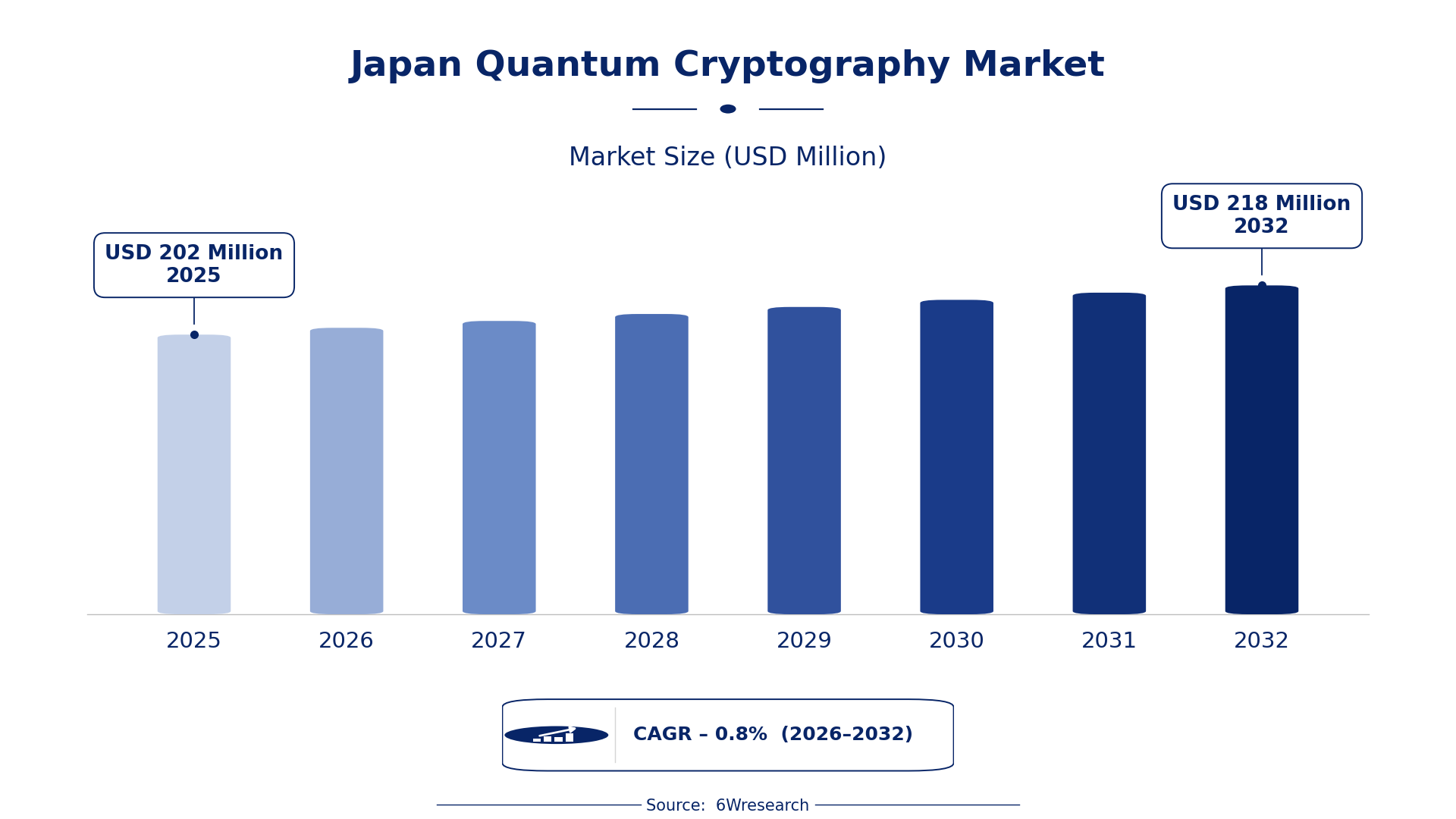
The Japan Quantum Cryptography Market was estimated at USD 202 Million in 2025 and is projected to reach USD 218 Million by 2032, growing at a CAGR of 0.8% from 2026 to 2032.
Japan Quantum Cryptography Market Synopsis
In Japan, the demand for quantum cryptography solutions is surging, driven by an acute awareness of cybersecurity risks. Enterprises are increasingly seeking advanced encryption methods that quantum technology offers, recognizing its potential to offer unparalleled data protection.
The market dynamics are further influenced by substantial investment in research and development. Collaborations between technology companies and academic institutions are fostering innovation, establishing Japan as a leader in quantum cryptography development.
Japan Quantum Cryptography Market Year-wise Growth Rate and Key Drivers
This graph illustrates the annual growth rates of the Japan Quantum Cryptography Market from 2021 to 2032, highlighting a steady upward trajectory and projected expansion over the forecast period.
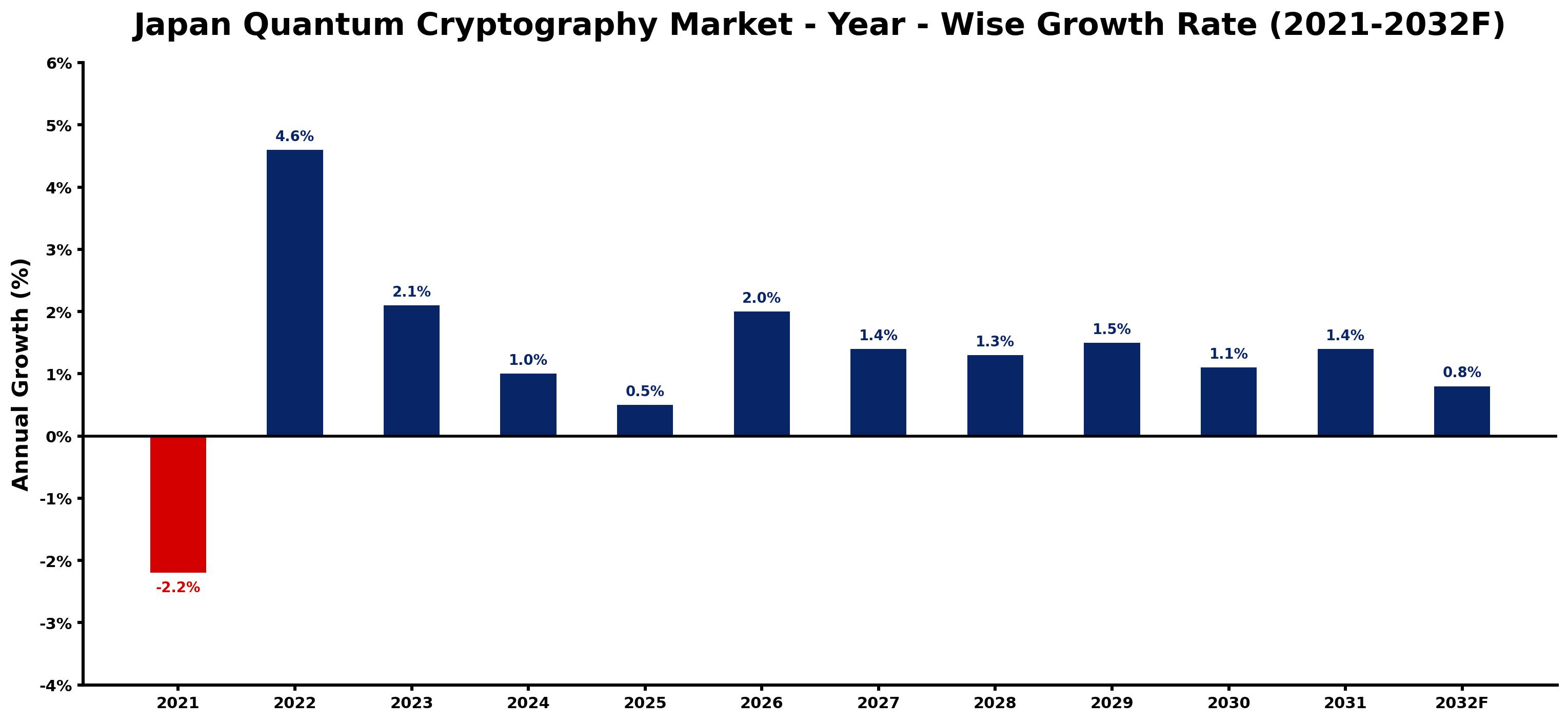
The table below presents the year‑wise growth rates along with the key drivers influencing the market
| Year | Growth Rate | Major Drivers |
| 2021 | -2.2% | Limited enterprise adoption due to bureaucratic procurement processes. |
| 2022 | 4.6% | Government support for quantum research and development initiatives. |
| 2023 | 2.1% | Increased focus on cybersecurity due to data breaches. |
| 2024 | 1.0% | Launch of national quantum security strategy by METI. |
| 2025 | 0.5% | Growing industry collaborations in privacy-enhancing technologies. |
| 2026 | 2.0% | Investment in critical infrastructure for data protection. |
| 2027 | 1.4% | Active participation in international quantum technology conferences. |
| 2028 | 1.3% | Demand for enhanced security in IoT device communications. |
| 2029 | 1.5% | Adoption of quantum key distribution by telecom operators. |
| 2030 | 1.1% | Rising awareness of quantum threats among enterprises. |
| 2031 | 1.4% | Development of educational programs in quantum cryptography. |
| 2032 | 0.8% | Emergence of domestic startups specializing in quantum security. |
Note: Market size estimations and growth projections presented in this report are based on 6Wresearch's proprietary forecasting methodology, utilizing the latest available industry data, government publications, and primary research inputs.
Japan Quantum Cryptography Market Key Takeaways
Below are some of the specific key takeaways from the market, including:
- Growing investment in quantum technology by public and private sectors.
- Shift towards quantum key distribution (QKD) systems as preferred encryption methods.
- Increased collaboration between industry players and academic institutions.
- Rising governmental support for cybersecurity initiatives.
- Continuous advancements in quantum technology enhancing market potential.
Evaluation of Restraints in Japan Quantum Cryptography Market
The Japan Quantum Cryptography Market is stymied by several challenges that hinder wider adoption. The technology is still maturing and remains complex, requiring specialized skills and resources for implementation. High development costs and the limited availability of commercial solutions further restrict access, particularly for smaller businesses. The scarcity of vendors offering quantum cryptography products creates a competitive gap, limiting choices for potential buyers. Addressing these barriers is vital for unlocking the market's full potential.
Japan Quantum Cryptography Market Trends
Currently, organizations are gravitating toward quantum key distribution systems as a robust alternative to conventional encryption technologies. As cyber threats evolve, there is an increasing inclination towards integrating quantum solutions to enhance data security protocols. on top of that, strategic partnerships and collaborations in research are fostering innovation in quantum cryptography, paving the way for more sophisticated solutions.
Japan Quantum Cryptography Market Opportunities
The market offers substantial investment avenues, particularly in developing secure communication technologies. With rising concerns about data breaches and cyberattacks, demand for quantum cryptography is expected to escalate. Key players can explore collaborations with research institutions to innovate quantum encryption solutions, enhancing their market position. The government’s active participation in funding initiatives also presents attractive opportunities for businesses looking to capitalize on advancements in quantum technology.
Government Initiatives in the Japan Quantum Cryptography Market
The Japanese government is actively shaping the future of quantum cryptography through a series of strategic initiatives aimed at boosting cybersecurity capabilities. With a focused approach on enhancing quantum technologies, the government is fostering an environment conducive to innovation and secure communication systems.
- A Quantum Cryptography Development Plan launched in 2020, emphasizing funding for research on quantum key distribution (QKD) technologies.
- Currently ongoing collaborations with industry partners to implement QKD in critical sectors, including healthcare and finance.
- Investment in a national digital infrastructure upgrade program aimed at bolstering the nation’s cybersecurity framework through advanced technologies.
- Plans for a comprehensive regulatory framework expected to be introduced by 2026, aimed at standardizing quantum cryptography implementations across sectors.
- Support for public-private partnerships that seek to advance quantum technology applications, expected to launch in 2026.
Future Insights of the Japan Quantum Cryptography Market
The outlook for the Japan Quantum Cryptography Market remains optimistic as businesses increasingly recognize the necessity for enhanced security measures. With continuing investments in quantum technology and supportive government policies, the market is set to experience sustained growth. The need for secure communication channels across various sectors, particularly finance and government, will further escalate demand for innovative quantum solutions in the coming years.
Japan Quantum Cryptography Market Latest Developments
In recent months, the Japan Quantum Cryptography Market has seen a notable uptick in activity, as organizations accelerate their efforts to implement quantum technologies for secure communications. Developments are focused on both innovation and collaboration across sectors.
- In early 2025, a major technology vendor completed a successful pilot project of a quantum key distribution system in a financial institution.
- An ongoing initiative that began in mid-2025 involves partnerships between universities and tech firms to develop next-generation quantum encryption technologies.
- Plans for a nationwide quantum cryptography awareness campaign are expected to roll out in late 2026, aiming to educate businesses on security benefits.
- A significant funding proposal for quantum technology research was approved by the government in Q3 2025, focusing on enhancing national cybersecurity measures.
- Upcoming deployment of a collaborative platform for sharing quantum encryption advancements is scheduled for early 2026.
Japan Quantum Cryptography Market - Key Attractiveness of the Report
- 10 Years of Market Numbers
- Historical Data Starting from 2022 to 2025
- Base Year: 2025
- Forecast Data until 2032
- Key Performance Indicators Impacting the Market
- Major Upcoming Developments and Projects
Key Highlights of the Report:
- Japan Quantum Cryptography Market Outlook
- Market Size of Japan Quantum Cryptography Market, 2025
- Forecast of Japan Quantum Cryptography Market, 2032
- Historical Data and Forecast of Japan Quantum Cryptography Revenues & Volume for the Period 2022-2032F
- Japan Quantum Cryptography Market Trend Evolution
- Japan Quantum Cryptography Market Drivers and Challenges
- Japan Quantum Cryptography Price Trends
- Japan Quantum Cryptography Porter's Five Forces
- Japan Quantum Cryptography Industry Life Cycle
- Historical Data and Forecast of Japan Quantum Cryptography Market Revenues & Volume By Component for the Period 2022-2032F
- Historical Data and Forecast of Japan Quantum Cryptography Market Revenues & Volume By Solutions for the Period 2022-2032F
- Historical Data and Forecast of Japan Quantum Cryptography Market Revenues & Volume By Services for the Period 2022-2032F
- Historical Data and Forecast of Japan Quantum Cryptography Market Revenues & Volume By Services for the Period 2022-2032F
- Historical Data and Forecast of Japan Quantum Cryptography Market Revenues & Volume By Consulting for the Period 2022-2032F
- Historical Data and Forecast of Japan Quantum Cryptography Market Revenues & Volume By Advisory for the Period 2022-2032F
- Historical Data and Forecast of Japan Quantum Cryptography Market Revenues & Volume By Deployment for the Period 2022-2032F
- Historical Data and Forecast of Japan Quantum Cryptography Market Revenues & Volume By Integration for the Period 2022-2032F
- Historical Data and Forecast of Japan Quantum Cryptography Market Revenues & Volume By Support for the Period 2022-2032F
- Historical Data and Forecast of Japan Quantum Cryptography Market Revenues & Volume By Maintenance for the Period 2022-2032F
- Historical Data and Forecast of Japan Quantum Cryptography Market Revenues & Volume By Security Type for the Period 2022-2032F
- Historical Data and Forecast of Japan Quantum Cryptography Market Revenues & Volume By Network for the Period 2022-2032F
- Historical Data and Forecast of Japan Quantum Cryptography Market Revenues & Volume By Application Security for the Period 2022-2032F
- Historical Data and Forecast of Japan Quantum Cryptography Market Revenues & Volume By Vertical for the Period 2022-2032F
- Historical Data and Forecast of Japan Quantum Cryptography Market Revenues & Volume By Government and defense for the Period 2022-2032F
- Historical Data and Forecast of Japan Quantum Cryptography Market Revenues & Volume By BFSI for the Period 2022-2032F
- Historical Data and Forecast of Japan Quantum Cryptography Market Revenues & Volume By Retail for the Period 2022-2032F
- Historical Data and Forecast of Japan Quantum Cryptography Market Revenues & Volume By Healthcare for the Period 2022-2032F
- Historical Data and Forecast of Japan Quantum Cryptography Market Revenues & Volume By Automotive for the Period 2022-2032F
- Historical Data and Forecast of Japan Quantum Cryptography Market Revenues & Volume By Others (telecom, energy and utilities, logistics, and education) for the Period 2022-2032F
- Japan Quantum Cryptography Import Export Trade Statistics
- Market Opportunity Assessment By Component
- Market Opportunity Assessment By Services
- Market Opportunity Assessment By Security Type
- Market Opportunity Assessment By Vertical
- Japan Quantum Cryptography Top Companies Market Share
- Japan Quantum Cryptography Competitive Benchmarking By Technical and Operational Parameters
- Japan Quantum Cryptography Company Profiles
- Japan Quantum Cryptography Key Strategic Recommendations






































