Japan Railway Platform Security Market Size & Growth Rate (2026-2032)
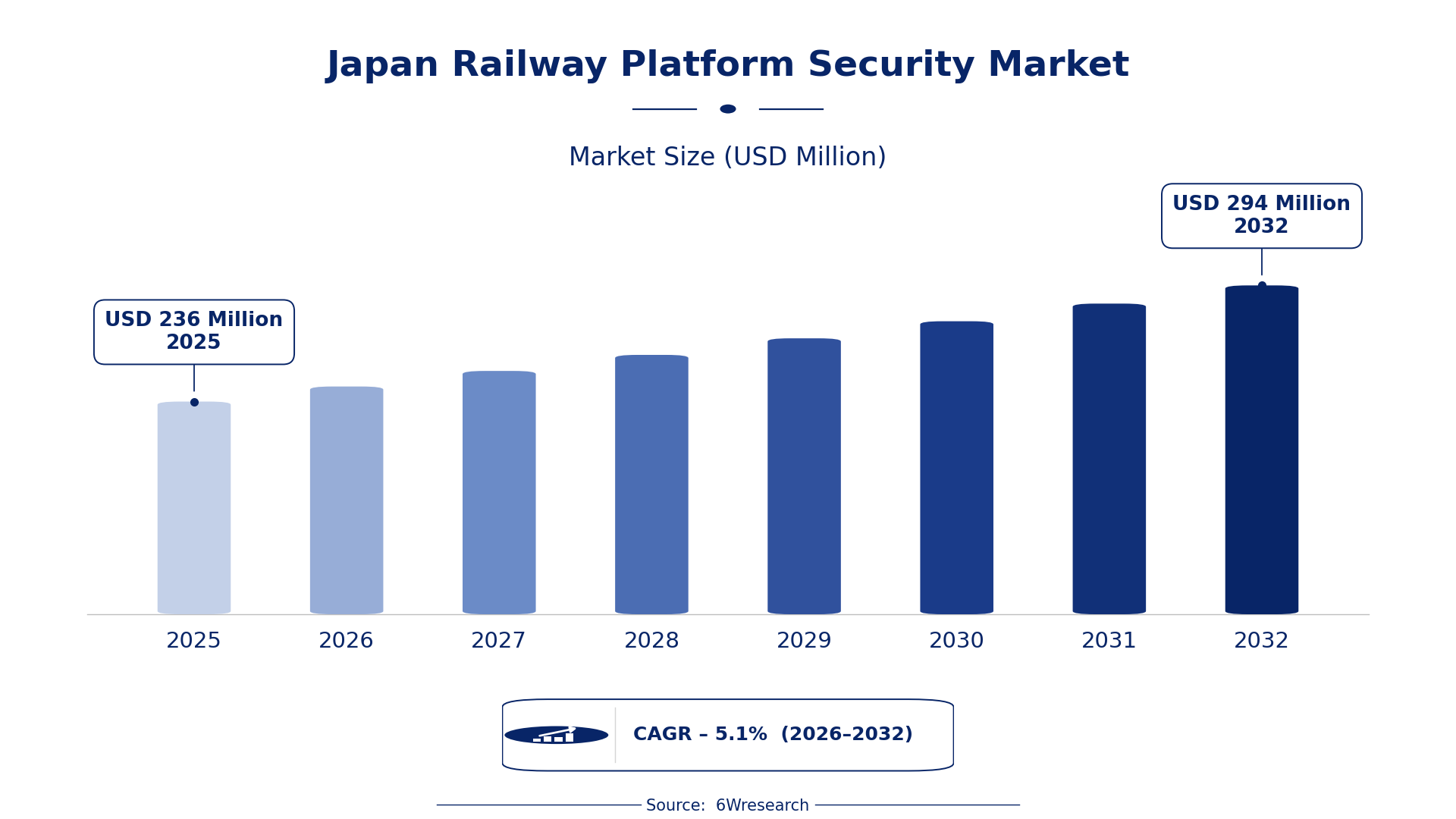
The Japan Railway Platform Security Market was estimated at USD 236 Million in 2025 and is projected to reach USD 294 Million by 2032, growing at a CAGR of 5.1% from 2026 to 2032.
Japan Railway Platform Security Market Synopsis
Japan's railway system, known for its efficiency and punctuality, faces growing scrutiny regarding passenger safety. As security concerns escalate, railway operators are prioritizing investments in advanced security technologies to protect passengers and infrastructure. These investments are increasingly essential as the volume of rail users continues to rise.
The integration of advanced technologies such as AI-driven surveillance and IoT-enabled monitoring systems is redefining how security is approached across Japan's railway platforms. As threats evolve, so too must the strategies employed to mitigate them, creating a dynamic environment for security providers and users alike.
Japan Railway Platform Security Market Year-wise Growth Rate and Key Drivers
This graph illustrates the annual growth rates of the Japan Railway Platform Security Market from 2021 to 2032, highlighting a steady upward trajectory and projected expansion over the forecast period.
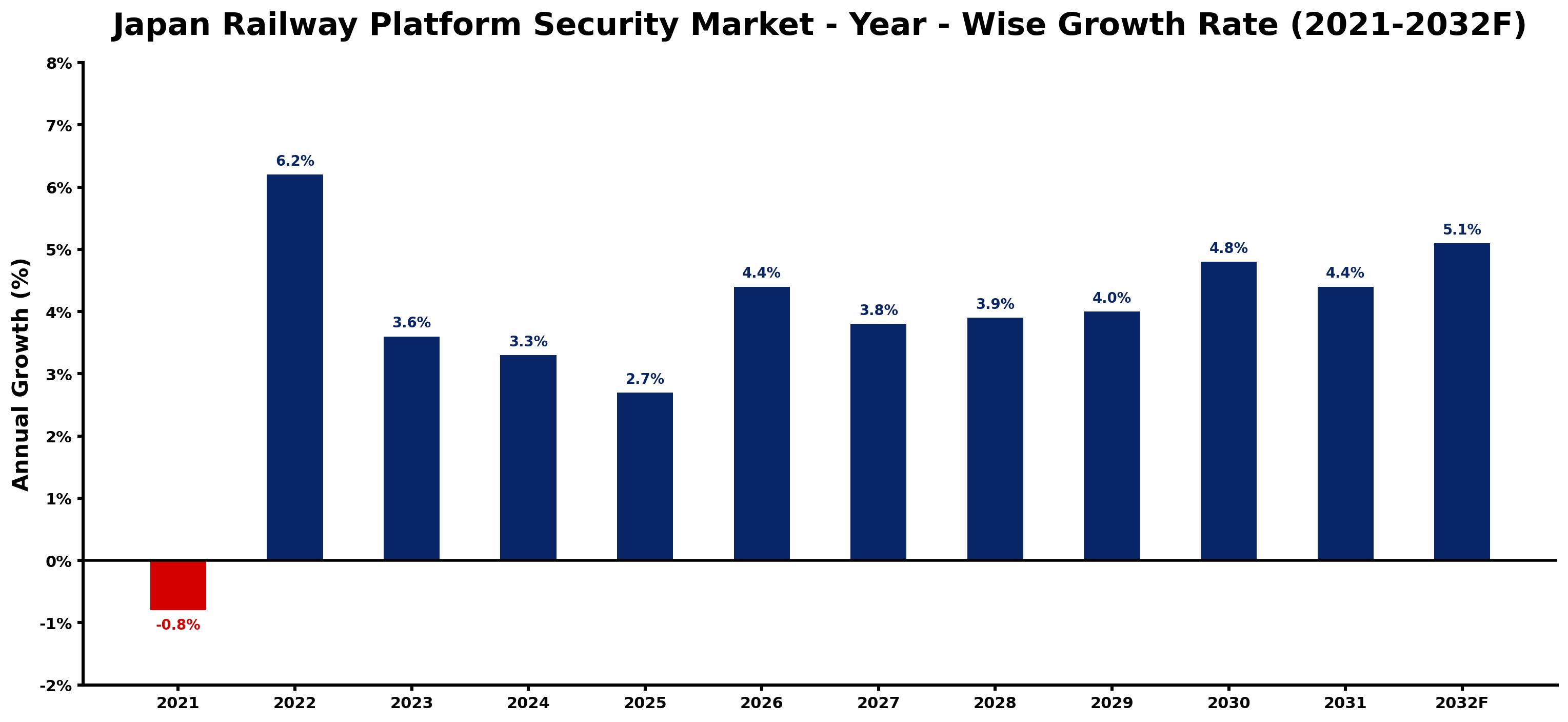
The table below presents the year‑wise growth rates along with the key drivers influencing the market
| Year | Growth Rate | Major Drivers |
| 2021 | -0.8% | Delayed adoption of biometric security by Japanese railways. |
| 2022 | 6.2% | Increased investments in cyber resilience by JR East. |
| 2023 | 3.6% | Launch of government’s security upgrade initiative for railways. |
| 2024 | 3.3% | Rise in passenger traffic boosting security service demand. |
| 2025 | 2.7% | Adoption of AI-driven surveillance systems in railway stations. |
| 2026 | 4.4% | Strengthening of railway security regulations by MLIT. |
| 2027 | 3.8% | Implementation of biometric access controls for improved safety. |
| 2028 | 3.9% | Growing public awareness of rail safety and security. |
| 2029 | 4.0% | Integration of advanced analytics in monitoring passenger flows. |
| 2030 | 4.8% | Collaboration with tech firms enhancing cybersecurity measures. |
| 2031 | 4.4% | Increase in funding for railway defense against cyber threats. |
| 2032 | 5.1% | Expanded training programs for staff on security protocols. |
Note: Market size estimations and growth projections presented in this report are based on 6Wresearch's proprietary forecasting methodology, utilizing the latest available industry data, government publications, and primary research inputs.
Japan Railway Platform Security Market Key Takeaways
Below are some of the specific key takeaways from the market, including:
- Growing emphasis on AI and IoT technologies to enhance surveillance and response capabilities.
- Increased government initiatives to upgrade security infrastructure across railway networks.
- Investment in cybersecurity measures to protect against digital threats targeting railway systems.
- Shift towards user-friendly security solutions that do not impede passenger flow.
- Emergence of cloud-based platforms for real-time security monitoring and management.
Evaluation of Restraints in Japan Railway Platform Security Market
The Japan Railway Platform Security Market faces several constraints that could hinder its growth. One of the most pressing issues is the challenge of implementing enhanced security measures without disrupting the flow of passengers. Striking a balance between thorough security checks and operational efficiency is essential. on top of that, the sheer volume of travelers makes it difficult to monitor and assess suspicious activities effectively.
on top of that, the fast-paced evolution of security threats demands that operators continuously update their technologies and strategies. This not only requires significant investment but also poses logistical challenges in training personnel to use new systems effectively. Ensuring that security measures remain non-intrusive and do not detract from the overall passenger experience is another critical factor that needs careful management.
Japan Railway Platform Security Market Trends
The current trends in the Japan Railway Platform Security Market are marked by a rapid adoption of cutting-edge technologies. AI-based analytics and facial recognition systems are gaining traction, enabling more effective threat detection and response. Additionally, railway operators are investing heavily in cybersecurity solutions, reflecting an awareness of the vulnerabilities inherent in increasingly digitalized environments.
Another notable trend is the move towards cloud-based security management systems. These platforms facilitate real-time monitoring and provide flexibility in managing security operations across multiple locations. As passenger safety becomes a top priority, the demand for innovative security solutions continues to rise, indicating that technology will be central to future developments in this market.
Japan Railway Platform Security Market Opportunities
Investors looking at the Japan Railway Platform Security Market can find substantial opportunities in several areas. The demand for AI-driven video surveillance systems and advanced access control solutions is on the rise, driven by the need for enhanced safety protocols in crowded environments. Additionally, the government’s push to modernize railway infrastructure opens avenues for innovative security technology providers.
Emerging companies that focus on developing user-friendly and efficient security solutions will likely see significant interest. The integration of mobile applications for security management and incident reporting offers another promising investment area, as operators seek to enhance their operational efficiency while prioritizing passenger safety.
Government Initiatives in the Japan Railway Platform Security Market
Government policy plays a crucial role in shaping the Japan Railway Platform Security Market. With heightened concerns about public safety, the Japanese government is actively implementing measures to bolster security across railway platforms. These initiatives not only enhance safety but also reflect the collaboration between various stakeholders to maintain a secure travel environment.
- A recently completed initiative involved the installation of advanced surveillance systems in major urban stations to deter crime and enhance passenger safety.
- Current efforts include the ongoing deployment of security personnel and the integration of AI technologies into existing monitoring systems for better threat assessment.
- Upcoming plans feature a nationwide upgrade of security protocols, expected to incorporate biometric identification systems by 2028.
- The government is also exploring public-private partnerships aimed at developing cutting-edge security technologies tailored for the railway sector.
- Regulatory frameworks are being strengthened to ensure compliance with safety protocols across all railway operators.
Future Insights of the Japan Railway Platform Security Market
Looking ahead to the period from 2026 to 2032, the Japan Railway Platform Security Market is expected to experience steady growth. As the threat landscape continues to evolve, there will be an increasing emphasis on integrating advanced technologies into security systems. AI and IoT capabilities will likely become standard, providing operators with tools for proactive risk management and real-time surveillance.
Investment in passenger safety will remain a top priority, driven by government initiatives aimed at modernizing infrastructure. This focus will create a fertile environment for security technology providers, encouraging innovation and the development of solutions that meet the specific needs of the railway sector.
Japan Railway Platform Security Market Latest Developments
In recent months, the Japan Railway Platform Security Market has seen a flurry of activity as operators and technology providers respond to increasing security demands. The focus has shifted towards integrating innovative technologies that enhance operational efficiency while ensuring passenger safety. This trend reflects a broader commitment to modernizing security infrastructure across the country.
- A major technology vendor launched an AI-powered surveillance system in Q2 2025, enhancing real-time threat detection capabilities in several key railway stations.
- Currently ongoing is a pilot program that combines IoT sensors with traditional surveillance methods, aimed at improving monitoring efficiency at crowded platforms.
- A partnership formed in late 2024 between several railway operators and tech firms is developing a unified platform for data sharing and incident response.
- Plans for a significant upgrade to the access control systems at major terminals are set to begin implementation in early 2026, with a focus on biometric solutions.
- A regulatory initiative launched in late 2023 mandates enhanced cybersecurity protocols for all railway operators, ensuring better protection against digital threats.
Japan Railway Platform Security Market - Key Attractiveness of the Report
- 10 Years of Market Numbers
- Historical Data Starting from 2022 to 2025
- Base Year: 2025
- Forecast Data until 2032
- Key Performance Indicators Impacting the Market
- Major Upcoming Developments and Projects
Key Highlights of the Report:
- Japan Railway Platform Security Market Outlook
- Market Size of Japan Railway Platform Security Market, 2025
- Forecast of Japan Railway Platform Security Market, 2032
- Historical Data and Forecast of Japan Railway Platform Security Revenues & Volume for the Period 2022-2032F
- Japan Railway Platform Security Market Trend Evolution
- Japan Railway Platform Security Market Drivers and Challenges
- Japan Railway Platform Security Price Trends
- Japan Railway Platform Security Porter's Five Forces
- Japan Railway Platform Security Industry Life Cycle
- Historical Data and Forecast of Japan Railway Platform Security Market Revenues & Volume By Components for the Period 2022-2032F
- Historical Data and Forecast of Japan Railway Platform Security Market Revenues & Volume By Solutions for the Period 2022-2032F
- Historical Data and Forecast of Japan Railway Platform Security Market Revenues & Volume By Services for the Period 2022-2032F
- Historical Data and Forecast of Japan Railway Platform Security Market Revenues & Volume By Applications for the Period 2022-2032F
- Historical Data and Forecast of Japan Railway Platform Security Market Revenues & Volume By Subways for the Period 2022-2032F
- Historical Data and Forecast of Japan Railway Platform Security Market Revenues & Volume By Trains for the Period 2022-2032F
- Japan Railway Platform Security Import Export Trade Statistics
- Market Opportunity Assessment By Components
- Market Opportunity Assessment By Applications
- Japan Railway Platform Security Top Companies Market Share
- Japan Railway Platform Security Competitive Benchmarking By Technical and Operational Parameters
- Japan Railway Platform Security Company Profiles
- Japan Railway Platform Security Key Strategic Recommendations






































