Japan Recordable Optical Disc Market Size, Share & Growth Rate
The Japan Recordable Optical Disc Market was estimated at USD 103 Million in 2025 and is projected to reach USD 110 Million by 2032, growing at a CAGR of 0.9% from 2026 to 2032. This stable growth trajectory reflects a continuing, albeit niche, demand for recordable optical discs amidst the increasing prevalence of digital streaming. Professionals and enthusiasts in various sectors are driving demand as they seek reliable physical storage solutions for data archiving and media distribution.
Japan Recordable Optical Disc Market Year-wise Growth Rate and Key Drivers
This graph highlights how the Japan Recordable Optical Disc Market has steadily grown over the years, supported by major growth factors.
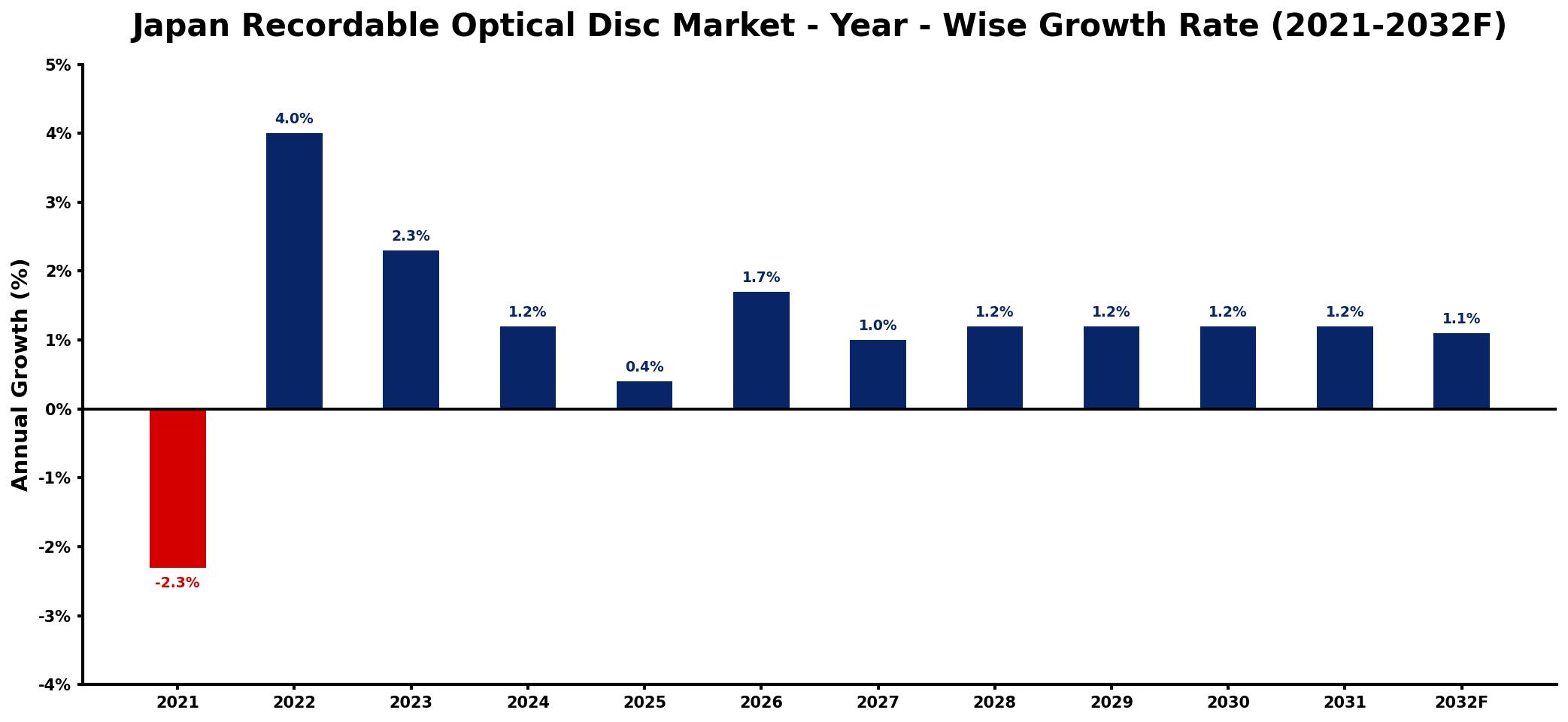
The table below presents the year‑wise growth rates along with the key drivers influencing the market
| Year | Growth Rate | Major Drivers |
| 2021 | -2.3% | shift towards digital media consumption |
| 2022 | 4.0% | increased demand for home entertainment |
| 2023 | 2.3% | growth in video content production |
| 2024 | 1.2% | rise in data storage requirements |
| 2025 | 0.4% | expansion of educational multimedia usage |
| 2026 | 1.7% | surge in gaming industry investment |
| 2027 | 1.0% | development of new media formats |
| 2028 | 1.2% | rising demand from electronics |
| 2029 | 1.2% | enhanced consumer interest in collectibles |
| 2030 | 1.2% | increase in multimedia streaming services |
| 2031 | 1.2% | growing automotive sector requirements |
| 2032 | 1.1% | growing use in event recording |
Note: Market size estimations and growth projections presented in this report are based on 6Wresearch's proprietary forecasting methodology, utilizing the latest available industry data, government publications, and primary research inputs.
Japan Recordable Optical Disc Market Synopsis
The Japan Recordable Optical Disc Market remains resilient despite the significant shift towards digital formats. As industries emphasize data security and long-term storage, the demand for high-capacity formats like Blu-ray discs is on the rise. This trend underscores the market's adaptation to meet the unique needs of businesses and content creators.
Current developments indicate a robust interest in archival uses, especially within corporate sectors and government entities that prioritize data retention regulations. As innovations in disc technology emerge, manufacturers are responding with enhanced durability and increased storage capabilities, thereby ensuring relevance in a rapidly evolving technological landscape.
Japan Recordable Optical Disc Market Key Takeaways
- The Japan Recordable Optical Disc Market is projected to show stable growth, driven by niche demand for physical storage solutions.
- High-capacity formats, particularly Blu-ray, are gaining traction as consumers seek quality in media storage.
- Archival storage requirements in corporate and government sectors are pivotal in maintaining market relevance.
- Innovations in disc technology focus on durability, longevity, and capacity to meet evolving consumer preferences.
- Investment opportunities exist in sustainable manufacturing practices and advanced production processes.
Evaluation of Restraints in Japan Recordable Optical Disc Market
The Japan Recordable Optical Disc Market faces notable restraints primarily stemming from the rapid adoption of digital media and cloud storage solutions. With streaming services dominating consumer media consumption, the traditional demand for physical media continues to wane. Furthermore, competition from alternative storage options poses challenges to market players. Issues related to piracy and counterfeit products undermine the profitability of legitimate optical disc manufacturers, complicating efforts to maintain market share in a declining demand landscape. High production costs and environmental concerns surrounding disc disposal further restrict potential growth and innovation.
Japan Recordable Optical Disc Market Trends
The current trends in the Japan Recordable Optical Disc Market are profoundly influenced by consumer preferences for higher-capacity and more durable formats. The rise of 4K content is propelling interest in Blu-ray technology, while traditional formats like CD and DVD are increasingly overshadowed by digital alternatives. Additionally, there is a rising focus on developing eco-friendly disc solutions, addressing consumer and regulatory concerns about sustainability. The corporate sector's need for secure archival storage is also fostering innovation in disc design and technology.
Japan Recordable Optical Disc Market Opportunities
There are significant investment opportunities within the Japan Recordable Optical Disc Market, particularly in high-quality manufacturing tailored to niche applications such as data storage and media distribution. The demand for physical media remains strong among professionals who require reliable storage solutions. Engaging in partnerships with electronics companies can further stimulate innovation, leading to the development of advanced disc formats. Additionally, targeting environmentally-conscious consumers with sustainable production practices can create a competitive advantage and attract a dedicated customer base.
Government Initiatives in the Japan Recordable Optical Disc Market
The Japanese government has implemented key policies to support the recordable optical disc market, primarily aimed at protecting intellectual property rights and combating piracy. The Copyright Act plays a crucial role in safeguarding creative works, imposing penalties for violations. Further, the Optical Disc Law mandates proper labeling of recordable discs to prevent unauthorized duplication. Collaborating with industry stakeholders, the government is actively working to ensure a level playing field in the market, thereby encouraging fair competition and innovation.
Future Insights of the Japan Recordable Optical Disc Market
Looking towards 2026-2032, the Japan Recordable Optical Disc Market is likely to continue adapting to the challenges posed by digital media consumption. While mainstream consumer demand is projected to gradually decline, specific applications in archival storage and professional media production present growth opportunities. Industry players will need to focus on enhancing disc capabilities and exploring new applications to remain competitive. Emphasizing data security and reliability will be crucial as businesses navigate an increasingly digital landscape.
Japan Recordable Optical Disc Market Latest Developments (2025 - 2026)
Recent developments in the Japan Recordable Optical Disc Market indicate a shift towards innovative storage solutions, focusing on enhancing disc durability and capacity. As manufacturers invest in new technologies, there is a notable increase in products designed specifically for archival purposes, catering to sectors with stringent data retention needs. Collaborative efforts among industry stakeholders aim to address environmental concerns, leading to the introduction of more sustainable manufacturing practices, thereby resonating with the growing demand for eco-friendly products.
Japan Recordable Optical Disc Market - Key Attractiveness of the Report
- 10 Years of Market Numbers
- Historical Data Starting from 2022 to 2025
- Base Year: 2025
- Forecast Data until 2032
- Key Performance Indicators Impacting the Market
- Major Upcoming Developments and Projects
Key Highlights of the Report:
- Japan Recordable Optical Disc Market Outlook
- Market Size of Japan Recordable Optical Disc Market, 2025
- Forecast of Japan Recordable Optical Disc Market, 2032
- Historical Data and Forecast of Japan Recordable Optical Disc Revenues & Volume for the Period 2022-2032F
- Japan Recordable Optical Disc Market Trend Evolution
- Japan Recordable Optical Disc Market Drivers and Challenges
- Japan Recordable Optical Disc Price Trends
- Japan Recordable Optical Disc Porter's Five Forces
- Japan Recordable Optical Disc Industry Life Cycle
- Historical Data and Forecast of Japan Recordable Optical Disc Market Revenues & Volume By Product Type for the Period 2022-2032F
- Historical Data and Forecast of Japan Recordable Optical Disc Market Revenues & Volume By Compact Discs (CD) for the Period 2022-2032F
- Historical Data and Forecast of Japan Recordable Optical Disc Market Revenues & Volume By Digital Versatile Discs (DVD) for the Period 2022-2032F
- Historical Data and Forecast of Japan Recordable Optical Disc Market Revenues & Volume By Sales Channel for the Period 2022-2032F
- Historical Data and Forecast of Japan Recordable Optical Disc Market Revenues & Volume By Online Sales of Recordable Optical Discs for the Period 2022-2032F
- Historical Data and Forecast of Japan Recordable Optical Disc Market Revenues & Volume By Offline Sales of Recordable Optical Discs for the Period 2022-2032F
- Historical Data and Forecast of Japan Recordable Optical Disc Market Revenues & Volume By Sales of Recordable Optical Discs by Distributors for the Period 2022-2032F
- Historical Data and Forecast of Japan Recordable Optical Disc Market Revenues & Volume By Sales of Recordable Optical Discs by Resellers for the Period 2022-2032F
- Historical Data and Forecast of Japan Recordable Optical Disc Market Revenues & Volume By Direct Sales of Sales of Recordable Optical Discs for the Period 2022-2032F
- Historical Data and Forecast of Japan Recordable Optical Disc Market Revenues & Volume By End Use for the Period 2022-2032F
- Historical Data and Forecast of Japan Recordable Optical Disc Market Revenues & Volume By Consumers for the Period 2022-2032F
- Historical Data and Forecast of Japan Recordable Optical Disc Market Revenues & Volume By Professionals for the Period 2022-2032F
- Historical Data and Forecast of Japan Recordable Optical Disc Market Revenues & Volume By Storage Capacity for the Period 2022-2032F
- Historical Data and Forecast of Japan Recordable Optical Disc Market Revenues & Volume By Below 5GB Recordable Optical Discs for the Period 2022-2032F
- Historical Data and Forecast of Japan Recordable Optical Disc Market Revenues & Volume By 5-10 GB Recordable Optical Discs for the Period 2022-2032F
- Historical Data and Forecast of Japan Recordable Optical Disc Market Revenues & Volume By Above 10 GB Recordable Optical Discs for the Period 2022-2032F
- Japan Recordable Optical Disc Import Export Trade Statistics
- Market Opportunity Assessment By Product Type
- Market Opportunity Assessment By Sales Channel
- Market Opportunity Assessment By End Use
- Market Opportunity Assessment By Storage Capacity
- Japan Recordable Optical Disc Top Companies Market Share
- Japan Recordable Optical Disc Competitive Benchmarking By Technical and Operational Parameters
- Japan Recordable Optical Disc Company Profiles
- Japan Recordable Optical Disc Key Strategic Recommendations






































