Japan RegTech Market Size & Growth Rate (2026-2032)
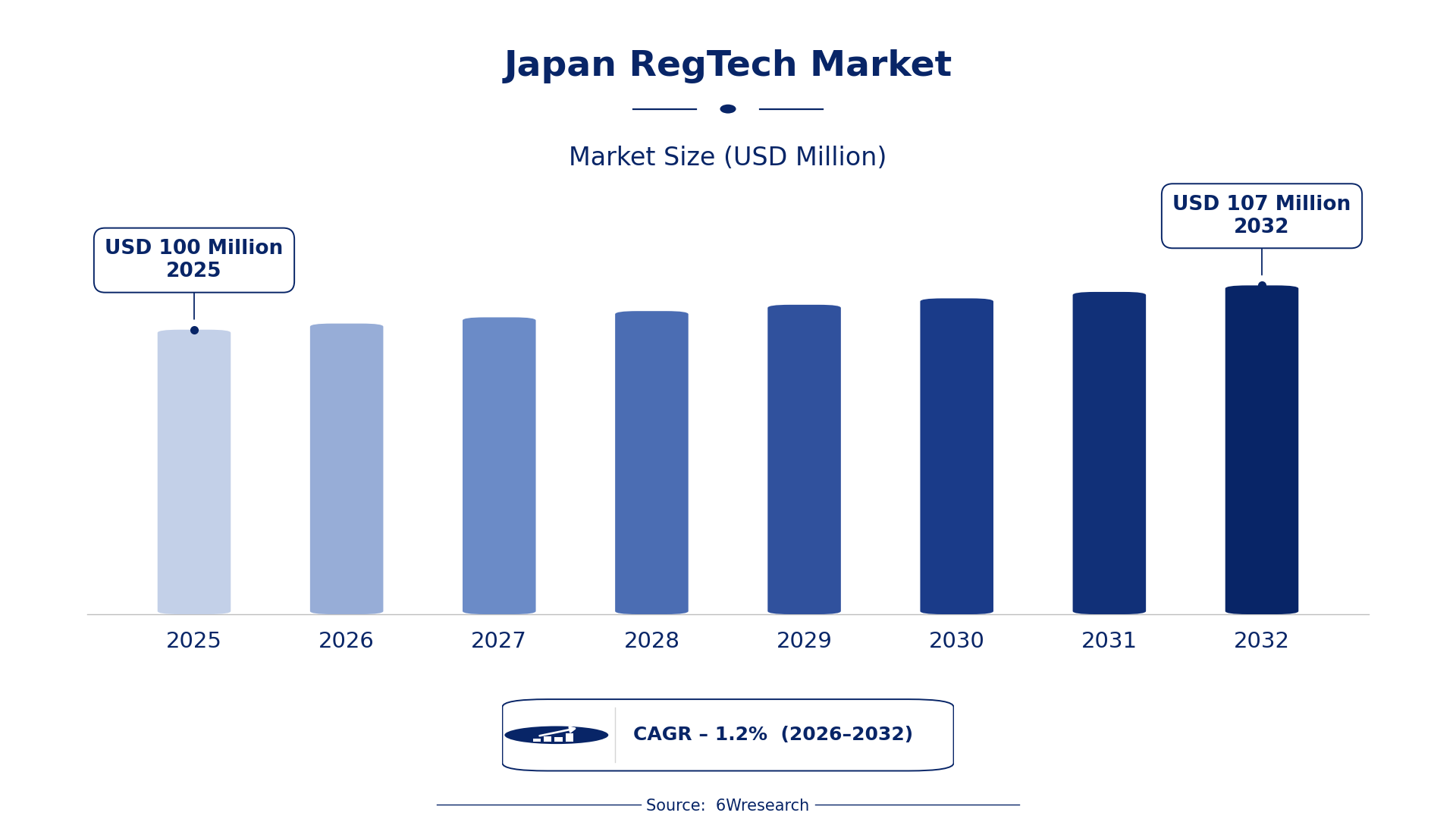
The Japan RegTech Market was estimated at USD 100 Million in 2025 and is projected to reach USD 107 Million by 2032, growing at a CAGR of 1.2% from 2026 to 2032.
Japan RegTech Market Synopsis
The driving force behind the Japan RegTech market is the increasing complexity of regulatory requirements in the financial sector. Financial institutions are scrambling to adopt solutions that enhance compliance, risk management, and reporting, which has led to a noticeable uptick in RegTech adoption.
As firms prioritize technological innovation, there is a burgeoning demand for advanced solutions utilizing artificial intelligence, machine learning, and blockchain. Collaborations between RegTech providers and financial institutions are becoming commonplace, aimed at tackling the unique regulatory challenges present in Japan.
Japan RegTech Market Year-wise Growth Rate and Key Drivers
This graph illustrates the annual growth rates of the Japan RegTech Market from 2021 to 2032, highlighting a steady upward trajectory and projected expansion over the forecast period.
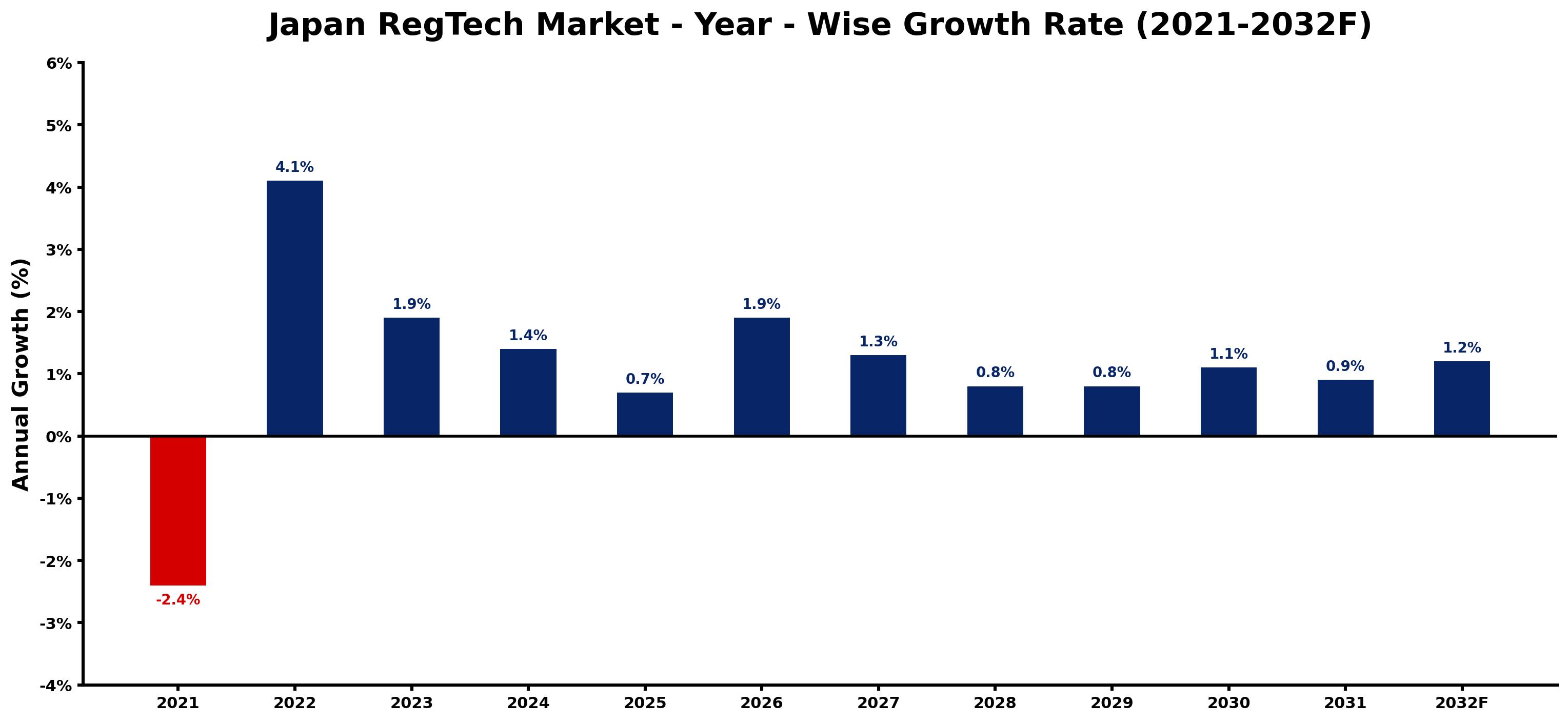
The table below presents the year‑wise growth rates along with the key drivers influencing the market
| Year | Growth Rate | Major Drivers |
| 2021 | -2.4% | Japan's Financial Services Agency strict data privacy regulations hindered adoption. |
| 2022 | 4.1% | Implementation of stricter AML regulations by FSA. |
| 2023 | 1.9% | Increased demand for KYC compliance solutions among fintech firms. |
| 2024 | 1.4% | Growth in digital banking systems requiring advanced cybersecurity. |
| 2025 | 0.7% | Rising fraud incidents prompting enhanced regulatory technologies. |
| 2026 | 1.9% | Government push for innovation in financial services regulation. |
| 2027 | 1.3% | Surge in enterprise adoption of AI for regulatory compliance. |
| 2028 | 0.8% | Heightened emphasis on data privacy and security measures. |
| 2029 | 0.8% | Greater investment in compliance platforms by SMEs. |
| 2030 | 1.1% | Development of blockchain solutions to ensure regulatory integrity. |
| 2031 | 0.9% | Collaboration between RegTech startups and traditional banks. |
| 2032 | 1.2% | Focus on sustainability regulations driving compliance solutions. |
Note: Market size estimations and growth projections presented in this report are based on 6Wresearch's proprietary forecasting methodology, utilizing the latest available industry data, government publications, and primary research inputs.
Japan RegTech Market Key Takeaways
Below are some of the specific key takeaways from the market, including:
- The Japan RegTech market is driven by stringent regulatory compliance requirements in the financial services sector.
- Advanced technologies such as AI and blockchain are critical to enhancing regulatory processes and automating compliance tasks.
- Collaboration between financial institutions and RegTech firms is increasing, leading to tailored compliance solutions.
- Investment opportunities are emerging in startups focusing on AML, KYC, and risk management solutions.
- The Japanese government is actively promoting RegTech adoption through initiatives like the Regulatory Sandbox.
Evaluation of Restraints in Japan RegTech Market
A major constraint impacting the Japan RegTech market is the intricate regulatory environment, which is characterized by rigorous compliance mandates and frequent updates. This complexity makes it challenging for RegTech companies to develop solutions that not only meet the evolving needs of financial institutions but also ensure compliance with new regulations. Additionally, a cultural inclination towards traditional business practices can slow down the acceptance of new technologies, further hindering growth.
Data privacy and security concerns also loom large, as sensitive financial information must be handled with the utmost care. Establishing robust cybersecurity measures is essential to build trust among stakeholders and facilitate wider adoption of RegTech solutions.
Japan RegTech Market Trends
One of the most significant trends in the Japan RegTech market is the escalating investment in automation technologies. Firms are increasingly adopting AI and machine learning to streamline compliance processes, allowing for greater efficiency in transaction monitoring and reporting. The trend of collaborative innovation is also gaining traction, as financial institutions partner with RegTech providers to create bespoke solutions tailored to specific regulatory demands.
Another emerging trend is the focus on real-time data analytics, which aids in proactive risk management and compliance monitoring. As organizations strive to improve their compliance capabilities, the need for agile and adaptive RegTech solutions has never been more pronounced.
Japan RegTech Market Opportunities
The Japan RegTech market presents lucrative opportunities for investment, particularly in areas related to anti-money laundering (AML) and know your customer (KYC) solutions. Companies focused on innovative technologies that simplify compliance processes are well-positioned for growth. The drive for digital transformation within financial services, combined with stringent regulatory requirements, creates a fertile environment for new entrants and startups that can deliver effective, cost-efficient solutions.
Investors should look closely at firms developing advanced analytics and blockchain-based solutions, as these technologies are gaining traction in addressing the complexities of regulatory compliance.
Government Initiatives in the Japan RegTech Market
The Japanese government is significantly influencing the RegTech market through various initiatives aimed at enhancing regulatory compliance and fostering innovation. A commitment to digitalization in financial services and proactive regulatory reforms are paving the way for a more conducive environment for RegTech solutions. By encouraging collaboration between regulators and technology firms, the government is addressing the need for compliance efficiency and transparency.
- A recently launched Regulatory Sandbox program by the Financial Services Agency (FSA) allows companies to test innovative solutions in a controlled environment.
- Current initiatives focus on regulatory reforms that accommodate new technologies while ensuring data security and privacy.
- A planned public-private partnership is expected to enhance collaboration between financial institutions and RegTech providers by 2026.
- The Japan RegTech Association was established to facilitate dialogue between stakeholders and promote innovative compliance solutions.
- Ongoing efforts by the FSA aim to streamline regulatory processes and foster a culture of innovation in compliance.
Future Insights of the Japan RegTech Market
Looking ahead to 2026-2032, the Japan RegTech market is set to experience notable expansion. As financial institutions increasingly adopt technology to streamline compliance, the demand for RegTech solutions will continue to rise. The pressing need for enhanced data security and the growing complexity of regulations will drive investment in innovative technologies. Collaborations between traditional financial institutions and tech innovators are expected to shape a dynamic and competitive market environment.
Japan RegTech Market Latest Developments
Recent activity in the Japan RegTech market reflects a strong push towards technological advancement and regulatory compliance. Over the past year, various initiatives have emerged, showcasing the sector's commitment to innovation and efficiency. The increasing collaboration between financial institutions and technology providers indicates a trend towards shared solutions that address regulatory challenges.
- A leading regional operator launched a new AI-driven compliance tool in early 2025, aimed at automating AML procedures.
- A major technology vendor is currently developing a blockchain-based platform for secure data sharing among financial institutions, expected to be operational by mid-2026.
- In Q4 2025, a new partnership between several banks and a RegTech firm was formed to enhance KYC processes through advanced analytics.
- An ongoing initiative that began in early 2025 focuses on integrating machine learning capabilities into regulatory reporting systems.
- A rollout of a public-private pilot program is planned for late 2026 to test innovative RegTech solutions in real-world scenarios.
Japan RegTech Market - Key Attractiveness of the Report
- 10 Years of Market Numbers
- Historical Data Starting from 2022 to 2025
- Base Year: 2025
- Forecast Data until 2032
- Key Performance Indicators Impacting the Market
- Major Upcoming Developments and Projects
Key Highlights of the Report:
- Japan RegTech Market Outlook
- Market Size of Japan RegTech Market, 2025
- Forecast of Japan RegTech Market, 2032
- Historical Data and Forecast of Japan RegTech Revenues & Volume for the Period 2022-2032F
- Japan RegTech Market Trend Evolution
- Japan RegTech Market Drivers and Challenges
- Japan RegTech Price Trends
- Japan RegTech Porter's Five Forces
- Japan RegTech Industry Life Cycle
- Historical Data and Forecast of Japan RegTech Market Revenues & Volume By Component for the Period 2022-2032F
- Historical Data and Forecast of Japan RegTech Market Revenues & Volume By Solutions for the Period 2022-2032F
- Historical Data and Forecast of Japan RegTech Market Revenues & Volume By Services for the Period 2022-2032F
- Historical Data and Forecast of Japan RegTech Market Revenues & Volume By Application for the Period 2022-2032F
- Historical Data and Forecast of Japan RegTech Market Revenues & Volume By Risk & Compliance Management for the Period 2022-2032F
- Historical Data and Forecast of Japan RegTech Market Revenues & Volume By Identity Management for the Period 2022-2032F
- Historical Data and Forecast of Japan RegTech Market Revenues & Volume By Regulatory Reporting for the Period 2022-2032F
- Historical Data and Forecast of Japan RegTech Market Revenues & Volume By AML and Fraud Management for the Period 2022-2032F
- Historical Data and Forecast of Japan RegTech Market Revenues & Volume By Regulatory Intelligence for the Period 2022-2032F
- Historical Data and Forecast of Japan RegTech Market Revenues & Volume By Organization Size for the Period 2022-2032F
- Historical Data and Forecast of Japan RegTech Market Revenues & Volume By SMEs for the Period 2022-2032F
- Historical Data and Forecast of Japan RegTech Market Revenues & Volume By Large Enterprises for the Period 2022-2032F
- Historical Data and Forecast of Japan RegTech Market Revenues & Volume By Deployment Mode for the Period 2022-2032F
- Historical Data and Forecast of Japan RegTech Market Revenues & Volume By On-Premises for the Period 2022-2032F
- Historical Data and Forecast of Japan RegTech Market Revenues & Volume By Cloud for the Period 2022-2032F
- Historical Data and Forecast of Japan RegTech Market Revenues & Volume By Vertical for the Period 2022-2032F
- Historical Data and Forecast of Japan RegTech Market Revenues & Volume By Banking for the Period 2022-2032F
- Historical Data and Forecast of Japan RegTech Market Revenues & Volume By Insurance for the Period 2022-2032F
- Historical Data and Forecast of Japan RegTech Market Revenues & Volume By Non-Financial for the Period 2022-2032F
- Japan RegTech Import Export Trade Statistics
- Market Opportunity Assessment By Component
- Market Opportunity Assessment By Application
- Market Opportunity Assessment By Organization Size
- Market Opportunity Assessment By Deployment Mode
- Market Opportunity Assessment By Vertical
- Japan RegTech Top Companies Market Share
- Japan RegTech Competitive Benchmarking By Technical and Operational Parameters
- Japan RegTech Company Profiles
- Japan RegTech Key Strategic Recommendations






































