Japan Remote Workplace Services Market Size & Growth Rate (2026-2032)
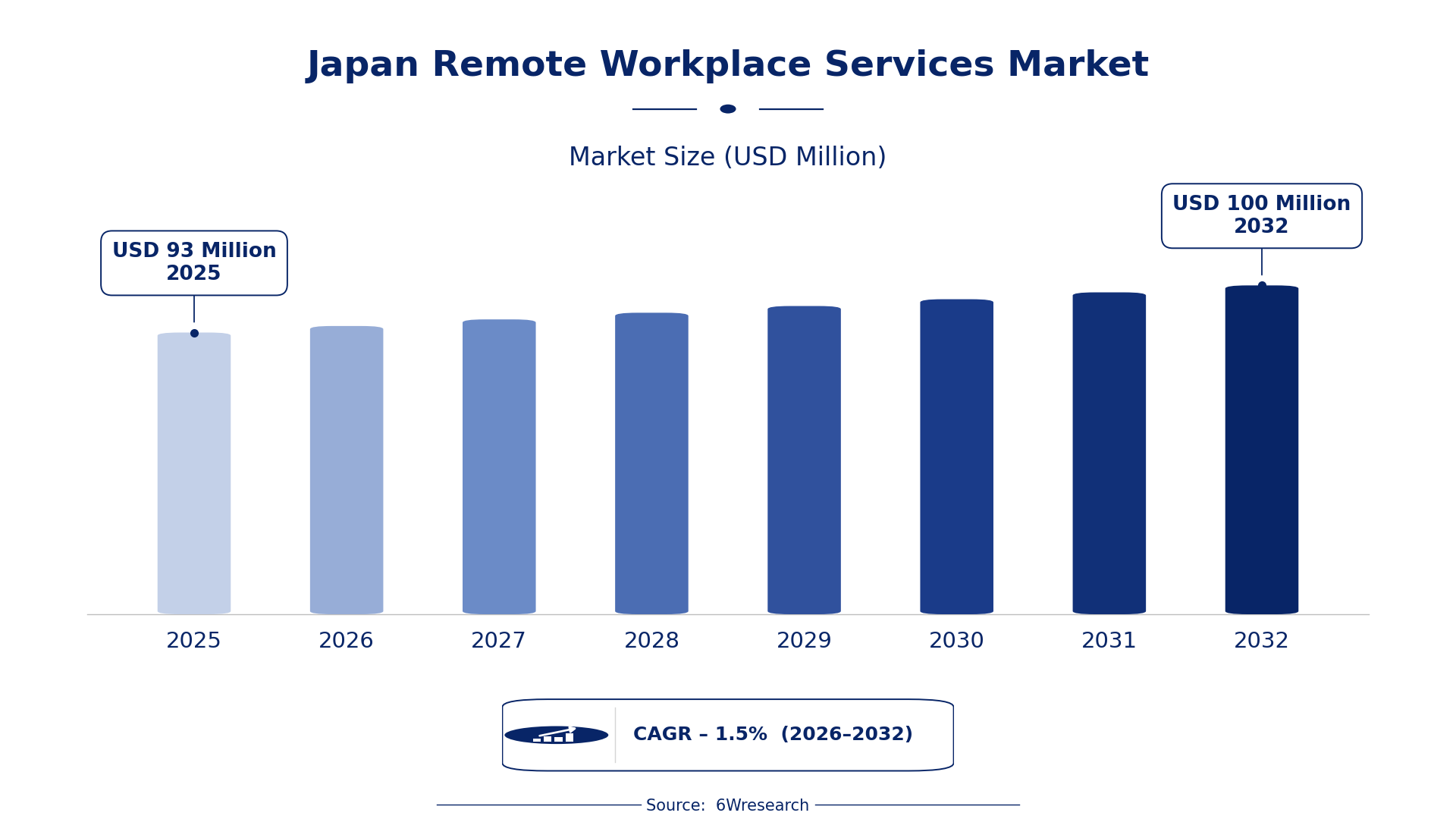
The Japan Remote Workplace Services Market was estimated at USD 93 Million in 2025 and is projected to reach USD 100 Million by 2032, growing at a CAGR of 1.5% from 2026 to 2032.
Japan Remote Workplace Services Market Synopsis
The demand for remote workplace services in Japan is surging as businesses adapt to flexible work arrangements post-pandemic. Organizations are increasingly investing in cloud-based solutions and cybersecurity measures to support their distributed workforce.
With a focus on employee well-being and productivity, companies are implementing digital tools that enhance collaboration. This shift not only addresses immediate operational needs but also sets the stage for long-term changes in workplace culture.
Japan Remote Workplace Services Market Year-wise Growth Rate and Key Drivers
This graph illustrates the annual growth rates of the Japan Remote Workplace Services Market from 2021 to 2032, highlighting a steady upward trajectory and projected expansion over the forecast period.
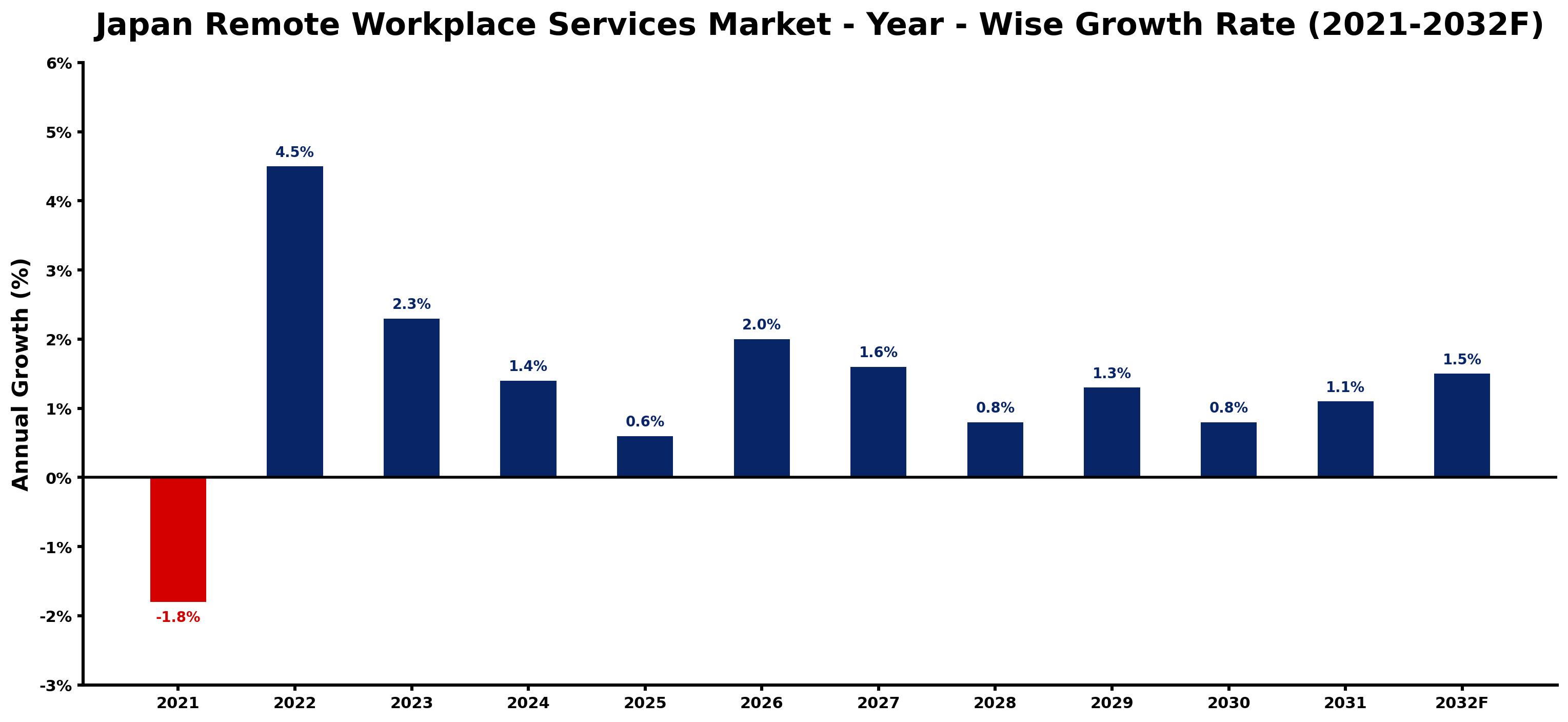
The table below presents the year‑wise growth rates along with the key drivers influencing the market
| Year | Growth Rate | Major Drivers |
| 2021 | -1.8% | Tokyo 2020 Olympics diverted tech investment focus. |
| 2022 | 4.5% | Increased adoption of telework policies by large corporations. |
| 2023 | 2.3% | Rising focus on cybersecurity for remote work environments. |
| 2024 | 1.4% | Demand surge for virtual team-building activities and software. |
| 2025 | 0.6% | Regulatory push for flexible work arrangements in Japan. |
| 2026 | 2.0% | Local tech developments enhancing remote security measures. |
| 2027 | 1.6% | Growth in freelance workforce driving tailored workplace solutions. |
| 2028 | 0.8% | Increased integration of AI tools for remote productivity. |
| 2029 | 1.3% | Aging population pursues flexible work options post-retirement. |
| 2030 | 0.8% | Greater emphasis on employee well-being in remote protocols. |
| 2031 | 1.1% | Evolving digital literacy among older employees boosts adoption. |
| 2032 | 1.5% | Growing interest in augmented reality for remote collaboration. |
Note: Market size estimations and growth projections presented in this report are based on 6Wresearch's proprietary forecasting methodology, utilizing the latest available industry data, government publications, and primary research inputs.
Japan Remote Workplace Services Market Key Takeaways
Below are some of the specific key takeaways from the market, including:
- Adoption of remote work technologies is accelerating, leading to increased demand for cloud-based solutions.
- Cybersecurity remains a top priority for organizations as they embrace remote workplace services.
- Investment in digital collaboration tools is shaping the future of work in Japan.
- Cultural norms are slowly shifting, promoting greater acceptance of remote work.
- Government initiatives are enhancing infrastructure to support the remote working environment.
Evaluation of Restraints in Japan Remote Workplace Services Market
Cultural resistance to remote work in Japan poses a notable challenge. The preference for in-person collaboration often limits the full implementation of remote workplace solutions. Additionally, access to high-speed internet in rural areas remains a barrier to effective remote operations. Language differences can hinder communication between remote teams and clients, complicating project execution. Companies must also address data security compliance with stringent local regulations, which can deter some firms from fully embracing remote services.
Japan Remote Workplace Services Market Trends
As organizations continue to embrace remote work, there’s a noticeable trend toward adopting virtual desktop infrastructure (VDI) and integrated project management tools. Companies are prioritizing employee engagement through innovative technologies that facilitate collaboration. The focus is shifting from merely enabling remote work to creating an engaging digital workspace that fosters productivity and well-being.
Japan Remote Workplace Services Market Opportunities
The market presents several investment opportunities in technology solutions that enhance remote collaboration. There is a growing demand for advanced cybersecurity services tailored to protect sensitive data in remote setups. Additionally, the development of tools specifically designed for virtual meetings and project management could cater to the unique requirements of Japanese businesses, paving the way for new market entrants.
Government Initiatives in the Japan Remote Workplace Services Market
Government policies are actively promoting the growth of remote workplace services in Japan. With initiatives focused on enhancing digital infrastructure and providing financial support to businesses adopting telework, the government is facilitating a shift in workplace dynamics. These efforts aim to build a more resilient workforce and improve productivity across sectors.
- A financial support program for companies transitioning to telework was launched in early 2023, aimed at facilitating the adoption of remote work technologies.
- Current initiatives are underway to improve high-speed internet access in rural areas, enhancing connectivity for remote workers.
- A planned public-private partnership is expected to expand coworking spaces across urban centers by 2026.
- Tax incentives for businesses implementing flexible work policies are currently being promoted by the government.
Future Insights of the Japan Remote Workplace Services Market
Looking ahead, the Japan Remote Workplace Services Market is set for gradual expansion as more companies adopt remote work strategies. The emphasis on employee well-being and organizational flexibility will drive demand for innovative solutions. With digital transformation at the forefront, investments in remote collaboration tools and cybersecurity are expected to increase, shaping the future of work in Japan.
Japan Remote Workplace Services Market Latest Developments
In the past year, the Japan Remote Workplace Services Market has witnessed significant activity as businesses adapt to new working environments. Companies are rapidly integrating advanced technologies to enhance remote work experiences, reflecting a growing commitment to innovation.
- A major technology vendor announced a new cloud-based collaboration platform in late 2023, designed specifically for remote teams.
- A leading regional operator is currently upgrading its cybersecurity framework to better protect remote operations, with completion expected by mid-2024.
- A recent partnership between software firms aims to develop integrated remote project management solutions, which is now underway.
- Upcoming in early 2025, a digital training program will be launched to support companies in effectively implementing remote workplace strategies.
Japan Remote Workplace Services Market - Key Attractiveness of the Report
- 10 Years of Market Numbers
- Historical Data Starting from 2022 to 2025
- Base Year: 2025
- Forecast Data until 2032
- Key Performance Indicators Impacting the Market
- Major Upcoming Developments and Projects
Key Highlights of the Report:
- Japan Remote Workplace Services Market Outlook
- Market Size of Japan Remote Workplace Services Market, 2025
- Forecast of Japan Remote Workplace Services Market, 2032
- Historical Data and Forecast of Japan Remote Workplace Services Revenues & Volume for the Period 2022-2032F
- Japan Remote Workplace Services Market Trend Evolution
- Japan Remote Workplace Services Market Drivers and Challenges
- Japan Remote Workplace Services Price Trends
- Japan Remote Workplace Services Porter's Five Forces
- Japan Remote Workplace Services Industry Life Cycle
- Historical Data and Forecast of Japan Remote Workplace Services Market Revenues & Volume By Component for the Period 2022-2032F
- Historical Data and Forecast of Japan Remote Workplace Services Market Revenues & Volume By Solutions for the Period 2022-2032F
- Historical Data and Forecast of Japan Remote Workplace Services Market Revenues & Volume By Services for the Period 2022-2032F
- Historical Data and Forecast of Japan Remote Workplace Services Market Revenues & Volume By Deployment Mode for the Period 2022-2032F
- Historical Data and Forecast of Japan Remote Workplace Services Market Revenues & Volume By On-Premises for the Period 2022-2032F
- Historical Data and Forecast of Japan Remote Workplace Services Market Revenues & Volume By Cloud for the Period 2022-2032F
- Historical Data and Forecast of Japan Remote Workplace Services Market Revenues & Volume By Organization Size for the Period 2022-2032F
- Historical Data and Forecast of Japan Remote Workplace Services Market Revenues & Volume By Large Enterprises for the Period 2022-2032F
- Historical Data and Forecast of Japan Remote Workplace Services Market Revenues & Volume By SMEs for the Period 2022-2032F
- Historical Data and Forecast of Japan Remote Workplace Services Market Revenues & Volume By Vertical for the Period 2022-2032F
- Historical Data and Forecast of Japan Remote Workplace Services Market Revenues & Volume By Telecommunication for the Period 2022-2032F
- Historical Data and Forecast of Japan Remote Workplace Services Market Revenues & Volume By Banking, Financial Services, & Insurance for the Period 2022-2032F
- Historical Data and Forecast of Japan Remote Workplace Services Market Revenues & Volume By IT & ITeS for the Period 2022-2032F
- Historical Data and Forecast of Japan Remote Workplace Services Market Revenues & Volume By Manufacturing for the Period 2022-2032F
- Historical Data and Forecast of Japan Remote Workplace Services Market Revenues & Volume By Retail & Consumer Goods for the Period 2022-2032F
- Historical Data and Forecast of Japan Remote Workplace Services Market Revenues & Volume By Media & Entertainment for the Period 2022-2032F
- Historical Data and Forecast of Japan Remote Workplace Services Market Revenues & Volume By Healthcare & Life Sciences for the Period 2022-2032F
- Historical Data and Forecast of Japan Remote Workplace Services Market Revenues & Volume By Government & Public Sectors for the Period 2022-2032F
- Japan Remote Workplace Services Import Export Trade Statistics
- Market Opportunity Assessment By Component
- Market Opportunity Assessment By Deployment Mode
- Market Opportunity Assessment By Organization Size
- Market Opportunity Assessment By Vertical
- Japan Remote Workplace Services Top Companies Market Share
- Japan Remote Workplace Services Competitive Benchmarking By Technical and Operational Parameters
- Japan Remote Workplace Services Company Profiles
- Japan Remote Workplace Services Key Strategic Recommendations






































