Japan Seasoning and Spices Market Size & Growth Rate
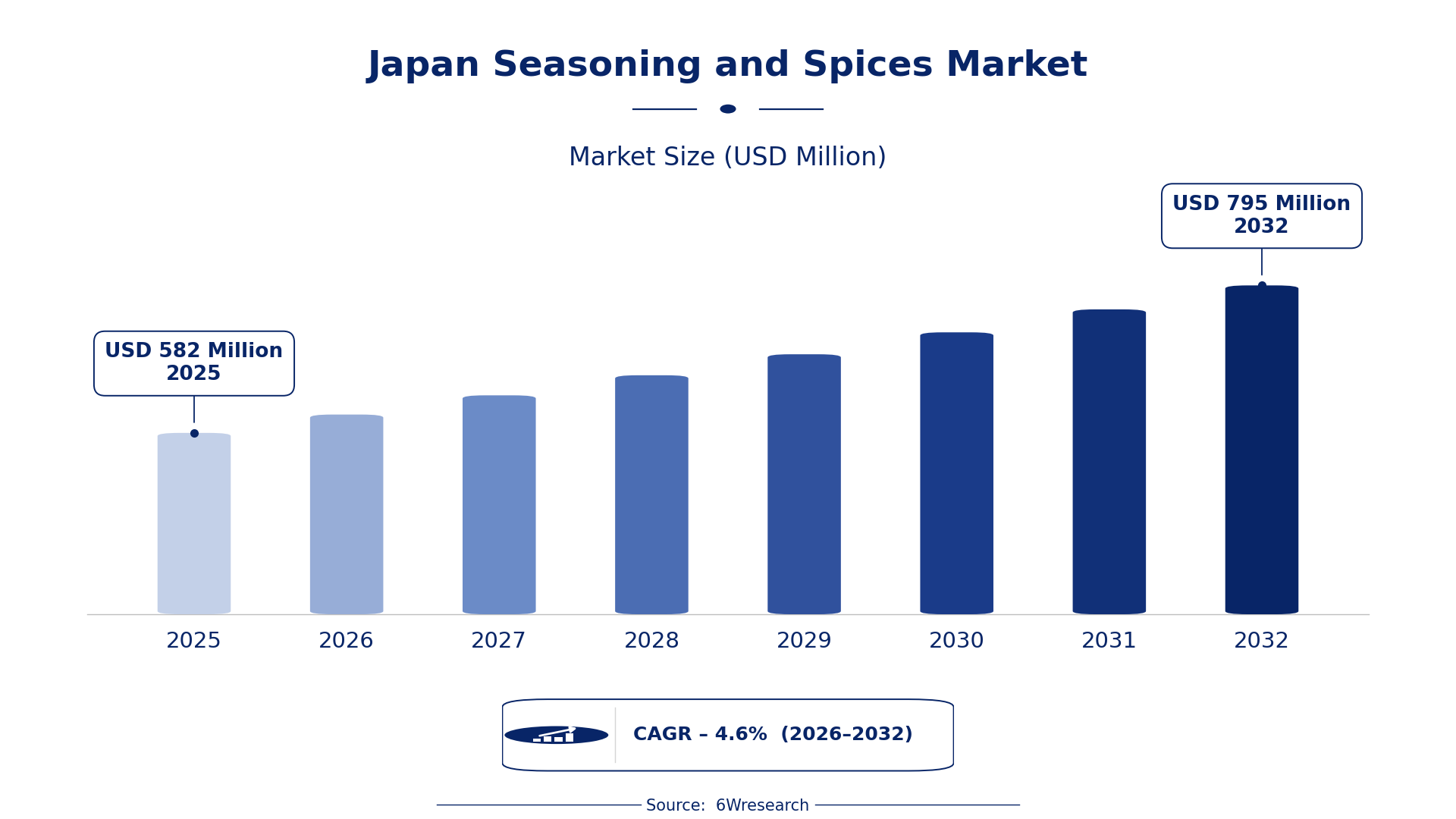
According to 6Wresearch internal database and industry insights, the Japan Seasoning and Spices Market was valued at USD 582 Million in 2025 and is projected to reach USD 795 Million by 2032, growing at a CAGR of approximately 4.6% during 2026–2032.
Japan Seasoning and Spices Market Highlights
| Report Metric | Details |
| Report Name | Japan Seasoning and Spices Market (2026-2032) |
| Market Size 2025 | USD 582 Million |
| Market Size 2032 | USD 795 Million |
| Absolute Growth 2025–2032 | USD 213 Million |
| CAGR 2026–2032 | 4.6% |
| Peak Annual Growth | 5.5% in 2028 |
| Forecast Period | 2026–2032 |
| Historical Data | 2022–2025 |
| Base Year | 2025 |
| Leading Product Type, 2025 | Salt and Salt Substitutes (52% share) |
| Leading Application, 2025 | Soup (42% share) |
| Fastest-Growing Product Type | Herbs (6.4% CAGR) |
| Fastest-Growing Application | Dressing (6.2% CAGR) |
| Growing Sector | Household and Food Service |
| Key End Users | Households, Restaurants, Food Service Establishments |
Japan Seasoning and Spices Market Year-wise Growth Rate and Key Drivers (2022–2032)
This graph illustrates the annual growth rates of the market from 2022 to 2032, highlighting a steady upward trajectory and projected market expansion over the forecast period.
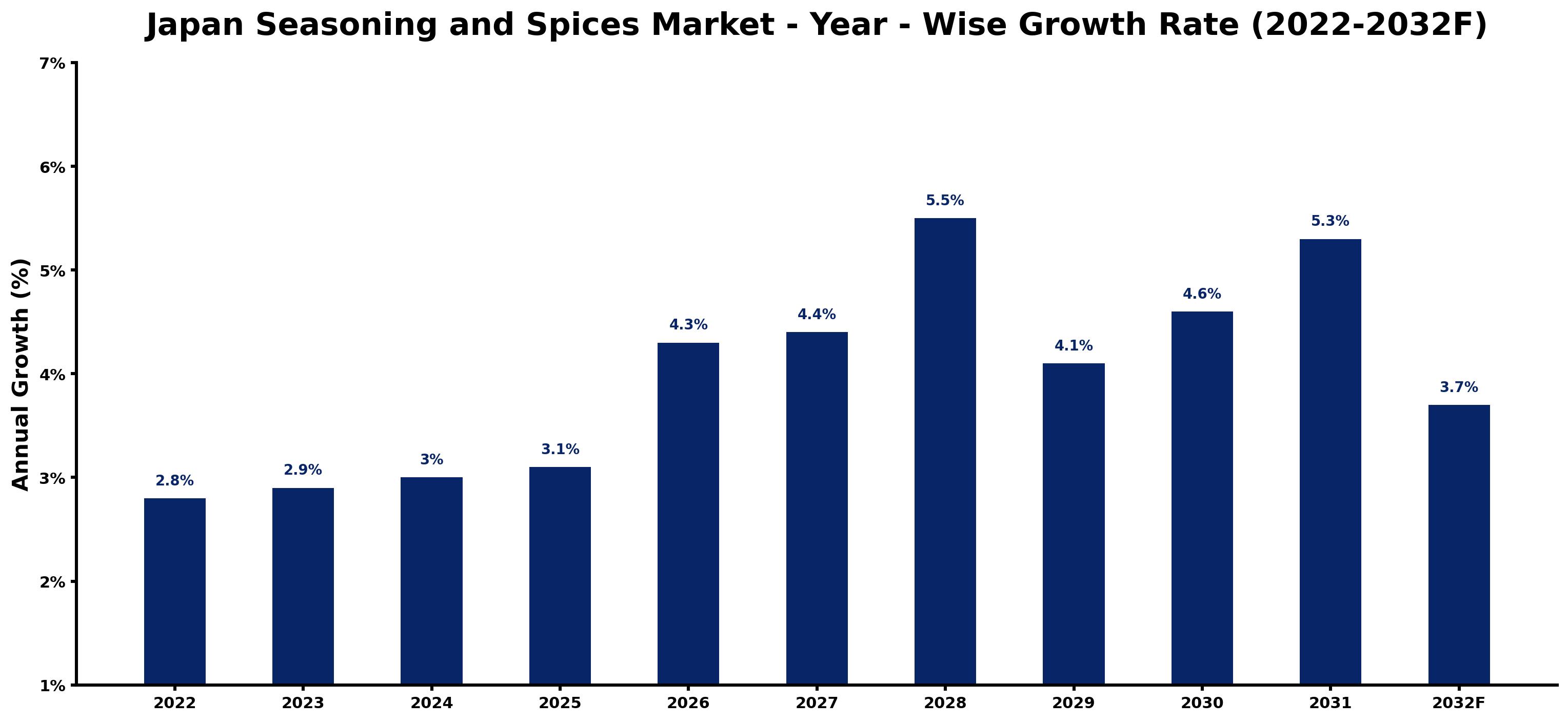
The table below sets out the estimated growth rate for each year and the main factor behind it.
| Year | Estimated Annual Growth (%) | Market Rationale |
| 2022 | 2.8 | The market showed steady growth with increasing household consumption of seasonings and spices. |
| 2023 | 2.9 | Growth accelerated as consumers sought diverse flavours in their meals and cooking. |
| 2024 | 3.0 | Demand continued to rise, driven by the popularity of home cooking and local cuisines. |
| 2025 | 3.1 | The market reached a historical peak as restaurants expanded their spice offerings and menus. |
| 2026 | 4.3 | Growth surged as investments in local spice production are anticipated to increase significantly. |
| 2027 | 4.4 | Demand will remain strong, supported by a focus on traditional Japanese cuisine and flavours. |
| 2028 | 5.5 | The market is projected to peak with heightened interest in gourmet cooking and unique spices. |
| 2029 | 4.1 | Growth is expected to slow slightly as market saturation begins to occur in some segments. |
| 2030 | 4.6 | Demand will rise again due to renewed interest in health-conscious eating and cooking habits. |
| 2031 | 5.3 | The market is projected to experience a resurgence as innovation in spice blends attracts buyers. |
| 2032 | 3.7 | Growth will slow as competition intensifies among local producers and new entrants. |
Note: Market size estimations and growth projections presented in this report are based on 6Wresearch's proprietary forecasting methodology, utilizing the latest available industry data, government publications, and primary research inputs.
Japan Seasoning and Spices Market Synopsis
Seasoning and spices are natural or processed substances used to improve food flavour, derived from plants, seeds, or minerals. In Japan, the Japan Seasoning and Spices Market is valued at approximately 300 billion yen, driven by domestic users such as households and restaurants. The increasing popularity of home cooking, campaigns promoting traditional spices, and the rising use of local herbs are propelling market growth. The average Japanese household consumes about 12 kg of salt annually, indicating a strong demand for these products.
Market Dynamics Impact Analysis (2026–2032)
| Factor | Type | Impact | Primary Segment Affected |
| Growing interest in traditional Japanese cuisine | Driver | High | Herbs |
| Increased home cooking trends | Driver | High | Spices |
| Expansion of local spice production facilities | Opportunity | High | Salt and Salt Substitutes |
| Rising demand for organic and sustainable spices | Opportunity | Medium | Spices |
| High competition among local producers | Restraint | Medium | Herbs |
| Fluctuating raw material prices | Restraint | High | Spices |
| Consumer preference for imported spices | Challenge | Medium | Salt and Salt Substitutes |
| Supply chain disruptions affecting availability | Challenge | High | Spices |
Evaluation of Drivers in Japan Seasoning and Spices Market (2026–2032)
Demand rests on the following drivers, each shown with the segment it touches most.
| Drivers | Primary Segment Affected | Why It Matters (Evidence) |
| Increased household cooking | Spices | The average Japanese household uses about 12 kg of salt annually, driving demand for various spices. |
| Growing popularity of gourmet cooking | Herbs | The annual consumption of spices in Japan is around 5 kg per person, reflecting health-focused trends. |
| Government initiatives promoting local herbs | Salt and Salt Substitutes | The Ministry of Agriculture, Forestry and Fisheries promotes local herbs, boosting their market presence. |
| Rising health consciousness among consumers | Spices | The average Japanese restaurant uses about 15 different spices, increasing demand for diverse herbs. |
| Increased variety in restaurant menus | Herbs | The average Japanese restaurant utilises about 15 different spices, driving further demand for diverse seasoning options. |
Much of the new demand traces back to the increasing interest in home cooking, with the average Japanese household consuming about 12 kg of salt annually. This trend is further supported by the growing popularity of gourmet cooking, where traditional herbs are frequently used. Campaigns promoting local herbs have also strengthened their market presence. Health consciousness is rising, with annual spice consumption around 5 kg per person reflecting this shift. The diversity in restaurant menus continues to expand, driving further demand for unique seasoning options.
Evaluation of Restraints in Japan Seasoning and Spices Market
The key brakes on demand, and where they bite hardest, are shown below.
| Market Restraint | Primary Segment Affected | Why It Matters (Evidence) |
| High competition among local producers | Herbs | Intense rivalry limits profit margins for producers, affecting their ability to innovate and invest. |
| Fluctuating raw material prices | Spices | Price volatility impacts production costs, causing potential supply chain disruptions for producers. |
| Consumer preference for imported spices | Salt and Salt Substitutes | Imported spices are often perceived as higher quality, impacting local sales and market share. |
| Limited awareness of local herb benefits | Herbs | Consumers may overlook local options, preferring familiar imported varieties, affecting local demand. |
| Regulatory challenges in food safety compliance | Spices | Producers face stringent regulations that can delay product launches and increase operational costs. |
Japan Seasoning and Spices Market Challenges
Annual seasoning consumption in Japan reaches around 5 kg per person, which intensifies competition among suppliers to secure market share. Many suppliers struggle with outdated production technology, causing delays that can extend lead times for buyers by up to three weeks. Compliance with ISO 22000 standards requires suppliers to invest in quality management systems, increasing operational costs by approximately 15%. Rising costs of raw materials, influenced by the Ministry of Agriculture's promotion of local herbs, can lead to price increases for buyers, affecting their purchasing decisions.
Trends in the Japan Seasoning and Spices Market
These developments are changing demand patterns in the Japan Seasoning and Spices Market.
- Campaign to Promote Traditional Spices: In 2023, a campaign was launched to promote traditional spices, aiming to boost local production. This initiative encourages consumers to explore regional flavours, targeting a 20% increase in local spice usage.
- Growing Demand for Organic Seasonings: Health-conscious consumers are increasingly opting for organic seasonings, with a notable rise in sales. Reports indicate a 15% increase in organic spice sales in 2023.
- Shift Towards Sustainable Spice Production: Tokyo is leading efforts in sustainable spice production, with government funding allocated for research in 2023. This initiative aims to reduce environmental impact by 25%.
- Expansion of Spice Varieties in Restaurants: The average Japanese restaurant now uses about 15 different spices, reflecting a trend towards diverse flavour profiles. This change has led to a 10% increase in spice procurement among restaurants.
Investment Opportunities in the Japan Seasoning and Spices Market
Several openings in the Japan Seasoning and Spices Market merit attention from investors.
- Tokyo as a Hub for Spice Innovation: Tokyo's vibrant culinary scene presents opportunities for unique spice blends. With a growing market, suppliers can collaborate with local chefs to create distinctive products.
- Investment in Sustainable Spice Production: The Japanese government allocated funds for sustainable spice production research in 2023, aiming for a 20% increase in local herb cultivation. Suppliers can engage with local farmers to meet this demand.
- Growing Market for Organic Seasonings: The rising health consciousness among consumers has created a gap for organic seasonings. Suppliers can target health-focused restaurants and retailers to capture this growing segment.
- Focus on Traditional Japanese Herbs: With the Ministry of Agriculture promoting local herbs, there is a significant opportunity for suppliers to introduce traditional herbs into modern cuisine, aiming for a 15% increase in market share.
Government Initiatives in the Japan Seasoning and Spices Market
The GX Basic Policy adopted in 2023 aims for about JPY 150 trillion of public-private decarbonisation investment over 10 years, influencing producers to adopt sustainable practices. This policy complements the Industrial Standardization Act, which governs product standards and ensures quality in seasoning production.
In 2023, JPY 5 billion was allocated for research on sustainable spice production, administered by the Ministry of Agriculture, Forestry and Fisheries. This funding supports local producers in improving their production capabilities and sustainability efforts.
Future Insight of the Japan Seasoning and Spices Market
Investment in sustainable spice production will surge, driven by government funding and ongoing research initiatives. By 2032, demand for traditional spices will grow due to promotional campaigns, creating new opportunities for suppliers to diversify their offerings. Stricter food safety standards will build consumer confidence, benefiting both buyers and suppliers. The adoption of advanced processing technologies will streamline production, potentially reducing costs and expanding the variety of spices available in the market.
Market Segmentation Analysis
Japan Seasoning and Spices Market report covers a detailed analysis of the following market segments:
By Product Type – Salt and Salt Substitutes Lead, Herbs Expected to Grow Fastest
According to Dhaval Chaurasia, Assistant Manager at 6Wresearch, with 52% of product type revenue in 2025, Salt and Salt Substitutes was the largest category. Salt and salt substitutes dominate the market because they are essential for flavour enhancement and preservation, with the average Japanese household consuming around 12 kg annually. This widespread use in both home cooking and food service establishments solidifies their leading position in the seasoning and spices market. Over 2026–2032, Herbs are expected to post the fastest growth, at a CAGR of 6.4%. Herbs are experiencing rapid growth as they become more popular in both traditional and modern cooking, reflecting a cultural shift towards fresh ingredients. The government's recent campaign to promote traditional spices is further driving the demand for herbs in various culinary applications. Suppliers should focus on expanding their herb offerings to meet the rising consumer interest in fresh flavouring alternatives.
By Application – Soup Leads, Dressing Expected to Grow Fastest
Soup accounted for 42% of the market by application in 2025. Soup holds the largest market share as it is a staple in Japanese cuisine, often flavoured with seasonings to enhance its taste. Its frequent inclusion in both home cooking and restaurant menus underscores its significance in the seasoning and spices market. Dressing is set to record the highest CAGR in this split, 6.2% over 2026–2032. Dressing is the fastest-growing application, reflecting a trend towards healthier eating and the increasing use of seasonings to enhance flavour in salads and cold dishes. This shift in consumer preferences for versatile and flavourful dressings is propelling rapid growth in this segment. Suppliers should consider developing new dressing products that align with the evolving tastes of health-conscious consumers.
Key Attractiveness of the Report
- 10 Years of Market Numbers
- Historical Data Starting from 2022 to 2025
- Base Year 2025
- Forecast Data until 2032
- Key Performance Indicators Impacting the Market
- Major Upcoming Developments and Projects
Key Highlights of the Report:
- Japan Seasoning and Spices Market Outlook
- Market Size of Japan Seasoning and Spices Market, 2025
- Forecast of Japan Seasoning and Spices Market, 2032
- Historical Data and Forecast of Japan Seasoning and Spices Revenues & Volume for the Period 2022-2032
- Japan Seasoning and Spices Market Trend Evolution
- Japan Seasoning and Spices Market Drivers and Challenges
- Japan Seasoning and Spices Price Trends
- Japan Seasoning and Spices Porter's Five Forces
- Japan Seasoning and Spices Industry Life Cycle
- Historical Data and Forecast of Japan Seasoning and Spices Market Revenues & Volume By Product Type for the Period 2022-2032
- Historical Data and Forecast of Japan Seasoning and Spices Market Revenues & Volume By Salt and Salt Substitutes for the Period 2022-2032
- Historical Data and Forecast of Japan Seasoning and Spices Market Revenues & Volume By Herbs for the Period 2022-2032
- Historical Data and Forecast of Japan Seasoning and Spices Market Revenues & Volume By Spices for the Period 2022-2032
- Historical Data and Forecast of Japan Seasoning and Spices Market Revenues & Volume By Application for the Period 2022-2032
- Historical Data and Forecast of Japan Seasoning and Spices Market Revenues & Volume By Soup for the Period 2022-2032
- Historical Data and Forecast of Japan Seasoning and Spices Market Revenues & Volume By Sauce for the Period 2022-2032
- Historical Data and Forecast of Japan Seasoning and Spices Market Revenues & Volume By Salad for the Period 2022-2032
- Historical Data and Forecast of Japan Seasoning and Spices Market Revenues & Volume By Dressing for the Period 2022-2032
- Historical Data and Forecast of Japan Seasoning and Spices Market Revenues & Volume By Savory Snack for the Period 2022-2032
- Historical Data and Forecast of Japan Seasoning and Spices Market Revenues & Volume By Others for the Period 2022-2032
- Japan Seasoning and Spices Import Export Trade Statistics
- Market Opportunity Assessment By Product Type
- Market Opportunity Assessment By Application
- Japan Seasoning and Spices Top Companies Market Share
- Japan Seasoning and Spices Competitive Benchmarking By Technical and Operational Parameters
- Japan Seasoning and Spices Company Profiles
- Japan Seasoning and Spices Key Strategic Recommendations
Market Covered
The report covers the following segments.
By Product Type
- Salt and Salt Substitutes
- Herbs
- Spices
By Application
- Soup
- Sauce
- Salad
- Dressing
- Savory Snack
- Others































