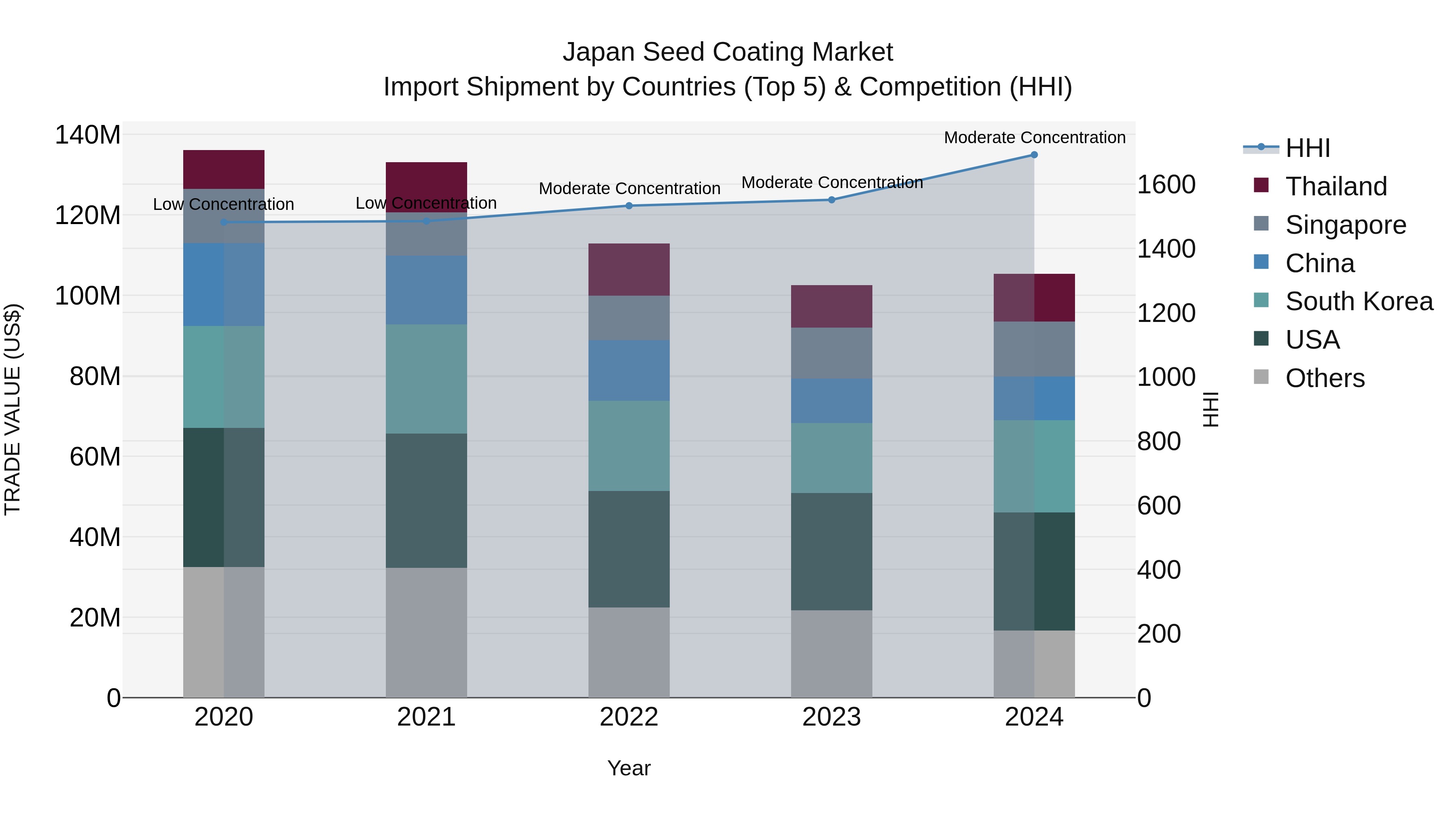
Japan Seed Coating Market Import Shipment by Countries (Top 5) & Competition (HHI)
Japan's seed coating import shipments in 2024 saw the USA, South Korea, Singapore, Thailand, and China as the top exporting countries. The Herfindahl-Hirschman Index (HHI) indicated moderate concentration within the market. Despite a negative compound annual growth rate (CAGR) of -6.19% from 2020 to 2024, there was a slight uptick in growth with a rate of 2.77% from 2023 to 2024. The consistent presence of key exporters highlights the competitive landscape and the potential for further market expansion in the seed coating industry in Japan.
Japan Seed Coating Market Synopsis
The Japan Seed Coating Market is experiencing steady growth driven by the increasing adoption of seed enhancement technologies among farmers to improve crop yield and protect seeds from pests and diseases. The market is characterized by the presence of key players offering a wide range of seed coating products such as polymers, colorants, and pesticides. Technological advancements in seed coating formulations and application techniques are further propelling market growth. The demand for high-quality seeds with enhanced characteristics for better germination rates and plant performance is also driving market expansion. Additionally, the focus on sustainable agriculture practices and the need for efficient crop protection solutions are contributing to the growing popularity of seed coating in Japan`s agricultural sector.
Japan Seed Coating Market Trends
The Japan Seed Coating Market is experiencing growth driven by the increasing demand for high-quality and high-yielding crops. One of the key trends in the market is the adoption of advanced seed coating technologies that offer benefits such as improved seed germination, disease resistance, and enhanced nutrient uptake. Additionally, there is a rising focus on sustainable agriculture practices, leading to the development of environmentally friendly seed coating products. Opportunities in the Japan Seed Coating Market include expanding product portfolios to cater to different crop types, collaborating with research institutions for innovative product development, and targeting niche markets such as organic farming. Overall, the market is poised for further growth as farmers seek solutions to optimize crop production and improve overall yields.
Japan Seed Coating Market Challenges
In the Japan Seed Coating Market, challenges mainly revolve around regulatory constraints, limited availability of advanced seed coating technologies, and increasing competition from international seed coating companies. Strict regulations imposed by the Japanese government on the use of certain chemicals in seed coating formulations can hinder innovation and product development in the market. Additionally, the slow adoption of modern seed coating technologies in Japan compared to other developed countries poses a challenge for local seed coating companies to remain competitive. The presence of established international seed coating companies with advanced technologies and larger R&D budgets also intensifies competition for local players. Overall, navigating through regulatory hurdles, upgrading technology capabilities, and effectively competing with global players are key challenges faced by companies in the Japan Seed Coating Market.
Japan Seed Coating Market Investment Opportunities
The Japan Seed Coating Market is primarily driven by the increasing adoption of advanced agricultural practices and technologies to enhance crop productivity and yield. Seed coating offers numerous benefits such as improved seed performance, protection against diseases, pests, and adverse environmental conditions, as well as efficient use of resources like water and fertilizers. Additionally, the growing focus on sustainable farming practices and environmentally friendly solutions is driving the demand for seed coating products in Japan. Furthermore, the rising awareness among farmers regarding the benefits of seed coating in terms of cost-effectiveness and higher returns on investment is also contributing to the market growth. Overall, these factors are driving the expansion of the Japan Seed Coating Market as farmers seek innovative solutions to optimize their agricultural operations.
Japan Seed Coating Market Government Polices
The Japan Seed Coating Market is subject to various government policies aimed at regulating the use of seed coating materials to ensure environmental safety and consumer protection. The Ministry of Agriculture, Forestry and Fisheries (MAFF) in Japan oversees the regulation of seed treatment products, including seed coating materials, to ensure compliance with safety standards and guidelines. The government has implemented strict regulations on the use of chemical seed coatings to prevent adverse effects on the environment and human health. Additionally, there are specific registration requirements for seed coating products to be approved for use in the market. Overall, the government policies in Japan aim to promote sustainable agriculture practices and ensure the safety and quality of seed coating products in the market.
Japan Seed Coating Market Future Outlook
The Japan Seed Coating Market is poised for steady growth in the coming years driven by increasing demand for high-quality seeds with enhanced characteristics. Advancements in seed coating technologies, such as the development of environmentally friendly and sustainable coatings, are expected to drive market expansion. Additionally, the rising adoption of precision agriculture practices and the growing awareness among farmers about the benefits of coated seeds in improving crop yield and resistance to pests and diseases will further fuel market growth. Collaboration between seed coating companies and research institutions to innovate new coating formulations tailored to specific crop varieties will also contribute to the market`s positive outlook. Overall, the Japan Seed Coating Market is projected to witness sustained growth in the foreseeable future.
Key Highlights of the Report:
- Japan Seed Coating Market Outlook
- Market Size of Japan Seed Coating Market, 2024
- Forecast of Japan Seed Coating Market, 2031
- Historical Data and Forecast of Japan Seed Coating Revenues & Volume for the Period 2021 - 2031
- Japan Seed Coating Market Trend Evolution
- Japan Seed Coating Market Drivers and Challenges
- Japan Seed Coating Price Trends
- Japan Seed Coating Porter's Five Forces
- Japan Seed Coating Industry Life Cycle
- Historical Data and Forecast of Japan Seed Coating Market Revenues & Volume By Additives for the Period 2021 - 2031
- Historical Data and Forecast of Japan Seed Coating Market Revenues & Volume By Polymers for the Period 2021 - 2031
- Historical Data and Forecast of Japan Seed Coating Market Revenues & Volume By Pellets for the Period 2021 - 2031
- Historical Data and Forecast of Japan Seed Coating Market Revenues & Volume By Colorants for the Period 2021 - 2031
- Historical Data and Forecast of Japan Seed Coating Market Revenues & Volume By Minerals/pumice for the Period 2021 - 2031
- Historical Data and Forecast of Japan Seed Coating Market Revenues & Volume By Process for the Period 2021 - 2031
- Historical Data and Forecast of Japan Seed Coating Market Revenues & Volume By Film coating for the Period 2021 - 2031
- Historical Data and Forecast of Japan Seed Coating Market Revenues & Volume By Encrusting for the Period 2021 - 2031
- Historical Data and Forecast of Japan Seed Coating Market Revenues & Volume By Pelleting for the Period 2021 - 2031
- Historical Data and Forecast of Japan Seed Coating Market Revenues & Volume By Crop for the Period 2021 - 2031
- Historical Data and Forecast of Japan Seed Coating Market Revenues & Volume By Cereals & grains for the Period 2021 - 2031
- Historical Data and Forecast of Japan Seed Coating Market Revenues & Volume By Oilseeds & pulses for the Period 2021 - 2031
- Historical Data and Forecast of Japan Seed Coating Market Revenues & Volume By Vegetables for the Period 2021 - 2031
- Historical Data and Forecast of Japan Seed Coating Market Revenues & Volume By Flowers & ornamentals for the Period 2021 - 2031
- Japan Seed Coating Import Export Trade Statistics
- Market Opportunity Assessment By Additives
- Market Opportunity Assessment By Process
- Market Opportunity Assessment By Crop
- Japan Seed Coating Top Companies Market Share
- Japan Seed Coating Competitive Benchmarking By Technical and Operational Parameters
- Japan Seed Coating Company Profiles
- Japan Seed Coating Key Strategic Recommendations






































