Topics Covered in Japan Self-Cleaning Glass Market Report
Japan Self-Cleaning Glass Market Report thoroughly covers the market by coating type and by application. Japan Self-Cleaning Glass Market Outlook report provides an unbiased and detailed analysis of the ongoing Japan Self-Cleaning Glass Market trends, opportunities/high growth areas, and market drivers. This would help stakeholders devise and align their market strategies according to the current and future market dynamics.
Japan Self-Cleaning Glass Market Synopsis
Japan’s Self-Cleaning Glass market recorded steady growth between 2022 and 2025, supported by rising commercial real estate activity, expanding solar installations, and growing demand from large-scale urban construction projects. Commercial real estate investment volume surged year-on-year, while solar capacity increased from 2023 to 2024, strengthening demand for low-maintenance, high-performance glass solutions. At the same time, rising skyscraper developments and transformative urban projects across Japan are accelerating the use of advanced façade materials that reduce cleaning costs and improve long-term building efficiency.
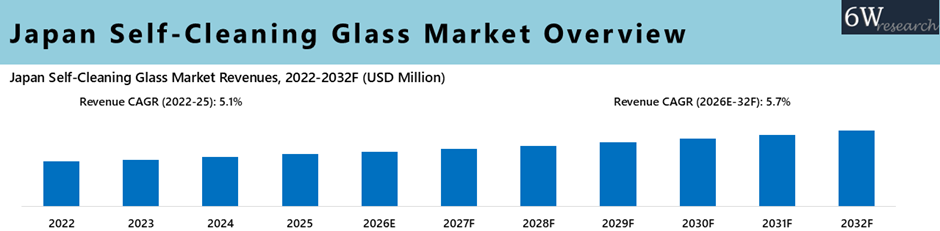
According to 6Wresearch, Japan’s Self-Cleaning Glass Market is projected to grow at a CAGR of 5.7% from 2026–2032F, supported by rising demand from high-rise construction and expanding solar deployment. Major skyscraper developments such as TOKYO Torch Tower, a 62-floor project scheduled for completion in 2028, and World Trade Center Tokyo Residential Tower, a 47-floor project targeted for completion by 2026, are expected to accelerate adoption of self-cleaning glass in premium façade applications, where low maintenance and long-term aesthetic performance are critical. In parallel, Japan’s cumulative solar capacity is projected to rise by 2030, while the Seventh Strategic Energy Plan finalized in February 2025 positions solar as the largest contributor to the country’s power mix by 2040, targeting a certain percentage of electricity generation. These trends are expected to strengthen demand for self-cleaning glass across both urban infrastructure and solar energy applications.
Market Segmentation By Coating Type
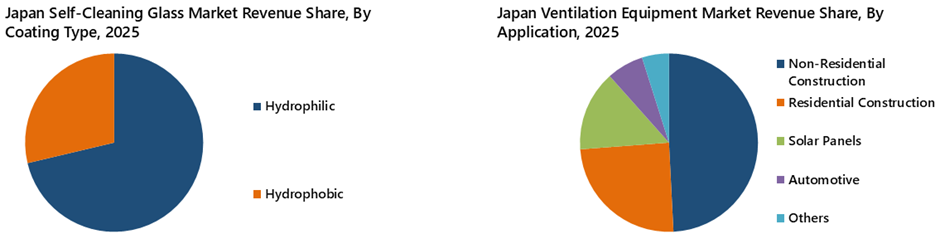
The hydrophilic coating segment is expected to witness the highest growth in the Japan self-cleaning glass market, driven by rising demand for low-maintenance and durable glass solutions. Rising adoption in solar panels, commercial buildings, and urban infrastructure is further supporting demand. Its ability to allow water to spread uniformly into a thin film ensures more effective and streak-free dirt removal, especially in humid conditions, accelerating its growth.
Market Segmentation By Application
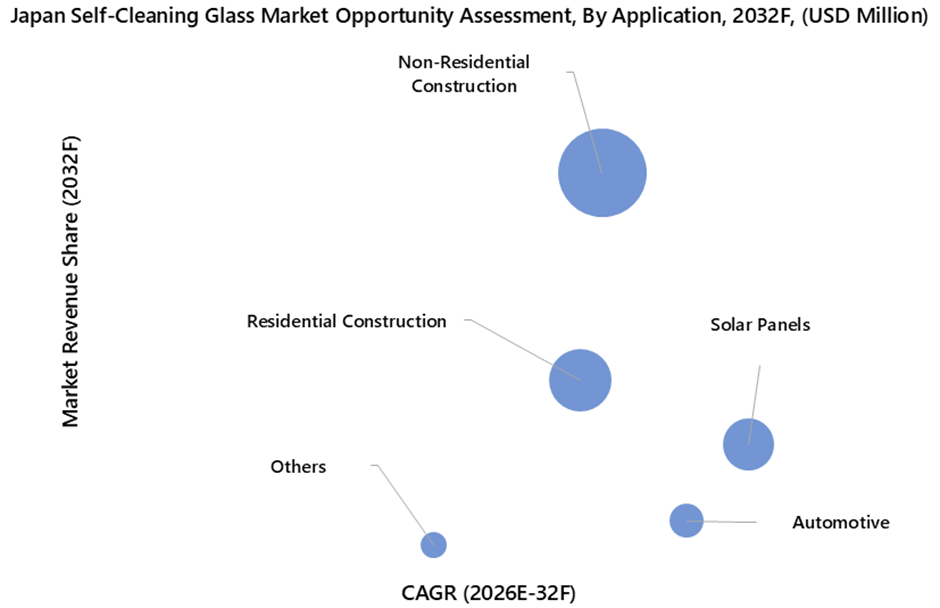
Solar panels are expected to witness the highest growth in the Japan self-cleaning glass market by application, driven by the country’s strong push toward renewable energy and rising solar capacity installations. The need to maintain high energy efficiency and minimize performance losses due to dust accumulation is accelerating adoption. Self-cleaning glass enhances light transmission and reduces maintenance costs, making it increasingly critical for large-scale solar deployments.
Key Attractiveness of the Report
- 10 Years Market Numbers.
- Historical Data Starting from 2022 to 2025
- Base Year: 2025
- Forecast Data until 2032
- Key Performance Indicators Impacting the Market.
- Major Upcoming Developments and Projects.
Key Highlights of the Report:
- Historical data & Forecast of Japan Self-Cleaning Glass Market Revenues for the Period 2022-2032F
- Historical data & Forecast of Japan Self-Cleaning Glass Market Revenues, By Coating Type, for the Period 2022-2032F
- Historical data & Forecast of Japan Self-Cleaning Glass Market Revenues, By Application, for the Period 2022-2032F
- Japan Self-Cleaning Glass Market Outlook on Drivers and Restraints
- Japan Self-Cleaning Glass Market Trends
- Japan Self-Cleaning Glass Opportunity Assessment
- Japan Self-Cleaning Glass Market Key Performance Indicators
- Japan Self-Cleaning Glass Market Ranking, By Company
- Japan Self-Cleaning Glass Market Overview on Competitive Benchmarking
- Company Profiles
- Key Strategic Recommendations
Market Scope and Segmentation
The report provides a detailed analysis of the following market segments:
By Coating Type
- Hydrophilic
- Hydrophobic
By Application
- Residential Construction
- Non-Residential Construction
- Solar Panels
- Automotive
- Others






































