Japan Semiconductor Foundry Market Size, Share & Growth Rate
The Japan Semiconductor Foundry Market was estimated at USD 215 Million in 2025 and is projected to reach USD 232 Million by 2032, growing at a CAGR of 1.1% from 2026 to 2032. This growth trajectory is primarily fueled by the escalating demand for advanced semiconductor technologies across diverse sectors, including consumer electronics and automotive applications. The countrys commitment to innovation and high-quality manufacturing continues to strengthen its role in the global semiconductor landscape.
Japan Semiconductor Foundry Market Year-wise Growth Rate and Key Drivers
This graph highlights how the Japan Semiconductor Foundry Market has steadily grown over the years, supported by major growth factors.
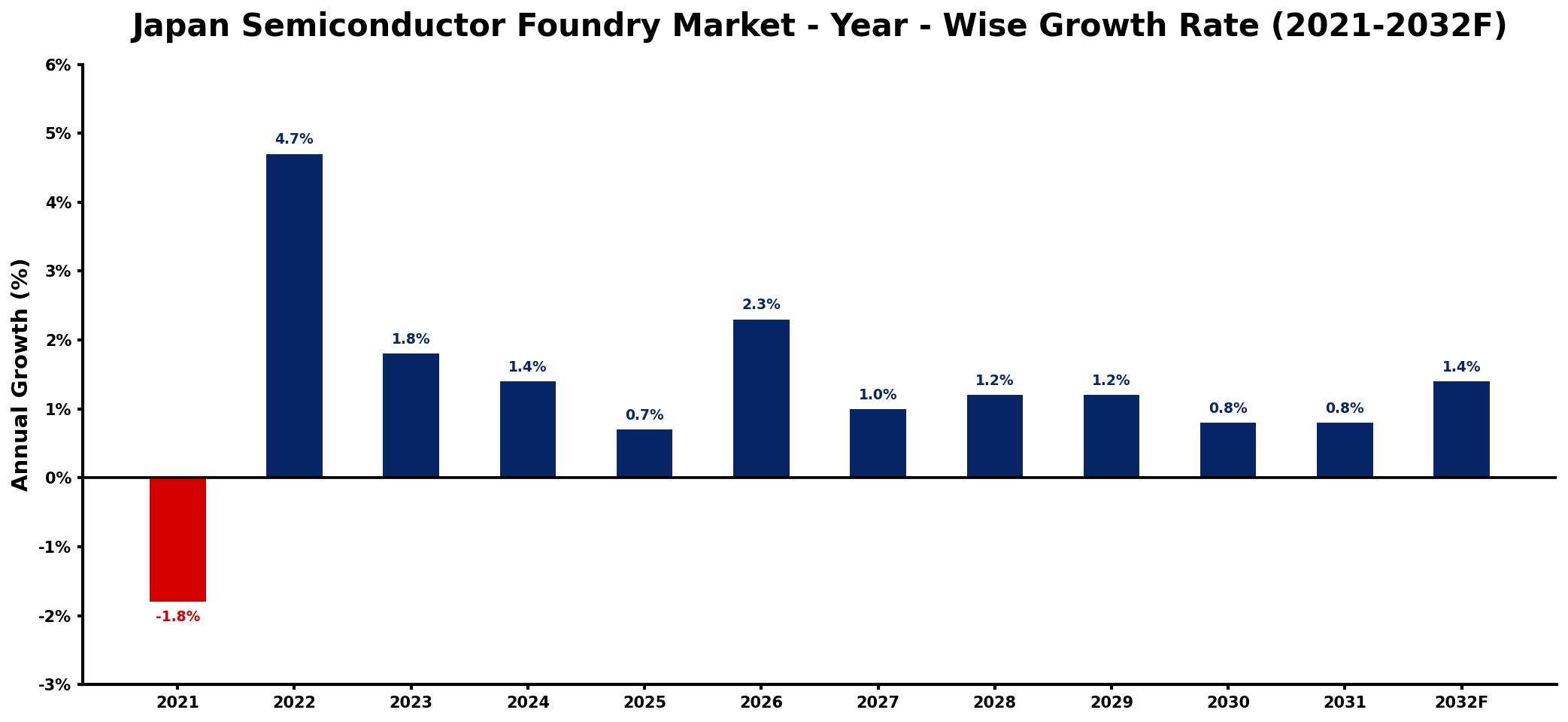
The table below presents the year‑wise growth rates along with the key drivers influencing the market
| Year | Growth Rate | Major Drivers |
| 2021 | -1.8% | global demand for electronics declines |
| 2022 | 4.7% | increase in automotive electronics production |
| 2023 | 1.8% | growing demand for IoT devices |
| 2024 | 1.4% | expansion of 5G infrastructure investments |
| 2025 | 0.7% | rise in renewable energy technologies |
| 2026 | 2.3% | surge in AI applications development |
| 2027 | 1.0% | growth in consumer electronics market |
| 2028 | 1.2% | increased focus on electric vehicles |
| 2029 | 1.2% | growing downstream application demand |
| 2030 | 0.8% | demand for data center upgrades |
| 2031 | 0.8% | increased overall sector activity |
| 2032 | 1.4% | strengthening underlying market demand |
Note: Market size estimations and growth projections presented in this report are based on 6Wresearch's proprietary forecasting methodology, utilizing the latest available industry data, government publications, and primary research inputs.
Japan Semiconductor Foundry Market Synopsis
Innovation remains the strongest force shaping the Japan Semiconductor Foundry Market. Key advancements in semiconductor manufacturing processes are vital for catering to the rising complexities in applications such as artificial intelligence and 5G technology.
Additionally, Japans focus on collaboration, both domestically and internationally, is propelling the market forward. This cooperative approach, coupled with the governments backing for research initiatives, enhances the capabilities of local foundries and helps them adapt to the fast-evolving demands of the global semiconductor industry.
Japan Semiconductor Foundry Market Key Takeaways
- The market is positioned for steady growth, driven by a surge in demand for sophisticated semiconductor solutions.
- Investment in advanced process technologies is essential to meet the requirements of high-performance computing and IoT applications.
- Japanese foundries are diversifying their services, expanding into wafer-level packaging and system-in-package solutions.
- Sustainability initiatives are becoming crucial, leading to investments in green semiconductor manufacturing technologies.
- Government support and policies significantly enhance the competitive landscape for Japans semiconductor foundry market.
Evaluation of Restraints in Japan Semiconductor Foundry Market
The Japan Semiconductor Foundry Market grapples with several restraints that challenge its growth. Primarily, intense competition from neighboring regions such as Taiwan and South Korea poses a significant hurdle. The relatively high labor and operational costs in Japan further complicate its competitiveness on a global scale. Compounded by a heavy reliance on imported raw materials and equipment, foundries face vulnerabilities to supply chain disruptions and shifts in exchange rates, making it imperative for companies to develop adaptive strategies in this challenging environment.
Japan Semiconductor Foundry Market Trends
Current trends in the Japan Semiconductor Foundry Market indicate a pronounced shift towards the adoption of advanced process nodes, particularly at 7nm and below. This is a direct response to the increasing demand for high-performance computing and the proliferation of artificial intelligence applications. Moreover, foundries are prioritizing the diversification of their service offerings, with an emphasis on advanced packaging techniques. Collaboration between local foundries and international entities is also on the rise, fostering a synergistic approach to innovation and expansion.
Japan Semiconductor Foundry Market Opportunities
The Japan Semiconductor Foundry Market is ripe with investment opportunities driven by burgeoning demand in key sectors such as 5G, IoT, and automotive electronics. Foundries stand to gain significantly by partnering with technology companies to leverage their expertise and capacity. Furthermore, as global demand for high-performance chips escalates, there are ample opportunities for investment in research and development to keep pace with technological advancements. This synergy could pave the way for groundbreaking innovations and an expanded market share for Japanese foundries.
Government Initiatives in the Japan Semiconductor Foundry Market
The Japanese government is actively implementing policies designed to foster growth in the Semiconductor Foundry Market. Initiatives such as the "Society 5.0" strategy promote technological innovation and digital transformation, providing a framework for industry advancement. In addition, subsidies and incentives for semiconductor firms encourage investments in cutting-edge manufacturing technologies. The emphasis on collaborative efforts among industry players, academic institutions, and government entities aims to create a robust and sustainable semiconductor ecosystem that bolsters Japan's standing in the global market.
Future Insights of the Japan Semiconductor Foundry Market
Looking ahead to 2026-2032, the Japan Semiconductor Foundry Market is anticipated to maintain its upward trajectory, driven by escalating semiconductor demand across automotive, consumer electronics, and telecommunications industries. The market is likely to benefit from technological advancements that pave the way for more complex chip designs, alongside the growing proliferation of IoT devices. With continuous governmental initiatives supporting the semiconductor sector and the concerted efforts of key market players, the foundation for sustained growth appears solid, despite potential challenges from global economic fluctuations and supply chain instabilities.
Japan Semiconductor Foundry Market Latest Developments (2025 - 2026)
Recent developments within the Japan Semiconductor Foundry Market have illustrated a clear trend towards innovation in chip design and manufacturing processes. There has been a notable increase in partnerships between local foundries and international firms aimed at enhancing capabilities and market reach. Additionally, sustainability measures have become a focal point, with many companies investing in green technologies to improve their manufacturing processes. The collaborative efforts across industry sectors are expected to usher in new advancements that could redefine operational paradigms.
Japan Semiconductor Foundry Market - Key Attractiveness of the Report
- 10 Years of Market Numbers
- Historical Data Starting from 2022 to 2025
- Base Year: 2025
- Forecast Data until 2032
- Key Performance Indicators Impacting the Market
- Major Upcoming Developments and Projects
Key Highlights of the Report:
- Japan Semiconductor Foundry Market Outlook
- Market Size of Japan Semiconductor Foundry Market, 2025
- Forecast of Japan Semiconductor Foundry Market, 2032
- Historical Data and Forecast of Japan Semiconductor Foundry Revenues & Volume for the Period 2022-2032F
- Japan Semiconductor Foundry Market Trend Evolution
- Japan Semiconductor Foundry Market Drivers and Challenges
- Japan Semiconductor Foundry Price Trends
- Japan Semiconductor Foundry Porter's Five Forces
- Japan Semiconductor Foundry Industry Life Cycle
- Historical Data and Forecast of Japan Semiconductor Foundry Market Revenues & Volume By Technology Node for the Period 2022-2032F
- Historical Data and Forecast of Japan Semiconductor Foundry Market Revenues & Volume By 10/7/5 nm for the Period 2022-2032F
- Historical Data and Forecast of Japan Semiconductor Foundry Market Revenues & Volume By 16/14 nm for the Period 2022-2032F
- Historical Data and Forecast of Japan Semiconductor Foundry Market Revenues & Volume By 20 nm for the Period 2022-2032F
- Historical Data and Forecast of Japan Semiconductor Foundry Market Revenues & Volume By 28 nm for the Period 2022-2032F
- Historical Data and Forecast of Japan Semiconductor Foundry Market Revenues & Volume By 45/40 nm for the Period 2022-2032F
- Historical Data and Forecast of Japan Semiconductor Foundry Market Revenues & Volume By 65 nm for the Period 2022-2032F
- Historical Data and Forecast of Japan Semiconductor Foundry Market Revenues & Volume By Other for the Period 2022-2032F
- Historical Data and Forecast of Japan Semiconductor Foundry Market Revenues & Volume By Application for the Period 2022-2032F
- Historical Data and Forecast of Japan Semiconductor Foundry Market Revenues & Volume By Consumer Electronics and Communication for the Period 2022-2032F
- Historical Data and Forecast of Japan Semiconductor Foundry Market Revenues & Volume By Automotive for the Period 2022-2032F
- Historical Data and Forecast of Japan Semiconductor Foundry Market Revenues & Volume By Industrial for the Period 2022-2032F
- Historical Data and Forecast of Japan Semiconductor Foundry Market Revenues & Volume By HPC for the Period 2022-2032F
- Historical Data and Forecast of Japan Semiconductor Foundry Market Revenues & Volume By Other Applications for the Period 2022-2032F
- Japan Semiconductor Foundry Import Export Trade Statistics
- Market Opportunity Assessment By Technology Node
- Market Opportunity Assessment By Application
- Japan Semiconductor Foundry Top Companies Market Share
- Japan Semiconductor Foundry Competitive Benchmarking By Technical and Operational Parameters
- Japan Semiconductor Foundry Company Profiles
- Japan Semiconductor Foundry Key Strategic Recommendations






































