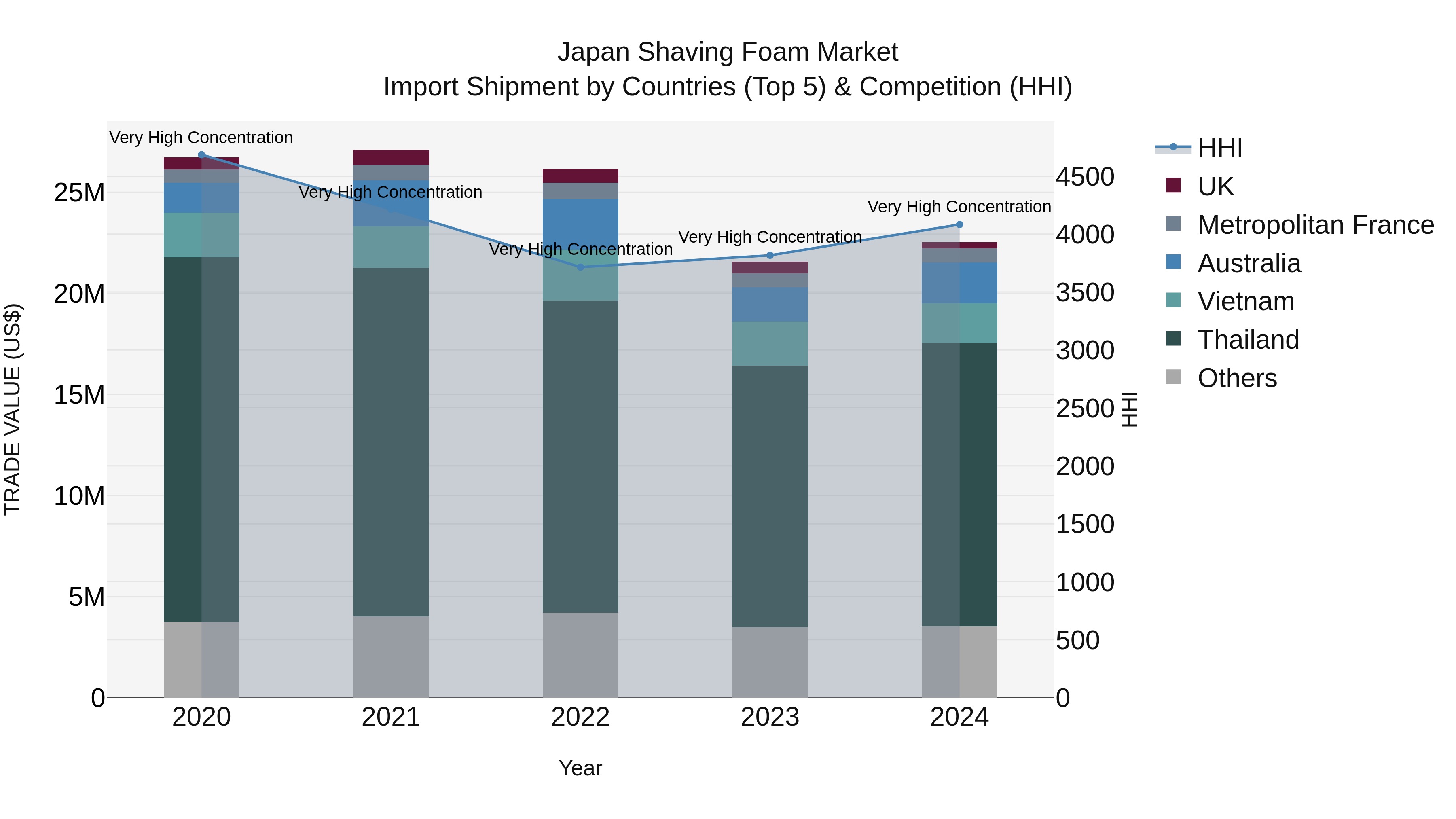
Japan Shaving Foam Market Import Shipment by Countries (Top 5) & Competition (HHI)
Japan's shaving foam import market in 2024 saw significant contributions from top exporting countries such as Thailand, Australia, Vietnam, Taiwan, and Metropolitan France. Despite a negative Compound Annual Growth Rate (CAGR) of -4.2% from 2020 to 2024, there was a positive growth rate of 4.47% from 2023 to 2024. The high Herfindahl-Hirschman Index (HHI) indicates a concentrated market, suggesting potential challenges for new entrants. Overall, the import market for shaving foam in Japan continues to show resilience and opportunities for growth in the coming years.
Japan Shaving Foam Market Synopsis
The Japan Shaving Foam Market is a mature and competitive sector dominated by well-established brands like Gillette, Schick, and Panasonic. Consumers in Japan value high-quality products, innovative packaging, and skin-friendly formulas, driving demand for premium shaving foams with added benefits like moisturizing properties and sensitive skin formulas. The market is also witnessing a growing trend towards natural and organic ingredients, prompting companies to introduce eco-friendly options to cater to environmentally conscious consumers. Online retail channels are gaining popularity among tech-savvy consumers, providing convenient access to a wide range of shaving foam products. As grooming habits evolve and male grooming becomes more mainstream in Japan, the shaving foam market is expected to continue its steady growth trajectory with a focus on product innovation and meeting evolving consumer preferences.
Japan Shaving Foam Market Trends
The Japan Shaving Foam Market is experiencing a shift towards eco-friendly and natural ingredients, driven by increasing consumer awareness of sustainability and health. Brands are focusing on developing products free from harmful chemicals and with skin-friendly formulations. Opportunities lie in launching innovative packaging designs for convenience and sustainability, such as refillable or recyclable containers. Additionally, with the rising popularity of grooming and self-care routines among men, there is a growing demand for specialized shaving foams tailored to specific skin types and preferences. Collaborations with influencers and online marketing strategies can also help brands reach a wider audience and engage with consumers in the digital age. Overall, the market is ripe for brands that can offer high-quality, sustainable, and customized shaving foam products to meet evolving consumer needs.
Japan Shaving Foam Market Challenges
In the Japan Shaving Foam Market, several challenges are faced, including strong competition from established international brands, rising consumer demand for natural and organic products leading to a shift away from traditional shaving foams with synthetic ingredients, and a decline in the male grooming market due to changing societal norms and preferences. Additionally, the economic impact of the COVID-19 pandemic has affected consumer spending patterns, leading to a decrease in discretionary purchases like grooming products. Companies operating in the Japan Shaving Foam Market must navigate these challenges by innovating their product offerings to cater to evolving consumer preferences, investing in marketing strategies to stand out in a crowded market, and adapting to the changing retail landscape to ensure their products remain accessible to consumers.
Japan Shaving Foam Market Investment Opportunities
The Japan Shaving Foam Market is primarily driven by factors such as the increasing focus on personal grooming and hygiene among the Japanese population, the growing trend of clean-shaven looks in professional settings, and the availability of innovative and specialized shaving foam products catering to different skin types and preferences. Additionally, the rising influence of social media and celebrity endorsements promoting grooming products has further fueled the demand for shaving foam in Japan. Moreover, the convenience and ease of use offered by shaving foam compared to traditional shaving methods have also contributed to the market growth. Overall, the combination of evolving grooming trends, product innovation, and increasing consumer awareness about personal care are key drivers propelling the Japan Shaving Foam Market.
Japan Shaving Foam Market Government Polices
The Japan Shaving Foam Market is subject to various government policies aimed at regulating product safety, labeling requirements, and environmental impact. The Ministry of Health, Labour and Welfare oversees regulations related to the safety and quality of shaving foam products, ensuring they meet strict standards to protect consumer health. Additionally, the Ministry of Economy, Trade and Industry enforces labeling requirements to provide consumers with accurate information about the contents and usage instructions of shaving foam products. Environmentally, the Ministry of the Environment promotes eco-friendly practices within the industry to minimize waste and reduce the carbon footprint of manufacturing and disposal processes. Overall, these government policies play a crucial role in shaping the Japan Shaving Foam Market by ensuring product quality, consumer information, and environmental sustainability.
Japan Shaving Foam Market Future Outlook
The Japan Shaving Foam Market is expected to witness steady growth in the upcoming years, driven by the increasing focus on personal grooming and hygiene among the male population. The market is likely to benefit from innovative product offerings, such as organic and natural ingredients, as well as advanced formulations catering to specific skin types. Furthermore, the rising disposable income levels and changing lifestyles in Japan are anticipated to boost the demand for premium shaving foam products. Manufacturers are also expected to invest in marketing strategies to target younger demographics and capitalize on the growing trend of male grooming. However, the market may face challenges such as intense competition and price sensitivity among consumers, necessitating continuous product innovation and strategic pricing strategies to maintain a competitive edge in the evolving market landscape.
Key Highlights of the Report:
- Japan Shaving Foam Market Outlook
- Market Size of Japan Shaving Foam Market, 2024
- Forecast of Japan Shaving Foam Market, 2031
- Historical Data and Forecast of Japan Shaving Foam Revenues & Volume for the Period 2021- 2031
- Japan Shaving Foam Market Trend Evolution
- Japan Shaving Foam Market Drivers and Challenges
- Japan Shaving Foam Price Trends
- Japan Shaving Foam Porter's Five Forces
- Japan Shaving Foam Industry Life Cycle
- Historical Data and Forecast of Japan Shaving Foam Market Revenues & Volume By Product for the Period 2021- 2031
- Historical Data and Forecast of Japan Shaving Foam Market Revenues & Volume By Organic for the Period 2021- 2031
- Historical Data and Forecast of Japan Shaving Foam Market Revenues & Volume By Conventional for the Period 2021- 2031
- Historical Data and Forecast of Japan Shaving Foam Market Revenues & Volume By Distribution Channel for the Period 2021- 2031
- Historical Data and Forecast of Japan Shaving Foam Market Revenues & Volume By Hypermarkets/Supermarkets for the Period 2021- 2031
- Historical Data and Forecast of Japan Shaving Foam Market Revenues & Volume By Departmental Stores for the Period 2021- 2031
- Historical Data and Forecast of Japan Shaving Foam Market Revenues & Volume By Speciality Stores for the Period 2021- 2031
- Historical Data and Forecast of Japan Shaving Foam Market Revenues & Volume By Online for the Period 2021- 2031
- Japan Shaving Foam Import Export Trade Statistics
- Market Opportunity Assessment By Product
- Market Opportunity Assessment By Distribution Channel
- Japan Shaving Foam Top Companies Market Share
- Japan Shaving Foam Competitive Benchmarking By Technical and Operational Parameters
- Japan Shaving Foam Company Profiles
- Japan Shaving Foam Key Strategic Recommendations






































