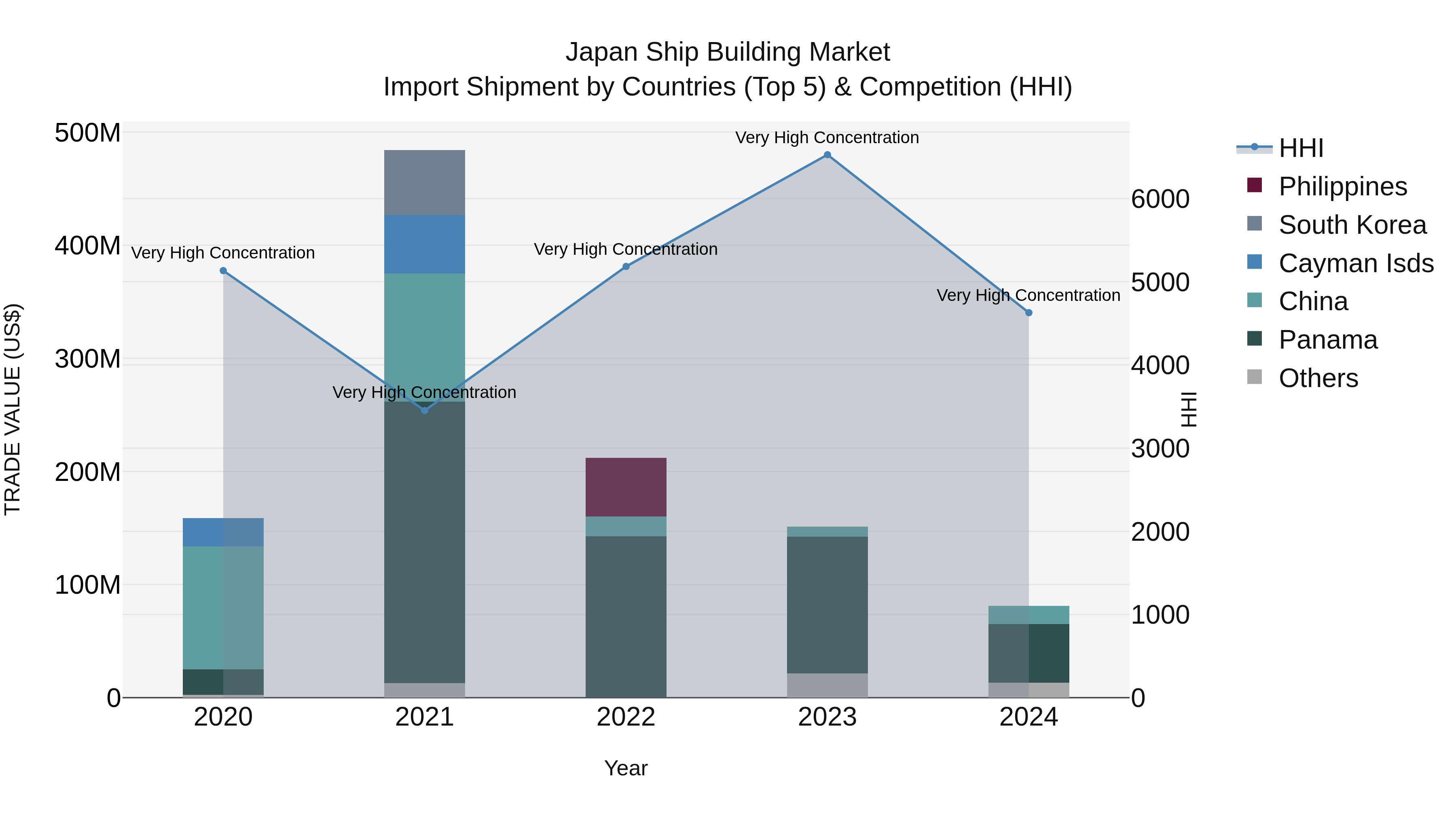
Japan Ship Building Market Import Shipment by Countries (Top 5) & Competition (HHI)
Japan's ship building import shipments in 2024 saw significant contributions from Panama, China, UK, Singapore, and Cayman Islands. Despite a negative Compound Annual Growth Rate (CAGR) of -15.49% from 2020 to 2024, the market remained highly concentrated with a high Herfindahl-Hirschman Index (HHI). The drastic growth rate decline of -46.46% from 2023 to 2024 reflects challenges faced by the industry, pointing towards a need for strategic measures to revitalize and strengthen the ship building import sector in Japan.
Japan Ship Building Market Synopsis
The Japan Shipbuilding market is a significant player in the global shipbuilding industry, renowned for its high-quality vessels and advanced technological capabilities. The country`s shipbuilders specialize in a wide range of vessels, including container ships, tankers, cruise ships, and naval vessels. Japanese shipyards are known for their efficiency, innovation, and adherence to strict quality standards, making them preferred choices for international customers. Despite facing competition from South Korean and Chinese shipbuilders, Japan maintains a strong position in the market due to its focus on specialization, research and development, and a skilled workforce. The industry is also adapting to emerging trends such as eco-friendly vessels and digitalization to stay competitive in the global market.
Japan Ship Building Market Trends
The Japan Ship Building Market is experiencing a shift towards sustainable and technologically advanced vessels to comply with strict environmental regulations. There is a growing focus on developing eco-friendly ships, such as LNG-powered vessels and hybrid electric propulsion systems. Additionally, the market is witnessing increased demand for offshore support vessels and autonomous ships. Opportunities lie in the expansion of the offshore wind industry, which requires specialized vessels for installation and maintenance. Digitalization and automation are also key trends, offering opportunities for companies to enhance operational efficiency and safety. Collaborations with international shipbuilders and investment in research and development are crucial for Japanese shipyards to stay competitive in the global market.
Japan Ship Building Market Challenges
In the Japan Ship Building Market, one significant challenge is the intense competition from other major shipbuilding nations such as South Korea and China. These countries have been able to offer competitive pricing and advanced technologies, putting pressure on Japanese shipbuilders to innovate and stay ahead. Additionally, the aging workforce in Japan poses a challenge in terms of skilled labor availability, leading to potential skill gaps and knowledge transfer issues. Moreover, fluctuating global demand for shipping vessels and the impact of economic uncertainties can create market volatility, affecting the stability and growth of the industry in Japan. Overall, Japanese shipbuilders need to focus on enhancing their competitiveness, investing in research and development, and adapting to changing market dynamics to overcome these challenges.
Japan Ship Building Market Investment Opportunities
The Japan Shipbuilding market is primarily driven by factors such as increasing demand for commercial vessels, particularly in the energy and transportation sectors. The country`s strong maritime tradition and advanced technology also play a crucial role in driving the market growth. Additionally, government initiatives to promote domestic shipbuilding industry, along with a focus on environmental sustainability and safety standards, are key drivers influencing the market. The rise in global trade activities and the need for modernization and replacement of aging fleet further contribute to the growth of the Japan Shipbuilding market. Overall, a combination of technological advancements, government support, and market demand are the main drivers fueling the growth of the shipbuilding industry in Japan.
Japan Ship Building Market Government Polices
The Japan Ship Building Market is heavily influenced by government policies aimed at supporting and promoting the industry. The Japanese government provides subsidies and financial assistance to domestic shipbuilders to enhance their competitiveness in the global market. Additionally, there are regulations in place to ensure the safety and quality of ships built in Japan, with stringent compliance requirements for environmental standards and technological advancements. The government also plays a key role in promoting research and development initiatives in the industry, encouraging innovation and sustainability practices. Overall, government policies in Japan are focused on maintaining the country`s position as a leading shipbuilding nation, fostering growth, and ensuring the industry`s long-term viability.
Japan Ship Building Market Future Outlook
The Japan Ship Building Market is expected to see steady growth in the coming years due to increased demand for eco-friendly and energy-efficient vessels, driven by stricter environmental regulations. The industry is also likely to benefit from the country`s strong technological expertise in shipbuilding, particularly in the development of advanced marine technologies. Additionally, the growing focus on maritime security and defense is expected to create opportunities for Japanese shipbuilders. However, challenges such as overcapacity, competition from South Korean and Chinese shipyards, and the impact of global economic uncertainties may pose risks to the market`s growth. Overall, the Japan Ship Building Market is poised for moderate expansion, with a continued emphasis on innovation and sustainability.
Key Highlights of the Report:
- Japan Ship Building Market Outlook
- Market Size of Japan Ship Building Market, 2024
- Forecast of Japan Ship Building Market, 2031
- Historical Data and Forecast of Japan Ship Building Revenues & Volume for the Period 2021- 2031
- Japan Ship Building Market Trend Evolution
- Japan Ship Building Market Drivers and Challenges
- Japan Ship Building Price Trends
- Japan Ship Building Porter's Five Forces
- Japan Ship Building Industry Life Cycle
- Historical Data and Forecast of Japan Ship Building Market Revenues & Volume By Type for the Period 2021- 2031
- Historical Data and Forecast of Japan Ship Building Market Revenues & Volume By Oil Tankers for the Period 2021- 2031
- Historical Data and Forecast of Japan Ship Building Market Revenues & Volume By Bulk Carriers for the Period 2021- 2031
- Historical Data and Forecast of Japan Ship Building Market Revenues & Volume By General Cargo Ships for the Period 2021- 2031
- Historical Data and Forecast of Japan Ship Building Market Revenues & Volume By Container Ships for the Period 2021- 2031
- Historical Data and Forecast of Japan Ship Building Market Revenues & Volume By Passenger Ships for the Period 2021- 2031
- Historical Data and Forecast of Japan Ship Building Market Revenues & Volume By Others for the Period 2021- 2031
- Historical Data and Forecast of Japan Ship Building Market Revenues & Volume By End User for the Period 2021- 2031
- Historical Data and Forecast of Japan Ship Building Market Revenues & Volume By Transport Companies for the Period 2021- 2031
- Historical Data and Forecast of Japan Ship Building Market Revenues & Volume By Military for the Period 2021- 2031
- Japan Ship Building Import Export Trade Statistics
- Market Opportunity Assessment By Type
- Market Opportunity Assessment By End User
- Japan Ship Building Top Companies Market Share
- Japan Ship Building Competitive Benchmarking By Technical and Operational Parameters
- Japan Ship Building Company Profiles
- Japan Ship Building Key Strategic Recommendations






































