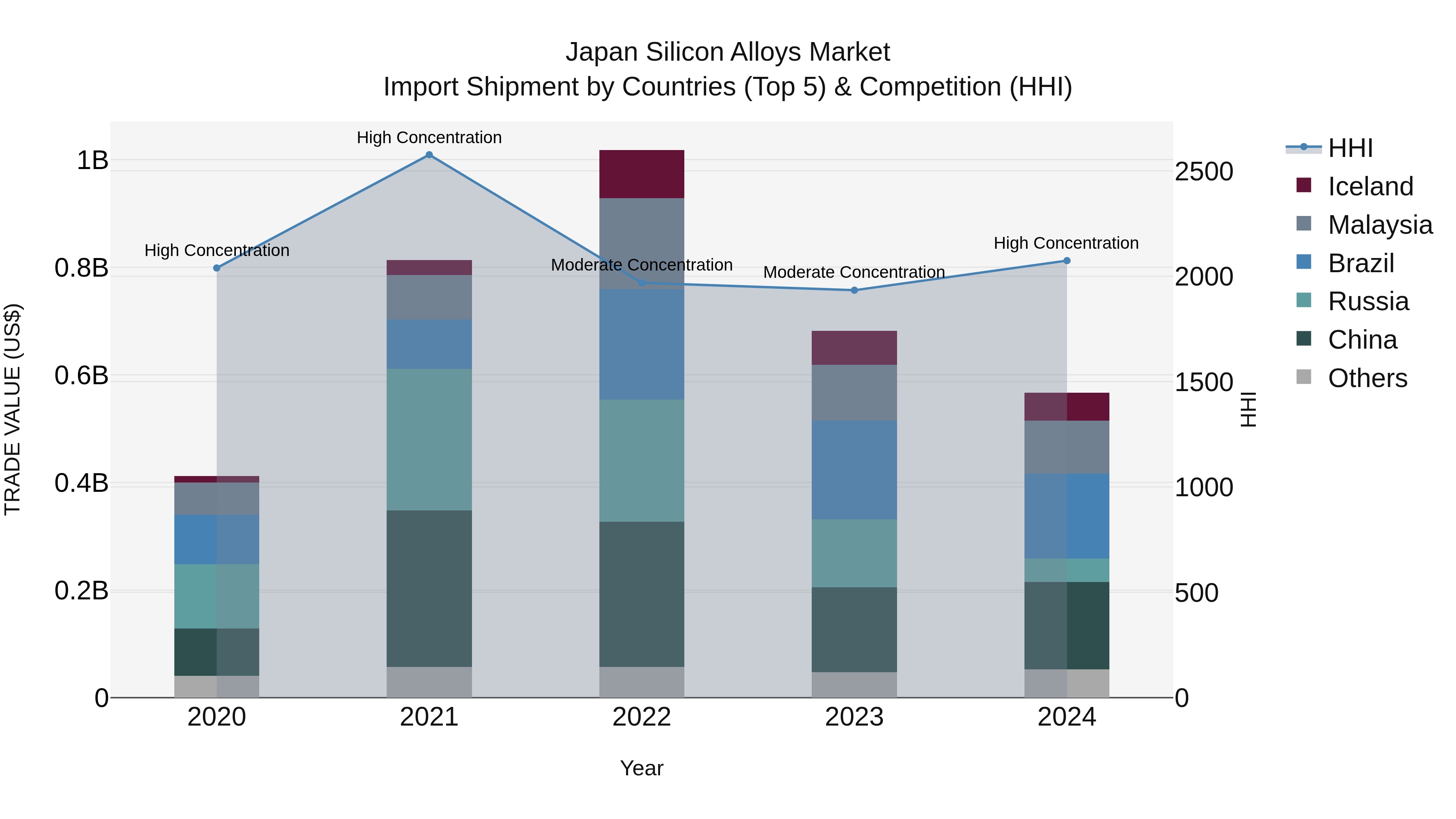
Japan Silicon Alloys Market Import Shipment by Countries (Top 5) & Competition (HHI)
In 2024, Japan's silicon alloys import market saw a significant shift with top exporters being China, Brazil, Malaysia, Iceland, and Russia. The market concentration, as measured by the Herfindahl-Hirschman Index (HHI), increased from moderate to high concentration within a year. Despite a notable compound annual growth rate (CAGR) of 8.29% from 2020 to 2024, the growth rate in 2024 experienced a decline of -16.89%. This suggests a dynamic market environment influenced by changing trade dynamics and potentially impacting the overall import landscape for silicon alloys in Japan.
Japan Silicon Alloys Market Overview
The Japan Silicon Alloys Market is characterized by a growing demand for silicon alloys in various industries such as automotive, electronics, and construction. Silicon alloys are used primarily as a deoxidizing agent in the steel manufacturing process to improve the quality of steel products. The market is witnessing steady growth due to the increasing production of steel in Japan coupled with the rising demand for high-performance steel in automotive and construction sectors. Key players in the Japan Silicon Alloys Market include Ferroglobe, Elkem, and Globe Specialty Metals. The market is also driven by advancements in technology leading to the development of innovative silicon alloy products with enhanced properties. Overall, the Japan Silicon Alloys Market is poised for continued growth in the coming years.
Japan Silicon Alloys Market Trends
The Japan Silicon Alloys Market is experiencing several key trends. One significant trend is the increasing demand for silicon alloys in the electronics and automotive industries, driven by the growing need for high-performance materials in these sectors. Another trend is the shift towards environmentally friendly silicon alloys, with a focus on developing sustainable production processes and reducing carbon emissions. Additionally, there is a rising interest in using silicon alloys in renewable energy applications such as solar panels and energy storage systems, contributing to the market`s growth. Overall, innovation in product development, sustainability initiatives, and expanding applications across various industries are shaping the current trends in the Japan Silicon Alloys Market.
Japan Silicon Alloys Market Challenges
In the Japan Silicon Alloys Market, some key challenges include intense competition from other global players, fluctuating raw material prices, and increasing environmental regulations. The market is highly competitive with established players constantly innovating to maintain their market position and attract new customers. Fluctuating prices of raw materials, such as silicon and other alloying elements, can impact the production costs and profit margins of companies operating in this market. Additionally, stringent environmental regulations in Japan require companies to invest in sustainable practices and technologies, adding to the overall operational costs. Navigating these challenges requires companies in the Japan Silicon Alloys Market to adopt efficient supply chain management practices, invest in research and development for product innovation, and ensure compliance with environmental standards to remain competitive and sustainable.
Japan Silicon Alloys Market Investment Opportunities
The Japan Silicon Alloys Market presents several investment opportunities for savvy investors. With the growing demand for silicon alloys in the electronics, automotive, and renewable energy sectors, there is a promising outlook for companies involved in the production and distribution of these materials. Investing in Japanese companies that specialize in manufacturing silicon alloys can offer potential returns as the market continues to expand. Additionally, with Japan`s focus on technological innovation and sustainability, there is an opportunity to invest in companies developing advanced silicon alloys for use in high-tech applications and green technologies. Overall, the Japan Silicon Alloys Market provides a fertile ground for investment with its strong industrial base and increasing demand for these materials across various sectors.
Japan Silicon Alloys Market Government Policy
Government policies in Japan related to the Silicon Alloys Market primarily focus on promoting innovation, sustainability, and competitiveness within the industry. Key initiatives include providing subsidies and incentives for research and development activities to drive technological advancements and improve product quality. Additionally, there are regulations in place to ensure environmental protection and energy efficiency in the production and usage of silicon alloys. The Japanese government aims to support domestic manufacturers in expanding their market share both domestically and internationally through trade agreements and investment promotion. Overall, the policies aim to enhance the overall growth and global competitiveness of the Japan Silicon Alloys Market while also addressing environmental and sustainability concerns.
Japan Silicon Alloys Market Future Outlook
The future outlook for the Japan Silicon Alloys Market appears promising, driven by increasing demand from the automotive and electronics industries. Silicon alloys are essential components in the manufacturing of electric vehicles and electronic devices, and as these sectors continue to grow, the demand for silicon alloys is expected to rise. Additionally, with the global shift towards renewable energy sources such as solar power, the demand for silicon alloys used in photovoltaic cells is also anticipated to increase. Technological advancements and innovations in the production processes of silicon alloys are likely to further boost market growth in Japan. However, challenges such as fluctuating raw material prices and environmental regulations may impact the market dynamics in the near future.
Key Highlights of the Report:
- Japan Silicon Alloys Market Outlook
- Market Size of Japan Silicon Alloys Market, 2021
- Forecast of Japan Silicon Alloys Market, 2031
- Historical Data and Forecast of Japan Silicon Alloys Revenues & Volume for the Period 2021 - 2031
- Japan Silicon Alloys Market Trend Evolution
- Japan Silicon Alloys Market Drivers and Challenges
- Japan Silicon Alloys Price Trends
- Japan Silicon Alloys Porter's Five Forces
- Japan Silicon Alloys Industry Life Cycle
- Historical Data and Forecast of Japan Silicon Alloys Market Revenues & Volume By Type for the Period 2021 - 2031
- Historical Data and Forecast of Japan Silicon Alloys Market Revenues & Volume By Ferrosilicon for the Period 2021 - 2031
- Historical Data and Forecast of Japan Silicon Alloys Market Revenues & Volume By Deoxidizers for the Period 2021 - 2031
- Historical Data and Forecast of Japan Silicon Alloys Market Revenues & Volume By Inoculants for the Period 2021 - 2031
- Historical Data and Forecast of Japan Silicon Alloys Market Revenues & Volume By Others for the Period 2021 - 2031
- Historical Data and Forecast of Japan Silicon Alloys Market Revenues & Volume By Application for the Period 2021 - 2031
- Historical Data and Forecast of Japan Silicon Alloys Market Revenues & Volume By Carbon Steel & Other Alloy Steel for the Period 2021 - 2031
- Historical Data and Forecast of Japan Silicon Alloys Market Revenues & Volume By Stainless Steel for the Period 2021 - 2031
- Historical Data and Forecast of Japan Silicon Alloys Market Revenues & Volume By Electrical Steel for the Period 2021 - 2031
- Historical Data and Forecast of Japan Silicon Alloys Market Revenues & Volume By Cast Iron for the Period 2021 - 2031
- Historical Data and Forecast of Japan Silicon Alloys Market Revenues & Volume By Others for the Period 2021 - 2031
- Japan Silicon Alloys Import Export Trade Statistics
- Market Opportunity Assessment By Type
- Market Opportunity Assessment By Application
- Japan Silicon Alloys Top Companies Market Share
- Japan Silicon Alloys Competitive Benchmarking By Technical and Operational Parameters
- Japan Silicon Alloys Company Profiles
- Japan Silicon Alloys Key Strategic Recommendations






































