Japan Smart Card Market Size & Growth Rate
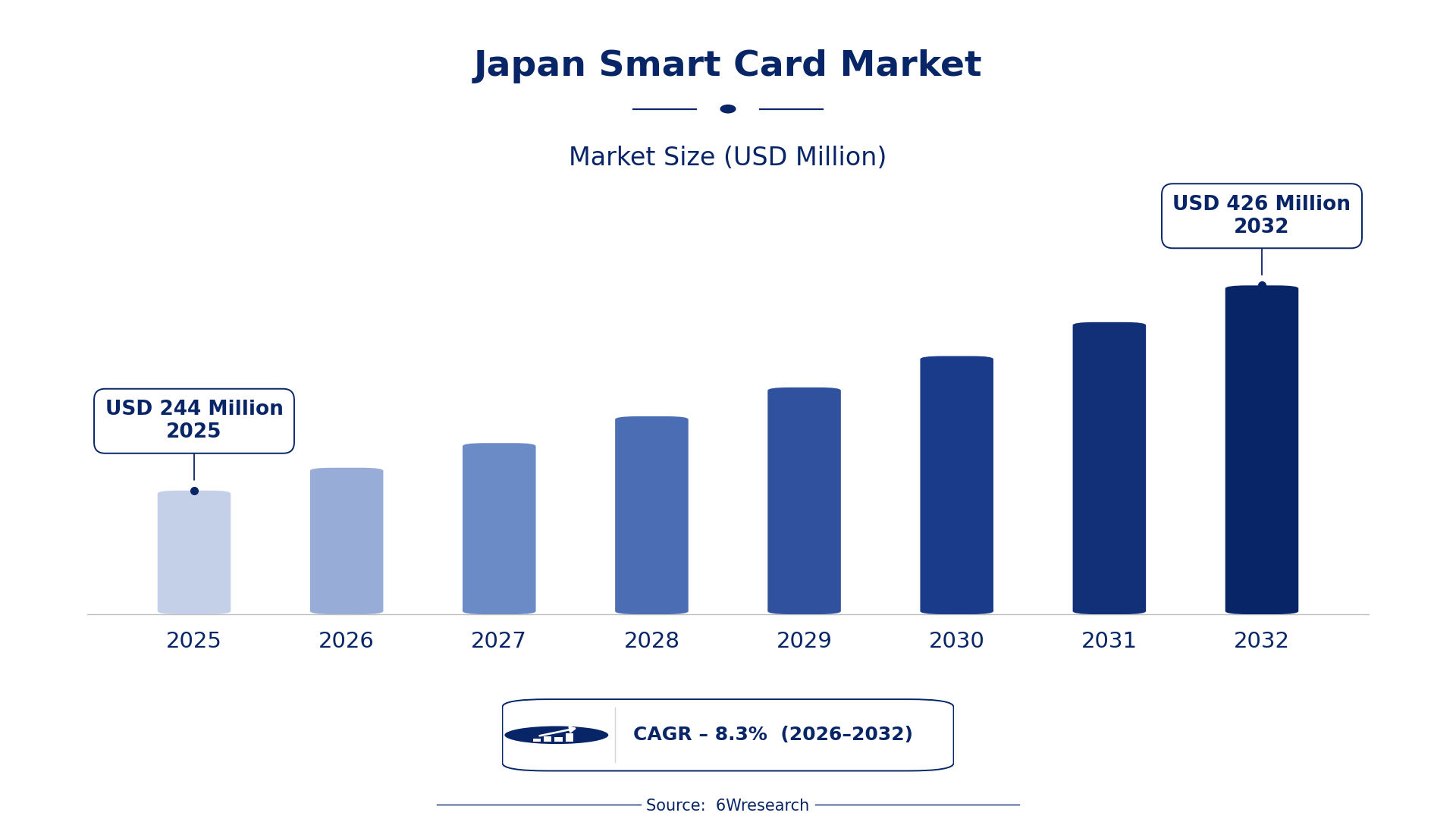
According to 6Wresearch internal database and industry insights, the Japan Smart Card Market was valued at USD 244 Million in 2025 and is projected to reach USD 426 Million by 2032, growing at a CAGR of approximately 8.3% during 2026–2032.
Japan Smart Card Market Highlights
| Report Metric | Details |
| Report Name | Japan Smart Card Market (2026-2032) |
| Market Size 2025 | USD 244 Million |
| Market Size 2032 | USD 426 Million |
| Absolute Growth 2025–2032 | USD 182 Million |
| CAGR 2026–2032 | 8.3% |
| Peak Annual Growth | 9.0% in 2029 |
| Forecast Period | 2026–2032 |
| Historical Data | 2022–2025 |
| Base Year | 2025 |
| Leading Types, 2025 | Contact Cards (47% share) |
| Leading Component, 2025 | Memory-based (61% share) |
| Leading Application, 2025 | BFSI (34% share) |
| Fastest-Growing Types | Contactless cards (11.1% CAGR) |
| Fastest-Growing Component | Microcontroller-based (11.0% CAGR) |
| Fastest-Growing Application | Government (11.3% CAGR) |
| Growing Sector | Healthcare |
| Key End Users | Banks, Government agencies, Healthcare providers, Transportation authorities |
Japan Smart Card Market Year-wise Growth Rate and Key Drivers (2022–2032)
This graph illustrates the annual growth rates of the market from 2022 to 2032, highlighting a steady upward trajectory and projected market expansion over the forecast period.
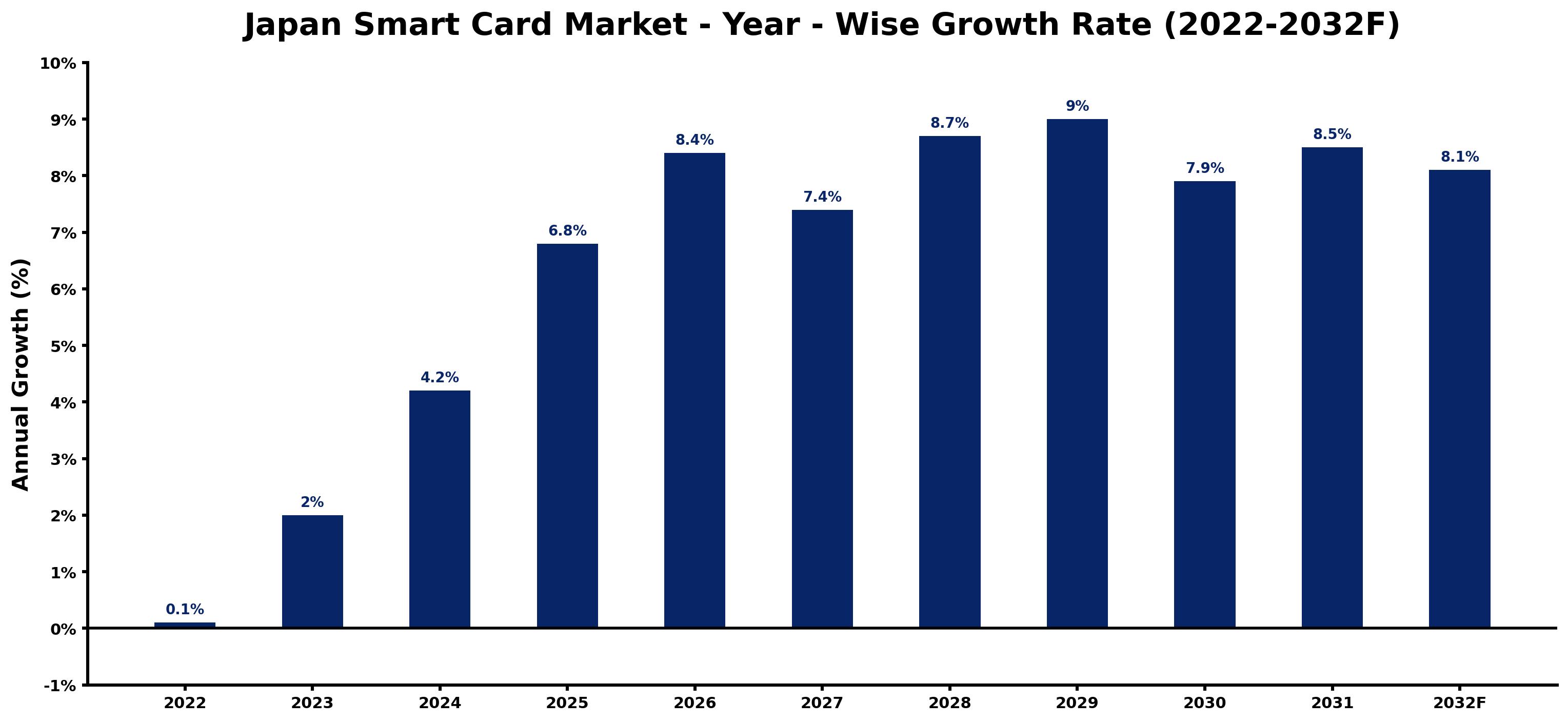
Each row of the following table gives one year's estimated growth and the event or demand shift that explains it.
| Year | Estimated Annual Growth (%) | Market Rationale |
| 2022 | 0.1 | The market experienced minimal growth, reflecting stable demand for smart cards. |
| 2023 | 2.0 | Demand for smart cards rose due to increased adoption in banking and transportation sectors. |
| 2024 | 4.2 | Growth accelerated as more users embraced contactless payment options in daily transactions. |
| 2025 | 6.8 | The market peaked with substantial investments in smart card technology across various sectors. |
| 2026 | 8.4 | Investment in digital ID programs is expected to spur further demand for secure identification solutions. |
| 2027 | 7.4 | Growth is projected to slow slightly as the market adjusts to increased production capabilities. |
| 2028 | 8.7 | Demand is expected to surge again with the rise of contactless cards in public transport systems. |
| 2029 | 9.0 | The market is projected to reach its peak growth as the adoption of smart cards becomes widespread. |
| 2030 | 7.9 | Growth is anticipated to moderate as the market begins to stabilise after rapid expansion. |
| 2031 | 8.5 | Demand is expected to remain strong, driven by ongoing technological advancements in smart card applications. |
| 2032 | 8.1 | Growth is projected to slow slightly as the market matures, with steady demand across key sectors. |
Note: Market size estimations and growth projections presented in this report are based on 6Wresearch's proprietary forecasting methodology, utilizing the latest available industry data, government publications, and primary research inputs.
Japan Smart Card Market Synopsis
Smart cards are integrated circuit cards designed for secure data storage and processing, widely used in Japan for identification, payment transactions, and access control. Valued at approximately 200 million USD in 2022, the Japan Smart Card Market is experiencing growth driven by increased adoption in banking, transportation, and healthcare sectors. The Tokyo metropolitan area accounts for over 50% of smart card usage, while the digital ID program launched in 2021 further supports secure identification needs.
Market Dynamics Impact Analysis (2026–2032)
| Factor | Type | Impact | Primary Segment Affected |
| Growing adoption of contactless payment solutions | Driver | High | Contactless cards |
| Increased investment in digital ID programs | Driver | High | BFSI |
| Rising demand for secure identification in healthcare | Opportunity | High | Healthcare |
| Expansion of smart card applications in public transport | Opportunity | Medium | Contactless cards |
| Limited production capacity for advanced smart card technology | Restraint | High | Microcontroller-based |
| Regulatory compliance costs affecting small producers | Restraint | Medium | Contact Cards |
| Competition from alternative payment technologies | Challenge | High | Contactless cards |
| Supply chain disruptions impacting production timelines | Challenge | Medium | Microcontroller-based |
Evaluation of Drivers in Japan Smart Card Market (2026–2032)
The table below links each growth driver to the segment it affects and the evidence for it.
| Drivers | Primary Segment Affected | Why It Matters (Evidence) |
| Increased usage of contactless payments | Contactless cards | Over 80% of Japanese banks utilize smart cards for transactions, driving demand for contactless solutions. |
| Investment in digital ID initiatives | BFSI | The Japanese government's digital ID program launched in 2021 increases the need for secure banking transactions. |
| Growth in healthcare smart card applications | Healthcare | The healthcare sector has seen a rise in smart card adoption for patient management systems, increasing demand for secure identification solutions. |
| Expansion of public transport smart card systems | Contactless cards | Contactless smart cards are widely used in public transportation, boosting demand in this sector. |
| Technological advancements in smart card production | Microcontroller-based | Innovations in semiconductor technology enable complex processing tasks, increasing market demand. |
Purchasing is picking up as the banking sector increasingly adopts smart cards for transactions, with over 80% of banks utilising these technologies. The healthcare sector has seen a rise in smart card usage for patient management systems, reflecting a growing need for identification. Public transport systems have led to a surge in contactless smart card adoption, further driving market growth. By 2025, smart card transactions in retail are projected to increase by 30%, indicating a shift towards contactless payment preferences.
Evaluation of Restraints in Japan Smart Card Market
These restraints slow adoption and weigh on supplier margins.
| Market Restraint | Primary Segment Affected | Why It Matters (Evidence) |
| Limited production capacity for advanced smart card technology | Microcontroller-based | Production constraints limit the availability of sophisticated smart cards, impacting market growth. |
| Regulatory compliance costs affecting small producers | Contact Cards | Compliance with safety regulations increases operational costs for smaller manufacturers, hindering competitiveness. |
| Market saturation in established sectors | BFSI | The BFSI sector faces saturation, limiting growth opportunities for new smart card solutions. |
| Slow adoption of smart cards in niche markets | Multi-component cards | Limited applications in specialized areas restrict the market potential for multi-component cards. |
| Dependence on traditional payment methods | Contactless cards | Resistance to change from consumers accustomed to cash transactions slows the transition to contactless solutions. |
Japan Smart Card Market Challenges
Producers in the smart card industry struggle with a shortage of skilled technicians, which limits their ability to innovate and meet market demands. Buyers in the banking sector face delays in smart card deployment due to lengthy certification processes, causing transaction inefficiencies that can last up to three months. Supply chain disruptions arise from concentrated production in the Kanto region, increasing lead times for buyers across Japan by an average of 20%. Rising production costs, driven by semiconductor shortages, compel banks to reconsider their smart card strategies, potentially raising transaction fees for consumers by 15%.
Trends in the Japan Smart Card Market
The following changes are redrawing the Japan Smart Card Market.
- Shift from Cash to Digital Payments: Consumers in Japan are increasingly moving away from cash transactions, with contactless smart cards becoming the preferred payment method. In 2022, over 80% of transactions in urban areas were made using smart cards, reflecting this trend.
- Transition to Digital ID Solutions: The launch of the digital ID program in 2021 has accelerated the adoption of smart cards for secure identification. By 2023, the program is projected to cover over 70% of the population, enhancing security measures.
- Emergence of Smart Cards in Healthcare: Smart cards are gaining traction in the healthcare sector for patient identification and record management. The adoption rate in hospitals has increased by 25% since 2021, highlighting their growing importance.
- Prioritisation of Contactless Technology: Public transportation systems are prioritising contactless technology, with smart cards like Suica and Pasmo leading the way. In 2023, over 60% of users opted for contactless payments in transit.
Investment Opportunities in the Japan Smart Card Market
The following opportunities in the Japan Smart Card Market pair current demand with a clear way in.
- Smart Card Solutions for Healthcare: The healthcare sector is increasingly adopting smart card technology, with a projected growth of 20% in usage by 2025. Hospitals and clinics are the primary buyers, and partnerships with local tech firms can facilitate entry.
- Investment in Digital ID Programs: With the government's digital ID initiative expected to cover 70% of the population by 2023, there is a strong opportunity for suppliers of secure identification solutions. Engaging with government agencies can streamline entry.
- Expansion of Contactless Payment Systems: The retail sector is projected to see a 30% increase in smart card transactions by 2025, creating opportunities for suppliers of contactless technology. Collaborating with retail chains can enhance market penetration.
- Development of Smart Card Applications in Transportation: Public transport systems are expanding their smart card usage, with over 50% of commuters using contactless cards. Suppliers can enter this market by partnering with transit authorities.
Government Initiatives in the Japan Smart Card Market
The Electrical Appliance and Material Safety Act of 1961 regulates the safety of electrical appliances, including smart cards, ensuring that producers comply with safety standards. The Long-Term Care Insurance Act of 1997 provides funding for nursing care services, indirectly supporting the use of smart cards in healthcare for patient management. The Medical Care Act of 1948 sets standards for hospitals and clinics, including facilities and staffing, which also influences smart card adoption in healthcare.
The Digital Agency oversees the implementation of the digital ID program, which promotes smart card usage for secure identification. This agency also funds initiatives aimed at advancing smart card technology, ensuring compliance with safety and security standards. In 2023, the agency allocated 50 million USD to support the digital ID initiative, enhancing the infrastructure for smart card deployment.
Future Insight of the Japan Smart Card Market
Emerging technologies will redefine smart card functionalities, enhancing data security and processing capabilities. By 2032, the digital ID programme will expand its reach, integrating smart cards into various sectors like healthcare and transportation. Smart card transactions in retail are projected to increase by 30% by 2025, driven by the growing preference for contactless payments. New manufacturing facilities will emerge in regions outside Kanto, fostering supply diversification and improving market resilience.
Market Segmentation Analysis
Japan Smart Card Market report covers a detailed analysis of the following market segments:
By Types – Contact Cards Lead, Contactless cards Expected to Grow Fastest
According to Summon Dutta, Assistant Manager at 6Wresearch, the largest types category in 2025 was Contact Cards, at 47% of revenue. Contact cards hold the largest share due to their extensive use in secure identification and transactions, especially within the banking sector. For instance, over 80% of Japanese banks rely on contact cards for secure transactions, highlighting their critical role in financial operations. Contactless cards are set to record the highest CAGR in this split, 11.1% over 2026–2032. Contactless cards are experiencing rapid growth, primarily driven by their convenience in public transportation systems like Suica and Pasmo. The increasing demand for quick and efficient transactions in urban areas is significantly propelling this sub-segment's expansion. Suppliers should focus on advancing contactless technologies to meet the rising consumer demand for convenient transaction options.
By Component – Memory-based Leads, Microcontroller-based Expected to Grow Fastest
Memory-based took 61% of component revenue in 2025, more than any other category. Memory-based smart cards dominate the market as they are specifically designed for applications that require secure data storage, making them essential across various sectors. Their established reliability in managing sensitive information has led to widespread adoption in industries prioritising security. Microcontroller-based is projected to grow fastest, at a CAGR of 11.0% during 2026–2032. Microcontroller-based smart cards are witnessing swift growth due to their capability to perform complex processing tasks, which are increasingly required in advanced applications. This trend is likely to continue as technology evolves and the need for multifunctional cards increases. Buyers should explore microcontroller-based solutions that offer improved functionality and security to meet their evolving needs.
By Application – BFSI Leads, Government Expected to Grow Fastest
BFSI accounted for 34% of the market by application in 2025. The BFSI sector is the market leader, essential for secure banking transactions, with many financial institutions relying on smart cards for customer identification and transaction security. This reliance highlights the critical role of smart card technology in ensuring financial integrity. The quickest growth will come from Government, forecast to expand at a CAGR of 11.3% between 2026 and 2032. Government applications are growing the fastest, spurred by initiatives like the digital ID program launched in 2021 that heighten the need for secure identification and access control. This trend is expected to accelerate as more government services transition to digital formats. Suppliers should align their products with government initiatives to capitalise on the rising demand for secure identification solutions.
Key Attractiveness of the Report
- 10 Years of Market Numbers
- Historical Data Starting from 2022 to 2025
- Base Year 2025
- Forecast Data until 2032
- Key Performance Indicators Impacting the Market
- Major Upcoming Developments and Projects
Key Highlights of the Report:
- Japan Smart Card Market Outlook
- Market Size of Japan Smart Card Market, 2025
- Forecast of Japan Smart Card Market, 2032
- Historical Data and Forecast of Japan Smart Card Revenues & Volume for the Period 2022-2032
- Japan Smart Card Market Trend Evolution
- Japan Smart Card Market Drivers and Challenges
- Japan Smart Card Price Trends
- Japan Smart Card Porter's Five Forces
- Japan Smart Card Industry Life Cycle
- Historical Data and Forecast of Japan Smart Card Market Revenues & Volume By Types for the Period 2022-2032
- Historical Data and Forecast of Japan Smart Card Market Revenues & Volume By Contact Cards for the Period 2022-2032
- Historical Data and Forecast of Japan Smart Card Market Revenues & Volume By Contactless cards for the Period 2022-2032
- Historical Data and Forecast of Japan Smart Card Market Revenues & Volume By Multi-component cards for the Period 2022-2032
- Historical Data and Forecast of Japan Smart Card Market Revenues & Volume By Component for the Period 2022-2032
- Historical Data and Forecast of Japan Smart Card Market Revenues & Volume By Memory-based for the Period 2022-2032
- Historical Data and Forecast of Japan Smart Card Market Revenues & Volume By Microcontroller-based for the Period 2022-2032
- Historical Data and Forecast of Japan Smart Card Market Revenues & Volume By Application for the Period 2022-2032
- Historical Data and Forecast of Japan Smart Card Market Revenues & Volume By BFSI for the Period 2022-2032
- Historical Data and Forecast of Japan Smart Card Market Revenues & Volume By Government for the Period 2022-2032
- Historical Data and Forecast of Japan Smart Card Market Revenues & Volume By Telecommunication for the Period 2022-2032
- Historical Data and Forecast of Japan Smart Card Market Revenues & Volume By Retail for the Period 2022-2032
- Historical Data and Forecast of Japan Smart Card Market Revenues & Volume By Healthcare for the Period 2022-2032
- Historical Data and Forecast of Japan Smart Card Market Revenues & Volume By Hospitality for the Period 2022-2032
- Historical Data and Forecast of Japan Smart Card Market Revenues & Volume By Others for the Period 2022-2032
- Japan Smart Card Import Export Trade Statistics
- Market Opportunity Assessment By Types
- Market Opportunity Assessment By Component
- Market Opportunity Assessment By Application
- Japan Smart Card Top Companies Market Share
- Japan Smart Card Competitive Benchmarking By Technical and Operational Parameters
- Japan Smart Card Company Profiles
- Japan Smart Card Key Strategic Recommendations
Market Covered
The study includes the following segmentation.
By Types
- Contact Cards
- Contactless cards
- Multi-component cards
By Component
- Memory-based
- Microcontroller-based
By Application
- BFSI
- Government
- Telecommunication
- Retail
- Healthcare
- Hospitality
- Others































