Japan Smart Juicer Market Size & Growth Rate
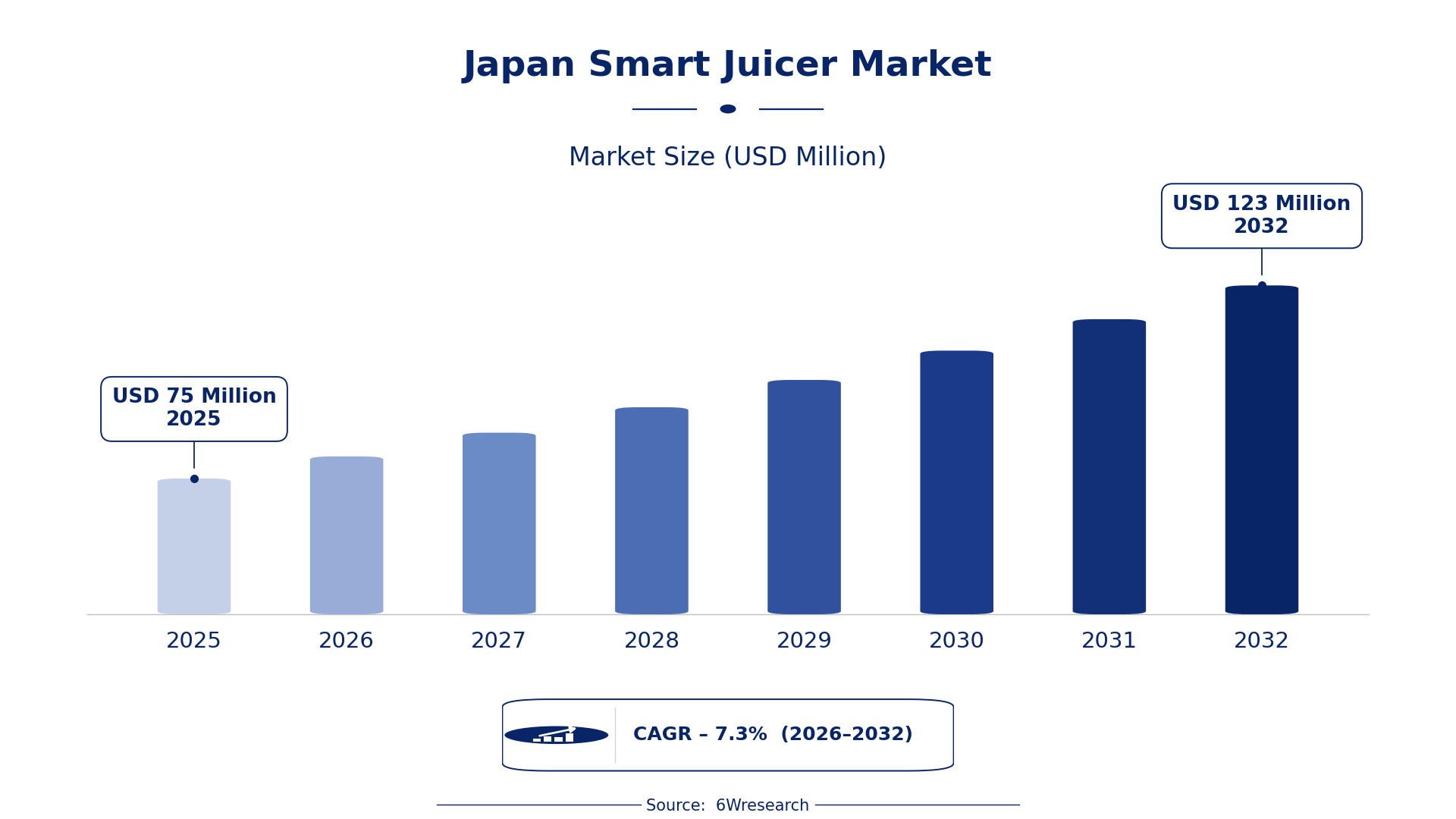
According to 6Wresearch internal database and industry insights, the Japan Smart Juicer Market was valued at USD 75 Million in 2025 and is projected to reach USD 123 Million by 2032, growing at a CAGR of approximately 7.3% during 2026–2032.
Japan Smart Juicer Market Highlights
| Report Metric | Details |
| Report Name | Japan Smart Juicer Market (2026-2032) |
| Market Size 2025 | USD 75 Million |
| Market Size 2032 | USD 123 Million |
| Absolute Growth 2025–2032 | USD 48 Million |
| CAGR 2026–2032 | 7.3% |
| Peak Annual Growth | 8.8% in 2032 |
| Forecast Period | 2026–2032 |
| Historical Data | 2022–2025 |
| Base Year | 2025 |
| Leading Juicer Type, 2025 | Centrifugal Juicers (47% share) |
| Leading Smart Features, 2025 | AI-Powered Extraction (37% share) |
| Leading Connectivity, 2025 | Wi-Fi Enabled (40% share) |
| Leading Application, 2025 | Home Use (39% share) |
| Leading End User, 2025 | Households (35% share) |
| Fastest-Growing Juicer Type | Cold Press Juicers (10.5% CAGR) |
| Fastest-Growing Connectivity | Bluetooth Connected (10.8% CAGR) |
| Fastest-Growing Application | Cafes & Restaurants (10.2% CAGR) |
| Fastest-Growing End User | Gyms & Wellness Centers (10.0% CAGR) |
| Growing Sector | Health and Wellness |
| Key End Users | Households, Cafes & Restaurants, Fitness Centers, Juice Bars |
Japan Smart Juicer Market Year-wise Growth Rate and Key Drivers (2022–2032)
This graph illustrates the annual growth rates of the market from 2022 to 2032, highlighting a steady upward trajectory and projected market expansion over the forecast period.
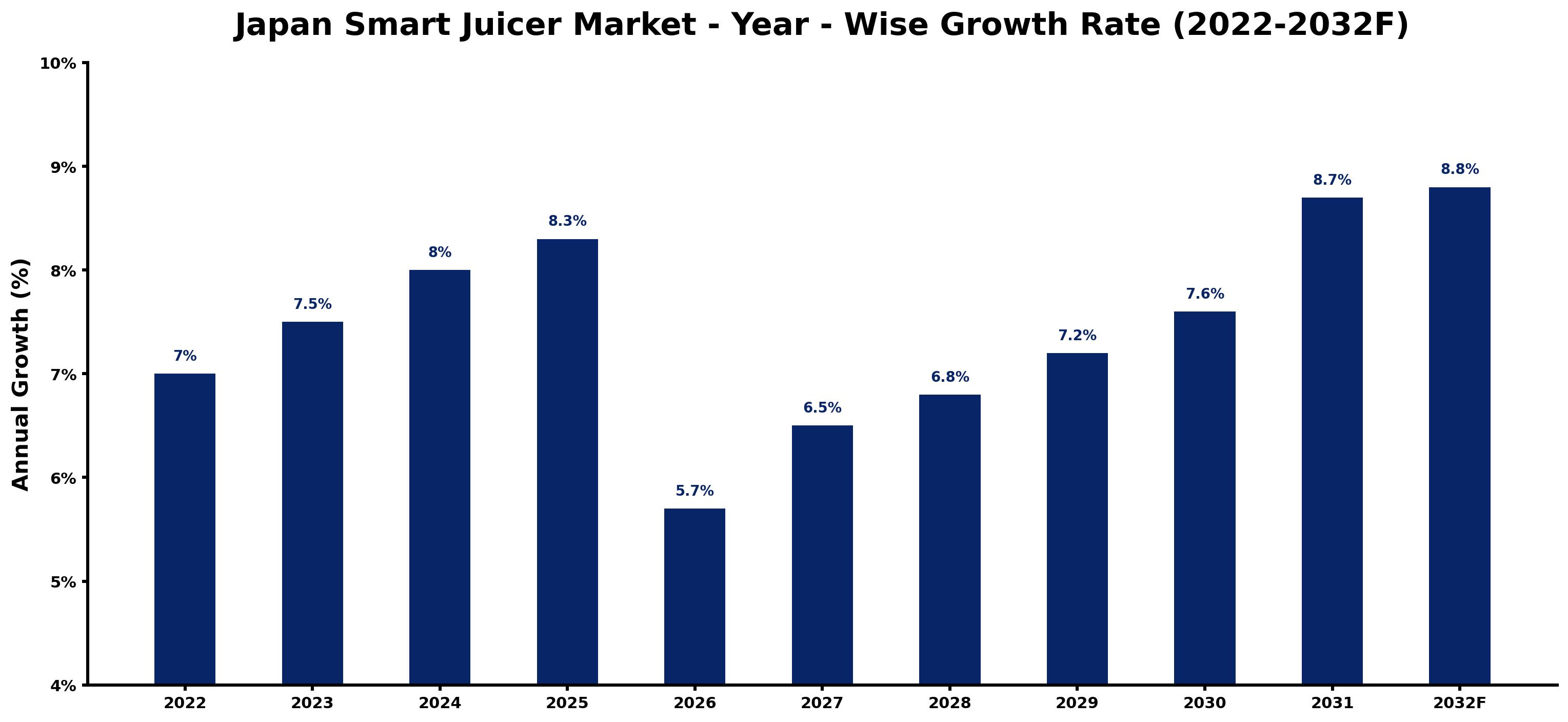
Year by year, the estimates below pair each growth rate with the development that shaped it.
| Year | Estimated Annual Growth (%) | Market Rationale |
| 2022 | 7.0 | The market experienced steady growth as health-conscious consumers sought advanced juicing solutions. |
| 2023 | 7.5 | Increased awareness of nutritional benefits drove faster growth in smart juicer adoption. |
| 2024 | 8.0 | The introduction of new models with improved features further accelerated market expansion. |
| 2025 | 8.3 | Consumer demand peaked as premium appliances gained traction among urban households. |
| 2026 | 5.7 | Growth is expected to slow as the market begins to stabilise after rapid expansion in previous years. |
| 2027 | 6.5 | An uptick in health-focused consumer behaviour will contribute to renewed growth. |
| 2028 | 6.8 | The trend towards fresh and organic foods is projected to continue supporting market demand. |
| 2029 | 7.2 | Increased disposable income among consumers will drive purchases of smart juicers. |
| 2030 | 7.6 | Growing popularity of juicing in cafes and restaurants will enhance market performance. |
| 2031 | 8.7 | Health initiatives and nutrition education campaigns are expected to spur further juicer sales. |
| 2032 | 8.8 | The market is projected to peak as AI technology integration becomes commonplace. |
Note: Market size estimations and growth projections presented in this report are based on 6Wresearch's proprietary forecasting methodology, utilizing the latest available industry data, government publications, and primary research inputs.
Japan Smart Juicer Market Synopsis
Smart juicers are advanced kitchen appliances that utilise technology to improve the juicing process. Made from high-quality materials, they incorporate features like AI and connectivity options, catering to health-conscious consumers. The Japan Smart Juicer Market is expanding due to rising health awareness, increased urban household adoption, and the growing popularity of juice bars, with over 1,000 establishments reported in 2023. This growth is supported by a high disposable income among consumers, encouraging premium appliance purchases.
Market Dynamics Impact Analysis (2026–2032)
| Factor | Type | Impact | Primary Segment Affected |
| Growing health consciousness among consumers | Driver | High | Home Use |
| Increasing disposable income in urban households | Driver | High | Households |
| Expansion of juice bars and cafes incorporating smart juicers | Opportunity | High | Cafes & Restaurants |
| Rising demand for nutrient retention in juices | Opportunity | Medium | Cold Press Juicers |
| Competition from traditional juicers | Restraint | High | Centrifugal Juicers |
| Consumer hesitation to invest in premium appliances | Restraint | Medium | Masticating Juicers |
| High initial costs of smart juicers | Challenge | High | AI-Powered Extraction |
| Limited awareness of advanced features among consumers | Challenge | Medium | Centrifugal Juicers |
Evaluation of Drivers in Japan Smart Juicer Market (2026–2032)
The factors lifting demand, and the evidence behind each, are summarised below.
| Drivers | Primary Segment Affected | Why It Matters (Evidence) |
| Health-conscious consumer behaviour | Home Use | Approximately 125 million people in Japan are prioritising nutritious diets, driving demand for smart juicers. |
| Technological advancements in juicing | AI-Powered Extraction | Integration of AI technology in juicers appeals to tech-savvy consumers in urban areas. |
| Rising popularity of juice bars | Cafes & Restaurants | Over 1,000 juice bars reported in 2023 indicate a strong market for smart juicers in commercial settings. |
| Increased disposable income | Households | The average household in Japan has a high disposable income, supporting the purchase of premium kitchen appliances. |
| Nutrient retention trends | Cold Press Juicers | Growing consumer preference for nutrient-rich juices boosts demand for cold press juicers. |
Behind the steady rise in orders sits the increasing health consciousness among Japanese consumers, with a strong focus on nutritious diets. The integration of AI technology into juicers attracts tech-savvy households, improving efficiency. Urban areas are seeing a surge in juice bars, with over 1,000 establishments reported in 2023, creating demand for smart juicers. The average household's high disposable income supports premium appliance purchases, while the trend towards nutrient retention in juices drives interest in cold press juicers. This combination of factors is propelling market growth in Japan.
Evaluation of Restraints in Japan Smart Juicer Market
Several factors work against faster growth; the main ones are summarised below.
| Market Restraint | Primary Segment Affected | Why It Matters (Evidence) |
| Competition from traditional juicers | Centrifugal Juicers | Traditional juicers remain popular due to their lower price points, limiting the market share of smart juicers. |
| Consumer hesitation to invest in premium appliances | Masticating Juicers | Some consumers are reluctant to pay higher prices for advanced features, affecting sales. |
| Limited awareness of smart juicer benefits | AI-Powered Extraction | Many consumers are unaware of the advantages of AI technology in juicing, hindering adoption. |
| Market saturation in urban areas | Households | Urban markets are becoming saturated, making it challenging for new entrants to gain traction. |
| Supply chain disruptions affecting availability | Cold Press Juicers | Ongoing supply chain issues may delay the delivery of smart juicers to consumers. |
Japan Smart Juicer Market Challenges
Juice bars in Japan face strict compliance with ISO 22000 standards, raising operational costs by approximately 20% and delaying product launches by up to six months. Urban households encounter challenges integrating advanced technology into existing kitchen setups, leading to installation costs that can exceed 15,000 yen, deterring potential purchases of smart juicers. Competition intensifies as new entrants flood the market, forcing established brands to lower prices, impacting profit margins by about 15%. A shortage of skilled workers familiar with advanced juicing technology prevents suppliers from fully capitalising on the health trend, resulting in slower market responses.
Trends in the Japan Smart Juicer Market
The trends below show where the Japan Smart Juicer Market is heading.
- Shift towards Health-Conscious Juicing: Japan is experiencing a shift towards health-conscious juicing, with the rise of juice bars promoting fresh, organic options. In 2023, over 1,000 juice bars were reported, indicating a strong trend towards nutritious beverages.
- Transition from Traditional to Smart Juicers: The transition from traditional juicers to smart juicers is clear, particularly in urban households. The growing adoption of AI technology in kitchen appliances is reshaping consumer preferences, with smart juicers gaining popularity.
- Emergence of AI Integration in Appliances: The emergence of AI integration in kitchen appliances began in 2025, improving user experience and efficiency. This trend is apparent in smart juicers, appealing to tech-savvy consumers seeking convenience.
- Rise of Nutrient Retention Focus: The focus on nutrient retention in juices has gained momentum, particularly among health-conscious consumers. This trend is driving demand for cold press juicers, which are known for preserving nutrients.
Investment Opportunities in the Japan Smart Juicer Market
The following areas offer the clearest openings for investors and suppliers in the Japan Smart Juicer Market.
- Urban Cafes and Juice Bars: In urban areas, cafes and juice bars are increasingly incorporating smart juicers into their menus, with over 1,000 establishments reported in 2023. This presents a strong opportunity for suppliers to meet growing demand.
- Health-Conscious Households: With Japan's population prioritising health, households are seeking premium kitchen appliances. The average household's high disposable income supports investment in smart juicers, particularly those with advanced features.
- Fitness Centers Offering Fresh Juices: Fitness centers are beginning to offer fresh juice options to members, increasing demand for smart juicers. This trend aligns with the growing health consciousness among gym-goers, creating a niche market.
- Sustainability in Appliance Choices: The trend towards sustainability is influencing consumer choices in appliances, with a focus on energy-efficient options. Suppliers can capitalise on this by offering eco-friendly smart juicers.
Government Initiatives in the Japan Smart Juicer Market
The regulatory framework affecting smart juicers includes the 'Healthy Japan 21' initiative, which promotes healthy eating habits among the population. Additionally, ISO 22000 standards for food safety management in juice production ensure that manufacturers adhere to high-quality practices, impacting the production and sale of smart juicers. The Ministry of Health, Labour and Welfare has been instrumental in promoting nutrition education, influencing consumer choices and juicer sales.
The Digital Agency, established in September 2021, leads government digital transformation efforts, approving standards for smart kitchen appliances. This agency supports manufacturers in developing products that meet consumer demands for technology integration, while funding initiatives that enhance digital capabilities in the appliance sector.
Future Insight of the Japan Smart Juicer Market
Investment in smart juicer technology will increase by 2032, driven by health-conscious consumers seeking advanced kitchen solutions and government initiatives like 'Healthy Japan 21' promoting nutritious eating. Urban households will adopt AI-integrated juicers that improve nutrient retention and convenience. Trade shows will highlight innovations that cater to changing consumer preferences, while cafes and restaurants will expand their fresh juice offerings, creating new opportunities for suppliers. The market will shift towards sustainable practices, influencing buyers and suppliers in their product selections.
Market Segmentation Analysis
Japan Smart Juicer Market report covers a detailed analysis of the following market segments:
By Juicer Type – Centrifugal Juicers Lead, Cold Press Juicers Expected to Grow Fastest
According to Bhawna Singh, Assistant Manager at 6Wresearch, the largest juicer type category in 2025 was Centrifugal Juicers, at 47% of revenue. Centrifugal juicers dominate the market due to their popularity among consumers seeking quick and efficient juicing solutions. Their widespread use in urban households, particularly in the Tokyo region, contributes to their leading share. Cold Press Juicers are set to record the highest CAGR in this split, 10.5% over 2026–2032. Cold press juicers are experiencing rapid growth as health-conscious consumers increasingly prioritise nutrient retention in their juices. The rise in juice bars, with over 1,000 establishments in 2023, is driving this trend further. Suppliers should focus on promoting the health benefits of cold press juicers to capture the growing market segment.
By Smart Features – AI-Powered Extraction Leads and Records the Fastest Growth
In 2025, AI-Powered Extraction led the smart features split with a 37% share. The segment for advanced extraction methods leads due to their ability to significantly improve juicing efficiency, appealing to health-conscious consumers. This feature is particularly popular among urban households where convenience and quality are paramount. AI-Powered Extraction is also forecast to expand faster than any other category, at a CAGR of 10.1% over 2026–2032. The growth in advanced extraction methods is set to accelerate as consumers increasingly seek efficient juicing solutions that retain nutrients. Its position as both leader and fastest indicates a widening gap in consumer preference for high-tech appliances. Suppliers must focus on developing advanced extraction technologies to maintain competitiveness in the market.
By Connectivity – Wi-Fi Enabled Leads, Bluetooth Connected Expected to Grow Fastest
Wi-Fi Enabled accounted for 40% of the market by connectivity in 2025. Wi-Fi enabled juicers dominate the connectivity segment as they allow users to control their appliances remotely, catering to the needs of tech-savvy urban households. This feature aligns well with the increasing demand for convenience in kitchen appliances. Bluetooth Connected is projected to grow fastest, at a CAGR of 10.8% during 2026–2032. Bluetooth connected juicers are witnessing rapid growth as they offer users the convenience of easy pairing with mobile devices. This trend reflects a broader consumer shift towards seamless integration of technology in kitchen settings. Manufacturers should enhance connectivity features to attract consumers who prioritise convenience and modern technology.
By Application – Home Use Leads, Cafes & Restaurants Expected to Grow Fastest
Home Use took 39% of application revenue in 2025, more than any other category. Home use is the leading application for smart juicers, driven by the growing trend of health-conscious consumers investing in kitchen appliances. The primary market for juicers remains households, particularly among millennials in urban areas. Over 2026–2032, Cafes & Restaurants are expected to post the fastest growth, at a CAGR of 10.2%. Cafes and restaurants are rapidly adopting smart juicers to meet the rising demand for fresh juice options on their menus. This trend indicates a shift towards healthier beverage offerings in the food service industry. Suppliers should target commercial establishments to capitalise on the increasing demand from cafes and restaurants.
By End User – Households Lead, Gyms & Wellness Centers Expected to Grow Fastest
Households held 35% of the Japan Smart Juicer Market by end user in 2025. Households are the largest consumer segment for smart juicers, driven by a strong focus on health and wellness in dietary habits. The financial capability of average households supports their preference for premium kitchen appliances that promote healthy living. Gyms & Wellness Centers are set to record the highest CAGR in this split, 10.0% over 2026–2032. Gyms and wellness centres are quickly becoming a significant end user segment, motivated by the desire to provide fresh juice options to health-conscious patrons. This niche market is expanding as fitness facilities enhance their service offerings to attract more members. Manufacturers should consider partnerships with gyms and wellness centres to leverage this growing demand for health-oriented products.
Key Attractiveness of the Report
- 10 Years of Market Numbers
- Historical Data Starting from 2022 to 2025
- Base Year 2025
- Forecast Data until 2032
- Key Performance Indicators Impacting the Market
- Major Upcoming Developments and Projects
Key Highlights of the Report:
- Japan Smart Juicer Market Outlook
- Market Size of Japan Smart Juicer Market,2025
- Forecast of Japan Smart Juicer Market, 2032
- Historical Data and Forecast of Japan Smart Juicer Revenues & Volume for the Period 2022-2032
- Japan Smart Juicer Market Trend Evolution
- Japan Smart Juicer Market Drivers and Challenges
- Japan Smart Juicer Price Trends
- Japan Smart Juicer Porter's Five Forces
- Japan Smart Juicer Industry Life Cycle
- Historical Data and Forecast of Japan Smart Juicer Market Revenues & Volume By Juicer Type for the Period 2022-2032
- Historical Data and Forecast of Japan Smart Juicer Market Revenues & Volume By Cold Press Juicers for the Period 2022-2032
- Historical Data and Forecast of Japan Smart Juicer Market Revenues & Volume By Centrifugal Juicers for the Period 2022-2032
- Historical Data and Forecast of Japan Smart Juicer Market Revenues & Volume By Masticating Juicers for the Period 2022-2032
- Historical Data and Forecast of Japan Smart Juicer Market Revenues & Volume By Twin Gear Juicers for the Period 2022-2032
- Historical Data and Forecast of Japan Smart Juicer Market Revenues & Volume By Citrus Juicers for the Period 2022-2032
- Historical Data and Forecast of Japan Smart Juicer Market Revenues & Volume By Smart Features for the Period 2022-2032
- Historical Data and Forecast of Japan Smart Juicer Market Revenues & Volume By AI-Powered Extraction for the Period 2022-2032
- Historical Data and Forecast of Japan Smart Juicer Market Revenues & Volume By Automated Cleaning for the Period 2022-2032
- Historical Data and Forecast of Japan Smart Juicer Market Revenues & Volume By Nutrient Retention AI for the Period 2022-2032
- Historical Data and Forecast of Japan Smart Juicer Market Revenues & Volume By Smart Recipe Suggestions for the Period 2022-2032
- Historical Data and Forecast of Japan Smart Juicer Market Revenues & Volume By Remote Monitoring for the Period 2022-2032
- Historical Data and Forecast of Japan Smart Juicer Market Revenues & Volume By Connectivity for the Period 2022-2032
- Historical Data and Forecast of Japan Smart Juicer Market Revenues & Volume By Wi-Fi Enabled for the Period 2022-2032
- Historical Data and Forecast of Japan Smart Juicer Market Revenues & Volume By Bluetooth Connected for the Period 2022-2032
- Historical Data and Forecast of Japan Smart Juicer Market Revenues & Volume By NFC Integrated for the Period 2022-2032
- Historical Data and Forecast of Japan Smart Juicer Market Revenues & Volume By Cloud-Based for the Period 2022-2032
- Historical Data and Forecast of Japan Smart Juicer Market Revenues & Volume By IoT-Connected for the Period 2022-2032
- Historical Data and Forecast of Japan Smart Juicer Market Revenues & Volume By Application for the Period 2022-2032
- Historical Data and Forecast of Japan Smart Juicer Market Revenues & Volume By Home Use for the Period 2022-2032
- Historical Data and Forecast of Japan Smart Juicer Market Revenues & Volume By Cafes & Restaurants for the Period 2022-2032
- Historical Data and Forecast of Japan Smart Juicer Market Revenues & Volume By Fitness Centers for the Period 2022-2032
- Historical Data and Forecast of Japan Smart Juicer Market Revenues & Volume By Juice Bars for the Period 2022-2032
- Historical Data and Forecast of Japan Smart Juicer Market Revenues & Volume By Office Spaces for the Period 2022-2032
- Historical Data and Forecast of Japan Smart Juicer Market Revenues & Volume By End User for the Period 2022-2032
- Historical Data and Forecast of Japan Smart Juicer Market Revenues & Volume By Households for the Period 2022-2032
- Historical Data and Forecast of Japan Smart Juicer Market Revenues & Volume By Restaurants for the Period 2022-2032
- Historical Data and Forecast of Japan Smart Juicer Market Revenues & Volume By Gyms & Wellness Centers for the Period 2022-2032
- Historical Data and Forecast of Japan Smart Juicer Market Revenues & Volume By Hotels & Resorts for the Period 2022-2032
- Historical Data and Forecast of Japan Smart Juicer Market Revenues & Volume By Corporate Canteens for the Period 2022-2032
- Japan Smart Juicer Import Export Trade Statistics
- Market Opportunity Assessment By Juicer Type
- Market Opportunity Assessment By Smart Features
- Market Opportunity Assessment By Connectivity
- Market Opportunity Assessment By Application
- Market Opportunity Assessment By End User
- Japan Smart Juicer Top Companies Market Share
- Japan Smart Juicer Competitive Benchmarking By Technical and Operational Parameters
- Japan Smart Juicer Company Profiles
- Japan Smart Juicer Key Strategic Recommendations
Market Covered
Segments analysed in this report are listed below.
By Juicer Type
- Cold Press Juicers
- Centrifugal Juicers
- Masticating Juicers
- Twin Gear Juicers
- Citrus Juicers
By Smart Features
- AI-Powered Extraction
- Automated Cleaning
- Nutrient Retention AI
- Smart Recipe Suggestions
- Remote Monitoring
By Connectivity
- Wi-Fi Enabled
- Bluetooth Connected
- NFC Integrated
- Cloud-Based
- IoT-Connected
By Application
- Home Use
- Cafes & Restaurants
- Fitness Centers
- Juice Bars
- Office Spaces
By End User
- Households
- Restaurants
- Gyms & Wellness Centers
- Hotels & Resorts
- Corporate Canteens






































