Japan Smart Watch Market Size & Growth Rate
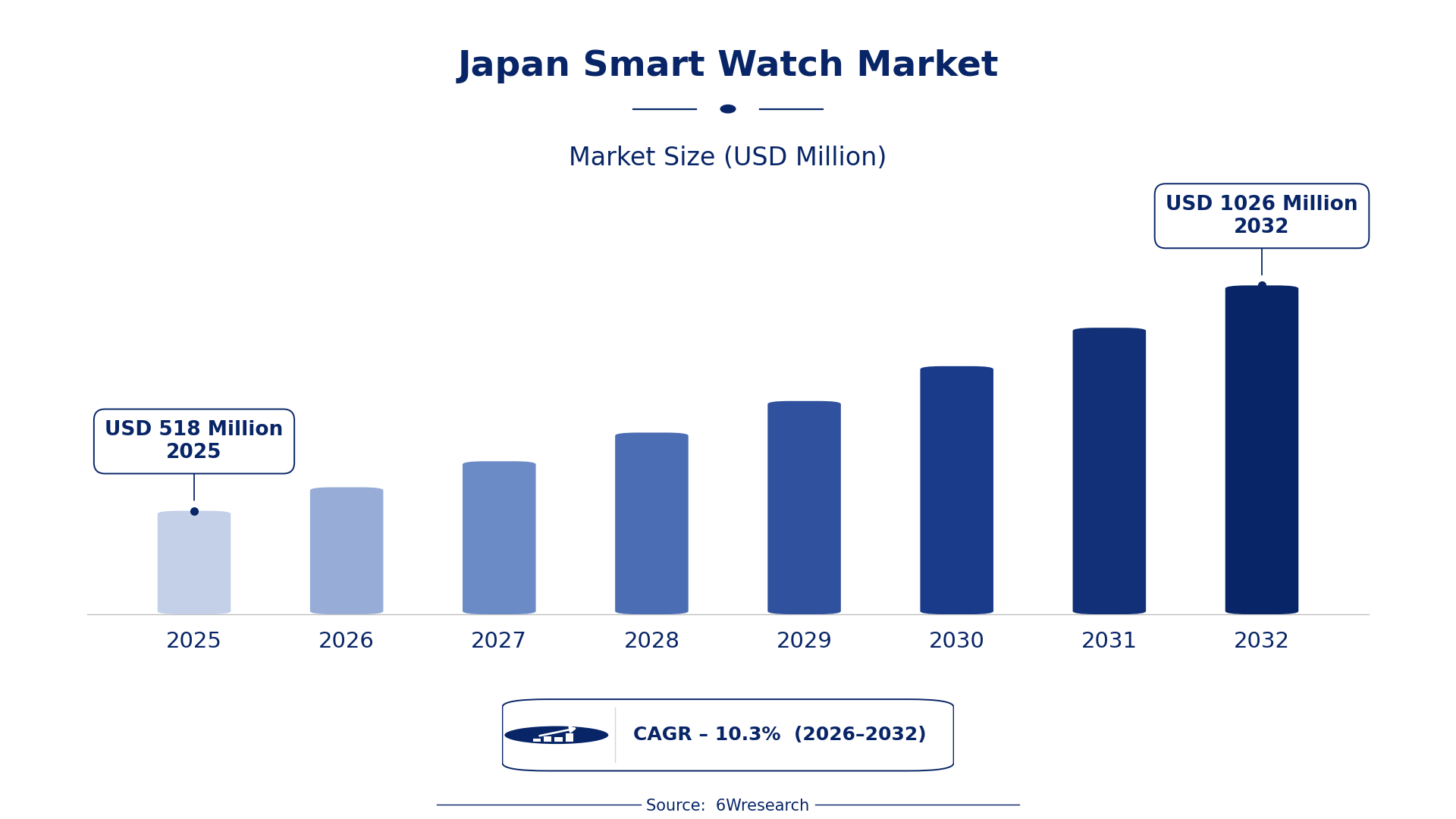
According to 6Wresearch internal database and industry insights, the Japan Smart Watch Market was valued at USD 518 Million in 2025 and is projected to reach USD 1,026 Million by 2032, growing at a CAGR of approximately 10.3% during 2026–2032.
Japan Smart Watch Market Highlights
| Report Metric | Details |
| Report Name | Japan Smart Watch Market (2026-2032) |
| Market Size 2025 | USD 518 Million |
| Market Size 2032 | USD 1,026 Million |
| Absolute Growth 2025–2032 | USD 508 Million |
| CAGR 2026–2032 | 10.3% |
| Peak Annual Growth | 11.5% in 2031 |
| Forecast Period | 2026–2032 |
| Historical Data | 2022–2025 |
| Base Year | 2025 |
| Leading Operating Systems, 2025 | Watch OS (46% share) |
| Leading Display Type, 2025 | AMOLED (47% share) |
| Leading Application, 2025 | Personal Assistance (48% share) |
| Fastest-Growing Operating Systems | Android/Wear OS (14.3% CAGR) |
| Fastest-Growing Display Type | PMOLED (14.2% CAGR) |
| Fastest-Growing Application | Medical (13.7% CAGR) |
| Growing Sector | Health and Fitness Tracking |
| Key End Users | Health-conscious consumers, fitness enthusiasts, technology adopters, elderly users |
Japan Smart Watch Market Year-wise Growth Rate and Key Drivers (2022–2032)
This graph illustrates the annual growth rates of the market from 2022 to 2032, highlighting a steady upward trajectory and projected market expansion over the forecast period.
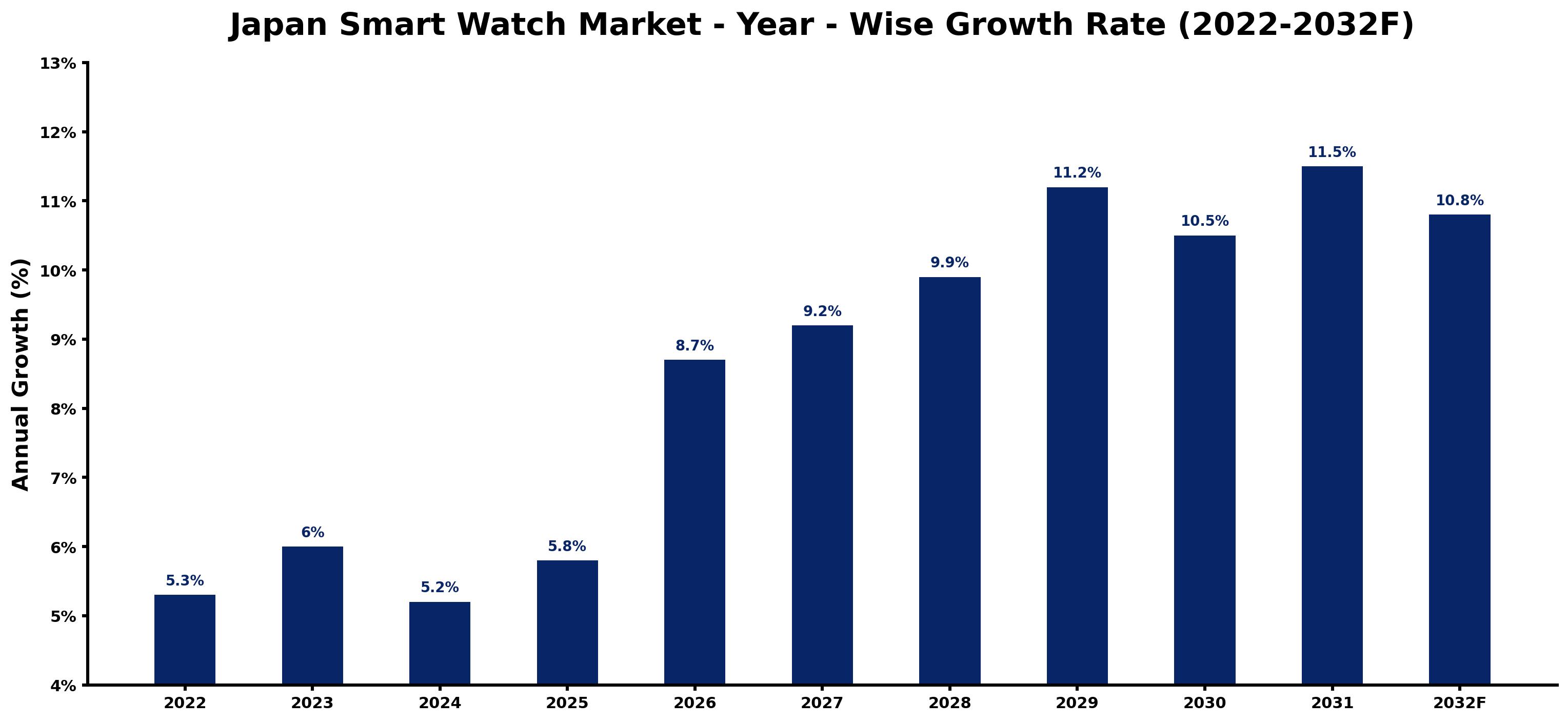
The table below sets out the estimated growth rate for each year and the main factor behind it.
| Year | Estimated Annual Growth (%) | Market Rationale |
| 2022 | 5.3 | The market showed steady demand with 10 million users driving sales. |
| 2023 | 6.0 | Growth accelerated as health monitoring features gained popularity among users. |
| 2024 | 5.2 | The rate slowed due to increased competition among various brands. |
| 2025 | 5.8 | Sales increased following the Tokyo 2020 Olympics highlighting smart watch benefits. |
| 2026 | 8.7 | The market is expected to expand as technology adoption continues to rise. |
| 2027 | 9.2 | Demand is projected to increase with the integration of innovative features. |
| 2028 | 9.9 | Growth is anticipated as more users adopt smart watches for fitness tracking. |
| 2029 | 11.2 | The market is set to expand with heightened consumer awareness of health benefits. |
| 2030 | 10.5 | Growth is expected to slow as market saturation begins to take effect. |
| 2031 | 11.5 | The market is projected to peak as new technology enhances user experience. |
| 2032 | 10.8 | Growth is expected to stabilise as the user base matures. |
Note: Market size estimations and growth projections presented in this report are based on 6Wresearch's proprietary forecasting methodology, utilizing the latest available industry data, government publications, and primary research inputs.
Japan Smart Watch Market Synopsis
Smart watches are sophisticated wearable devices that merge technology with health and fitness tracking. Equipped with advanced electronics and sensors, they perform a variety of functions, including personal assistance and health monitoring. The Japan Smart Watch Market is growing as consumer interest in health technology rises, with around 30% of users taking advantage of health monitoring features. Sales are strongest in the Tokyo region, where the average price of a smart watch hovers around ¥25,000. With an anticipated annual growth rate of 10.3% from 2026 to 2032, the market benefits from heightened health awareness and ongoing technological progress.
Market Dynamics Impact Analysis (2026–2032)
| Factor | Type | Impact | Primary Segment Affected |
| Growing health consciousness among consumers | Driver | High | Medical |
| Integration of advanced health monitoring features | Driver | High | Medical |
| Expansion of health tech integration initiatives | Opportunity | High | Medical |
| Rising demand for fitness tracking devices | Opportunity | High | Sports |
| Intense competition among brands | Restraint | High | Watch OS |
| Market saturation in urban areas | Restraint | Medium | Personal Assistance |
| High price points for advanced models | Challenge | High | Android/Wear OS |
| Rapid technological advancements leading to obsolescence | Challenge | Medium | Other Operating Systems |
Evaluation of Drivers in Japan Smart Watch Market (2026–2032)
The factors lifting demand, and the evidence behind each, are summarised below.
| Drivers | Primary Segment Affected | Why It Matters (Evidence) |
| Increased consumer health awareness | Medical | Approximately 30% of users in Japan utilise health monitoring features, driving demand for smart watches. |
| Technological advancements in wearable devices | Sports | The average price of a smart watch is around ¥25,000, reflecting investment in advanced features. |
| Integration with mobile devices | Watch OS | Watch OS holds a 46% market share, ensuring seamless connectivity for users. |
| Popularity of fitness tracking | Sports | The Tokyo 2020 Olympics showcased smart watches, boosting their adoption for athletic performance. |
| Government initiatives promoting health tech | Medical | The Japanese government allocated ¥1 billion for digital health technologies in 2023. |
Several external shifts are propelling sales. Increased health awareness among consumers boosts demand for smart watches, especially in the medical segment, where 30% of users utilise health monitoring features. The average price of a smart watch is approximately ¥25,000, indicating a solid investment in advanced functionalities. The surge in interest for fitness tracking is clear, particularly after the Tokyo 2020 Olympics, which highlighted the role of wearables in sports.
Evaluation of Restraints in Japan Smart Watch Market
Below are the constraints most often cited by buyers and suppliers, with the segment each affects.
| Market Restraint | Primary Segment Affected | Why It Matters (Evidence) |
| High price points for advanced models | Android/Wear OS | The average price of smart watches at ¥25,000 limits accessibility for some consumers. |
| Market saturation in urban areas | Personal Assistance | In major cities, the user base is nearing saturation, limiting growth opportunities. |
| Intense competition among brands | Watch OS | Numerous brands competing for market share can lead to price wars and reduced profit margins. |
| Limited presence of niche operating systems | Other Operating Systems | The minor market share of other operating systems restricts their growth potential. |
| Consumer hesitation towards new technology | Medical | Some consumers are cautious about adopting new health monitoring features due to privacy concerns. |
Japan Smart Watch Market Challenges
Producers encounter fierce competition from a range of local and international brands, which drives prices down and pressures profit margins. This competitive environment stems from Japan's dynamic technology sector, potentially resulting in a 15% decline in profits for manufacturers. Importers face strict regulatory requirements, particularly related to ISO 13485, which raises compliance costs and complicates the introduction of new products. Buyers may experience delays in product delivery due to supply chain disruptions, especially when sourcing components, which can extend lead times by as much as three months. Technology integration presents challenges for producers, as developing advanced health features requires considerable investment, delaying product launches and affecting market responsiveness.
Trends in the Japan Smart Watch Market
Below are the shifts with the largest effect on the Japan Smart Watch Market.
- Shift from Basic to Advanced Health Monitoring: Consumers are increasingly choosing smart watches with advanced health features, such as ECG and blood oxygen monitoring. The Tokyo region has recorded a 30% rise in users adopting these functionalities.
- Transition from Fitness Tracking to Health Management: Smart watches are transforming from basic fitness trackers to comprehensive health management devices. The uptake of health monitoring features is expected to increase by 15% annually until 2025.
- Personal Assistance Features Gaining Popularity: Smart watches are improving personal assistance capabilities, incorporating voice commands and notifications. The leading application, Personal Assistance, represented 48% of the market share in 2025.
- Emergence of Health Tech Integration Standards: The establishment of JIS standards for wearable health devices is influencing the market. These standards will guarantee quality and safety, benefiting both producers and consumers.
Investment Opportunities in the Japan Smart Watch Market
The openings below show where demand in the Japan Smart Watch Market is visible and how suppliers can enter.
- Gap in Affordable Smart Watch Models: With the average price at ¥25,000, there exists a gap for affordable models aimed at budget-conscious consumers. Collaborating with local manufacturers could ease market entry.
- Growing Demand for Health Monitoring Features: As 30% of users embrace health monitoring, there is a chance to invest in advanced health technology. Targeting fitness enthusiasts in urban areas can boost sales.
- Rising Interest in Sports Technology: The Tokyo 2020 Olympics underscored the significance of smart watches in sports. Investing in features tailored for athletes can tap into this expanding segment.
- Funding for Digital Health Technologies: The Japanese government has earmarked ¥1 billion for digital health technologies in 2023. Partnering with local health tech firms can aid development.
Government Initiatives in the Japan Smart Watch Market
The Medical Care Act and the Long-Term Care Insurance Act set standards for health-related devices, impacting smart watch producers. Compliance with these regulations is essential for market entry and consumer trust, with the potential to reach a user base of 15 million by 2023.
The Ministry of Health, Labour and Welfare oversees the integration of health tech in wearable devices, funding initiatives that promote innovation. With a budget of ¥1 billion for 2023, this agency supports the growth of the smart watch market.
Future Insight of the Japan Smart Watch Market
Investment in digital health technologies will generate substantial demand for smart watches featuring integrated health monitoring capabilities. By 2032, the smart watch user base is expected to grow to 20 million units, driven by government initiatives that promote health tech integration. The establishment of JIS standards for wearable health devices will improve product quality and consumer safety. The Japan Wearable Technology Association will facilitate collaboration among suppliers, encouraging innovation and strengthening the market's overall capabilities.
Market Segmentation Analysis
Japan Smart Watch Market report covers a detailed analysis of the following market segments:
By Operating Systems – Watch OS Leads, Android/Wear OS Expected to Grow Fastest
According to Vasudha, AM at 6Wresearch, the largest operating systems category in 2025 was Watch OS, at 46% of revenue. Watch OS holds the largest share due to its extensive use in smart watches that offer seamless integration with iOS devices, attracting a large user base particularly in major urban areas like Tokyo. This compatibility fosters loyalty among consumers who prefer to remain within the Apple ecosystem for their technology needs. Android/Wear OS is projected to grow fastest, at a CAGR of 14.3% during 2026–2032. Android/Wear OS is experiencing rapid growth as it caters to a wide variety of brands, thus making smart watches more accessible to a broader audience. The increasing number of users choosing these devices highlights the demand for compatibility with various Android smartphones, driving this segment's expansion. Suppliers must focus on enhancing features and compatibility for Android/Wear OS to effectively engage with the growing consumer base.
By Display Type – AMOLED Leads, PMOLED Expected to Grow Fastest
AMOLED took 47% of display type revenue in 2025, more than any other category. AMOLED displays lead the market due to their vibrant colours and energy efficiency, particularly in high-end smart watches that attract discerning consumers. This preference is strong among users in metropolitan areas who prioritise display quality and battery longevity. The quickest growth will come from PMOLED, forecast to expand at a CAGR of 14.2% between 2026 and 2032. PMOLED is the fastest-growing display type, largely because it offers a cost-effective solution for budget models. As consumers increasingly seek affordable smart watch options, the demand for PMOLED displays is on the rise, indicating a shift towards economical choices. Manufacturers should consider adding PMOLED options to their product lines to appeal to price-sensitive consumers.
By Application – Personal Assistance Leads, Medical Expected to Grow Fastest
Personal Assistance accounted for 48% of the market by application in 2025. Personal Assistance is the leading application for smart watches, as it provides essential functionalities like notifications and reminders that users rely on daily. This core functionality resonates strongly with the Japanese market, where efficiency and connectivity are valued. Medical is set to record the highest CAGR in this split, 13.7% over 2026–2032. The Medical application is growing rapidly, driven by increasing awareness of health monitoring features among users. The recent push for health tech integration by the Ministry of Health, Labour and Welfare has further accelerated this trend, attracting more users to smart watches with health capabilities. Suppliers should invest in developing advanced health monitoring features to capitalise on the growing interest in medical applications.
Key Attractiveness of the Report
- 10 Years of Market Numbers
- Historical Data Starting from 2022 to 2025
- Base Year 2025
- Forecast Data until 2032
- Key Performance Indicators Impacting the Market
- Major Upcoming Developments and Projects
Key Highlights of the Report:
- Japan Smart Watch Market Outlook
- Market Size of Japan Smart Watch Market, 2025
- Forecast of Japan Smart Watch Market, 2032
- Historical Data and Forecast of Japan Smart Watch Revenues & Volume for the Period 2022-2032
- Japan Smart Watch Market Trend Evolution
- Japan Smart Watch Market Drivers and Challenges
- Japan Smart Watch Price Trends
- Japan Smart Watch Porter's Five Forces
- Japan Smart Watch Industry Life Cycle
- Historical Data and Forecast of Japan Smart Watch Market Revenues & Volume By Operating Systems for the Period 2022-2032
- Historical Data and Forecast of Japan Smart Watch Market Revenues & Volume By Watch OS for the Period 2022-2032
- Historical Data and Forecast of Japan Smart Watch Market Revenues & Volume By Android/Wear OS for the Period 2022-2032
- Historical Data and Forecast of Japan Smart Watch Market Revenues & Volume By Other Operating Systems for the Period 2022-2032
- Historical Data and Forecast of Japan Smart Watch Market Revenues & Volume By Display Type for the Period 2022-2032
- Historical Data and Forecast of Japan Smart Watch Market Revenues & Volume By AMOLED for the Period 2022-2032
- Historical Data and Forecast of Japan Smart Watch Market Revenues & Volume By PMOLED for the Period 2022-2032
- Historical Data and Forecast of Japan Smart Watch Market Revenues & Volume By TFT LCD for the Period 2022-2032
- Historical Data and Forecast of Japan Smart Watch Market Revenues & Volume By Application for the Period 2022-2032
- Historical Data and Forecast of Japan Smart Watch Market Revenues & Volume By Personal Assistance for the Period 2022-2032
- Historical Data and Forecast of Japan Smart Watch Market Revenues & Volume By Medical for the Period 2022-2032
- Historical Data and Forecast of Japan Smart Watch Market Revenues & Volume By Sports for the Period 2022-2032
- Historical Data and Forecast of Japan Smart Watch Market Revenues & Volume By Other Applications for the Period 2022-2032
- Japan Smart Watch Import Export Trade Statistics
- Market Opportunity Assessment By Operating Systems
- Market Opportunity Assessment By Display Type
- Market Opportunity Assessment By Application
- Japan Smart Watch Top Companies Market Share
- Japan Smart Watch Competitive Benchmarking By Technical and Operational Parameters
- Japan Smart Watch Company Profiles
- Japan Smart Watch Key Strategic Recommendations
Market Covered
The report covers the following segments.
By Operating Systems
- Watch OS
- Android/Wear OS
- Other Operating Systems
By Display Type
- AMOLED
- PMOLED
- TFT LCD
By Application
- Personal Assistance
- Medical
- Sports
- Other Applications































