Japan Smartphone Market Size & Growth Rate
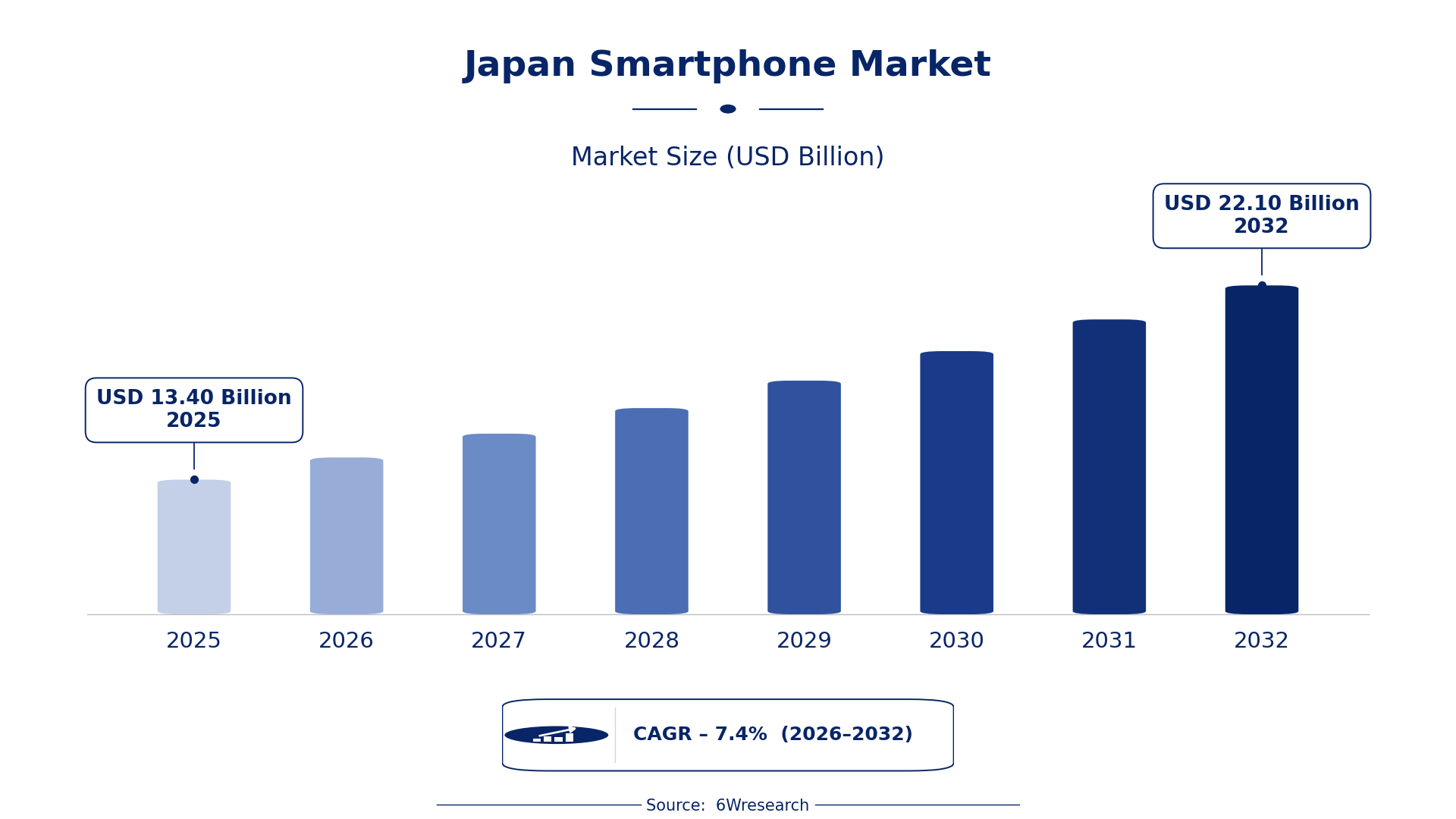
According to 6Wresearch internal database and industry insights, the Japan Smartphone Market was valued at USD 13.40 Billion in 2025 and is projected to reach USD 22.10 Billion by 2032, growing at a CAGR of approximately 7.4% during 2026–2032.
Japan Smartphone Market Highlights
| Report Metric | Details |
| Report Name | Japan Smartphone Market (2026-2032) |
| Market Size 2025 | USD 13.40 Billion |
| Market Size 2032 | USD 22.10 Billion |
| Absolute Growth 2025–2032 | USD 8.70 Billion |
| CAGR 2026–2032 | 7.4% |
| Peak Annual Growth | 8.9% in 2028 |
| Forecast Period | 2026–2032 |
| Historical Data | 2022–2025 |
| Base Year | 2025 |
| Leading Product Type, 2025 | Android (45% share) |
| Leading Distribution Channel, 2025 | OEM (52% share) |
| Fastest-Growing Product Type | iOS (10.2% CAGR) |
| Fastest-Growing Distribution Channel | Retailer (9.4% CAGR) |
| Growing Sector | E-commerce |
| Key End Users | Retailers, manufacturers, consumers, tech startups |
Japan Smartphone Market Year-wise Growth Rate and Key Drivers (2022–2032)
This graph illustrates the annual growth rates of the market from 2022 to 2032, highlighting a steady upward trajectory and projected market expansion over the forecast period.
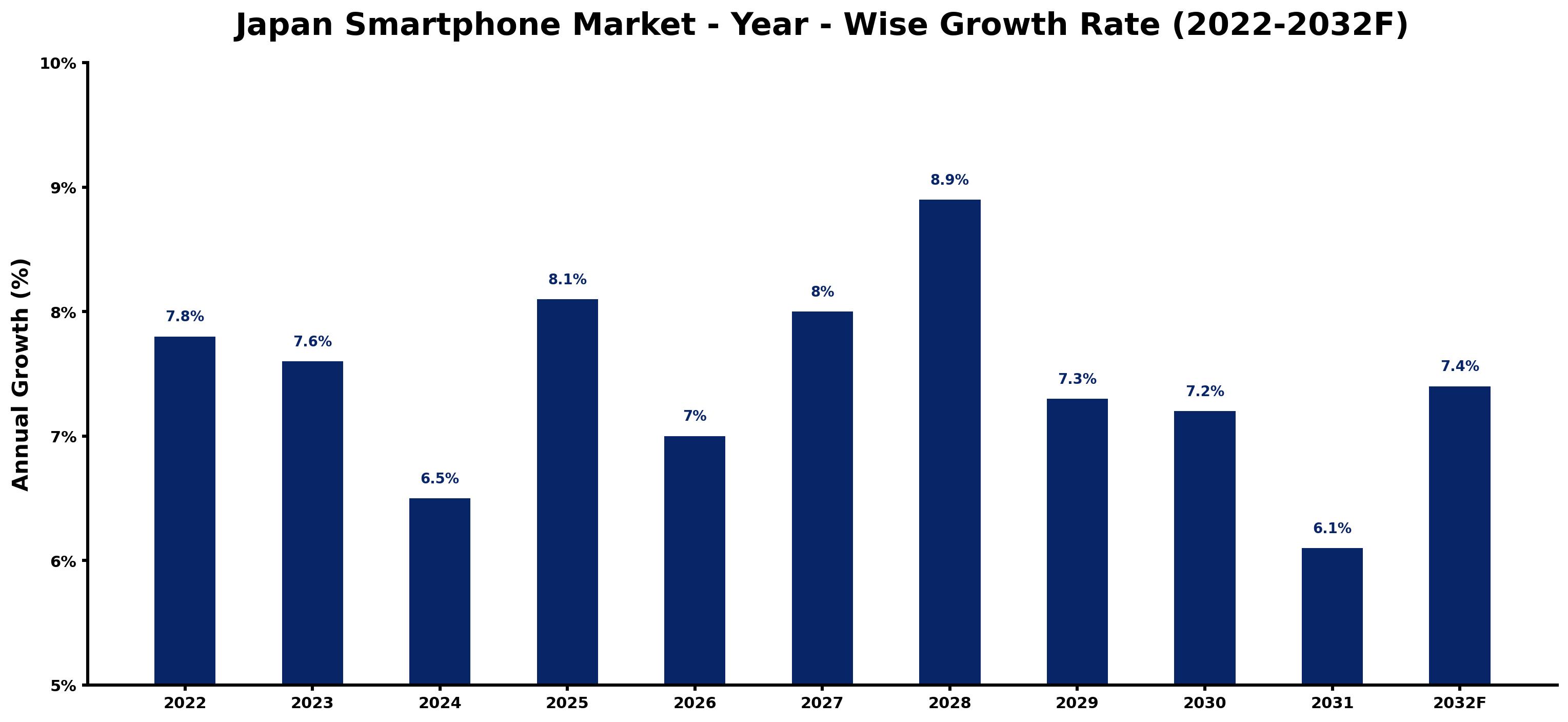
Annual growth estimates for each year appear below with the principal reason behind them, explaining the shifts that set the pace of the market.
| Year | Estimated Annual Growth (%) | Market Rationale |
| 2022 | 7.8 | The market showed strong activity with a penetration rate of approximately 80%. |
| 2023 | 7.6 | Growth slowed slightly as smartphone users reached over 100 million in Japan. |
| 2024 | 6.5 | Demand continued to rise, albeit at a slower pace than previous years. |
| 2025 | 8.1 | The market rebounded with increased sales driven by new smartphone models. |
| 2026 | 7.0 | Growth is expected to slow as the market stabilises after peak sales in 2025. |
| 2027 | 8.0 | Demand is projected to increase as consumers upgrade to newer models with advanced features. |
| 2028 | 8.9 | The market is expected to peak with high growth due to the introduction of new technologies. |
| 2029 | 7.3 | Growth will slow as market saturation begins to affect new purchases. |
| 2030 | 7.2 | Demand is expected to continue to slow as consumers hold onto devices longer. |
| 2031 | 6.1 | The market will experience a further slowdown as competition intensifies. |
| 2032 | 7.4 | Growth is projected to pick up again as new models and features attract buyers. |
Note: Market size estimations and growth projections presented in this report are based on 6Wresearch's proprietary forecasting methodology, utilizing the latest available industry data, government publications, and primary research inputs.
Japan Smartphone Market Synopsis
Smartphones are advanced mobile devices combining cellular and computing functions, primarily used for communication and multimedia applications. The Japan Smartphone Market is growing, driven by a high penetration rate of approximately 80% and over 100 million users. The rapid expansion of the e-commerce sector, which grew by 15% in 2023, along with continuous technological advancements, fuels demand. Support from the Tokyo Metropolitan Government for tech startups stimulates innovation in mobile technology, creating a dynamic market environment.
Market Dynamics Impact Analysis (2026–2032)
| Factor | Type | Impact | Primary Segment Affected |
| High smartphone penetration and user base. | Driver | High | Android |
| Growing e-commerce sector driving online smartphone sales. | Driver | High | e-Commerce |
| Expansion of smartphone models available in the market. | Opportunity | High | iOS |
| Increased investment in mobile technology startups. | Opportunity | Medium | OEM |
| High competition leading to price wars affecting margins. | Restraint | High | Retailer |
| Consumer preference for longer smartphone lifespans. | Restraint | Medium | Android |
| Supply chain disruptions affecting production capacity. | Challenge | High | OEM |
| Rapid technological changes requiring constant adaptation. | Challenge | Medium | iOS |
Evaluation of Drivers in Japan Smartphone Market (2026–2032)
Below are the drivers that matter most for revenue growth, with supporting evidence.
| Drivers | Primary Segment Affected | Why It Matters (Evidence) |
| High smartphone penetration rate. | Android | With approximately 80% penetration, a large user base leads to increased purchases. |
| Growth of e-commerce sales channels. | e-Commerce | The e-commerce sector for smartphones grew by 15% in 2023, prompting more online purchases. |
| Diverse smartphone models available. | iOS | With over 300 smartphone models, consumers have more choices, driving demand for premium devices. |
| Support for tech startups in Tokyo. | OEM | The Tokyo Metropolitan Government promotes mobile technology startups, boosting innovation and production capacity. |
| Rising average smartphone selling prices. | Retailer | The average selling price of around 70,000 yen encourages retailers to stock premium devices. |
Buyers are adding capacity as smartphone penetration in Japan reaches approximately 80%, resulting in increased purchases across various segments. The e-commerce sector is thriving, with a growth rate of 15% in 2023, driving more online sales of smartphones. The availability of over 300 different models attracts consumers, particularly in the premium segment, which is gaining traction. Retailers benefit from rising average selling prices, motivating them to stock premium smartphones.
Evaluation of Restraints in Japan Smartphone Market
The following restraints limit how fast demand can grow.
| Market Restraint | Primary Segment Affected | Why It Matters (Evidence) |
| High competition leading to price wars. | Retailer | Intense competition among retailers results in price reductions, affecting profit margins. |
| Consumer preference for longer smartphone lifespans. | Android | The average smartphone lifespan of 2.5 years leads to fewer purchases as consumers delay upgrades. |
| Supply chain disruptions impacting production. | OEM | Disruptions in supply chains limit the availability of components, delaying production schedules. |
| Rapid technological changes requiring constant adaptation. | iOS | Frequent technological advancements necessitate continuous updates, straining resources for manufacturers. |
| Consumer hesitation due to economic uncertainties. | Retailer | Economic fluctuations may cause consumers to postpone purchasing new smartphones, affecting sales. |
Japan Smartphone Market Challenges
Smartphone buyers in Japan face supply chain disruptions due to reliance on specific semiconductor components, causing delays in product availability and longer wait times for new models. Technology adaptation issues arise for suppliers as rapid innovation requires constant updates to meet consumer expectations, resulting in increased development costs. High production costs stem from stringent JIS standards, inflating prices for consumers, with the average smartphone costing around 70,000 yen. Intense competition among over 100 million smartphone users pressures producers to lower prices, squeezing margins and impacting profitability for manufacturers.
Trends in the Japan Smartphone Market
Several trends are reshaping the Japan Smartphone Market; the most important are set out below.
- Shift from Physical to Online Sales Channels: Retailers are increasingly moving towards e-commerce platforms for smartphone sales, reflecting a 15% growth in online purchases in 2023. This shift allows for broader market reach and convenience for consumers.
- Emergence of Premium Smartphone Models: Consumers are gravitating towards premium smartphones, particularly iOS devices, which are projected to grow at a CAGR of 10.2% from 2026 to 2032. This trend reflects rising disposable incomes and consumer preferences for advanced features.
- Adoption of the JIS Standard for Manufacturing: The implementation of the JIS standard for smartphone manufacturing ensures quality and safety, influencing production practices across the industry. This standardisation supports consumer confidence and market growth.
- Increased Focus on Mobile Technology Startups: The Tokyo Metropolitan Government's support for tech startups is driving innovation in mobile technology. This initiative aims to improve connectivity and is expected to lead to new product developments in the smartphone market.
Investment Opportunities in the Japan Smartphone Market
Below are the investment opportunities with the strongest case in the Japan Smartphone Market.
- Expansion of E-commerce Platforms: Tokyo is experiencing a surge in e-commerce platforms for smartphones, with the sector growing by 15% in 2023. Suppliers can invest in partnerships with local e-commerce firms to improve distribution and reach a wider audience.
- Investment in Mobile Technology Startups: The Tokyo Metropolitan Government supports tech startups focusing on mobile technology, creating investment opportunities. With over 100 million smartphone users, there is a growing demand for innovative applications and services.
- Development of 5G Infrastructure: The ongoing rollout of 5G infrastructure in Japan presents opportunities for smartphone manufacturers to create compatible devices. By 2025, the market is projected to reach 1 trillion yen, indicating substantial growth potential.
- Focus on Sustainable Manufacturing Practices: The GX Basic Policy aims for about JPY 150 trillion in public-private decarbonisation investment over 10 years. This creates opportunities for suppliers to adopt sustainable practices in smartphone production, appealing to environmentally conscious consumers.
Government Initiatives in the Japan Smartphone Market
The Act on Japanese Industrial Standards, originally adopted in 1949 and amended in 2019, sets the framework for product and test standards in Japan, including smartphones. This law ensures that manufacturers adhere to quality and safety regulations, impacting production processes and consumer trust.
The Ministry of Internal Affairs and Communications oversees telecommunications regulations, approving standards and funding initiatives that improve mobile connectivity. Their support for the GX Basic Policy aims to drive public-private investment in decarbonisation, impacting the smartphone industry by promoting sustainable practices.
Future Insight of the Japan Smartphone Market
The launch of a digital transformation initiative will improve mobile connectivity, benefiting both buyers and suppliers. By 2032, advancements in semiconductor technology will streamline production processes, reducing costs for manufacturers. The average smartphone lifespan of 2.5 years may decrease as consumers pursue the latest features, driving demand for newer models. E-commerce for smartphones is projected to grow significantly, providing buyers with easier access to a broader array of smartphone options.
Market Segmentation Analysis
Japan Smartphone Market report covers a detailed analysis of the following market segments:
By Product Type – Android Leads, iOS Expected to Grow Fastest
According to Summon Dutta, Assistant Manager at 6Wresearch, Android took 45% of product type revenue in 2025, more than any other category. Android holds the largest share due to its widespread adoption among various user demographics, including budget-conscious individuals and tech-savvy consumers. The operating system's flexibility and extensive model range cater to the preferences of over 60 million smartphone users in Japan. iOS are set to record the highest CAGR in this split, 10.2% over 2026–2032. iOS is experiencing rapid growth as premium smartphone users in urban areas increasingly seek high-end devices with advanced features. The notable rise in demand for iOS in Tokyo highlights the importance of brand prestige in consumer choices. This trend suggests that suppliers should focus on enhancing premium offerings to meet the rising expectations of affluent consumers.
By Distribution Channel – OEM Leads, Retailer Expected to Grow Fastest
In 2025, OEM led the distribution channel split with a 52% share. OEM is the leading distribution channel as it represents the primary method for smartphone production in Japan, ensuring quality and compliance with local standards. This method allows manufacturers to maintain control over the design and functionality of devices, appealing to a broad customer base. Retailer is projected to grow fastest, at a CAGR of 9.4% during 2026–2032. Retailer channels are growing quickly due to the increasing preference for in-person shopping experiences, where customers can physically examine devices before purchase. The convenience and immediacy of retail outlets are attracting more consumers, particularly in urban centres. Suppliers should consider strengthening partnerships with retailers to maximise visibility and accessibility for potential buyers.
Key Attractiveness of the Report
- 10 Years of Market Numbers
- Historical Data Starting from 2022 to 2025
- Base Year 2025
- Forecast Data until 2032
- Key Performance Indicators Impacting the Market
- Major Upcoming Developments and Projects
Key Highlights of the Report:
- Japan Smartphone Market Outlook
- Market Size of Japan Smartphone Market, 2025
- Forecast of Japan Smartphone Market, 2032
- Historical Data and Forecast of Japan Smartphone Revenues & Volume for the Period 2022-2032
- Japan Smartphone Market Trend Evolution
- Japan Smartphone Market Drivers and Challenges
- Japan Smartphone Price Trends
- Japan Smartphone Porter's Five Forces
- Japan Smartphone Industry Life Cycle
- Historical Data and Forecast of Japan Smartphone Market Revenues & Volume By Product Type for the Period 2022-2032
- Historical Data and Forecast of Japan Smartphone Market Revenues & Volume By Android for the Period 2022-2032
- Historical Data and Forecast of Japan Smartphone Market Revenues & Volume By iOS for the Period 2022-2032
- Historical Data and Forecast of Japan Smartphone Market Revenues & Volume By Windows for the Period 2022-2032
- Historical Data and Forecast of Japan Smartphone Market Revenues & Volume By Blackberry Operating System for the Period 2022-2032
- Historical Data and Forecast of Japan Smartphone Market Revenues & Volume By Other for the Period 2022-2032
- Historical Data and Forecast of Japan Smartphone Market Revenues & Volume By Distribution Channel for the Period 2022-2032
- Historical Data and Forecast of Japan Smartphone Market Revenues & Volume By OEM for the Period 2022-2032
- Historical Data and Forecast of Japan Smartphone Market Revenues & Volume By Retailer for the Period 2022-2032
- Historical Data and Forecast of Japan Smartphone Market Revenues & Volume By e-Commerce for the Period 2022-2032
- Japan Smartphone Import Export Trade Statistics
- Market Opportunity Assessment By Product Type
- Market Opportunity Assessment By Distribution Channel
- Japan Smartphone Top Companies Market Share
- Japan Smartphone Competitive Benchmarking By Technical and Operational Parameters
- Japan Smartphone Company Profiles
- Japan Smartphone Key Strategic Recommendations
Market Covered
The following segment groups are covered in the report.
By Product Type
- Android
- iOS
- Windows
- Blackberry Operating System
- Other
By Distribution Channel
- OEM
- Retailer
- e-Commerce































