Japan Socks Market Size & Growth Rate
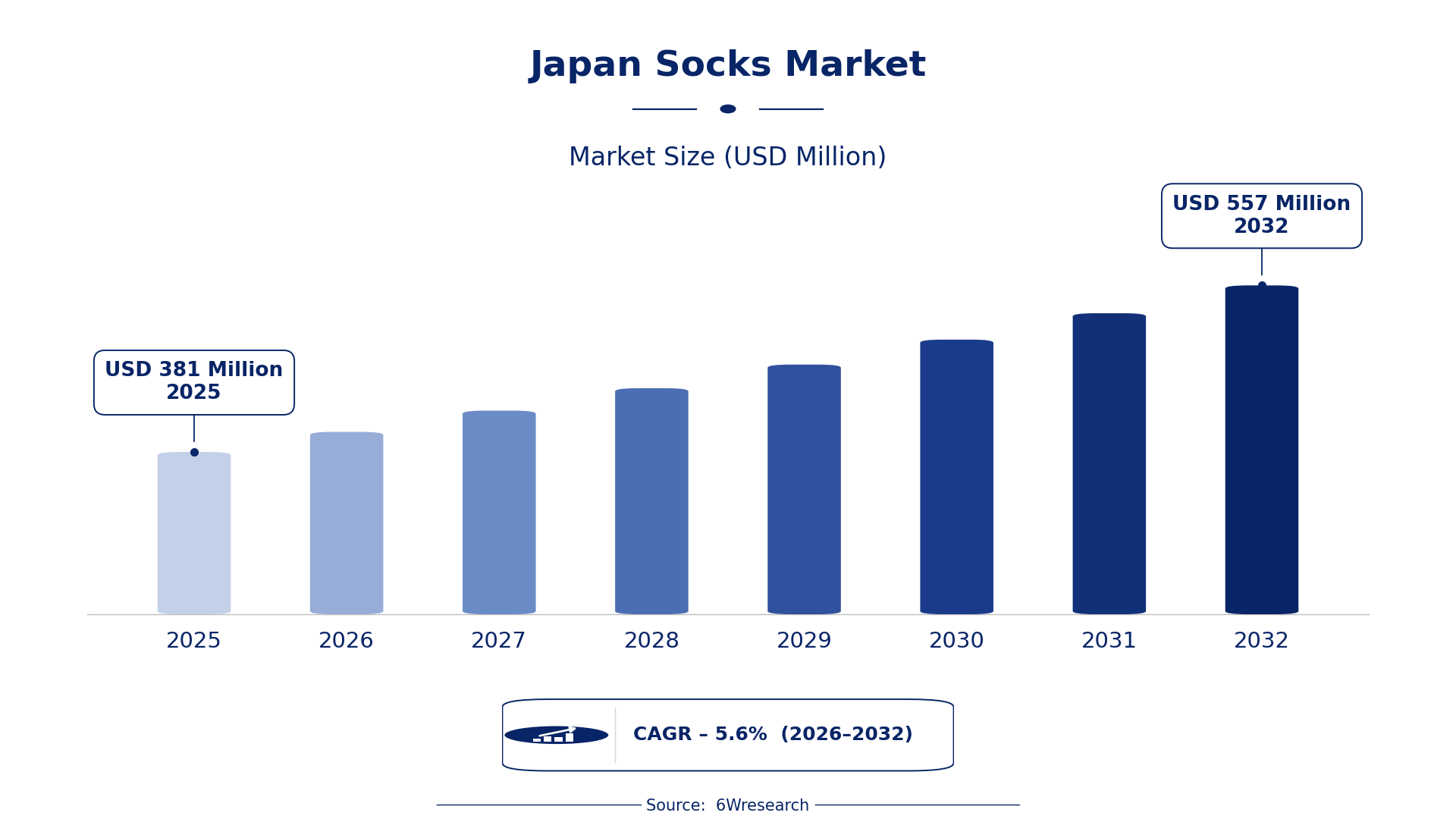
According to 6Wresearch internal database and industry insights, the Japan Socks Market was valued at USD 381 Million in 2025 and is projected to reach USD 557 Million by 2032, growing at a CAGR of approximately 5.6% during 2026–2032.
Japan Socks Market Highlights
| Report Metric | Details |
| Report Name | Japan Socks Market (2026-2032) |
| Market Size 2025 | USD 381 Million |
| Market Size 2032 | USD 557 Million |
| Absolute Growth 2025–2032 | USD 176 Million |
| CAGR 2026–2032 | 5.6% |
| Peak Annual Growth | 6.8% in 2029 |
| Forecast Period | 2026–2032 |
| Historical Data | 2022–2025 |
| Base Year | 2025 |
| Leading Product, 2025 | Casual (48% share) |
| Leading Application, 2025 | Men (50% share) |
| Leading Distribution Channel, 2025 | Hypermarket & Supermarket (53% share) |
| Fastest-Growing Product | Athletic (7.6% CAGR) |
| Fastest-Growing Application | Children (7.2% CAGR) |
| Fastest-Growing Distribution Channel | Online (7.3% CAGR) |
| Growing Sector | Children's socks |
| Key End Users | Retailers, online platforms, sports facilities, fashion designers |
Japan Socks Market Year-wise Growth Rate and Key Drivers (2022–2032)
This graph illustrates the annual growth rates of the market from 2022 to 2032, highlighting a steady upward trajectory and projected market expansion over the forecast period.
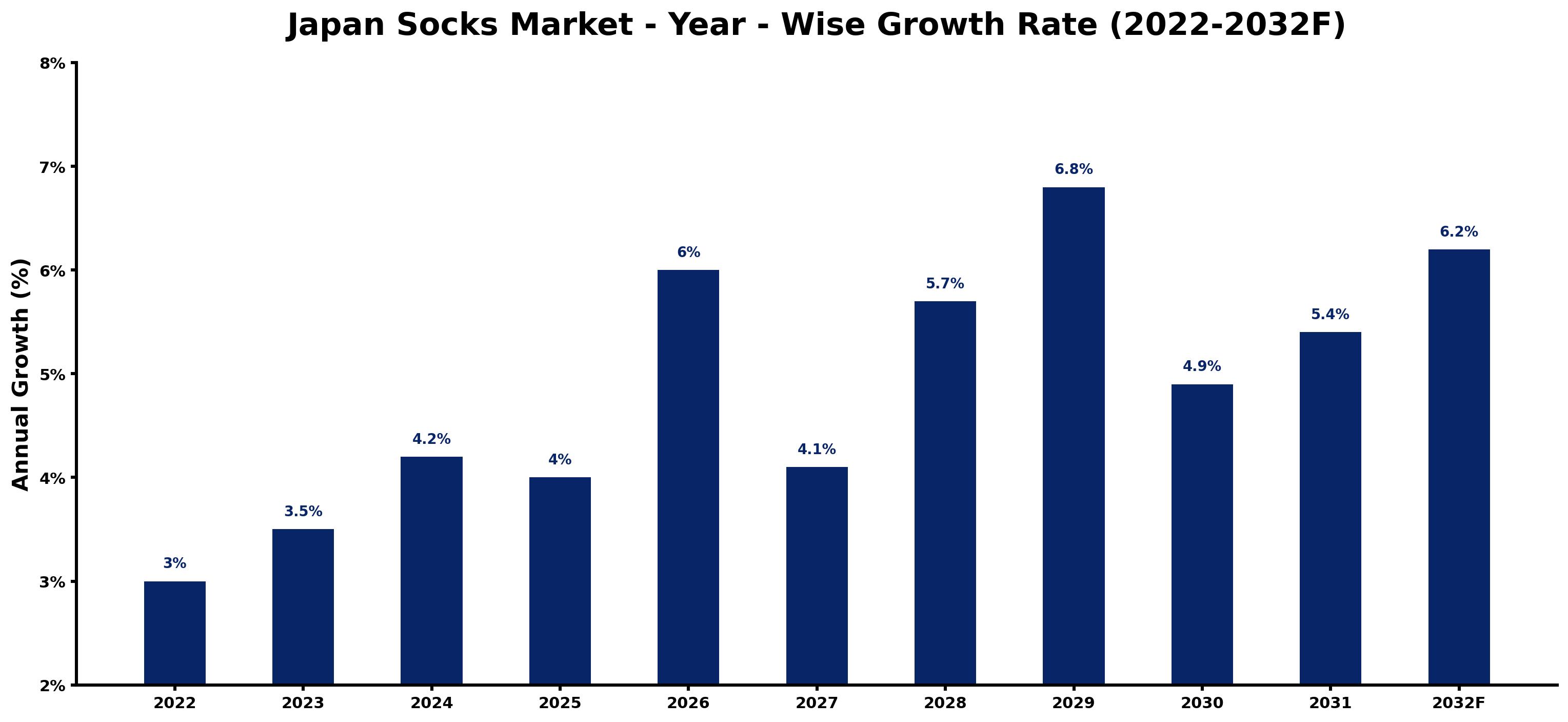
Each row of the following table gives one year's estimated growth and the event or demand shift that explains it.
| Year | Estimated Annual Growth (%) | Market Rationale |
| 2022 | 3.0 | The market experienced steady demand from both retail and online sales channels. |
| 2023 | 3.5 | Consumer interest in sustainable materials began to influence purchasing decisions. |
| 2024 | 4.2 | The Tokyo Fashion Week highlighted fresh sock designs, boosting market visibility. |
| 2025 | 4.0 | Growth slowed as consumers became more selective about their purchases. |
| 2026 | 6.0 | An increase in athletic activities is expected to lead to higher demand for performance socks. |
| 2027 | 4.1 | The market will show resilience as online sales continue to expand rapidly. |
| 2028 | 5.7 | Rising disposable incomes will support greater spending on fashion socks. |
| 2029 | 6.8 | The introduction of new sock technologies will drive significant consumer interest. |
| 2030 | 4.9 | Growth will moderate as market saturation begins to set in for casual socks. |
| 2031 | 5.4 | Demand for children's socks will surge due to increased school attendance. |
| 2032 | 6.2 | Consumer preferences will shift towards eco-friendly sock options. |
Note: Market size estimations and growth projections presented in this report are based on 6Wresearch's proprietary forecasting methodology, utilizing the latest available industry data, government publications, and primary research inputs.
Japan Socks Market Synopsis
Socks are textile products made from cotton, wool, or synthetic fibres, primarily produced through knitting or weaving. The Japan Socks Market is valued at approximately 200 billion yen annually, driven by the popularity of casual socks, which account for 50% of total sales, and the growing trend towards sustainable materials. The market is further supported by a thriving retail environment, particularly in Tokyo, which hosts over 500 sock stores, catering to diverse consumer needs.
Market Dynamics Impact Analysis (2026–2032)
| Factor | Type | Impact | Primary Segment Affected |
| Growing interest in sustainable materials | Driver | High | Casual |
| Increased participation in sports and fitness activities | Driver | High | Athletic |
| Rising demand for eco-friendly products | Opportunity | High | Children |
| Expansion of online retail channels | Opportunity | High | Online |
| Market saturation in casual sock segment | Restraint | Medium | Casual |
| Rising production costs due to material prices | Restraint | High | Formal |
| Compliance with stringent quality standards | Challenge | Medium | Athletic |
| Capacity constraints in manufacturing | Challenge | High | Children |
Evaluation of Drivers in Japan Socks Market (2026–2032)
The main growth drivers and the segments they affect most are set out below.
| Drivers | Primary Segment Affected | Why It Matters (Evidence) |
| Increased consumer spending on fashion items | Casual | The average Japanese consumer purchases 5 pairs of socks annually, driving demand for trendy designs. |
| Growth in fitness and sports participation | Athletic | The rise in athletic activities has led to a growing demand for performance-oriented products. |
| Shift towards sustainable materials | Children | Socks made from sustainable materials are gaining popularity, appealing to eco-conscious parents. |
| Expansion of e-commerce platforms | Online | Online sales are increasing, providing consumers with diverse options and convenience. |
| Focus on quality and innovation in manufacturing | Formal | Quality standards are commonly applied, ensuring high-quality production processes. |
What keeps demand rising is the average Japanese consumer purchasing 5 pairs of socks annually, which drives demand for fashionable designs. Increased participation in sports has led to a growing demand for performance-oriented products, as consumers seek socks that improve their athletic experience. The trend towards sustainable materials is gaining traction, with eco-friendly options appealing to parents buying children's socks. Online sales are expanding, providing consumers with diverse options and convenience, while adherence to quality standards ensures high-quality production processes that attract discerning buyers.
Evaluation of Restraints in Japan Socks Market
These restraints slow adoption and weigh on supplier margins.
| Market Restraint | Primary Segment Affected | Why It Matters (Evidence) |
| Market saturation in the casual sock segment | Casual | Casual socks account for 50% of total sock sales, limiting growth potential. |
| Rising production costs due to material prices | Formal | The average price of a pair of socks in Japan is around 1,000 yen, impacting margins. |
| Compliance with stringent quality standards | Athletic | Manufacturers must adhere to JIS standards, increasing operational costs. |
| Limited product differentiation in the market | Children | Children's socks are often sold in packs of 3 to 5 pairs, reducing uniqueness. |
| Dependence on seasonal trends | Online | Sales can fluctuate based on seasonal fashion trends. |
Japan Socks Market Challenges
High demand for casual socks leads to supply shortages, causing delays for retailers who struggle to meet consumer needs. Many manufacturers encounter difficulties due to outdated knitting technology, which raises production costs and limits output, ultimately increasing prices for buyers. Stringent regulations on textile quality result in higher compliance costs for producers, reducing their pricing competitiveness in a crowded market. A shortage of skilled workers in textile manufacturing compromises product quality, negatively affecting brand reputation and sales for companies that depend on high standards.
Trends in the Japan Socks Market
Below are the shifts with the largest effect on the Japan Socks Market.
- Increase in Eco-Friendly Sock Options: Consumer demand for eco-friendly socks is rising, with a notable increase in sustainable materials. In 2023, the Tokyo Fashion Week featured a focus on sustainable sock designs, reflecting changing preferences among buyers.
- Surge in Online Shopping for Socks: The online segment is projected to grow at a CAGR of 7.3%, reflecting consumer demand for convenience. This shift is clear as more buyers prefer digital shopping experiences, enhancing market accessibility.
- Growth in Athletic Sock Market: Athletic socks are gaining traction as more individuals engage in sports and fitness activities. This segment is expected to grow significantly, reflecting a shift in consumer preferences towards performance-oriented products.
- Emergence of Fashion-Forward Sock Designs: Fashion-forward sock designs are becoming increasingly prevalent, appealing to style-conscious consumers. The Tokyo Fashion Week in 2023 showcased unique sock designs, indicating a trend towards stylish options that attract attention.
Investment Opportunities in the Japan Socks Market
The openings below show where demand in the Japan Socks Market is visible and how suppliers can enter.
- Supply of Eco-Friendly Socks: The demand for sustainable materials is growing, with eco-friendly socks gaining popularity. This trend offers an opportunity for suppliers to cater to environmentally conscious consumers, particularly in urban areas, where demand is high.
- Expansion into Online Retail: Online sales channels are projected to grow, providing a gap for suppliers to fill. Retailers focusing on e-commerce can tap into this expanding market, especially among younger consumers who prefer online shopping.
- Investment in Unique Sock Designs: There is a growing opportunity for investment in fashionable sock designs. The Tokyo Fashion Week highlighted this trend, encouraging designers to create standout products that attract fashion-conscious buyers seeking unique options.
- Development of Performance Socks: The rise in sports participation creates a demand for high-performance socks. Suppliers can target athletic facilities and sports retailers to meet this growing need, aligning with the fitness trend.
Government Initiatives in the Japan Socks Market
The Industrial Standardization Act governs product and test standards, ensuring that sock manufacturers comply with quality regulations. This law, amended in 2019, sets the framework for maintaining high standards in production, benefiting both producers and consumers by ensuring product reliability and safety.
The Digital Agency promotes government initiatives for digital transformation, impacting how sock retailers operate. By advancing common system standards, this agency helps streamline processes for online and brick-and-mortar stores, improving the shopping experience for consumers.
Future Insight of the Japan Socks Market
Investment in textile innovation programmes will create new production technologies, driving efficiency in sock manufacturing. By 2032, consumer demand for sustainable materials will push eco-friendly options to represent 30% of total sales, benefiting suppliers who adapt their offerings. Enhanced design capabilities showcased at events like Tokyo Fashion Week will inspire fresh trends, appealing to younger consumers. Retailers will expand their e-commerce platforms to cater to changing shopping preferences, ensuring they remain competitive in a dynamic market.
Market Segmentation Analysis
Japan Socks Market report covers a detailed analysis of the following market segments:
By Product – Casual Leads, Athletic Expected to Grow Fastest
According to Ravi Bhandari, Research Head at 6Wresearch, the largest product category in 2025 was Casual, at 48% of revenue. Casual socks are widely worn for everyday use, making them the most popular choice among consumers. Their availability in various styles and comfort levels appeals to a broad audience, contributing to their substantial market presence. Over 2026–2032, Athletic is expected to post the fastest growth, at a CAGR of 7.6%. Athletic socks are essential for sports and physical activities, driving their rapid growth as fitness trends gain momentum. The increasing participation in sports events and fitness activities among the population is propelling demand for these products. Suppliers should focus on expanding their casual and athletic sock offerings to meet consumer preferences.
By Application – Men Leads, Children Expected to Grow Fastest
Men took 50% of application revenue in 2025, more than any other category. Men constitute a crucial consumer segment for socks, demonstrating steady purchasing habits across diverse styles. Their need for both casual and formal options fuels a strong demand for men's socks in the market. The quickest growth will come from Children, forecast to expand at a CAGR of 7.2% between 2026 and 2032. The necessity of children's socks for daily wear and school propels swift growth in this segment. The convenience of buying socks in packs for children is a key factor in this rising trend. Suppliers should focus on tailored marketing strategies to effectively engage both men and parents of children.
By Distribution Channel – Hypermarket & Supermarket Leads, Online Expected to Grow Fastest
In 2025, Hypermarket & Supermarket led the distribution channel split with a 53% share. Hypermarkets and supermarkets act as the main retail channels for socks, providing consumers with a broad selection. Their extensive reach and convenience make them the preferred shopping destination for many sock buyers. Online is set to record the highest CAGR in this split, 7.3% over 2026–2032. Online sales are experiencing rapid growth as consumers seek diverse options and convenience in their shopping experiences. This shift towards digital platforms indicates a lasting trend in how socks are purchased. Suppliers must strengthen their online presence to take advantage of the increasing trend towards e-commerce in sock sales.
Key Attractiveness of the Report
- 10 Years of Market Numbers
- Historical Data Starting from 2022 to 2025
- Base Year 2025
- Forecast Data until 2032
- Key Performance Indicators Impacting the Market
- Major Upcoming Developments and Projects
Key Highlights of the Report:
- Japan Socks Market Outlook
- Market Size of Japan Socks Market, 2025
- Forecast of Japan Socks Market, 2032
- Historical Data and Forecast of Japan Socks Revenues & Volume for the Period 2022-2032
- Japan Socks Market Trend Evolution
- Japan Socks Market Drivers and Challenges
- Japan Socks Price Trends
- Japan Socks Porter's Five Forces
- Japan Socks Industry Life Cycle
- Historical Data and Forecast of Japan Socks Market Revenues & Volume By Product for the Period 2022-2032
- Historical Data and Forecast of Japan Socks Market Revenues & Volume By Casual for the Period 2022-2032
- Historical Data and Forecast of Japan Socks Market Revenues & Volume By Formal for the Period 2022-2032
- Historical Data and Forecast of Japan Socks Market Revenues & Volume By Athletic for the Period 2022-2032
- Historical Data and Forecast of Japan Socks Market Revenues & Volume By Application for the Period 2022-2032
- Historical Data and Forecast of Japan Socks Market Revenues & Volume By Men for the Period 2022-2032
- Historical Data and Forecast of Japan Socks Market Revenues & Volume By Women for the Period 2022-2032
- Historical Data and Forecast of Japan Socks Market Revenues & Volume By Children for the Period 2022-2032
- Historical Data and Forecast of Japan Socks Market Revenues & Volume By Distribution Channel for the Period 2022-2032
- Historical Data and Forecast of Japan Socks Market Revenues & Volume By Hypermarket & Supermarket for the Period 2022-2032
- Historical Data and Forecast of Japan Socks Market Revenues & Volume By Convenience Store for the Period 2022-2032
- Historical Data and Forecast of Japan Socks Market Revenues & Volume By Online for the Period 2022-2032
- Japan Socks Import Export Trade Statistics
- Market Opportunity Assessment By Product
- Market Opportunity Assessment By Application
- Market Opportunity Assessment By Distribution Channel
- Japan Socks Top Companies Market Share
- Japan Socks Competitive Benchmarking By Technical and Operational Parameters
- Japan Socks Company Profiles
- Japan Socks Key Strategic Recommendations
Market Covered
The report covers the following segments.
By Product
- Casual
- Formal
- Athletic
By Application
- Men
- Women
- Children
By Distribution Channel
- Hypermarket & Supermarket
- Convenience Store
- Online






































